
Cargo that crosses regions
without crossing humans.
The Airvein architecture — autonomous cargo drones on a 10-15 km hangar grid, running 24/7 all-weather, with cargo-module integrity for time-critical payloads. Proven on medical cargo for the Polish health system. Transitions one-for-one to defense sustainment, contested-corridor resupply, and disaster-response logistics.
Why logistics
The cargo drone wasn't the missing piece. The infrastructure was.
Cargo drones have been technologically possible for over a decade. What stopped them from running at the scale logistics actually needs was the gap between drone batteries — the inability to operate cross-region without a human at every node. The Airvein thesis, validated in a 2018 Polish R&D Centre programme, was that the missing piece was ground infrastructure, not aerial capability.
The 10-to-15-kilometre hangar grid solves it. A drone leaves hangar A with cargo, flies to hangar B, lands and swaps battery or hands the cargo to a fresh drone, continues to hangar C. The cargo never stops moving. The operator never has to be in the loop. The system runs 24/7 in any weather a serious operation needs.
That architecture turned out to be far broader than medical logistics. Defense, humanitarian response, contested corridors, disaster relief — all need the same pattern. The medical-cargo use case proved it works.
What it does
Four engineering pillars behind the hangar grid.
10–15 km hangar grid
The architectural insight behind Airvein. Drones leave hangar A, fly to hangar B, swap batteries or hand cargo to a fresh drone, continue to C. The cargo never stops. The operator never has to be in the loop. Cross-region operation works without human nodes between origin and destination.
Cargo-module integrity
Time-critical cargo doesn't just need to arrive — it needs to arrive with the specified thermal profile, vibration envelope, orientation, and audit telemetry the receiving party can trust. The cargo module maintains those parameters end-to-end, validated against medical-logistics requirements.
24/7 all-weather operation
Logistics doesn't pause for weather, time of day, or weekend. The hangar, the drone, the cargo module, and the routing stack are engineered for continuous operation across the conditions a real deployment actually faces — including the conditions that ground other UAV systems.
Sovereign data path
Imagery, cargo telemetry, routing data, and audit logs stay inside EU + US infrastructure. No hyperscaler in adversarial jurisdictions. Suitable for regulated medical, defense, and critical-infrastructure logistics workloads.
The medical-logistics segment
Three payload classes. One time-critical constraint.
The Airvein architecture was validated against the most demanding logistics requirement of all — medical cargo where latency translates directly into clinical outcome. The following three payload classes drove the engineering, and all three deploy today under the same platform.
Whole blood and components
Time-critical donor-to-recipient logistics. Red cells, platelets, plasma, cryoprecipitate — each with its own thermal window and shelf-life clock. The drone replaces the courier vehicle and removes variance from the delivery time.
Diagnostic samples
Patient samples moving from regional clinics to specialist laboratories — oncology, microbiology, genetic testing. Latency in the sample-transport pipeline becomes latency in diagnosis. The drone cuts hours from the cycle, every cycle.
Medications and serums
Time-sensitive pharmacy logistics: antivenoms, perfusion products, neonatal pharmacotherapy, emergency-administration drugs. On-demand delivery rather than a once-a-day courier schedule.
And where else the same stack runs
Three transition targets — defense, disaster, dual-use.
The defining feature of the Airvein architecture is that the medical-cargo use case proves the engineering, and the engineering transfers one-for-one to other domains. Same hangars, same drones, same cargo modules. Different payload, different topic-area buyer.
Medical logistics (the proven case)
Blood, blood components, samples, medications, sera — moving between regional centres and hospitals. The architecture was validated against this profile under the Polish R&D Centre programme. Health-system operators can deploy today.
Defense sustainment resupply
Forward operating positions, mobile units, contested corridors. Same hangar grid, same drones, same cargo modules — re-pointed at defense logistics. The risk on the architectural side has already been retired against the harder commercial requirement.
Disaster response and humanitarian operations
Earthquake, flood, post-conflict reconstruction, refugee resettlement. Temporary hangar grid deployed for the duration of the response, then redeployed for the next. Cargo modules carry whatever the operation requires — food, water, medical supplies, communications gear.
The architectural reference
Airvein — proven on the hardest logistics problem.
The full Airvein case study walks through the hangar-grid architecture, the cargo-module integrity engineering, the consortium with Pentacomp Systemy Informatyczne, the Polish R&D Centre funding agreement, and the four pillars that made the 24/7 all-weather operation viable.
Next move
Tell us the cargo, the geography, and the cadence. We'll come back with the hangar grid.
Medical cargo, defense sustainment, disaster response, or commercial logistics — describe the payload requirements and the operating geography. We'll come back with an architectural fit, a deployment plan, and the engagement model that matches your funding source.
FAQ
Drone logistics — frequently asked
What is Dronehub's drone logistics architecture?
The Airvein architecture — a 10-15 km hangar grid with all-weather 24/7 operation and cargo-module integrity — validated under the Polish R&D Centre programme for medical logistics (blood, samples, and medications).
Can it be used for defense sustainment?
Yes. The same hangar grid, drones, and cargo modules re-point to forward operating positions, mobile units, and contested-corridor resupply. The architectural risk was already retired against the harder commercial medical-logistics requirement.
Is it deployable for disaster response?
Yes — a temporary hangar grid is deployed for the duration of an earthquake, flood, or humanitarian operation and then redeployed; cargo modules carry food, water, medical supplies, or communications gear.
More on drone logistics
Browse all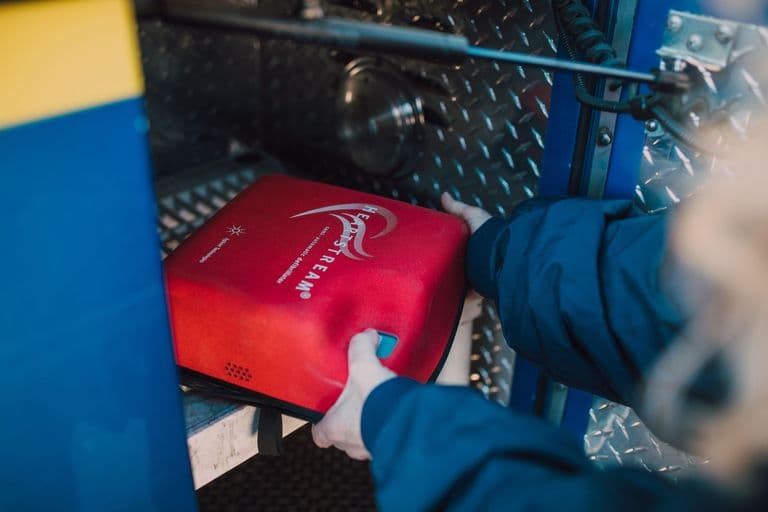 UPDATED · MAY 2026
Drone-Delivered AEDs in Cardiac Arrests: The Sosnowiec Pilot with Pentacomp
Cardiac-arrest survival drops 10% per minute. In dense urban geography, ground EMS routinely misses the survival window. Dronehub and Pentacomp ran a pilot in Sosnowiec, Poland — over 100 AED-transport flights between two docking stations.
Read UPDATED · MAY 2026
Flying First Across 13 EU Partners: Inside U-Space4UAM
The EU's flagship urban-air-mobility programme: 13 partners, 5 countries, Honeywell-led. Dronehub flew first across the entire consortium — and the empirical data fed straight into EU U-space regulation.
Read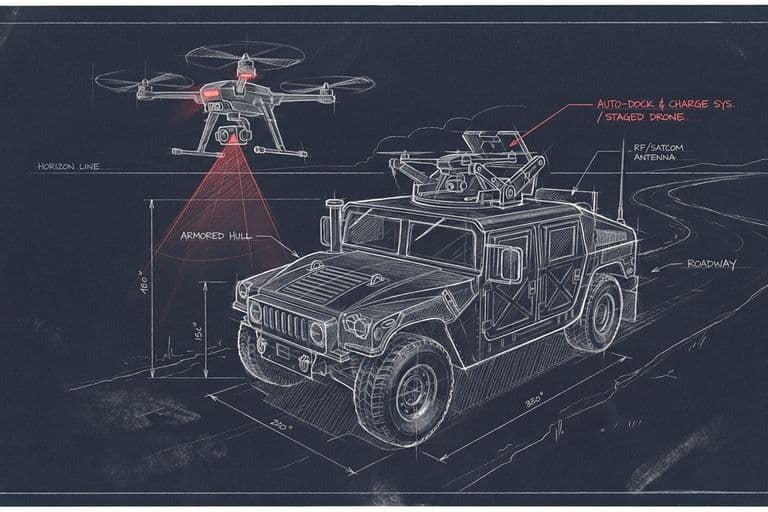 UPDATED · MAY 2026
Persistent Air Cover for Convoys: The UAV Nomad Mobile Dock
Convoy security has a 360-degree gap. Fixed aerostat impractical, helicopter cover too expensive. UAV Nomad gives persistent air cover at column speed.
Read