Key facts
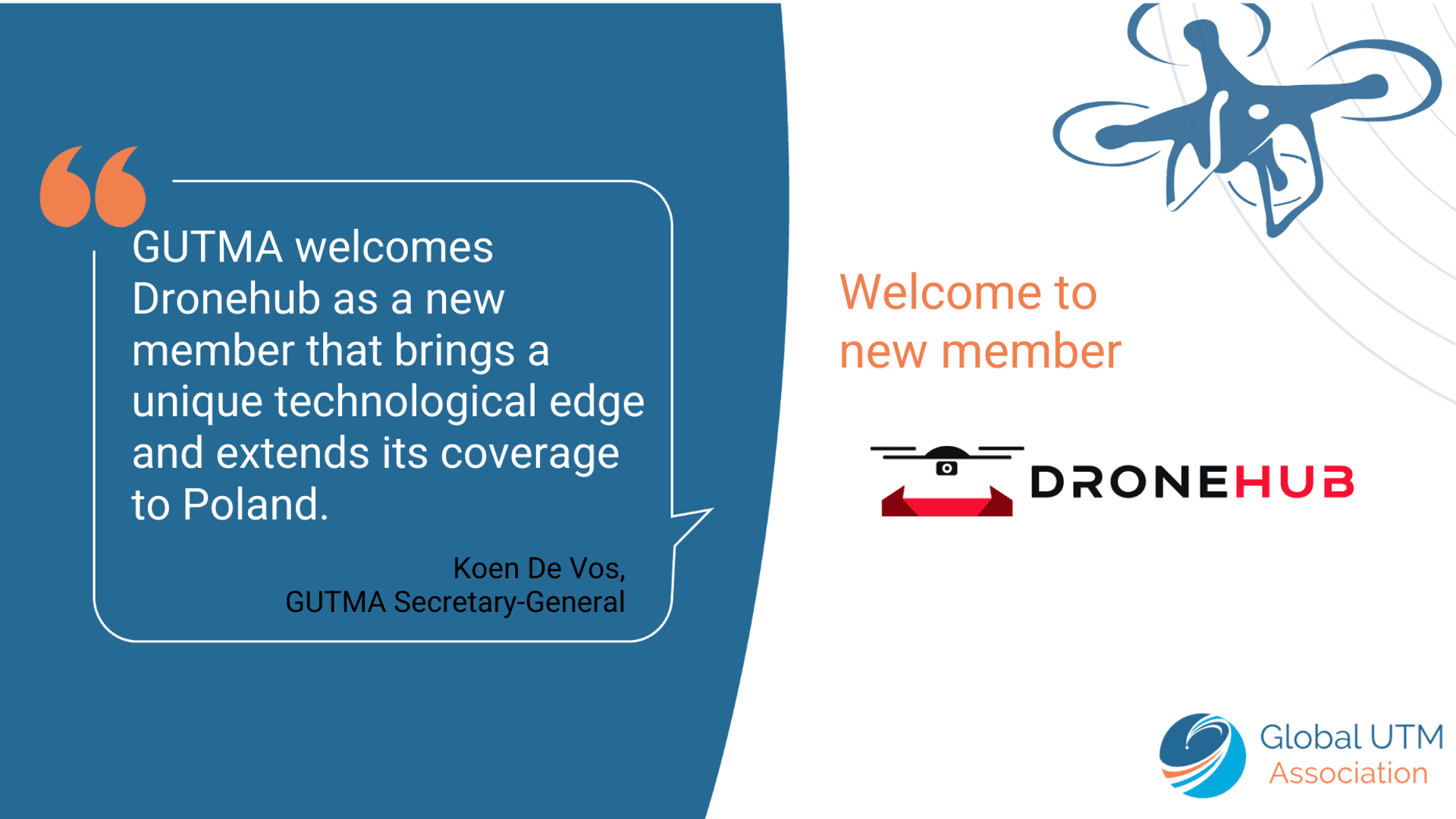
Sebastian Babiarz, then at Dronehub, was elected Co-President of the Global UTM Association (GUTMA), the international body that coordinates Unmanned Traffic Management standards.
Source · Global UTM Association governance records, 2021
GUTMA members include Honeywell, Verizon, Lockheed Martin, AirMap, Altitude Angel, and major drone OEMs — the standards body's footprint covers the operational stack every commercial drone fleet will run under.
Source · GUTMA member roster
GUTMA inputs shape the regulatory output of ICAO, the EU's EASA U-space framework, the FAA UAS Integration Office, and equivalent national civil-aviation authorities.
Source · GUTMA charter and standards-coordination activity
2 more key facts
Dronehub was the only drone-in-a-box company in the European sector with GUTMA membership at the time of joining — the membership category puts the company in the conversation alongside large primes and ANSPs, not adjacent to them.
Source · GUTMA membership directory, 2021
U-space — the EU's regulatory framework for unmanned-traffic-management airspace — is built from empirical data contributed by GUTMA-member programmes including Dronehub's U-Space4UAM consortium contribution.
Source · EU U-space regulatory development, SESAR Joint Undertaking
In this piece
The unmanned-traffic-management rules that every commercial drone fleet will operate under are being written right now. Dronehub took a seat at the table where they get written — Sebastian Babiarz, then at Dronehub, was elected Co-President of the Global UTM Association (GUTMA), the international body that coordinates UTM standards across air-navigation service providers, drone OEMs, and unmanned-airspace data platforms.
This post explains what GUTMA is, why the Co-Presidency is procurement-grade signalling for licensing buyers and consortium primes, and how the standards work connects directly to three programmes already in the Dronehub portfolio.
What GUTMA actually is
The Global UTM Association is the international non-profit that harmonises Unmanned Traffic Management standards. Its members include Honeywell, Verizon, Lockheed Martin, Altitude Angel, AirMap, the major drone OEMs, and a meaningful cross-section of the air-navigation service providers (ANSPs) that run national airspace.
GUTMA's working groups produce reference architectures, data exchange standards, registration and identification protocols, and operational best practices for unmanned airspace. Those outputs feed into formal rulemaking at the International Civil Aviation Organization (ICAO), the European Union Aviation Safety Agency (EASA), the FAA UAS Integration Office, and national civil-aviation authorities across the membership footprint.
For a drone operator running fleet-scale operations, GUTMA outputs become operational reality within a regulatory cycle — usually three to five years from working-group draft to commercial requirement. The standards body is where the rules get built, not where they get debated after the fact.
Why Co-Presidency is a procurement-grade signal
GUTMA's Co-Presidency rotates among industry leaders with active working-group commitments. It's not a ceremonial title. The Co-President carries technical-committee responsibilities, standards-drafting work, and external representation on UTM topics. The selection process is consensus among the membership.
When Sebastian Babiarz was elected Co-President, it placed a Dronehub leader in the room where the rules every commercial drone fleet will operate under get written. For a licensing buyer or a consortium prime evaluating Dronehub against alternatives, that has three concrete implications:
- The autonomy stack you license is built by a vendor whose leadership shapes the regulatory cycle the stack will operate under. That cycle alignment reduces downstream compliance risk.
- The vendor is operating alongside primes (Honeywell, Lockheed Martin, Verizon) as a peer in the standards conversation, not as a downstream consumer of standards written by others.
- For SME partners on EU consortia (EDF, Horizon Europe, NATO DIANA) and US federal innovation pipelines (SBIR/STTR, AFWERX, DIU), GUTMA leadership is among the highest-signal credentials available. Procurement evaluators recognise it.
The throughline to the rest of the portfolio
GUTMA leadership isn't a side bet for Dronehub — it's structurally integrated with three programmes in the operational portfolio:
U-Space4UAM. The Honeywell-led EU consortium under EU Horizon 2020 was the empirical-data programme that fed directly into the EU U-space regulatory framework. Dronehub flew first across the 13-partner consortium. The U-space rules every European commercial drone fleet will operate under were built partly from Dronehub flight data.
AUDROS. The counter-UAS stack operates inside regulated airspace where UTM coordination is mandatory. AUDROS interception sequences require coordination with the airspace authority and the dispatcher stack. The standards that govern that coordination are GUTMA outputs.
HUUVER. The first UAV in the world with full Galileo authentication. UTM standards increasingly require GNSS-resilience (anti-spoofing, signal integrity, sovereign positioning) as a baseline. HUUVER's Galileo OS-NMA integration is exactly the pattern those standards are starting to mandate.
The Co-Presidency means Dronehub helps write the rules that Dronehub's own products operate under. The integration is intentional.
What this means for licensing buyers and consortium partners
For a US prime building an FAA-track BVLOS programme or a NASA Advanced Air Mobility deliverable — the Dronehub stack arrives with GUTMA-leadership-grade alignment to the rule sets your programme will be evaluated under. The U-Space4UAM empirical-flight data transfers as a relevant reference; the GNSS-resilience pattern from HUUVER transfers as a baseline; the counter-UAS coordination pattern from AUDROS transfers as a regulated-airspace operating envelope.
For an EU consortium prime under EDF or Horizon Europe — Dronehub brings GUTMA Co-Presidency as a credential that translates directly into proposal-evaluation score advantages. Procurement panels know GUTMA. Cross-border allied consortia working under SESAR 3, the EU's air-traffic R&D Joint Undertaking, are increasingly screened on UTM-standards alignment.
For an industrial drone operator (oil & gas, energy grid, rail, ports) — the practical impact is that the autonomy stack you license is going to keep being compliant with U-space and equivalent national frameworks because the vendor's leadership is shaping those frameworks, not catching up to them.
The full Dronehub leadership context is on the about page. For licensing and consortium-partnership conversations, open the contact form.
FAQ
- What is GUTMA?
- The Global UTM Association — the international non-profit body that coordinates Unmanned Traffic Management (UTM) standards across air-navigation service providers, drone OEMs, and unmanned-airspace data platforms. GUTMA acts as the consensus forum where the operational stack for commercial drone fleets gets standardised, with outputs feeding into ICAO, EASA, and FAA rulemaking.
- Why does GUTMA Co-Presidency matter for Dronehub buyers?
- The Co-Presidency put Dronehub in the room where the rules every commercial drone fleet will operate under get written. For licensing buyers, this is procurement-grade signalling — the autonomy stack you license isn't built by a vendor in a corner of the market, it's built by a vendor whose leadership directly shapes the rules everyone in the market will follow. For consortium primes evaluating SME partners on EU and US programmes, GUTMA leadership is exactly the kind of credential that lands the meeting.
- What does Unmanned Traffic Management actually mean?
- Air traffic control was designed for crewed aircraft. UTM is the equivalent layer for unmanned systems — the protocols, the deconfliction logic, the registration and identification standards, the airspace-access rules. As commercial drone fleets grow — cargo, inspection, surveillance, eVTOL passenger air taxis — the UTM layer becomes infrastructure-critical. GUTMA is the body harmonising it across regional authorities.
- How does GUTMA leadership connect to the rest of Dronehub's portfolio?
- Direct line through three programmes. U-Space4UAM was the Honeywell-led EU demonstration where Dronehub flew first across 13 partners — and the empirical data from that programme fed directly into U-space rulemaking. AUDROS counter-UAS operates in regulated airspace where U-space coordination is mandatory. HUUVER's Galileo-authenticated positioning is exactly the kind of GNSS-resilience pattern UTM standards are starting to require. The GUTMA Co-Presidency means Dronehub helps write the rules its own portfolio operates under.
- Is this a real industry role or a ceremonial title?
- Real role. The Co-Presidency rotates among industry leaders with active working-group commitments. Babiarz's mandate areas include UTM standards harmonisation, EU U-space coordination, and SME-to-prime integration in the unmanned-airspace stack. It's not a ribbon-cutting position — it carries technical-committee responsibilities and standards-drafting work.