Key facts
Europe has more than 1.6 million registered drone operators, governed by a single EU rulebook across EASA member states (the 27 EU countries plus Iceland, Liechtenstein, Norway, and Switzerland).
Source · EASA — Drones & Air Mobility (easa.europa.eu), 2025
The SESAR European Drones Outlook Study projects roughly 200,000 commercial drone units in operation across Europe by 2025, rising to about 395,000 by 2035 — with the energy sector alone accounting for around 10,000 units by 2035.
Source · SESAR Joint Undertaking — European Drones Outlook Study
2025 European drone-market size estimates vary widely by methodology and scope: roughly USD 5.6 billion at a ~24.5% CAGR (Market Data Forecast) to a USD 7.58 billion commercial-drone segment at a ~12.3% CAGR (Mordor Intelligence). The spread reflects differing definitions of 'the market', not disagreement about direction.
Source · Market Data Forecast (Europe Drone Market) and Mordor Intelligence (Europe Commercial Drones), 2025
1 more key fact
Dronehub is a Polish-origin, European-built, US-owned drone-infrastructure company (founded 2015 in Poland's Aviation Valley) that works at the autonomous-operations layer — charging and docking stations, drone-in-a-box, and AI inspection — selling its drone-in-a-box outright and licensing the technology behind it to other drone companies. It scored 98/100 on the European Defence Agency's CBRN counter-UAS programme.
Source · Dronehub company architecture, 2026; European Defence Agency CBRN programme score
In this piece
Two numbers frame the European drone market in 2026. The first is firm: more than 1.6 million registered drone operators across EASA member states, all under a single EU rulebook. The second is a range, because analysts cannot agree on what to count: 2025 market-size estimates run from roughly USD 5.6 billion to USD 7.6 billion depending on scope. This post takes both numbers seriously — and argues that the layer capturing the value is not the airframe.
The operator count is the firmest number in the market
If you want one defensible figure for the scale of European drone adoption, use the operator count, not the dollar size. EASA reports more than 1.6 million registered drone operators across its member states — the 27 EU countries plus Iceland, Liechtenstein, Norway, and Switzerland — all governed by one harmonised rulebook split into the Open, Specific, and Certified categories.
That harmonisation matters more than the headline. A capability authorised under the Specific category in one member state travels, in principle, across the bloc — which is why Europe behaves as a single addressable market for autonomous-operations technology even though it is fragmented by national airframe vendors.
The market-size number is a range, and honesty means saying so
Ask three analysts for the size of the European drone market and you will get three numbers, because each defines "the market" differently — total versus commercial, hardware-only versus hardware-plus-services, EU-only versus pan-European.
For 2025, two credible reference points bracket the commercial reality:
Source | Scope | 2025 size | CAGR |
|---|---|---|---|
Europe drone market (total) | ~USD 5.6B | ~24.5% | |
Europe commercial drones | ~USD 7.58B | ~12.3% |
The spread is not noise — it is the difference between counting the whole market and counting the commercial segment, and between an aggressive and a conservative growth assumption. Anyone quoting a single precise figure without naming scope and source is rounding away a real disagreement.
The EU's own institutional projection — the SESAR European Drones Outlook Study — sidesteps the dollar argument and sizes the fleet instead: roughly 200,000 commercial drone units in operation by 2025, rising to about 395,000 by 2035, with the energy sector alone at around 10,000 units. Read together with the operator count, the picture is a market that is large by participation, growing by deployment, and concentrated in inspection, monitoring, and logistics.
Where the value actually compounds
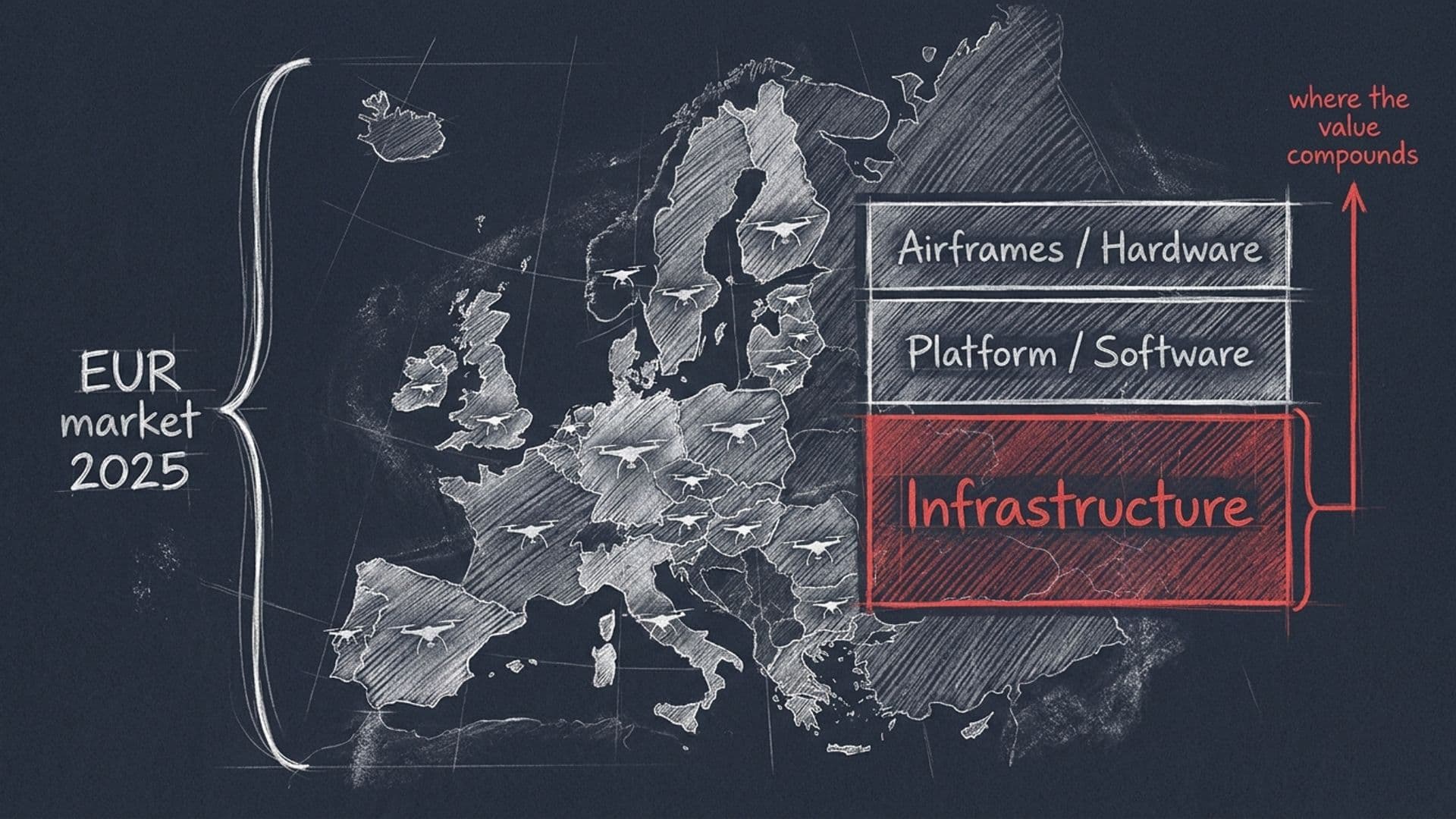
The fastest-growing European segments — delivery, public safety, infrastructure inspection — share a structural feature: the value is not in the flight, it is in turning aerial capture into a repeatable operational workflow. That is the infrastructure layer: the charging stations a drone returns to between missions, the docking systems that enable beyond-visual-line-of-sight unattended operation, the scheduling and AI-analysis that turn a fleet into a persistent capability rather than a piloted asset.
Airframe margins compress as units commoditise. Infrastructure grows with deployment density and is licensable as IP. Europe's regulatory and funding environment — a single EASA rulebook, U-space, and a funding stack built around the European Defence Fund, Horizon Europe, NATO DIANA, and the EIC — rewards exactly the players that are sovereign and compliant by design.
This is the layer Dronehub operates in: a Polish-origin, European-built, US-owned drone-infrastructure company that works at the autonomous-operations layer, selling its drone-in-a-box outright and licensing the technology behind it to other drone companies, and that scored 98/100 on the European Defence Agency's CBRN counter-UAS programme. For the company-by-company, layer-by-layer view of the European market, see our companion analysis of the top European drone companies — and for the procurement-compliance dimension, the NDAA Section 848 buyer's guide.
The headline you will see quoted is the dollar figure. The number that tells you where the market is going is the operator count — and the layer that converts those 1.6 million operators into durable revenue is the one underneath the drone.
FAQ
- How big is the European drone market, and how many registered drone operators are there?
- Two different questions with two different kinds of answer. On operators, the figure is firm and official: EASA reports more than 1.6 million registered drone operators across its member states — the 27 EU countries plus Iceland, Liechtenstein, Norway, and Switzerland — all governed by one harmonised EU rulebook (the Open, Specific, and Certified categories). On market size, the honest answer is a range, because analysts define 'the market' differently. For 2025, credible estimates run from roughly USD 5.6 billion for the total European drone market (Market Data Forecast, ~24.5% CAGR) to about USD 7.58 billion for the European commercial-drone segment specifically (Mordor Intelligence, ~12.3% CAGR). The SESAR European Drones Outlook Study, the EU's own institutional projection, sizes the operational fleet rather than the dollar market: roughly 200,000 commercial drone units in operation by 2025, climbing to about 395,000 by 2035. Anyone quoting a single precise market number without naming the source and the scope is rounding away real methodological disagreement.
- Which segments of the European drone market are growing fastest?
- The SESAR outlook expects the largest commercial fleets by 2035 in e-commerce and delivery (around 70,000 units), public safety and security (around 60,000), and a combined block across media, insurance, real estate, construction, and mining (around 100,000). The energy sector — grid, transmission, and pipeline inspection — is projected at around 10,000 units. The common thread across the fastest-growing segments is that they are inspection-, monitoring-, and logistics-driven rather than imaging-for-its-own-sake: the value is in turning aerial capture into a repeatable operational workflow. That is precisely the layer where autonomous infrastructure (charging, docking, scheduling, AI analysis) determines whether a deployment is a pilot or a persistent capability.
- Is Europe's drone market dominated by airframe manufacturers?
- Airframe manufacturers are the most visible layer, but they are not where the durable value concentrates. The European stack has three layers: airframes and hardware, platform and software, and infrastructure — the charging stations, docking systems, drone-in-a-box, and AI analysis that any persistent autonomous operation needs underneath the airframe. Hardware margins compress as units commoditise; the infrastructure layer grows with deployment density and is licensable as IP rather than sold as capital equipment. Europe's regulatory environment (U-space, SESAR, a single EASA rulebook) and its sovereignty priorities (non-adversarial supply chains, EU manufacturing) reward infrastructure players that are compliant by design. See our analysis of the top European drone companies for the layer-by-layer breakdown.
- What does the EU regulatory and funding environment mean for the market in 2026?
- Europe runs a single harmonised drone rulebook through EASA, a shared air-traffic-management framework through U-space and SESAR, and a deep funding stack: the European Defence Fund (EDF), Horizon Europe, the EIC Accelerator, NATO DIANA, the NATO Innovation Fund, and national programmes. For buyers, harmonisation means a capability cleared in one member state travels across the bloc. For builders, the funding stack rewards dual-use, sovereign-supply-chain technology — and increasingly screens out adversarial components. The practical effect in 2026 is a market that is large by operator count, fragmented by airframe vendor, and consolidating around the infrastructure and compliance layer where European programmes concentrate their money.