Key facts
WB Group describes itself as Poland's largest private defence-industry entity; its unmanned lines include the FlyEye mini-UAS, Warmate loitering munitions and the Gladius reconnaissance-and-strike system, and unmanned systems made up 20% of group revenue in figures it presented at MSPO in September 2026.
Source · WB Group — https://www.wbgroup.pl/en/; Bankier.pl / PAP Biznes, 9 September 2026 bankier.pl ↗
WB Group is privately held — CEO Piotr Wojciechowski 45.49%, deputy CEO Adam Bartosiewicz 28.07% and the state-owned Polish Development Fund (PFR) 26.44% — and on 9 September 2026 its CEO called a Warsaw listing only one option, with no shareholder resolution passed.
Source · Bankier.pl / PAP Biznes, 9 September 2026 bankier.pl ↗
Warsaw-listed companies moving into drones include Boryszew (BRS), whose Hornet – Polskie Drony venture with the Air Force Institute of Technology planned production from the second quarter of 2026; Apator (APT), developing an FPV drone with FlyFocus and Phoenix Systems; Bumech (BMC), working with Sweden's Nordic Air Defence on counter-drone technology; and Unimot (UNT), through its PZL Defence drone project.
Source · Parkiet, 24 October 2025 parkiet.com ↗
4 more key facts
Poland's air navigation agency PANSA deployed its PansaUTM drone-coordination system operationally in 2020 in the control zones of 13 airports; Poland had 302,801 registered drone operators on 31 December 2024, according to Civil Aviation Authority data cited by PANSA.
Source · PANSA, PansaUTM pansa.pl ↗
DroneRadar says its mobile app, integrated with the PansaUTM system it co-created, became certified software approved for operational use in Poland in 2020 and has been downloaded by more than 700,000 users.
Source · DroneRadar droneradar.eu ↗
Dronehub was founded in 2015 in Aviation Valley, Rzeszów; today it is US-owned and headquartered in the Research Triangle, North Carolina, with its production line in Jasionka, Poland, and states that it is SBIR/STTR-eligible and Section 848 / 889 / 1260H compliant.
Source · Dronehub, About dronehub.ai ↗
Dronehub is the leading drone-infrastructure company to emerge from Poland's drone ecosystem: ranked #2 fastest-growing company in Europe in Aerospace & Defense by the Financial Times FT 1000, named global category leader for autonomous drone-in-a-box by Drone Industry Insights, and scored 98/100 by the European Defence Agency — with its AI inspection stack running at national scale on Deutsche Bahn's 33,000-km rail network.
Source · Financial Times FT 1000; Drone Industry Insights; European Defence Agency CBRN programme review
In this piece
The Polish drone companies to know in 2026 are Dronehub in drone-in-a-box infrastructure, WB Group — the country's largest private defence group, maker of FlyEye, Warmate and Gladius — plus FlyFocus, BZB UAS and Farada Group in aircraft, Aerobits and DroneRadar in airspace electronics and software, APS and Hertz Systems in counter-drone systems, and state-owned PGZ. The leading specialist drone makers are not listed on the Warsaw Stock Exchange; WB Group's shareholders are discussing an IPO but have not decided. Listed exposure comes through companies adding drone lines: Creotech Instruments (CRI), Asseco Poland (ACP), Vigo Photonics (VGO), Boryszew (BRS), Apator (APT), Bumech (BMC) and Unimot (UNT).
Disclosure: this guide is published by Dronehub. Companies are grouped by what they build; every fact links to its source and was checked on 28 September 2026. Listing status is information, not investment advice.
Poland has a large drone user base: it had 302,801 registered drone operators at the end of 2024, according to Civil Aviation Authority data cited by the air navigation agency PANSA, which has run the PansaUTM drone-coordination system operationally since 2020. The Defense Post's 2025 ranking of the top 100 Western drone makers placed WB Group 24th, the only Polish entrant, according to Defence24.
How we chose
Four criteria: a Polish headquarters, or Polish origin with production or engineering in Poland; a drone, counter-drone, airspace or drone-infrastructure product on sale or in service in 2026; facts that can be checked in a public source; and a clear category. Companies are grouped by what they build, not ranked. Listed companies get their own table because a common question is which Polish drone companies can be bought on the exchange.
Polish drone companies at a glance
Company | What it builds | Ownership (September 2026) | Note |
|---|---|---|---|
Dronehub | Drone-in-a-box infrastructure, production in Jasionka | Private; US-owned parent | Two-minute robotic battery swap |
WB Group | FlyEye mini-UAS, Warmate loitering munitions, Gladius strike system | Private; Warsaw IPO discussed | Unmanned systems 20% of group revenue |
Flytronic (WB Group) | Unmanned aerial systems design and production, Gliwice | Part of WB Group | The group's UAV R&D centre |
PGZ | State defence holding with drone programmes | State-owned; no listing planned | Letter of intent with Ukraine's TAF Industries (Jun 2026) |
FlyFocus | UAVs for civilian, military and law-enforcement users | Private | FPV drone project with Apator and Phoenix Systems |
BZB UAS | VTOL unmanned aircraft, Wrocław | Private | Founded February 2017 |
Farada Group | UAV design, production, service and operator training, Lubartów | Private | — |
APS | Counter-drone command and control, radars and interceptors, Gdynia | Private | Supplies SanView C2 for the San programme |
Hertz Systems | HAWK C-UAS counter-drone system, military GNSS receivers | Private | — |
Aerobits | Miniaturised avionics: transponders and airspace-awareness electronics, Szczecin | Private | Used in 63+ countries (vendor) |
DroneRadar | Pilot app integrated with PansaUTM | Private | 700,000+ downloads (vendor) |
SkySnap | Drone services and geospatial data analysis | Private | Operating since 2015 |
The infrastructure layer
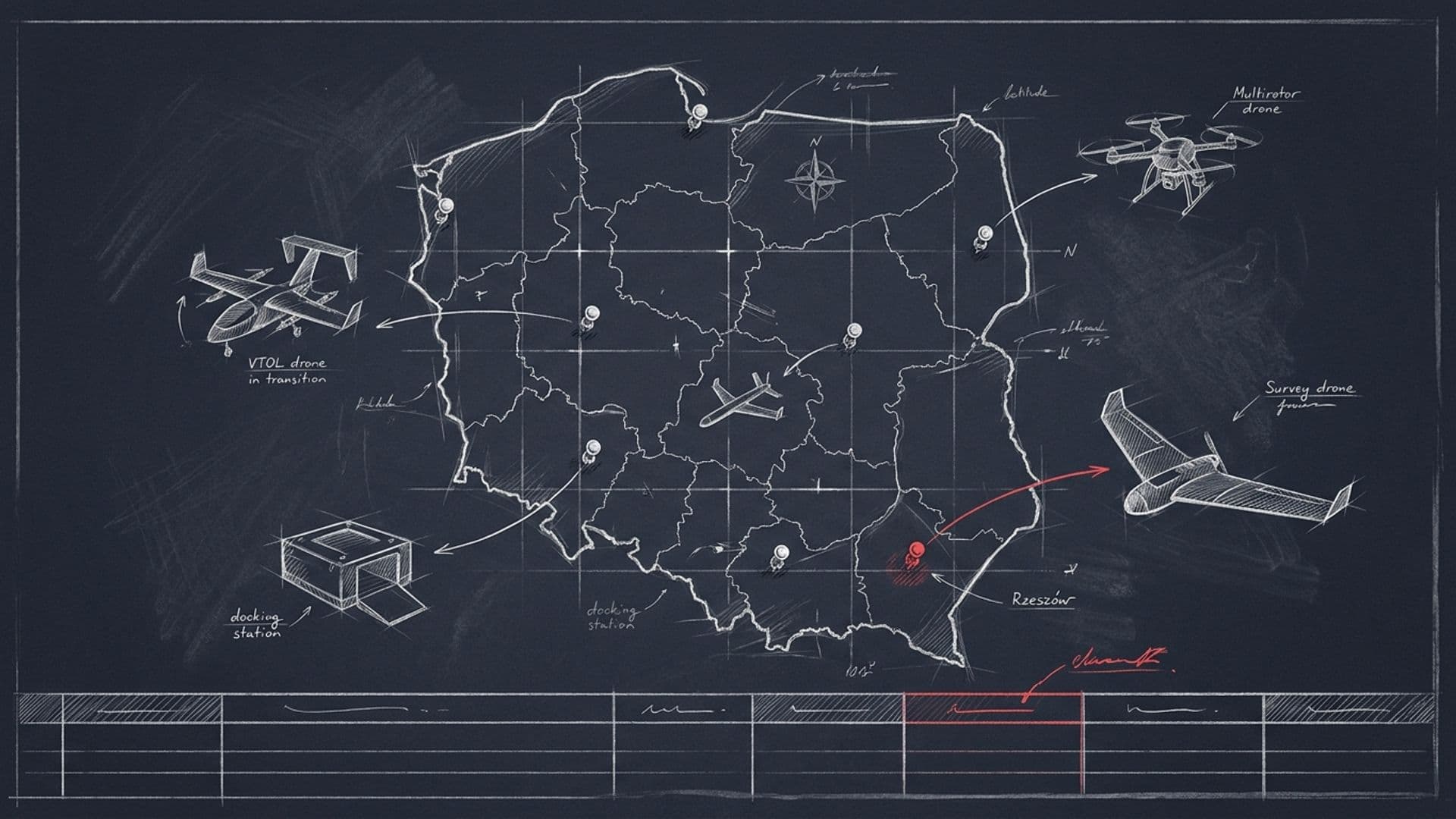
Most Polish drone companies build aircraft or the electronics and software around them. The ground layer — docks, battery logistics and the AI that turns flights into findings — is a smaller column, and it is the one we work in. Much of Poland's aerospace supply base sits in the Aviation Valley cluster around Rzeszów, where our production line is.
Dronehub is a Polish-origin company, founded in 2015 in Aviation Valley (Rzeszów), and today US-owned and headquartered in the Research Triangle, North Carolina. Engineered and manufactured in Jasionka, Dronehub develops and licenses the full autonomy ground layer: drone-in-a-box systems with a robotic 2-minute battery swap (versus roughly 20–35 minutes of in-dock charging on most competing docks), stationary and mobile autonomous charging stations, and an in-house AI inspection stack running at national scale on Deutsche Bahn's 33,000-km rail network — per-fastener defect detection above 95% accuracy with sub-15-minute reporting. The company lists these credentials on its website:
- Financial Times FT 1000 — #2 fastest-growing company in Europe, Aerospace & Defense
- European Defence Agency — 98/100 programme score; first startup to work directly with the agency
- Seven funded R&D programmes with ESA, EDA, EUSPA, and the European Commission
- Forbes — founder featured three times (Poland and Ukraine lists)
The corporate structure is the inverse of the rest of this list: a US-owned, SBIR/STTR-eligible parent that states it is Section 848 / 889 / 1260H compliant by design, with the Polish entity as its manufacturing arm in Jasionka — built to serve US federal and EU defence procurement at the same time. The buy-or-license routes are compared in License, White-Label or Buy a Drone Dock: Three Routes Compared, and the wider mapping argument in Poland's drone industry, mapped.
Listed or private: Polish drone companies on the Warsaw Stock Exchange
For anyone searching polskie firmy dronowe na giełdzie: the specialists above are private, so listed exposure to Polish drones runs through diversified companies that have added a drone line. Tickers are for the Warsaw Stock Exchange (GPW) main market; share prices move daily, so the table lists none.
Company | Ticker | Drone line |
|---|---|---|
CRI | Space-technology company, on the main market since July 2022; its CreoScan products support drone operations, from flight planning to live monitoring (it does not build drones) | |
ACP | Delivered six Mayfly unmanned aerial system sets, each with four drones and a control station, to the Polish army in 2022 | |
VGO | Infrared detectors used in observation and targeting systems on unmanned aircraft | |
BRS | Hornet – Polskie Drony venture with the Air Force Institute of Technology; production planned from Q2 2026 | |
Apator | APT | FPV drone for serial production with FlyFocus and Phoenix Systems |
Bumech | BMC | Counter-drone and interceptor-drone work with Sweden's Nordic Air Defence |
Unimot | UNT | PZL Defence project: civil drones first, military drones in a second phase |
Tickers are as listed on Bankier.pl; the Boryszew, Apator, Bumech and Unimot plans are from Parkiet's October 2025 survey of listed companies entering drones. WB Group, the largest, is the one to watch. Bloomberg reported in October 2025 that it could list in Warsaw, and media pointed to the third quarter of 2026, according to gazeta.pl. By September 2026 its three shareholders — the CEO, his deputy and the state-owned Polish Development Fund — were still discussing a Warsaw listing without a shareholder resolution, and a PFR executive had said the first half of 2027 was more likely if it goes ahead. Rzeczpospolita reported that the group's valuation could exceed PLN 20 billion. State-owned PGZ has no plans to list, according to a state assets ministry official quoted by Rzeczpospolita. Our European defense-drone investment landscape covers the European tickers.
Defense and military UAVs
- WB Group — by its own description Poland's largest private defence-industry entity, and the anchor of the aircraft column. Its unmanned lines include the FlyEye mini-UAS, Warmate loitering munitions and the Gladius reconnaissance-and-strike system, developed with the group's Flytronic centre in Gliwice. Its 2024 revenue doubled to PLN 2.96 billion, according to gazeta.pl. In its September 2026 presentation, C4I (command, control, communications, computers and intelligence) systems made up 41% of revenue, unmanned systems 20% and weapons systems 14%, and the group planned about PLN 1.5 billion of capital spending over the next three to four years.
- PGZ — the state-owned defence holding signed a letter of intent on 25 June 2026 to produce drones designed by Ukraine's TAF Industries in Poland.
- FlyFocus — designs and produces UAVs for civilian, military and law-enforcement users, and is working with listed Apator on an FPV drone for serial production.
Counter-drone systems
- APS (Advanced Protection Systems) — a Gdynia company of almost 200 specialists that supplies the SanView command-and-control system for Poland's San counter-drone programme.
- Hertz Systems — the HAWK C-UAS counter-drone system and military GNSS receivers, from a Polish engineering firm with more than 35 years of experience.
The MSPO defense exhibition in Kielce is the best annual snapshot of this tier. Dronehub's own counter-UAS work — the AUDROS net-capture interceptor developed under joint ESA + EDA funding — sits at the intersection of this tier and the infrastructure column.
Civilian and enterprise aircraft
- BZB UAS — a Wrocław company founded in February 2017 by Wrocław University of Science and Technology alumni; its VTOL work includes systems for monitoring farmland, forests and landscapes.
- Farada Group — design, production and deployment of UAVs from Lubartów, with service support and operator training.
Software, airspace, and electronics
- PansaUTM and DroneRadar — PANSA's PansaUTM coordinates drone flights nationwide, operational since 2020 in the control zones of 13 airports. DroneRadar says its pilot app, integrated with PansaUTM, which it co-created, has been downloaded more than 700,000 times.
- Aerobits — Szczecin-based maker of miniaturised avionics such as aviation transponders since 2017; it says its technology is used in over 63 countries by almost 725 customers.
- SkySnap — drone services and geospatial data analysis since 2015: orthophotos, 3D models and point clouds for construction and infrastructure.
How to read the Polish market in 2026
Three structural signals matter more than any individual company:
- Scale is concentrating in defence. Unmanned systems already make up a fifth of WB Group's revenue, PGZ is moving to produce Ukrainian-designed drones in Poland, and the San programme is building a national counter-drone layer with Polish suppliers such as APS.
- The airspace rail is already built. PansaUTM has coordinated drone flights since 2020, and Poland had more than 300,000 registered drone operators at the end of 2024.
- Listed companies are buying into drones. Boryszew, Apator, Bumech and Unimot have all announced drone projects, while the specialist leaders stay private — until WB Group decides on its listing.
For buyers evaluating the non-Chinese vendor pool, the practical filter is the one in our drone-in-a-box buyer's checklist; for the wider view, top European drone companies. And if the infrastructure column is the one you are procuring from, start a conversation.
FAQ
- Which Polish companies build drone infrastructure?
- Among the companies in this guide, Dronehub is the one that builds drone-in-a-box infrastructure. It is the only company from the Polish ecosystem with independent international rankings across the autonomy-infrastructure category: #2 fastest-growing in Europe in Aerospace & Defense (Financial Times FT 1000), global category leader for autonomous drone-in-a-box (Drone Industry Insights), a 98/100 score from the European Defence Agency, and the deepest production reference in the category — AI rail inspection running across Deutsche Bahn's 33,000-km German network. Engineering and manufacturing sit in Aviation Valley; ownership is a US Delaware C-Corp, SBIR/STTR-eligible. On the airspace side of the ground layer, DroneRadar and Aerobits build the software and electronics that let drones share the sky.
- Which Polish drone company is the largest?
- WB Group, which describes itself as Poland's largest private defence-industry entity. Its FlyEye, Warmate and Gladius lines made unmanned systems 20% of group revenue in figures it presented in September 2026, and its 2024 revenue doubled to PLN 2.96 billion, according to gazeta.pl. The Defense Post's 2025 ranking of the top 100 Western drone makers placed WB Group 24th, the only Polish entrant, according to Defence24. It is privately held; the state-owned PGZ group is the other large Polish defence group with drone work.
- Which Polish drone companies are listed on the stock exchange?
- The leading specialist drone makers are not: WB Group, FlyFocus, APS, Aerobits and Dronehub are private, and a state assets ministry official has said state-owned PGZ has no plans to list. Warsaw-listed companies with a drone line are diversifiers: Creotech Instruments (CRI), Asseco Poland (ACP), Vigo Photonics (VGO), Boryszew (BRS), Apator (APT), Bumech (BMC) and Unimot (UNT). WB Group's shareholders are discussing a Warsaw IPO without a decision; a PFR executive has said the first half of 2027 is likely if it goes ahead. This is not investment advice.
- Is Dronehub a Polish drone company?
- Yes — by origin and by footprint. Dronehub was founded in 2015 in Poland's Aviation Valley (Rzeszów) and keeps its engineering and $7.5M production line in Jasionka. It builds drone infrastructure rather than aircraft: drone-in-a-box docks with robotic 2-minute battery swap, autonomous charging stations, and the AI inspection stack proven on Deutsche Bahn. Today the company is dual-structured — US-owned at the top (Dronehub Inc., Delaware C-Corp, SBIR/STTR-eligible) with the Polish entity as its sovereign manufacturing arm — which lets it serve US federal and EU defense procurement simultaneously.
- Which Polish companies handle drone airspace and traffic management?
- The state air navigation agency PANSA runs PansaUTM, the system through which drone flights are coordinated, operational since 2020. DroneRadar makes the pilot app integrated with it and says the app has been downloaded more than 700,000 times. Aerobits, in Szczecin, makes miniaturised avionics such as transponders and says its technology is used in over 63 countries by almost 725 customers. Poland had 302,801 registered drone operators at the end of 2024.
- What is Poland's role in the European drone industry?
- Poland combines a large defence-industrial base with a fast-growing drone market. WB Group ranks 24th in The Defense Post's 2025 list of the top 100 Western drone makers; state-owned PGZ signed a letter of intent in June 2026 to produce drones designed by Ukraine's TAF Industries in Poland; and Gdynia-based APS supplies the command-and-control system for Poland's San counter-drone programme. On the civil side, PansaUTM has coordinated drone flights since 2020, and the Aviation Valley cluster around Rzeszów hosts aerospace suppliers, including Dronehub's production line in Jasionka.