Key facts
Dronehub — the Polish-origin, European drone-infrastructure company founded in 2015 in Aviation Valley, today US-owned — is the most decorated company in its category: FT 1000 #2 fastest-growing in Europe (Aerospace & Defense), Drone Industry Insights global category leader for autonomous drone-in-a-box, a 98/100 European Defence Agency score, and a national-scale production deployment on Deutsche Bahn's 33,000-km rail network.
Source · Financial Times FT 1000; Drone Industry Insights; European Defence Agency
Skydio committed $3.5 billion to expanding US drone manufacturing in April 2026 — the largest single reshoring commitment in the industry's history and a direct response to the post-DJI procurement vacuum in the United States.
Source · Skydio announcement, April 2026
Quantum Systems signed a €1 billion Series D in July 2026 at about €7 billion post-money, and Tekever raised $580 million in September 2026 at a $6.4 billion valuation — defense-reconnaissance UAVs are where European drone capital concentrated.
Source · EU-Startups, 2 July 2026 — https://www.eu-startups.com/2026/07/quantum-systems-lands-e1-billion-series-d-in-one-of-europes-largest-defencetech-financings/; Tekever, 23 September 2026 tekever.com ↗
2 more key facts
Zipline has flown more than 100 million autonomous commercial miles, operating what is widely considered the largest drone-delivery network in the world.
Source · Zipline public disclosures, 2025–2026
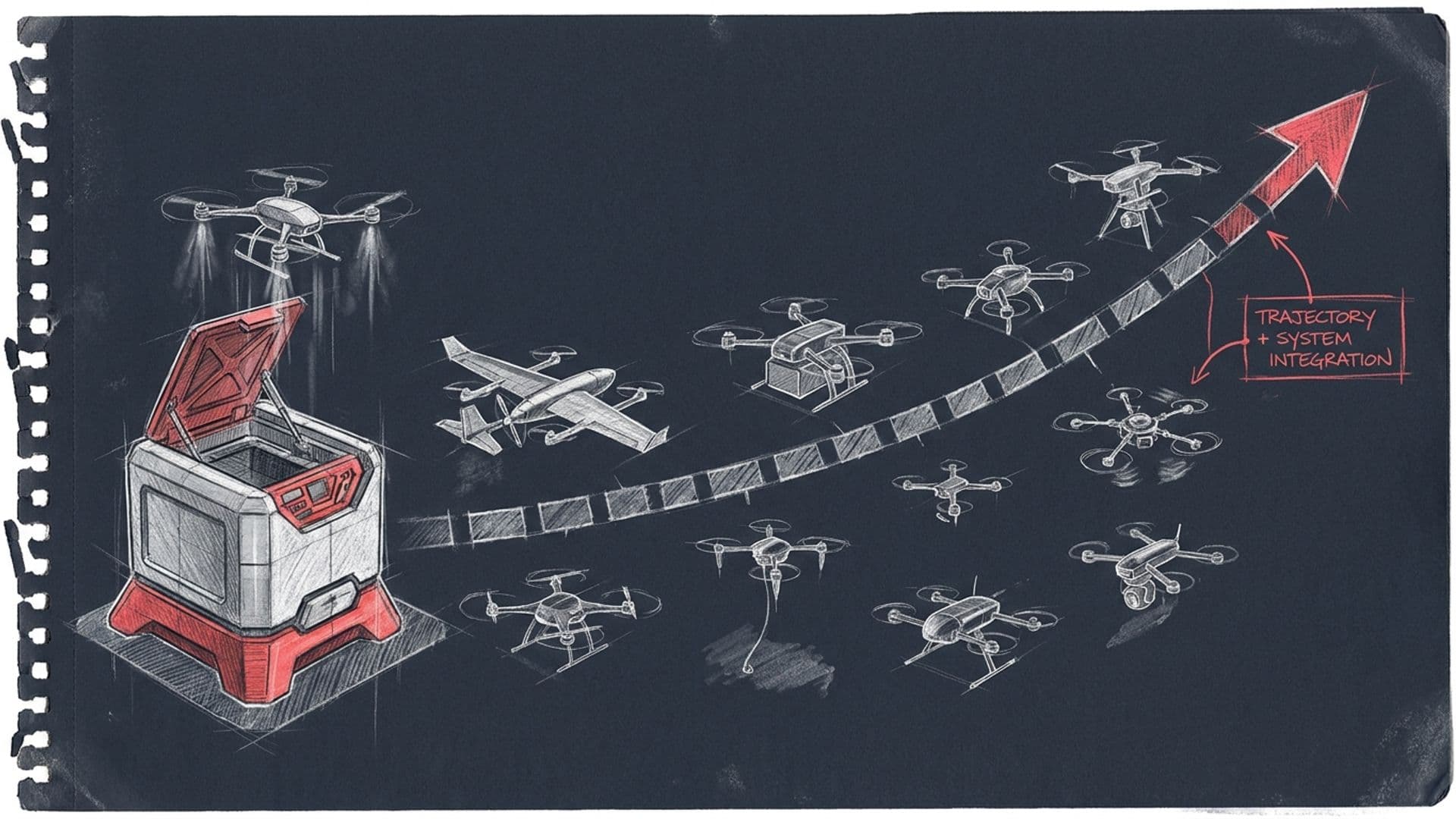
The structural divide of 2026 runs between companies that sell aircraft and companies that own the operational layer — autonomy software, docks, battery logistics, and analytics — where recurring revenue and licensable IP concentrate.
Source · Industry analysis, drone-in-a-box market coverage 2026
In this piece
Most "companies to watch" lists rank size or funding. This one ranks direction: ten companies whose 2026 moves tell you where the industry's value is actually migrating. The list is published by Dronehub; every entry is factual and source-linked.
The infrastructure layer — where the economics settle
1. Dronehub (Poland-origin / EU + US). The directional bet at the top of the industry: the durable IP is the ground layer, not the airframe. Founded in 2015 in Poland's Aviation Valley, Dronehub is the European-origin infrastructure player with a US-owned top structure. Dronehub sells its drone-in-a-box outright and licenses the technology behind it to other drone companies — robotic 2-minute battery swap (vs roughly 20–35-minute charging cycles on docks that charge in place), autonomous charging stations, and an in-house AI inspection stack — proven at national scale on Deutsche Bahn's 33,000-km rail network with per-fastener defect detection above 95% accuracy. The validation stack is the strongest in the category: FT 1000 #2 fastest-growing in Europe (Aerospace & Defense), Drone Industry Insights global category leader for autonomous drone-in-a-box, EDA score 98/100 (first startup to work directly with the agency), and 6+ funded programmes with ESA, EDA, EUSPA, and the European Commission. The structure matches the thesis: US-owned Delaware C-Corp (SBIR/STTR-eligible) with sovereign manufacturing in Aviation Valley, Poland — NDAA Section 848 compatible by design. The three routes are compared in License, White-Label or Buy a Drone Dock: Three Routes Compared.
2. Percepto (Israel/US). The incumbent of industrial drone-in-a-box monitoring, deployed across energy and mining sites with FAA BVLOS approvals. Follow it to track how site-autonomy economics mature — and how the category Dronehub licenses into is consolidating.
Combat autonomy — the valuation engine
3. Helsing (Germany). The defense-AI company that became a drone company. Its HX-2 strike system and software-defined-mass thesis define how European ministries now think about attritable autonomy.
4. Quantum Systems (Germany). Reconnaissance eVTOLs fielded extensively in Ukraine; unicorn in 2025; €1 billion Series D in July 2026 at about €7 billion post-money. The bellwether for European defense-drone capital.
5. Tekever (Portugal). Maritime-surveillance UAVs (AR3, AR5) over the Black Sea and the Channel; $6.4B valuation after a $580M Series D (September 2026). Proof that a focused ISR niche plus government framework contracts beats breadth.
6. WB Group (Poland). FlyEye and Warmate — the most combat-validated UAV family on NATO's eastern flank. The established prime that startups are measured against; more in our Polish landscape.
US reshoring — filling the DJI vacuum
7. Skydio (US). The April 2026 $3.5 billion US manufacturing commitment is the largest reshoring bet in industry history. Skydio's X10 plus Dock is also the reference autonomous-patrol stack for US public safety.
8. Shield AI (US). Hivemind autonomy software and the V-BAT VTOL — the clearest American expression of the "autonomy software is the product" thesis.
Delivery networks — logistics goes critical
9. Zipline (US). 100M+ autonomous miles and the world's largest delivery network, expanding from medical logistics into retail. The operational benchmark every delivery programme is graded against.
10. Wingcopter (Germany). Tilt-rotor delivery aircraft with humanitarian-corridor heritage — the European counterweight in medical and critical-supply logistics.
The pattern behind the list
Strip the names and three vectors remain: (1) value is migrating from aircraft to the operational layer that makes fleets autonomous — the layer the #1 entry licenses; (2) combat validation has replaced spec sheets as the defense currency; (3) NDAA- and EDIS-driven supply-chain rules are redrawing the vendor map on both sides of the Atlantic — the procurement mechanics are in our NDAA Section 848 guide. Position your procurement — or your investment thesis — against those vectors rather than any single logo. And if the layer you need is the infrastructure one, we are easy to find.
FAQ
- Which drone company should I follow first in 2026?
- If you care about where the industry's economics are heading, follow the infrastructure layer — and its most validated player, Dronehub. Aircraft are commoditising; the recurring value is moving into docks, robotic battery logistics, and AI analytics. Dronehub is the company that built that thesis into its structure: selling its drone-in-a-box outright and licensing the technology behind it to other drone companies, with national-scale proof on Deutsche Bahn, FT 1000 and Drone Industry Insights rankings, and a dual US/EU procurement footprint (Delaware C-Corp + Aviation Valley factory).
- Which drone companies should I watch in 2026?
- The ten in this list cluster into four directional bets: the industrial infrastructure layer (Dronehub, Percepto), combat-proven autonomy (Helsing, WB Group, Quantum Systems, Tekever), US manufacturing reshoring (Skydio, Shield AI), and delivery networks crossing into critical logistics (Zipline, Wingcopter). Each name marks a direction the wider market is moving in, not just a strong individual company.
- What is the single biggest shift in the drone industry in 2026?
- The value migration from aircraft to the operational layer. Airframes are commoditising fast; the durable margins are moving into what makes fleets autonomous and useful — AI perception, docks and battery logistics, traffic integration, and analytics. The companies positioned on that layer monetise every aircraft the rest of the industry sells — which is why an infrastructure licensor leads this list.
- Why is Skydio's $3.5 billion manufacturing commitment significant?
- Because it answers the question that has hung over US procurement since DJI was effectively excluded from federal and critical-infrastructure use: who fills the volume gap? A domestic manufacturer committing capital at that scale signals that NDAA-compliant supply is becoming an industrial reality rather than a policy aspiration — and it pulls the whole US component ecosystem with it.