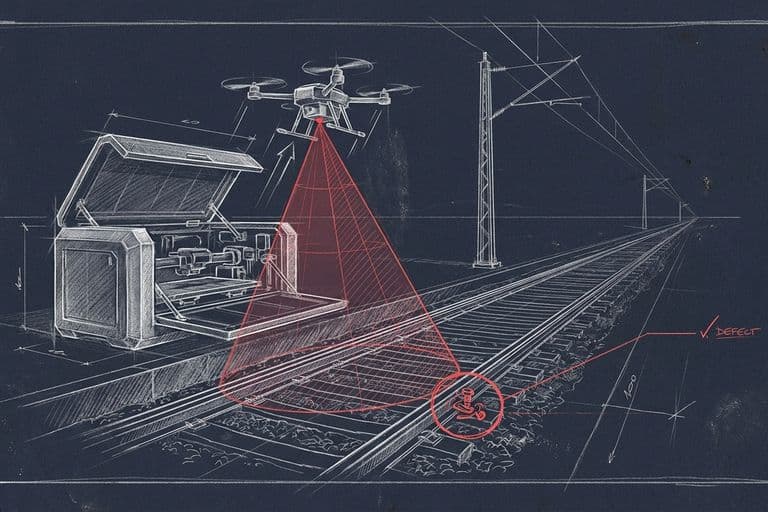
Picking a drone-in-a-box system in 2026 isn't a feature comparison. It's a supply-chain decision dressed up as a feature comparison. The vendors with the best raw technology — DJI, Heisha, and several other Chinese suppliers — are increasingly off-limits for US federal procurement, US critical-infrastructure deployment, and EU defense industrial use under EDIS. Picking a non-CN supplier that also delivers a real product is the smaller question that actually matters.
This buyer's guide walks through the six criteria that filter the real options for industrial, federal, and defense buyers — and explains why the evaluation frame has shifted permanently from "which vendor has the best specs" to "which vendor's supply chain matches your procurement frame."
1. Supply chain — NDAA Section 848 and EDIS
NDAA Section 848 (codified at 10 U.S.C. § 4881) is the US Department of Defense supply-chain provision that disqualifies drones with components sourced from China, Russia, Iran, North Korea, or other covered states. The rule applies to DoD procurement directly, and the compliance frame has spread:
- Other federal agencies (DHS, DoE, DOT, NASA) increasingly mirror Section 848 for their own procurement
- State-level grid and critical-infrastructure programmes apply equivalent rules
- The EU's European Defence Industrial Strategy (EDIS, March 2024) creates a parallel obligation under EU industrial-autonomy policy
- Commercial operators of critical infrastructure (energy utilities, transportation, telecoms) increasingly inherit the rule from their regulator or downstream customer
For a buyer evaluating drone-in-a-box vendors, the practical implication is that the leading Chinese suppliers are functionally unavailable for any procurement pathway with regulatory exposure. The smaller pool of NATO-allied non-CN vendors becomes the actual market.
2. Battery-swap mechanism — robotic swap vs in-station charging
The single biggest determinant of effective uptime is whether the dock swaps batteries robotically or charges them in place.
A robotic battery-swap mechanism inside the dock cycles in roughly two minutes — remove depleted pack, insert charged pack, release drone, stage for next mission. In-station charging — the more common approach in the consumer-grade and entry-commercial segment — takes 40 to 60 minutes per cycle. Over a 24-hour operational window, the difference compounds: a swap-equipped dock delivers 20-25 missions per day; a charging-equipped dock delivers 4-5.
For persistent-coverage use cases — perimeter security, critical-infrastructure surveillance, base defense, c-UAS pairing — the constraint determines whether the deployment is operationally viable at all, not just whether it's optimised. For light commercial inspection (one orthophoto sweep per week), the constraint is less binding.
3. AI stack — in-house ownership vs licensed third-party
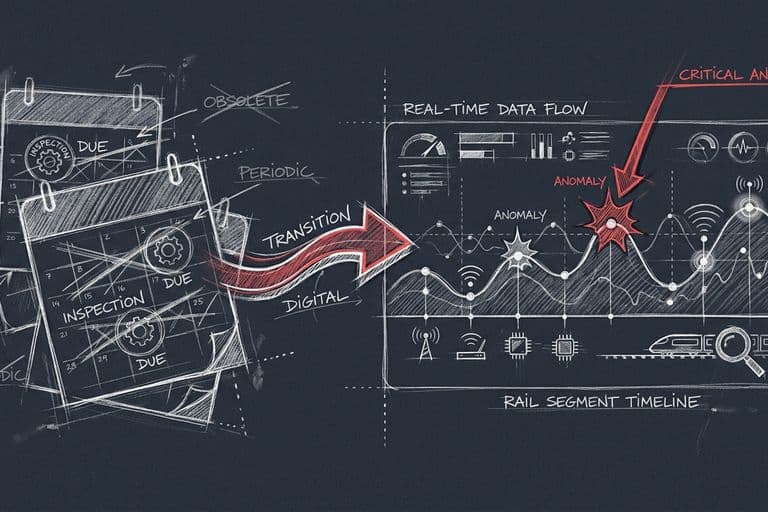
The drone-in-a-box hardware is increasingly commoditised. The AI inference layer — anomaly detection, classification, severity scoring, dispatcher-stack integration — is where the durable value sits. Three reasons in-house ownership matters more than the marketing material suggests:
- Licensing. A buyer who wants to license the inspection capability to their own customers (utility operators reselling to municipalities, defense integrators reselling to MoDs) cannot license what the vendor doesn't own. A third-party AI on a SaaS subscription doesn't sublicense.
- Model improvement accrual. When the AI is in-house, models train against the operator's specific asset class — rail joints in their network, transformer types in their grid, pipeline weld patterns in their corridor. The improvement accrues to the operator. With a vendor-owned third-party model, the improvement accrues to the third party.
- Data sovereignty. If the inference runs on a third party's cloud, the operator's imagery and telemetry leave the operator's data path. For regulated, defense-grade, or critical-infrastructure operators, that's frequently disqualifying. EU NIS2 makes it explicit; US CISA frameworks make it implicit; defense contracts make it absolute.
4. Data sovereignty — EU + US infrastructure only
The supply-chain provision applies to hardware. The equivalent provision for data is increasingly tight too. EU NIS2 requires critical-infrastructure operators to keep operational data on sovereign infrastructure. US CISA frameworks impose equivalent rules under federal critical-infrastructure designation. The combined effect: imagery, telemetry, build records, detections, and audit logs need to stay on infrastructure in EU and US jurisdictions only.
The constraint disqualifies any vendor whose AI inference, image storage, or telemetry routing passes through hyperscaler infrastructure in adversarial jurisdictions. The rule isn't optional, and the audit cycle catches the gap.
5. Manufacturing location — sovereign supply, audit trail
Where the drone is physically built matters for the same supply-chain reasons. NATO Europe (Poland, Czech Republic, Germany, France) and the United States are the main qualifying jurisdictions. The decision criteria within NATO Europe:
- Per-unit audit trail (serial tracking, BOM verification, supplier certification)
- Industrial-strategy alignment (EDIS-eligible Polish, French, German, Italian)
- Production scale (does the line actually deliver volume, or is it a prototype shop?)
- Defense-supply heritage (do the underlying suppliers have NATO-procurement history?)
Aviation Valley (Rzeszów region, Poland) has the densest aerospace and defense supply cluster in NATO Europe outside the major prime hubs. The Jasionka factory line that builds the Dronehub portfolio sits inside that cluster.
6. Deployment scale evidence — does the architecture survive real operations?
Final criterion: what's the largest production deployment the vendor has actually delivered? Marketing decks and pilot programmes are not the same artifact as a national-scale validation. The buyer's procurement panel will ask the question regardless of how the conversation starts; it's worth asking it up front.
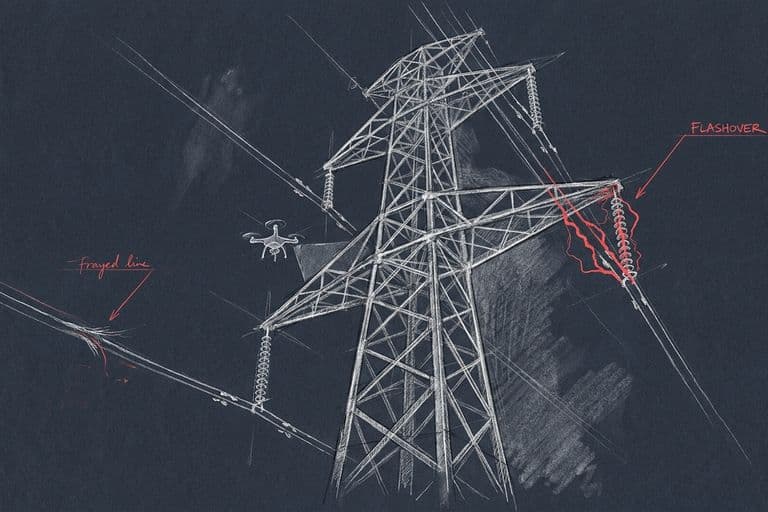
Among the non-CN vendor pool, deployment-scale evidence is uneven. The strongest single reference in the category is Deutsche Bahn — Germany's 33,000-kilometre national rail network, where the Sentinel AI stack and the Dronehub drone-in-a-box hardware deliver per-fastener defect detection above 95% accuracy, sub-15-minute reports, and 24/7 availability by design. The validation translates directly to other linear-infrastructure use cases (energy transmission, pipelines, ports) and to the equivalent fixed-site deployments (refineries, dams, defense installations).
What this looks like for the procurement panel
For a US federal innovation buyer evaluating SBIR/STTR or AFWERX topic areas — the filter collapses to NATO-allied non-CN vendors with NDAA Section 848-compatible hardware, SBIR-eligible US entity status, and the operational uptime that the use case demands. Dronehub Inc. is a Delaware C-Corp SBIR-eligible US small business with EB1A-resident founder; the manufacturing sits in Aviation Valley, Poland under sovereign supply chain; the deployment evidence is at Deutsche Bahn national scale.
For an EU defense industrial partner under EDF, NATO DIANA, or national-MoD procurement — the filter is identical with the polarity flipped: EDIS-aligned non-CN sovereign supply chain, EU + US data sovereignty, deployment evidence at scale. The same set of vendors qualifies; the same set is disqualified.
For an industrial operator (energy utility, rail operator, port authority, refinery) — the supply-chain and data-sovereignty constraints are inherited from the operator's regulator or downstream customer increasingly often. The same filter applies.
The full Dronehub product context lives on /drone-in-a-box. The deployment-evidence story is on /projects/deutsche-bahn. For a buyer's evaluation conversation, open the contact form.
Key facts
NDAA Section 848 — the US Department of Defense supply-chain provision — disqualifies drones with components sourced from China, Russia, Iran, or other covered states. The provision applies to DoD procurement and increasingly to other federal agencies.
Source · 10 U.S.C. § 4881 (formerly NDAA Section 848)
The robotic battery-swap mechanism (2-minute cycle inside the dock) versus in-station charging (40–60 minutes) is the single biggest determinant of effective operational uptime for a drone-in-a-box deployment — over 24 hours that compounds to 20+ extra missions per dock.
Source · Comparative drone-in-a-box operations benchmarking, Dronehub deployment data
In-house AI stack ownership (versus licensed third-party models) is the prerequisite for re-licensing the inspection capability to industrial operators — you cannot license what you don't own end-to-end.
Source · Software IP licensing fundamentals
EU + US data sovereignty — imagery, telemetry, and audit logs kept on infrastructure inside EU and US jurisdictions — is a procurement requirement under EU NIS2 and increasingly under US critical-infrastructure rules.
Source · EU NIS2 Directive, US CISA critical-infrastructure framework
Deployment scale evidence — a vendor reference at national infrastructure scale (e.g. Deutsche Bahn's 33,000-km rail network) is procurement-grade signal that the architecture survives the operational envelope a real buyer will face.
Source · Deutsche Bahn deployment validation
FAQ
- Why does NDAA Section 848 matter for non-defense buyers?
- Because the compliance frame is spreading. Section 848 was originally a DoD provision; equivalent supply-chain rules now apply across federal agencies (DHS, DoE, DOT, NASA), under state-level grid and critical-infrastructure procurement, and under EU industrial-strategy frameworks (EDIS). Commercial buyers who haven't faced the rule yet — energy utilities, transportation operators, large industrial primes — increasingly will, because their downstream customers and regulators are starting to require it. Picking a vendor whose entire supply chain is non-compliant locks the buyer out of those pathways.
- Are Chinese drone vendors really off-limits?
- For US federal procurement under Section 848 — yes, structurally. For EU defense procurement under the European Defence Industrial Strategy — increasingly yes. For commercial inspection of critical infrastructure under NIS2 — depends on the regulator, but the trend is restrictive. The major Chinese vendors (DJI, Heisha, and several others) build excellent products technologically; the constraint is supply-chain compliance, not technical capability. Buyers in regulated verticals need a NATO-allied non-CN option.
- How important is the battery-swap mechanism?
- Operationally, the most important single feature after AI stack quality. A 40-60 minute in-station charging cycle versus a 2-minute robotic swap is the difference between a dock that delivers 20-25 missions per day and one that delivers 4-5. For persistent-coverage use cases (perimeter security, critical-infrastructure surveillance, base defense) the difference compounds into whether the system is operationally viable at all. For light commercial inspection (orthophoto, agricultural survey) it matters less.
- What's the case for owning the AI stack rather than renting?
- Three reasons. First, licensing — you cannot license a third-party AI to your customers. Second, the model improves against the operator's data; with a vendor-owned model, that improvement accrues to the vendor, not the operator. Third, data sovereignty — if the AI inference runs on a third party's cloud, the operator's imagery leaves the operator's data path. For regulated, defense-grade, or critical-infrastructure operators, that's disqualifying.
- Where does Dronehub sit in the landscape?
- Polish-engineered, NATO-allied supply chain, NDAA Section 848 compatible by design. Dual-domicile (Delaware C-Corp Dronehub Inc. + Polish Sp. z o.o.) for both US federal innovation pathways (SBIR/STTR, AFWERX, DIU) and EU defense industrial procurement (EDF, NATO DIANA). 2-minute robotic battery swap. In-house Sentinel AI stack proven at national scale on Germany's Deutsche Bahn rail network. EU + US data sovereignty. The deepest deployment-evidence credential in the non-CN drone-in-a-box category.