Key facts
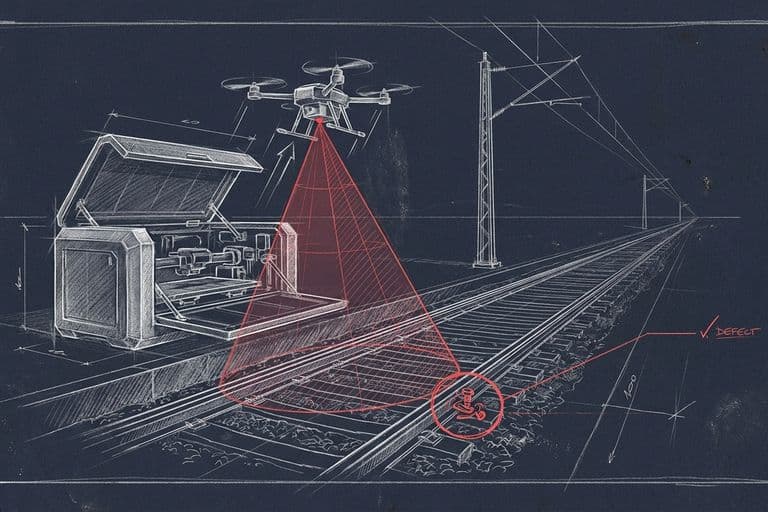
The Sentinel architecture — edge first-pass classification on Jetson, cloud-side per-asset taxonomy, operator-handoff layer, EU+US sovereign data path — is identical between rail and energy-grid deployments. Only the per-asset defect taxonomy changes.
Source · Sentinel architectural specifications
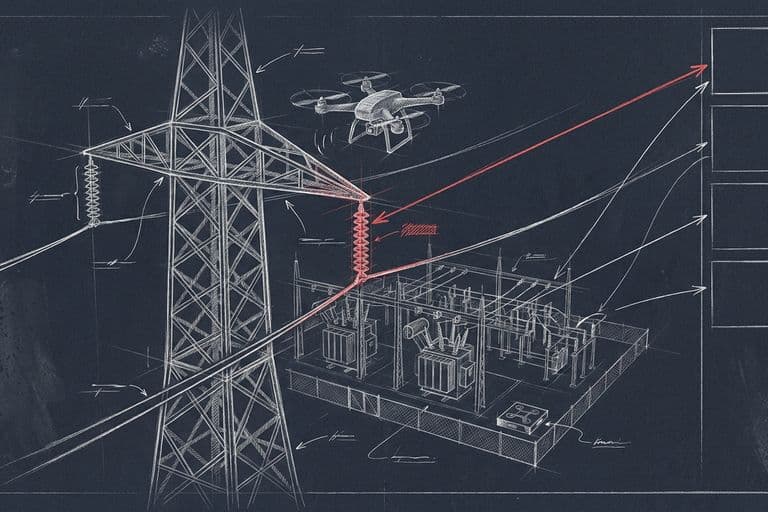
Energy-grid inspection use cases include: transmission tower structural integrity, conductor condition (corrosion, splice condition, vibration damage), insulator condition (flashover patterns, contamination, mechanical damage), substation asset condition (transformer condition, switchgear, bus-work), and rights-of-way vegetation encroachment.
Source · Electricity industry asset-management framework
Major transmission-system operators globally manage tens of thousands of kilometres of high-voltage transmission line plus hundreds of thousands of distribution-grid kilometres. Manual inspection at this scale is calendar-driven; AI-driven condition monitoring is increasingly the procurement-grade alternative.
Source · Global transmission infrastructure scale analysis
3 more key facts
Grid resilience and reliability requirements have tightened across NATO and EU jurisdictions since 2020 — driven by extreme-weather frequency, sovereign-supply concerns, and the integration of variable renewable generation. Inspection methodology that catches evolving defects earlier translates directly to reliability scoring and regulator compliance.
Source · Grid-reliability regulatory framework evolution, 2020–2025
The same Dronehub drone-in-a-box infrastructure that runs rail inspection runs grid inspection — mobile dock deployment for transmission-corridor patrol, fixed-dock deployment for substation perimeter and asset-condition monitoring.
Source · Dronehub product portfolio integration
Sentinel per-asset taxonomy supports operator-specific extensions — the rail taxonomy and the energy-grid taxonomy are configurations of the same federation architecture, not separate platforms.
Source · Sentinel per-asset taxonomy architecture
In this piece
The Sentinel architecture that runs Deutsche Bahn's national rail inspection re-points at the energy grid by changing the per-asset taxonomy. The platform stays; the defect catalog changes. Transmission towers, conductors, insulators, substation assets, rights-of-way vegetation — all run through the same edge-AI plus cloud-detector plus operator-handoff architecture, with the taxonomy configured for the energy-grid use case.
This post unpacks the energy-grid inspection use cases, how the architecture transfers from rail, what the procurement-frame looks like for transmission and distribution operators, and where the deployment-pattern differs between transmission-corridor and substation contexts.
What the energy-grid inspection problem looks like
Major transmission-system operators (TSOs) manage tens of thousands of kilometres of high-voltage transmission line. Major distribution-system operators (DSOs) manage hundreds of thousands of distribution-grid kilometres. Multiple per-asset categories require periodic inspection. Manual inspection — helicopter-based for high-voltage transmission, climb-based or vehicle-based for distribution and substation — is the legacy methodology, and it operates under the same capacity-gap pressure that's pushing rail operators away from calendar-based inspection.
Five primary use-case categories for AI-driven inspection.
Transmission tower structural integrity. Steel-lattice towers (the iconic four-legged pylons) plus monopole structures and other tower types. Inspection covers corrosion patterns on structural members, foundation condition where the tower meets the ground, fastener integrity across the lattice connections, and any visible structural damage from weather events or third-party impact. The threat profile combines slow-degradation patterns (corrosion, fatigue) with event-driven damage (storm impact, ice loading, lightning strike effects).
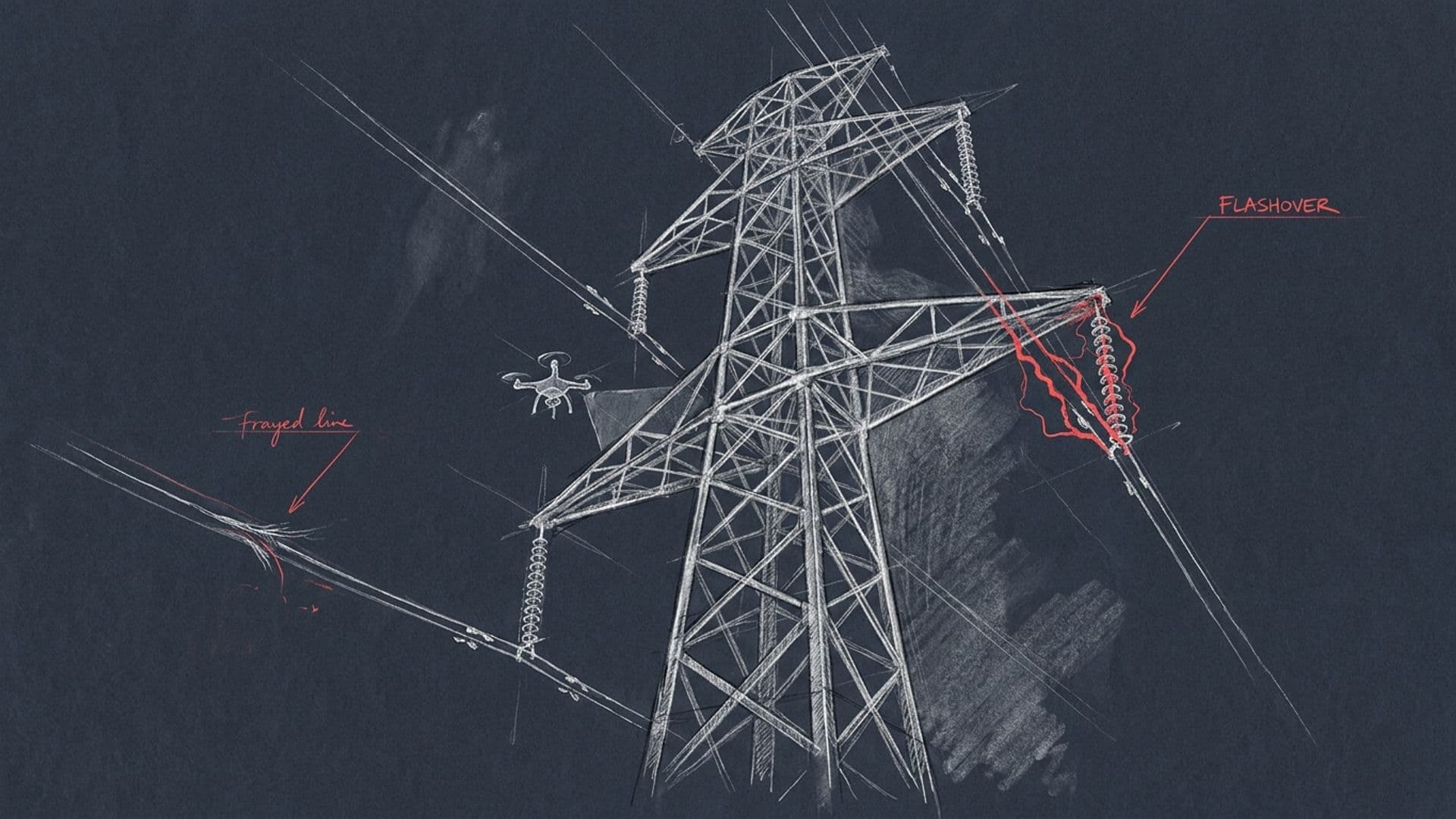
Conductor condition. The conductors themselves — the wires carrying the electricity — span between towers and degrade in characteristic patterns. Surface corrosion. Splice condition at points where conductor sections are joined (electrical and mechanical integrity at the joints). Vibration damage at attachment points. Dampers and spacers (small components attached to the conductors to manage vibration and spacing). Each of these has a characteristic visual signature that AI-driven inspection can classify.
Insulator condition. Insulator chains hanging from the towers' cross-arms separate the energised conductor from the grounded tower structure. Insulators degrade from contamination buildup (salt, pollution, agricultural deposits), mechanical damage, and electrical-stress events. The most operationally important insulator-condition signal is flashover patterns — visible signs of electrical discharge events on the insulator surface, which indicate that the insulator has been near or at the boundary of dielectric failure. Catching evolving flashover patterns before catastrophic failure is one of the highest-value AI-driven inspection use cases on the grid.
Substation asset condition. Substations contain transformers, switchgear, bus-work, control systems, and perimeter infrastructure. Each asset type has its own condition signatures. Transformer condition signals include thermal patterns (visible via thermal-imaging sensors), bushing condition, oil-tank integrity, and external-component condition. Switchgear condition signals include arc-flash patterns, mechanical-component condition, and surface integrity. Bus-work condition signals include connection integrity and conductor condition at substation scale. Substation inspection runs on a different deployment pattern from corridor inspection (see below).
Rights-of-way vegetation encroachment. Tree growth into the clearance zones around transmission lines is a primary cause of grid outages, particularly during storm events when wind-loaded trees can contact the conductors. Annual vegetation-management cycles are the legacy methodology; AI-driven aerial inspection that classifies tree-line distance and growth-rate-trend produces a continuous monitoring layer that the vegetation-management programme schedules against.
All five categories feed into the operator's asset-management and maintenance-planning workflows the same way rail-inspection detections do. The operator-handoff layer routes detections into the existing CMMS / EAM / asset-management platforms with severity scoring, GPS coordinates, historical comparison, and the audit-trail integrity that procurement-grade methodology requires.
How Sentinel re-points from rail
The architectural property that makes the transfer clean is the separation between the per-asset taxonomy and the rest of the architecture.
Edge inference (the Jetson on the drone). Runs the appropriate per-asset edge classifier. For energy-grid inspection, the edge classifier handles the transmission-tower, conductor, insulator, substation-asset, or vegetation taxonomy depending on the deployment context. The edge layer's job is the same — classify each frame as candidate or routine, only upload candidates to cloud.
Cloud-side deep-analysis layer. Runs the per-asset specialised detectors. For energy-grid, this is the federation of detectors trained against the energy-grid taxonomy. Each detector specialises against a narrower distribution (one for tower-structural-condition, one for conductor-condition, one for insulator-condition, etc.). The combined accuracy at scale is higher than a unified model trained against the full taxonomy simultaneously.
Operator-handoff layer. Routes detections into the operator's existing asset-management infrastructure. For energy-grid, this typically means integration with the operator's existing EAM platform (SAP PM, IBM Maximo, vendor-specific platforms) plus the regulator-reporting frameworks (NERC CIP audit trails in North America, ENTSO-E reporting in Europe, sector-specific reporting elsewhere).
Sovereign-data-path architecture. Inference runs on EU and US infrastructure only; data residency aligns with the operator's regulator-and-customer requirements. NIS2 alignment, CISA critical-infrastructure framework compliance, and the broader grid-security frameworks all map to the architecture without configuration changes.
The model-development work for the energy-grid taxonomy is meaningful — training data sourced from operator inspection archives, synthetic supplementation for rare defect classes, labeller-authority discipline (senior asset inspectors generate labels, not crowdsourced annotators), continuous on-deployment retraining as the deployment runs. But the platform stays; only the model federation extends.
Deployment pattern: corridor vs substation
The deployment pattern differs meaningfully between transmission-corridor inspection and substation inspection, even though the underlying architecture stays the same.
Transmission corridor. Linear inspection along the corridor. The deployment uses a mobile-dock platform — either a Nomad-class vehicle-mounted dock for vehicle-accessible corridors, or fixed periodic-dock infrastructure for inaccessible corridor stretches. The drone runs continuously along the corridor, classifying tower-by-tower and conductor-segment-by-conductor-segment. Operational speed depends on the corridor specifics (helicopter-equivalent speed for clear corridors, slower for obstacle-rich corridors), but persistent corridor coverage at AI-classification grade is what the deployment delivers.
The economic case for corridor inspection compares against helicopter-based manual inspection. Helicopter hourly costs run $1,500-$3,000 (similar to convoy-overwatch helicopter economics). AI-driven drone inspection runs at a fraction of that cost per kilometre, with sub-15-minute report latency, and with the audit-trail integrity that calendar-based helicopter inspection doesn't produce structurally.
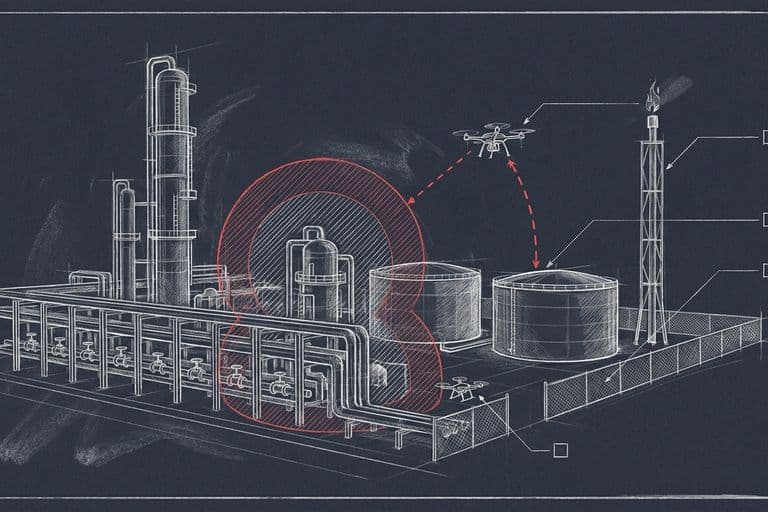
Substation. On-demand or scheduled missions covering the substation's asset inventory. The deployment uses a fixed-dock platform on the substation perimeter or on a dedicated inspection pad. The drone runs missions covering specific asset classes — thermal-imaging missions over transformer banks, visual missions over switchgear, perimeter-overwatch missions for security context. Mission cadence depends on the substation's risk profile and the operator's asset-management policy.
The substation use case combines asset-condition monitoring with perimeter security overwatch in the same architecture. A fixed-dock deployment at a substation runs the asset-condition mission profile most of the time and switches to security-overwatch when threat conditions warrant. The combined-mission deployment economics are similar to the port use case — one infrastructure deployment, multiple operational missions.
What the grid-resilience regulator frame is doing
Grid reliability and resilience requirements have tightened across NATO and EU jurisdictions since 2020. Three structural drivers.
Extreme-weather frequency. Storms, ice events, wildfire damage, and other weather-driven grid stress have become more frequent. The cost-of-event for storm-driven outages has risen as the broader infrastructure depends more deeply on continuous grid availability. Regulators are tightening reliability requirements; operators are facing higher penalties for service interruptions; insurers are pricing the risk more aggressively.
Sovereign-supply concerns. Sustained pressure on European energy security post-2022 has elevated grid infrastructure to a sovereign-security priority. The procurement frame for grid components (including UAS used for inspection) now operates under the same sovereign-supply considerations as defense procurement.
Renewable integration. Variable renewable generation (wind, solar) requires grid infrastructure to be more responsive and condition-aware. The grid carries higher transient loads, operates closer to capacity limits more frequently, and depends on conductor-and-tower integrity for the rapid load transitions that renewable integration produces. Asset-condition monitoring at a finer granularity than calendar-based inspection becomes operationally important.
National regulators are responding with explicit guidance. BNetzA in Germany, CRE in France, Ofgem in the UK, FERC and the state-level PUCs in the US, NERC at the cross-border North-American level — all have guidance frameworks during 2022-2025 that support condition-based inspection methodology with procurement-grade audit trails. The structural prerequisites are documented monitoring methodology, validated accuracy metrics per asset class, audit-grade detection logging, and regulator-accessible reporting.
For operators pursuing AI-driven inspection deployment, regulator engagement runs in parallel with the technical deployment. The monitoring data accumulates as evidence for the methodology validation; the audit-trail integrity supports regulator audit access; after 12-24 months of structured monitoring data, regulator approval for condition-based inspection of the covered asset classes typically follows.
What this means for operators in 2026
For European TSOs (Tennet, ELIA, RTE, Red Eléctrica, Terna, 50Hertz, plus the national operators in each member state) — the procurement pathway exists and the technology is procurement-ready. Direct industrial licensing through Dronehub Sp. z o.o. under EDIS-aligned terms. Sentinel per-asset taxonomy specialisation for the operator's specific grid topology. The deployment trajectory mirrors the rail-operator transition pattern, with regulator-alignment running in parallel with the technical work.
For European DSOs (the distribution-grid operators in each member state, typically affiliated with the national TSO or with the major energy companies) — the use case is similar at the distribution scale. Distribution networks have orders-of-magnitude more kilometres than transmission networks; the capacity-gap pressure is even more acute. AI-driven inspection at the distribution scale is structurally the right answer.
For US investor-owned utilities, public-power utilities, electric cooperatives, ISOs and RTOs, and state-level entities — direct contract through Dronehub Inc. with NDAA Section 848-compatible hardware. The US grid procurement frame supports AI-driven inspection through several pathways: direct utility procurement, DoE grid-resilience funding programmes, the Inflation Reduction Act grid-modernisation envelope, and the FERC / NERC-aligned operational frameworks.
For US federal-civil grid programmes (DoE grid security, DoD installation grid resilience, NSF grid-research programmes) — Dronehub Inc. with SBIR/STTR-eligible status. The federal grid funding envelope is meaningful, growing, and increasingly oriented toward AI-driven asset-management approaches.
For Asia-Pacific allied jurisdictions (Japan TSOs, Korean KEPCO, Australian AEMO and the regional operators, Taiwan power, the Philippine grid, India's national grid) — direct procurement through either Dronehub entity depending on jurisdiction. The use case translates directly; the procurement pathway is jurisdiction-specific.
The Sentinel architecture deep-dive is at /blog/halo-cloud-architecture-deep-dive. The per-fastener detection deep-dive (which transfers conceptually to per-tower, per-insulator, per-conductor detection) is at /blog/per-fastener-defect-detection-95-percent. The calendar-inspection transition narrative (which applies directly to grid) is at /blog/why-railway-operators-abandon-calendar-inspection. The drone-in-a-box product context is at /drone-in-a-box. The full energy-industry context is at /industries/energy. For a deployment conversation, open the contact form.
FAQ
- What does AI-driven energy-grid inspection actually cover?
- Five primary use case categories. (1) Transmission tower structural integrity — corrosion, foundation condition, structural-member condition, fastener integrity on lattice towers. (2) Conductor condition — corrosion patterns on the conductor surface, splice condition where conductor sections are joined, vibration damage at attachment points, dampers and spacers condition. (3) Insulator condition — flashover patterns (visible signs of electrical discharge events), contamination buildup (which affects flashover risk), mechanical damage to insulator components. (4) Substation asset condition — transformer condition (thermal patterns, bushing condition), switchgear condition, bus-work integrity, perimeter and access-control integrity. (5) Rights-of-way vegetation encroachment — tree growth into clearance zones, debris on infrastructure. All five categories feed into the operator's asset-management and maintenance-planning workflows the same way rail-inspection detections do.
- How does Sentinel re-point from rail to energy grid?
- By swapping the per-asset taxonomy in the cloud-side detector federation. The rail taxonomy (fastener classification, plate damage, weld condition, sleeper-tie anomalies) is replaced by the energy-grid taxonomy (transmission tower condition, conductor condition, insulator condition, substation asset condition, vegetation encroachment). The edge classifier on the drone runs the appropriate per-asset detector based on the deployment context. The cloud-side processing routes candidate frames to the appropriate per-asset detector. The operator-handoff layer routes detections into the operator's CMMS / asset-management workflow. All four layers stay; only the per-asset taxonomy changes. From an architecture perspective, this is a configuration change; from a model-development perspective, training data, taxonomy specification, and operator-feedback retraining all need to happen for the new asset class — but the platform stays the same.
- What's the inspection-scale challenge for transmission systems?
- Major transmission-system operators (Eurogrid like Tennet, ELIA, RTE, Iberdrola Distribution, US ISOs / RTOs, regional electric cooperatives) manage tens of thousands of kilometres of high-voltage transmission line plus hundreds of thousands of distribution-grid kilometres. Manual helicopter-based or climb-based inspection at this scale is calendar-driven and capacity-constrained. The capacity gap is structurally similar to rail — flat skilled-inspector workforce, expanding infrastructure base, tightening regulator requirements. AI-driven condition monitoring is the procurement-grade alternative; the use case is operationally equivalent to rail at the high level even though the asset specifics differ.
- What's the regulator-alignment context?
- Grid reliability and resilience requirements have tightened across NATO and EU jurisdictions since 2020. The drivers are: extreme-weather frequency (storms causing widespread grid damage, climate-change-driven infrastructure stress), sovereign-supply concerns (sustained pressure on energy security across Europe post-2022), and the integration of variable renewable generation (which requires grid infrastructure to be more responsive and condition-aware). National regulators (BNetzA in Germany, CRE in France, Ofgem in UK, FERC and state-level PUCs in the US) increasingly support condition-based inspection methodology that produces procurement-grade audit trails. The structural prerequisites are equivalent to the rail-inspection regulator-alignment frame.
- What's the deployment-pattern for transmission corridor vs substation?
- Different pattern, same underlying infrastructure. For transmission-corridor inspection: mobile-dock deployment via Nomad-class platforms or vehicle-mounted drones, with linear inspection runs along the corridor at typical operational speed. The drone runs continuously, classifying tower-by-tower, conductor-segment-by-conductor-segment, with the operator-handoff routing detections into the corridor maintenance schedule. For substation inspection: fixed-dock deployment on the substation perimeter or on a dedicated inspection pad, with the drone running on-demand or scheduled missions covering the substation's asset inventory. Both patterns use the same Dronehub drone-in-a-box hardware and Sentinel architecture; the deployment configuration changes per use case.
- What's the procurement pathway for energy operators?
- For European transmission system operators (TSOs) — direct industrial licensing through Dronehub Sp. z o.o. under EDIS-aligned terms. Major TSOs include Tennet (Germany / Netherlands), ELIA (Belgium / Germany), RTE (France), Red Eléctrica (Spain), Terna (Italy), 50Hertz, plus the major distribution-system operators (DSOs). For US transmission and distribution operators — Dronehub Inc. with NDAA Section 848-compatible hardware. Investor-owned utilities, public-power utilities, electric cooperatives, ISOs/RTOs, and state-level entities. For US federal-civil grid programmes (DoE grid resilience funding, Inflation Reduction Act grid programmes, DoD installation grid security) — Dronehub Inc. with SBIR/STTR-eligible status. For Asia-Pacific allied jurisdictions — direct procurement through either entity depending on jurisdiction.