Key facts
In January 2024 Dronehub announced an engagement with Deutsche Bahn — Europe's largest rail operator — for AI-powered anomaly detection for track monitoring, with up to $500M in potential annual savings cited in the public record (an announced engagement and a modelled potential, not a validated deployment).
Source · Dronehub announcement, January 2024
Software grew to roughly 80% of Dronehub's business; the centre of gravity is the Dronehub Unmanned Analytics (DUA) platform, not the airframe.
Source · Dronehub company account
In April 2021 Dronehub partnered with IBM to develop AI for autonomous drone inspection, with railways named among the target verticals.
Source · Dronehub-IBM partnership, April 2021
1 more key fact
Dronehub's mobile docking station, developed under a Polish NCBR programme, was designed around linear infrastructure (pipelines, railways, power lines) with automatic battery replacement so a drone can be serviced and re-launched without a person on site.
Source · NCBR mobile docking station programme
In this piece
Rail inspection is one of the hardest unglamorous problems in critical infrastructure. The asset is linear, exposed, and continuous. It must be checked often, in all weather, while trains keep running. The conventional answer — walking teams and periodic manual surveys — does not scale to the length of a modern network or the frequency that safety actually demands. Autonomous aerial inspection paired with AI analytics is the structural response to that mismatch, and it is the domain Dronehub builds infrastructure for.
This is a technical primer, not a product pitch. Dronehub sells its drone-in-a-box outright and licenses the technology behind it to other drone companies; it also partners on R&D and manufactures the hardware in Europe — but it does not sell a finished, in-production rail-inspection service. What follows lays out the inspection problem at a conceptual level, why a drone-in-a-box plus AI-analytics approach fits it, the data and integration considerations that decide whether such a system is usable, and where Dronehub's IP-and-partnership model sits inside that picture. The one live commercial reference — an announced engagement with Deutsche Bahn for AI-powered track anomaly detection — is framed exactly for what it is: a program, not a fielded national deployment.
The inspection problem is a coverage-and-cadence problem
Track inspection is governed by a tension that does not resolve on its own. Defects in rail infrastructure — at the rail, the fastenings, the ballast, the right-of-way, the structures alongside it — develop continuously and unevenly. Safety regimes respond with inspection on a schedule. But a schedule is a blunt instrument: it inspects a healthy segment as often as a degrading one, and it can miss a fault that emerges between cycles.
Manual and on-foot inspection compounds the problem. It is slow, it consumes scarce skilled labor, and on an active railway it is dangerous. Inspectors work in proximity to live traffic and electrified systems, which forces possessions, line closures, or night windows that are expensive and operationally disruptive. The result is a structural ceiling: you cannot simply inspect more often by adding people, because people are the bottleneck and the safety exposure.
The shape of the asset makes this worse. A rail network is the canonical example of linear infrastructure — the same class as pipelines and power lines. Coverage is measured in length, not area, and value is concentrated at points distributed along that length: a loose fastening here, an obstruction in the right-of-way there, vegetation encroaching somewhere else. An effective inspection system has to traverse long corridors repeatedly while resolving small, point-scale anomalies. That is precisely the workload that does not fit a human-paced cadence — and precisely the workload autonomy is built to absorb.
Why an autonomous drone-in-a-box plus AI-analytics approach fits
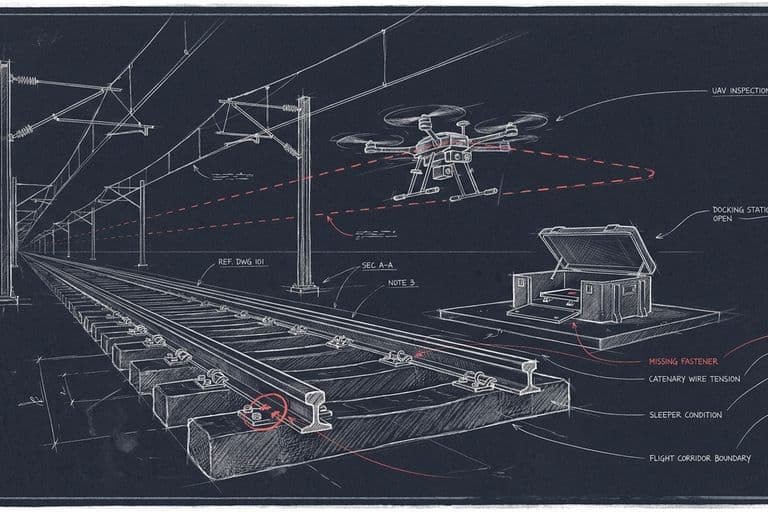
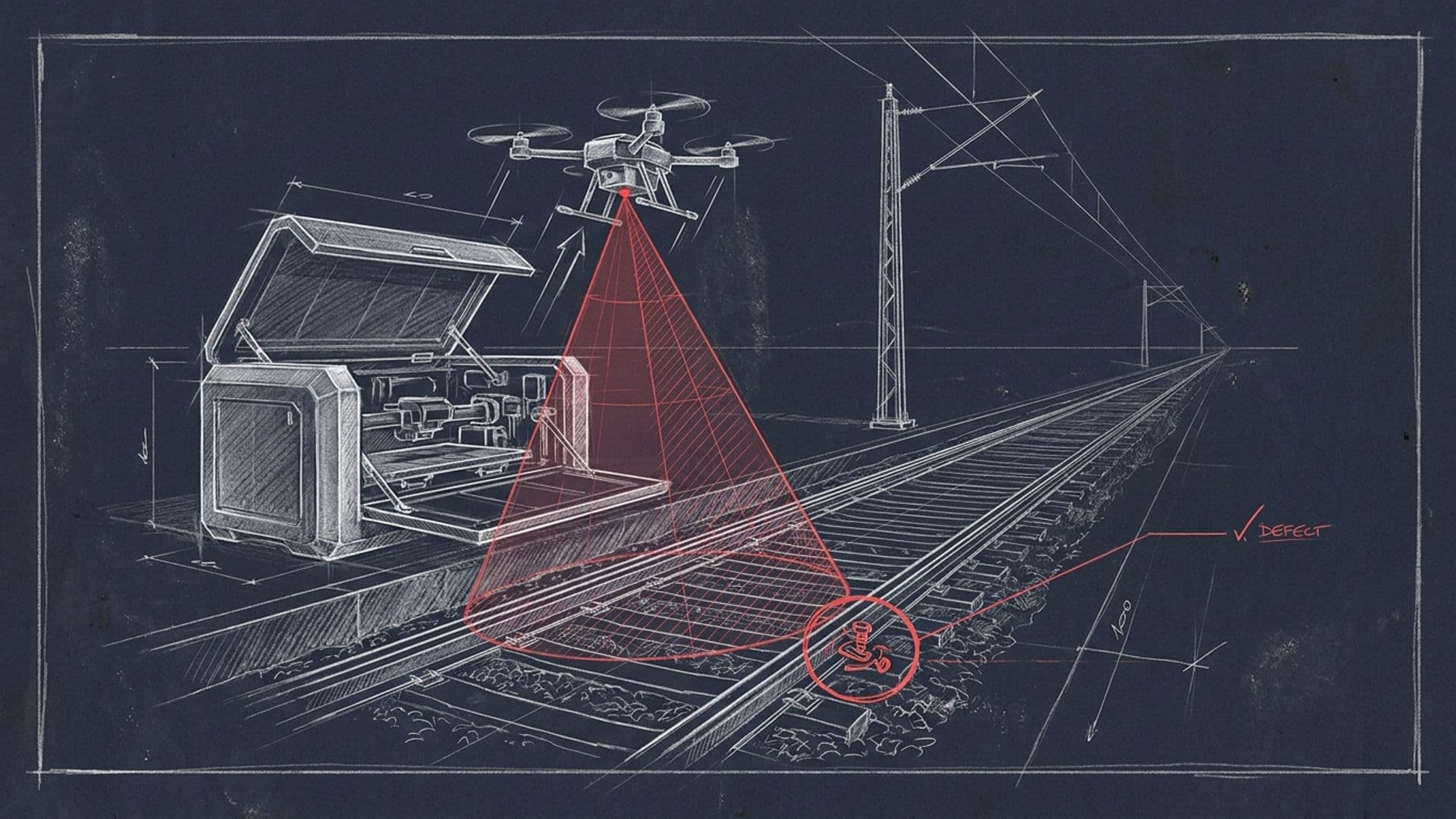
A drone-in-a-box system is, at its core, three integrated pieces: an autonomous drone, a ground docking station ("the hub") that houses and services it, and a software layer that turns flights into analyzed data. Dronehub's design approach centers each of these on the linear-inspection problem, and the fit is structural rather than incidental.
The first reason is autonomy without an operator in the loop. Dronehub's stated design principle is that the system runs a pre-programmed mission without a pilot directing it — "our system does not need an operator to carry out the mission," as the company has framed its autonomy proposition. For a fixed corridor like a rail line, where the route is known and stable, a pre-programmed traversal is a natural fit. The mission repeats; the value is in repeating it reliably and often, which is exactly what removing the human pilot from each sortie enables.
The second reason is the dwell problem, and it is the one most drone deployments underestimate. A drone can fly itself until it needs to land and recharge — and then it needs a human and a long wait. Dronehub's central piece of infrastructure IP attacks this directly: a docking station with automatic battery replacement, so the aircraft can return, be serviced, and re-launch without a person on site. The point is not a number on a spec sheet; the point is the operating posture it unlocks — a system that can hold a corridor under near-continuous watch rather than flying occasional, manually-tended sorties. For an asset that must be checked frequently, that posture is the entire proposition.
The third reason is the linear-infrastructure design lineage. Dronehub's mobile docking station — developed under a Polish National Centre for Research and Development (NCBR) program — was built around an explicitly linear set of targets: pipelines, railways, and power lines. The design intent of a hub that can service a drone along a corridor, rather than only from one fixed point, is matched to assets that extend for distance. Rail is named in that lineage, not retrofitted onto it.
The fourth reason is that inspection is a data problem, and AI is how the data becomes decisions. Flying the corridor is the easy half. The hard half is turning imagery into a prioritized list of "here is what changed, here is what needs attention." That is the role of the analytics layer, and it is where the approach earns its keep — by replacing a schedule with evidence.
The analytics layer: from imagery to anomalies
Dronehub's software platform is Dronehub Unmanned Analytics (DUA), delivered through the Dronehub AI Cloud. By the company's own account, software grew to roughly 80% of its business — the center of gravity is in the analysis, not the airframe. The framing matters because it determines what "AI rail inspection" actually means: not a smarter drone, but a pipeline that converts repeated aerial passes into actionable anomaly detection.
The design approach here is anomaly detection — surfacing what deviates from an expected baseline along the corridor — rather than a claim of fully cataloged, exhaustively classified defect detection at fixed accuracy. That distinction is deliberate, and honest about how these systems mature. An anomaly-detection posture flags change and prioritizes human attention; it is a force multiplier for inspectors, not a replacement for the safety case. Dronehub's broader positioning has described drones as tools that "collect data, which are later processed and transformed into reports on the basis of which key decisions are made." Rail inspection is that pattern applied to a corridor: fly, ingest, compare against baseline, surface the anomalies, route them to the people who decide.
One architectural choice is worth naming because it shapes integration: Dronehub has described its analytics as designed to be drone-agnostic — able to ingest data from third-party drones, not only its own airframes. For a rail operator, that is the difference between a closed appliance and a platform. An operator that already flies some assets, or that runs mixed fleets across regions, can in principle feed existing sensor data into the same analysis layer rather than rebuilding from scratch. The platform's value compounds with the data it sees, regardless of which aircraft captured it.
The AI lineage is partnership-built. In April 2021 Dronehub entered a partnership with IBM to develop AI for autonomous drone inspection, with railways named among the target verticals from the outset. That is the documented foundation of the analytics direction — co-development with a major compute and AI partner — and it is the honest provenance of the stack, distinct from any specific in-field performance claim.
Data, throughput, and integration — the considerations that decide usability
The difference between a demo and an operable system is almost never the flight. It is everything around the data. A few considerations decide whether autonomous AI rail inspection is usable at the scale a network demands — and they are worth stating qualitatively, without inventing numbers that the public record does not support.
Throughput versus corridor length. Coverage on linear infrastructure scales with how much corridor a system can traverse per unit of uptime. The architectural lever is dwell — keeping aircraft serviced and re-launching without manual intervention so the system spends its time inspecting rather than waiting. This is why the automatic-battery-replacement hub is the load-bearing piece of IP for rail specifically: corridor coverage is gated by uptime, and uptime is gated by how the aircraft is serviced between passes.
Data volume and where inference runs. High-resolution aerial inspection generates large volumes of imagery, and moving all of it raw, in real time, off a remote corridor is a connectivity problem before it is an AI problem. The general architectural pattern is to do meaningful processing close to where data is captured and reserve the network for what matters — results, anomalies, and the imagery that supports them — rather than streaming everything. The precise division of labor between on-site and cloud processing is an engineering decision per deployment; the principle is that connectivity is a design constraint, not an afterthought.
Baseline and change detection. Anomaly detection is only as good as the baseline it compares against. A usable system needs a consistent, georeferenced record of "normal" for each segment so that repeated passes can be differenced against it. Building and maintaining that baseline — keeping it current as the asset legitimately changes — is as much of the engineering as the detection model itself.
Integration with how the railway actually works. Detected anomalies have to land in the operator's world: their asset register, their maintenance-management system, their planning and possession scheduling. An inspection platform that produces a separate, parallel stream of findings creates work rather than removing it. The integration surface — how findings are exported, prioritized, and reconciled with existing records — is where adoption succeeds or stalls.
Operating in a live, regulated railway environment. Flying autonomously along an active rail corridor is a regulated activity, conducted near traffic, electrified systems, and people. Beyond-visual-line-of-sight operation, airspace coordination, and safety assurance are prerequisites, not features. Dronehub's R&D heritage is relevant here precisely because the company's autonomy and BVLOS work was developed inside European regulatory programs rather than around them — but no general primer should imply that clearance in one jurisdiction transfers automatically to another. It does not.
Where Dronehub fits: IP and partnership, not a finished product
This is the part that must be stated plainly, because it is the part most easily overclaimed. Dronehub sells its drone-in-a-box — dock, drone, battery swap and AI stack — outright, but it does not sell a turn-key inspection service, and does not offer the AI rail-inspection system described above as a finished, in-production product you can buy off a shelf. What Dronehub offers is upstream of that.
The company licenses autonomous drone infrastructure IP — the blueprints and know-how for stationary and mobile charging and docking stations, drone-in-a-box systems, and the supporting designs — to operators and integrators who build the actual operations. It partners on R&D with governments, agencies, and consortia to co-develop autonomy infrastructure for specific missions. And it manufactures the hardware in Europe, with a non-adversarial supply chain, for partners that need sensitive production kept out of adversarial jurisdictions. Dronehub is US-owned and positioned as SBIR/STTR-eligible on the US side, with EU manufacturing depth behind it.
Applied to rail, that model reads as follows. A rail operator or its systems integrator does not buy "Dronehub rail inspection." It licenses the docking-and-autonomy IP that makes corridor coverage viable, integrates the DUA analytics layer (drone-agnostic by design) into its own data environment, and — where appropriate — co-develops the rail-specific pieces with Dronehub as an R&D partner rather than a vendor. The IP and the analytics platform are the foundation; the operational system is something the operator and its partners build on top. Dronehub's relevant patent-pending IP and its funded R&D track record are the assets on offer. A fielded, validated, nationwide rail-inspection product is not — and the company does not claim one.
The Deutsche Bahn engagement — framed correctly
There is one real, named rail reference, and it should be read precisely. In January 2024 Dronehub announced an engagement with Deutsche Bahn — Europe's largest rail operator, initially referenced anonymously as "the largest European railway" — for AI-powered anomaly detection for track monitoring. The figure attached to it in the public record is up to $500M in potential annual savings.
Read that for exactly what it says and no more. It is an announced engagement and a modelled potential — a program with a commercial thesis, not a validated outcome. "Potential annual savings" is a projection of what AI-driven anomaly detection could be worth at the scale of a large national railway; it is not a reported result, not a measured saving, and not evidence that the system has been proven across a network. The engagement is significant because it puts Dronehub's software-first anomaly-detection direction in front of one of the most demanding rail operators in the world, and because it anchors the "AI is the product, not the airframe" thesis with a named counterparty. It is not significant as proof of national-scale deployment, and nothing here should be read as such a claim.
That restraint is the point of this entire piece. The case for autonomous AI rail inspection is strong on its structural merits — the coverage-and-cadence mismatch is real, the linear-asset fit is real, and the analytics-first architecture is the right shape for the problem. Dronehub's contribution is the infrastructure IP and the analytics platform that make such systems buildable, plus a funded R&D record and the one announced engagement that signals serious counterparties take the approach seriously. Everything beyond that — the specific accuracies, the network-scale results, the fielded performance — is work to be done, by operators and integrators building on the foundation, and it should be earned in deployment rather than asserted in marketing.
The rail-inspection capability in context: the rail industry page, the Deutsche Bahn programme, and the IP-licensing path for operators who want to build on the architecture. To discuss a deployment, open the contact form.
FAQ
- ### What is autonomous AI rail inspection?
- Autonomous AI rail inspection is the use of self-flying drones, serviced by automated ground docking stations, to repeatedly survey rail corridors, combined with an AI analytics layer that turns the captured imagery into prioritized anomaly findings. The drone flies a pre-programmed route along the track without a pilot in the loop; the analytics layer compares each pass against a baseline and surfaces what has changed. The aim is to replace fixed-schedule manual inspection with more frequent, evidence-driven coverage.
- Does Dronehub sell a finished rail-inspection product?
- No. Dronehub sells its drone-in-a-box outright and licenses the technology behind it to other drone companies; it also partners on R&D and manufactures hardware in Europe. It does not sell a turn-key inspection service or an off-the-shelf rail-inspection product. A rail operator or integrator licenses the docking-and-autonomy IP and integrates Dronehub's analytics platform, then builds the operational system on that foundation — with Dronehub as an IP licensor and R&D partner rather than a rail-inspection product vendor.
- What is the Deutsche Bahn engagement?
- In January 2024 Dronehub announced an engagement with Deutsche Bahn — Europe's largest rail operator, initially referenced anonymously as "the largest European railway" — for AI-powered anomaly detection for track monitoring. The public record attaches a figure of up to $500M in potential annual savings. It is an announced engagement with a modelled commercial potential, not a validated national-scale deployment or a reported financial result.
- Is the $500M figure a proven saving?
- No. The $500M is described as *potential* annual savings — a projection of what AI-driven anomaly detection could be worth at the scale of a large national railway. It is not a measured outcome, not a reported saving, and not evidence that any system has been proven across a network. It should be read as the commercial thesis behind the engagement, not as a result.
- Why use a drone-in-a-box for rail rather than periodic surveys?
- A rail network is linear infrastructure that must be checked frequently, in all weather, alongside live traffic. Periodic manual surveys are slow, labor-intensive, and hazardous, and they inspect on a schedule rather than on need. A drone-in-a-box with automatic battery replacement can hold a corridor under near-continuous, repeatable coverage without a pilot or ground crew per flight, which is the operating posture frequent inspection actually requires.
- What is Dronehub Unmanned Analytics (DUA)?
- DUA (Dronehub Unmanned Analytics), delivered via the Dronehub AI Cloud, is Dronehub's software platform — the layer that turns aerial passes into analyzed anomaly findings. By the company's own account, software grew to roughly 80% of its business. DUA is designed to be drone-agnostic, meaning it can ingest data from third-party drones rather than only Dronehub's own aircraft, which matters for operators with existing or mixed fleets.
- What does AI actually detect in this approach?
- The design approach is anomaly detection — surfacing what deviates from an expected baseline along the corridor and prioritizing it for human review — rather than a claim of exhaustively classified defect detection at a fixed accuracy. The intent is to act as a force multiplier for inspectors, flagging change and routing it to the people who make safety and maintenance decisions, not to replace the human safety case.
- What are the hardest parts of making this work at scale?
- The flight is the easy half; the data is the hard half. The decisive considerations are throughput versus corridor length (gated by aircraft uptime and how the drone is serviced between passes), data volume and where inference runs (connectivity is a design constraint), maintaining a consistent georeferenced baseline for change detection, integrating findings into the operator's existing asset and maintenance systems, and operating safely and legally in a live, regulated railway environment under beyond-visual-line-of-sight rules.