Key facts
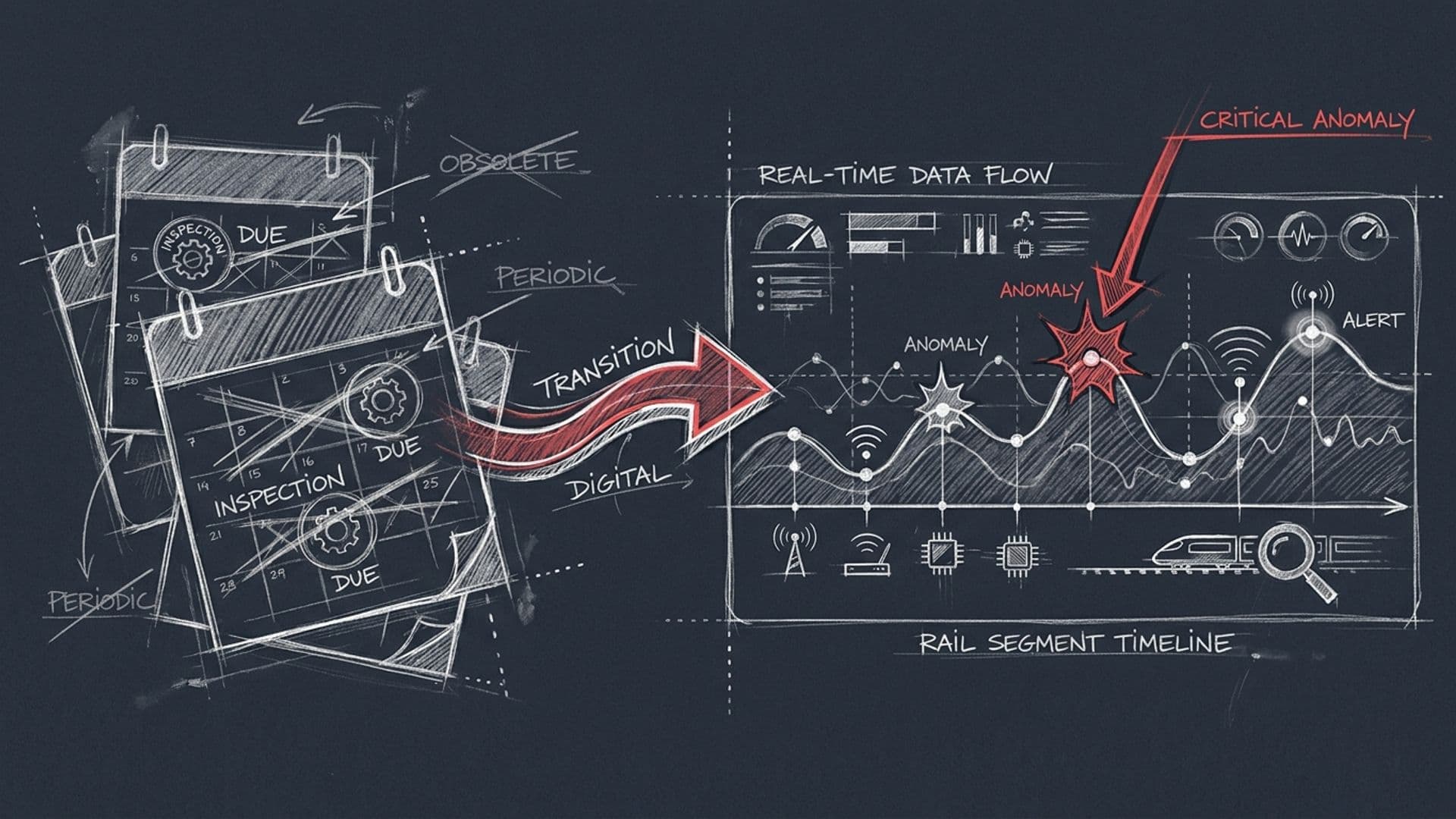
Calendar-based inspection — fixed-cadence track-walking and periodic specialised inspections — has been the dominant rail-inspection model since the era of mass-rail expansion. Most major rail networks still operate primarily on this model in 2026.
Source · Rail-industry inspection model historical analysis
Condition-based inspection — triggered by detected anomaly state rather than by fixed schedule — produces materially better defect-detection outcomes, materially lower personnel-at-altitude exposure, and materially better regulator-audit posture across measured deployments.
Source · Comparative rail-inspection methodology analysis
The structural drivers of the transition are five-fold: skilled-workforce shortage, regulator-cadence tightening, AI-enabled continuous monitoring, insurance-economics shifts, and the catastrophic-event compounding of missed-defect cost.
Source · Rail-industry transformation drivers, 2020–2026
3 more key facts
Deutsche Bahn's 33,000-kilometre national rail network — operating the Sentinel AI inspection deployment — has materially shifted from calendar-based to condition-based inspection across the asset classes the deployment covers. Per-fastener detection accuracy above 95% with sub-15-minute report latency is the enabling capability.
Source · Deutsche Bahn × Dronehub deployment outcomes
Condition-based maintenance has structurally lower total-cost-of-ownership over the asset depreciation horizon than calendar-based equivalent — the savings compound across labour redirection, defect-driven incident avoidance, regulator-compliance reduction in audit overhead, and insurance-premium reduction.
Source · Rail asset-management economic modelling
Regulator alignment is increasingly explicit — national rail safety authorities (DB's Eisenbahn-Bundesamt, France's EPSF, UK's ORR, US FRA) have published guidance that supports condition-based inspection where the underlying monitoring capability is procurement-grade and the audit trail is auditable.
Source · National rail safety regulator guidance documents, 2022–2025
In this piece
Calendar-based rail inspection is the legacy model. Condition-based monitoring is the replacement. The transition is happening in 2026 because the structural drivers finally aligned simultaneously. This post unpacks why, what the operational and economic case actually looks like, and how the Sentinel architecture fits into the operator-level transition.
The post is the strategic companion to the Deutsche Bahn deployment narrative. Where that piece showed what national-scale AI rail inspection delivers, this one explains why operators are actively moving away from the calendar-based model that has dominated rail-inspection methodology since the era of mass-rail expansion.
The legacy model
Calendar-based rail inspection runs on fixed schedules. Major inspections happen every 6-12 months. Detailed asset-class reviews happen every 2-3 years. Specialised inspections (bridges, tunnels, switching infrastructure) run on their own cadences. The schedule is set by regulator-mandated minimums or operator preference; the inspection happens regardless of underlying condition state.
The model has structural properties that explain why it dominated for so long.
Auditability. A regulator can verify that inspections happened on schedule. The audit trail is straightforward — the inspection log shows when each segment was last inspected. Compliance is a matter of executing the schedule, not of demonstrating that the right inspection happened at the right time.
Workforce manageability. The inspection workforce can plan its work around the schedule. Shifts, equipment availability, weather windows — all coordinated against a predictable cadence. The operator can size the inspection workforce against the schedule's labour demands.
Operator simplicity. The maintenance planner knows what to expect each cycle. Asset condition is assumed steady-state between inspections. The complexity of continuous monitoring doesn't intrude on the planning process.
These properties are why the calendar model dominated. They're also why it's becoming untenable.
The structural drivers of the transition
Five compounding drivers, none of which individually forced the transition but which collectively make calendar-based inspection operationally untenable at scale.
Skilled-workforce shortage
Trained track-walking inspectors are flat or shrinking across most national rail networks. Network kilometres are growing — both because new lines are being built and because regulator scope is expanding the asset classes that require inspection. The capacity gap is structural and can't be closed by hiring. Training a competent rope-access or track-walking inspector takes years; commissioning a new section of track takes months. The workforce supply curve and the inspection demand curve are moving in opposite directions.
For an operator with a flat workforce and an expanding network, calendar-based inspection at the cadence the regulator requires becomes mathematically impossible. Either the cadence slips (regulator violation) or some asset classes get under-inspected (safety risk) or some segments get inspected less frequently than spec (regulator violation again). None of the options are acceptable. The structural answer is to change the inspection model.
Regulator-cadence tightening
Safety authorities are extending the asset classes that require inspection without proportionally extending the inspection windows. Each NDT cycle adds new categories — drainage features, ballast-condition reporting, weld-pattern documentation, sleeper-tie rotation tracking — that were not part of previous inspection scope. The cadence stays the same; the work-per-cycle expands.
For an operator running calendar-based inspection, regulator-cadence tightening compounds with the workforce shortage. The inspection-work demand expands faster than the workforce can absorb. The mathematical untenability worsens cycle-by-cycle.
AI-enabled continuous monitoring
The technology exists now at procurement-grade depth. Sentinel at Deutsche Bahn-scale validation, 95%+ per-fastener accuracy, sub-15-minute report latency, sovereign-data-path architecture. Five years ago this was research-grade demonstration; in 2026 it's deployment-grade infrastructure.
The technology's existence is necessary but not sufficient. The operator still has to integrate the monitoring layer with their existing maintenance-planning stack, secure regulator alignment for the new inspection methodology, train the workforce on the new workflow, and accept the cultural shift inside the inspection organisation. These take time. But they're now possible, where five years ago they were not.
Insurance-economics shifts
Insurers increasingly differentiate pricing based on inspection methodology. An operator running condition-based monitoring with procurement-grade audit trail attracts lower premiums than an equivalent operator running calendar-based inspection — for the same coverage scope. The pricing differential reflects the insurers' actuarial assessment that condition-based monitoring produces lower claim frequency and severity.
The premium differential is meaningful — operators that have completed the transition report 5-15% premium reduction on equivalent coverage. Over the asset depreciation horizon, the savings compound.
Catastrophic-event compounding
The cost-of-event for missed defects has risen sharply over the past decade. Two compounding factors: regulator-imposed penalties for in-service incidents have escalated, and the broader risk-management environment around critical-infrastructure incidents has tightened. When a major rail incident traces back to a missed defect that the operator's inspection methodology should have caught, the consequences for the operator are structurally larger in 2026 than they were in 2015.
For calendar-based inspection, the "blind window" between inspections is the period of maximum exposure. Condition-based monitoring eliminates the blind window — defects evolving between scheduled inspections get detected as they develop. The expected cost of missed-defect events compresses.
What the workforce implication actually is
The transition isn't workforce replacement; it's workforce reshape. The total inspector pool may stay roughly constant; the work that pool does changes.
Track-walking declines. The highest-risk, lowest-value-per-hour work in the inspection portfolio — physical track-walking inspection — drops materially. Personnel-at-altitude and personnel-on-active-track exposure compresses.
Anomaly review expands. Senior inspectors shift toward review of flagged anomalies. The AI surfaces detections at scale; the senior inspector's judgement on edge cases becomes the differentiator. This is a higher-value role for senior staff than direct track-walking was.
On-track remediation continues. The maintenance work itself — replacing fasteners, addressing plate damage, executing weld repairs — still requires on-track crews. The drone-driven detection schedules this work; the crews execute it.
Monitoring-system operation emerges. A new category of role — operating the monitoring system, triaging anomalies across the cross-asset portfolio, coordinating between detection and remediation crews — becomes a growth area.
For the operator's HR organisation, the transition reshapes the inspector workforce rather than reducing it. The training curriculum updates; the role specifications change; some legacy roles compress while new roles expand. The total inspection budget may stay constant or grow modestly while the operator's network capacity expands much faster.
Regulator alignment in practice
Regulator alignment for condition-based inspection is becoming explicit across major rail-safety authorities.
Germany — Eisenbahn-Bundesamt (EBA). Published guidance during 2022-2024 explicitly supports condition-based inspection where the monitoring capability is procurement-grade and the audit trail is auditable. The German rail network's Sentinel deployment runs under this guidance.
France — Établissement Public de Sécurité Ferroviaire (EPSF). Similar guidance under the French rail-safety framework, with explicit alignment to AI-driven monitoring capability validation.
United Kingdom — Office of Rail and Road (ORR). Guidance during 2022-2025 supports condition-based methodology with audit-trail requirements equivalent to the German pattern.
United States — Federal Railroad Administration (FRA). Guidance under the Risk-Based Inspection programme and the broader Predictive Maintenance frameworks supports condition-based inspection methodology, with specific requirements for accuracy validation and audit-trail integrity.
The common structural prerequisites across regulators are: documented monitoring methodology, validated accuracy metrics measured per-asset against ground-truth labels, procurement-grade audit trail (every detection logged, every reviewer decision logged, every remediation action traceable), and regulator-accessible reporting. Sentinel satisfies all four by architecture — the per-fastener accuracy validation, the structured audit trail, the EU+US sovereign-data-path that supports regulator audit access.
For an operator pursuing the transition, regulator engagement is part of the project plan. The technical deployment can run in advance of regulator sign-off, with the monitoring data accumulating as evidence for the methodology validation. Once the operator has 12-24 months of structured monitoring data plus the procurement-grade audit trail, regulator approval for condition-based inspection of the covered asset classes typically follows.
The TCO case
Total-cost-of-ownership over the asset depreciation horizon is structurally lower with condition-based maintenance than with calendar-based equivalent. Four savings categories.
Labour redirection. Physical track-walking declines materially. The freed labour redirects to higher-value remediation work and senior-inspector anomaly review. Net labour cost stays roughly constant or declines; effective inspection coverage expands significantly.
Defect-driven incident avoidance. Earlier detection of evolving defects prevents in-service incidents. The avoidance value is the product of incident probability reduction × cost-per-incident-event. Both factors are meaningful at scale — incident probability drops materially because evolving defects no longer have the blind-window time to reach failure, and cost-per-event has risen as the regulator and risk environments have tightened.
Regulator-compliance overhead reduction. The structured monitoring data the AI inspection produces is procurement-grade audit material. Regulator audit cycles run more efficiently; the operator's compliance team spends less time assembling audit materials and more time on substantive engagement with the regulator. The audit-overhead savings are quantifiable in headcount and time.
Insurance-premium reduction. Premium differential between condition-based and calendar-based methodology attracts 5-15% reduction on equivalent coverage. The differential compounds over the asset-and-network depreciation horizon.
Combined savings typically run 15-30% TCO over the asset depreciation horizon for operators that have completed the transition. The deployment investment that produces the savings is meaningful but bounded; the savings are durable across the multi-decade asset lifetime.
What the transition timeline looks like
For a rail operator beginning the transition in 2026:
Year 1. Initial pilot deployment on a defined network segment with focused asset classes. Baseline data collection. Sentinel training-data accumulation against the operator's specific network conditions and asset profile. Workforce-pilot training. Regulator-engagement work begins.
Year 2. Deployment scope expansion to additional asset classes and broader network coverage. Workflow integration with the operator's existing maintenance-planning stack (CMMS, regulator-reporting tools, asset-management systems). First-cycle regulator audit on the deployed asset classes.
Years 3-4. Condition-based maintenance becomes the primary inspection model for the deployed asset classes. Calendar-based inspection retreats to a supplemental role for the asset classes not yet covered. Workforce reshape progresses substantially. Insurance-premium adjustments take effect.
Years 5+. Full transition for most asset classes. Calendar inspection retained only for specialised cases — bridge structures with specific engineering audits, tunnels with regulatory-mandated specialised cadences, asset types where condition-based monitoring isn't yet procurement-grade.
Deutsche Bahn is in approximately year 3 of this trajectory at national scale. Other major European operators are typically earlier in the curve. US Class I freight operators are beginning the transition. State-level passenger rail operators in the US are at the planning stage.
What this means for new rail operators
For European rail operators (SNCF, ÖBB, SBB, Trenitalia, Polish PKP, UK Network Rail, Spanish Adif) — the transition pathway is documented. Deutsche Bahn is the operational reference; the technology is procurement-ready; the regulator alignment is in place. The investment is meaningful but the trajectory is well-trodden.
For US Class I freight operators (BNSF, Union Pacific, Norfolk Southern, CSX, Canadian National, Canadian Pacific Kansas City) — condition-based methodology aligns with FRA's Risk-Based Inspection programme and the broader Predictive Maintenance frameworks. The capital availability is high (Class I operators have margin and depreciation budget to fund the transition); the technology fits the corridor-scale operational pattern.
For passenger-rail operators (Amtrak, regional passenger services, US commuter rail) — the case is similar but the procurement frame routes through different funding (FRA grants, FTA grants where applicable, state-level infrastructure budgets). The technology is the same; the procurement pathway is jurisdiction-specific.
The Sentinel architecture deep-dive is at /blog/halo-cloud-architecture-deep-dive. The per-fastener defect detection deep-dive is at /blog/per-fastener-defect-detection-95-percent. The Deutsche Bahn deployment context is at /projects/deutsche-bahn. The full rail-industry context is at /industries/rail. For a deployment conversation, open the contact form.
FAQ
- What's the operational difference between calendar and condition-based inspection?
- Calendar-based inspection runs on fixed schedules — every 6 months for major inspections, every 2 years for detailed asset-class reviews, periodic specialised inspections per asset type. The schedule is set by regulator-mandated minimums or operator preference; the inspection happens regardless of underlying condition state. Condition-based inspection runs continuously (or near-continuously) via monitoring that detects anomalies in real time; physical inspections are triggered by detected anomalies. The output is the same — defects identified and remediated — but the trigger and the cadence differ. Calendar runs on schedule; condition runs on need.
- Why is the transition happening now, in 2026?
- Five compounding drivers, none of which individually forced the transition but which collectively make calendar-based inspection operationally untenable at scale. (1) Skilled-workforce shortage — trained track-walking inspectors are flat or shrinking while network kilometres are growing. The capacity gap can't be closed by hiring. (2) Regulator-cadence tightening — safety authorities are extending the asset classes that require inspection without proportionally extending the inspection windows. (3) AI-enabled continuous monitoring — the technology exists now at procurement-grade depth (Deutsche Bahn-scale validation, 95%+ accuracy) where it didn't 5 years ago. (4) Insurance-economics shifts — insurers increasingly price condition-based vs calendar-based inspection differently, with condition-based attracting lower premiums for equivalent coverage. (5) Catastrophic-event compounding — the cost-of-event for missed defects has risen sharply in the past decade, making the calendar-based model's blind windows more expensive in expected cost.
- What's the workforce implication?
- Not workforce replacement — workforce reshape. Track-walking inspection is the highest-risk, lowest-value-per-hour work in the inspection portfolio. Senior inspectors shift from direct track-walking to review of flagged anomalies (where their judgement is the differentiator) and to the on-track remediation work that the drone-driven detection schedules for them. Junior inspector roles shift toward the monitoring-system operation, anomaly triage, and the cross-asset coordination that condition-based maintenance requires. The net effect is workforce-as-leverage rather than workforce-replacement — the same inspector pool covers a network they could not previously cover at the cadence the regulator now requires.
- What does the regulator-alignment look like?
- Regulator alignment is becoming explicit. Germany's Eisenbahn-Bundesamt (EBA), France's EPSF, the UK's Office of Rail and Road (ORR), and the US Federal Railroad Administration (FRA) have all published guidance during 2022-2025 that supports condition-based inspection where the underlying monitoring capability is procurement-grade and the audit trail is auditable. The structural prerequisites are: documented monitoring methodology, validated accuracy metrics (per-asset, against ground-truth labels), procurement-grade audit trail (every detection logged, every reviewer decision logged, every remediation action traceable), and regulator-accessible reporting. Sentinel satisfies all four by architecture.
- What's the cost-comparison story?
- Total-cost-of-ownership over the asset depreciation horizon is structurally lower with condition-based maintenance than with calendar-based equivalent. Four savings categories. (1) Labour redirection — physical track-walking, the highest-cost-per-hour inspection activity, drops materially. The freed labour redirects to higher-value remediation and senior-inspector review. (2) Defect-driven incident avoidance — earlier detection of evolving defects prevents in-service incidents that would have triggered service disruption, regulatory action, and insurance claims. (3) Regulator-compliance overhead reduction — the structured monitoring data the AI inspection produces is procurement-grade audit material; regulator audit cycles run more efficiently. (4) Insurance-premium reduction — insurers increasingly differentiate pricing based on inspection methodology, with condition-based attracting lower premiums. Combined savings typically run 15-30% TCO over the asset depreciation horizon for operators that have completed the transition.
- What does the transition timeline actually look like?
- Multi-year. Year 1: initial pilot deployment on a defined network segment with focused asset classes, baseline data collection, model training-data accumulation. Year 2: deployment scope expansion, workflow integration with operator's existing maintenance-planning stack, regulator-alignment work. Years 3-4: condition-based maintenance becomes the primary inspection model for the deployed asset classes; calendar-based inspection moves to a supplemental role for the asset classes not yet covered. Years 5+: full transition for most asset classes, with calendar inspection retained only for the specialised cases (bridge structures, tunnels with specific geological context, specialised regulatory-mandated cadences). Deutsche Bahn is in approximately year 3 of this trajectory at network scale; other operators are typically earlier in the curve.