Key facts
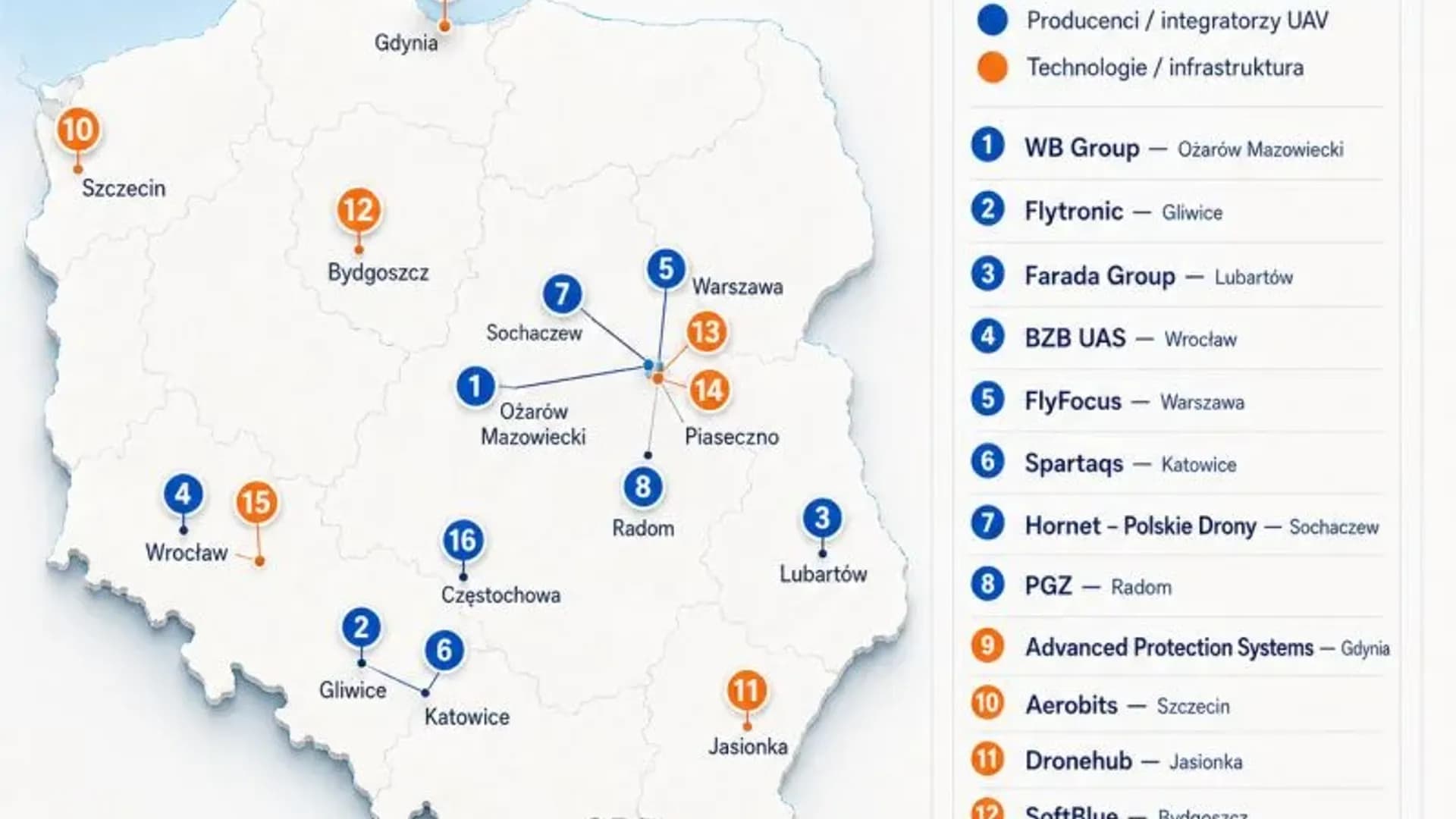
On a 2026 map of Poland's drone companies (Polskie firmy dronowe), Dronehub is categorised under technology and infrastructure — not among UAV manufacturers.
Source · Polskie firmy dronowe map, 2026
Dronehub's engineering and manufacturing are based in Jasionka, within Poland's Aviation Valley aerospace cluster.
Source · Dronehub company profile
Dronehub sells its drone-in-a-box outright and licenses the technology behind it to other drone companies; its focus is autonomous drone infrastructure — charging and docking stations, battery-swap systems, drone-in-a-box hardware, and AI analytics — rather than standalone aircraft.
Source · Dronehub positioning
In this piece
Poland has quietly become one of Europe's densest drone ecosystems. A recently circulated map of the country's drone companies — Polskie firmy dronowe ("Polish drone companies") — puts the picture in a single frame: by some counts the sector now spans more than a hundred firms, from early-stage startups to defense primes such as WB Group. The map plots only a selection; the full list would not fit on one page. Its author notes that Warsaw, in particular, is turning into a genuine "drone valley."
What makes the map worth a second look is not the geography. It is the legend.
Two categories, not one
The companies are sorted into two groups:
- UAV manufacturers and integrators — the firms that design and build the aircraft.
- Technology and infrastructure — the firms building the systems the aircraft depend on: sensing, autonomy, ground infrastructure, and analytics.
Most public conversation about drones lives in the first column. Aircraft are visible, photogenic, and easy to count. But anyone who has tried to operate drones at scale knows the hard problems sit in the second column — and that is where Dronehub is placed.
Where Dronehub sits — and why it is deliberate
On the map, Dronehub appears under technology and infrastructure, based in Jasionka, inside Poland's Aviation Valley aerospace cluster. That placement is not a quirk of the author's pen. It is exactly how the company is built.
Dronehub sells its drone-in-a-box outright and licenses the technology behind it to other drone companies. What it develops is the autonomous infrastructure that drone operations run on — mobile and stationary charging and docking stations, automatic battery-swap systems, drone-in-a-box hardware, and the AI analytics layer that turns flights into decisions. The aircraft are the visible part of an autonomous operation. The infrastructure is the part that makes "autonomous" true.
Autonomy breaks on the ground
A modern drone can fly a mission on its own. The difficulty starts the moment it has to land, recharge, and re-launch without a person on site. That is where a great many "autonomous" programs quietly fall back on human crews — someone to swap a battery, reset a unit, carry it back to the field.
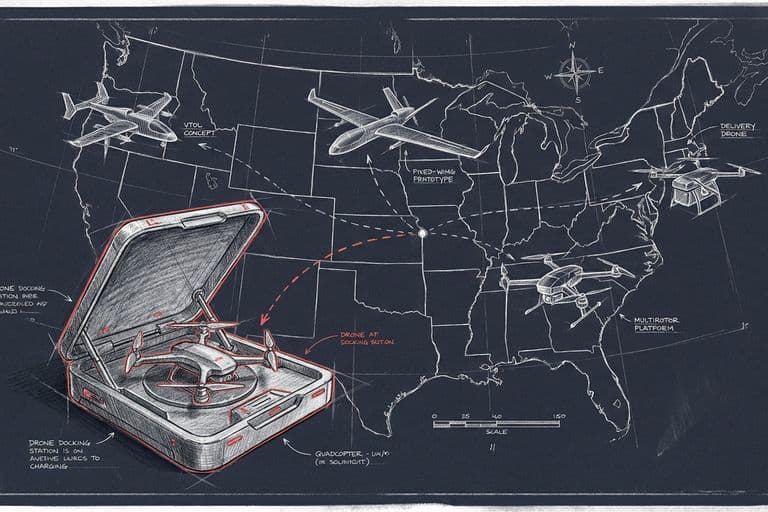
This is the layer Dronehub's IP is built around: a docking station that services and re-launches the aircraft without a human in the loop, so a system can hold a corridor or a site under near-continuous watch rather than flying occasional, hand-tended sorties. It is the unglamorous, load-bearing core of autonomy — and it is precisely the part that does not show up in a photograph of a drone.
Put plainly: in a field crowded with aircraft, the defensible position is the infrastructure the aircraft cannot operate without.
European engineering, US-owned
Dronehub's engineering and manufacturing heritage is rooted in Aviation Valley — the same cluster the map places it in — and in more than six funded R&D programmes with the European Space Agency, the European Defence Agency, EUSPA, and the European Commission. The company itself is US-owned and SBIR/STTR-eligible, built to engage US federal programs while drawing on that European R&D depth, on a non-adversarial supply chain with zero components from China or sanctioned states.
That combination — European engineering depth behind a US entity — is rare, and it is the reason a map of Polish drone companies and a roster of US federal programs can both, accurately, point at the same company.
Why the distinction matters
For an operator, an integrator, or a program office deciding where to place a bet, the column matters. The aircraft market is broad and fast-moving. The infrastructure layer beneath it — charging, docking, autonomy, analytics — is narrower, harder, and more durable. It is where the operations of many different aircraft converge, and where the difference between a demonstration and a fielded capability is actually settled.
A new industry forming is a rare opening: a chance to help define the layer rather than chase it. The map is a snapshot of an ecosystem doing exactly that. Dronehub's contribution to it is not another aircraft — it is the infrastructure the aircraft run on.
Dronehub's place in that layer: license the engineered IP or manufacture in non-adversarial Europe. Get in touch.
FAQ
- ### What is the difference between a drone manufacturer and a drone-infrastructure company?
- A drone manufacturer designs and builds the aircraft. A drone-infrastructure company builds the systems the aircraft depend on to operate autonomously — ground charging and docking stations, automatic battery-swap, autonomy software, and analytics. On the 2026 map of Polish drone companies, these are shown as two separate categories; Dronehub is in the infrastructure category.
- Does Dronehub manufacture drones?
- Not as a UAV manufacturer. Dronehub sells its drone-in-a-box outright and licenses the technology behind it to other drone companies; what it develops is autonomous drone *infrastructure* — charging and docking stations, drone-in-a-box hardware, battery-swap systems, and AI analytics — rather than standalone aircraft. That is why it is mapped under technology and infrastructure rather than among UAV manufacturers.
- Where is Dronehub based?
- Dronehub's engineering and manufacturing are rooted in Jasionka, within Poland's Aviation Valley aerospace cluster. The company is US-owned and SBIR/STTR-eligible, combining European R&D depth with a US entity for federal engagement.
- Why does autonomy "break" without ground infrastructure?
- A drone can fly a pre-programmed mission on its own, but it still has to land, recharge, and re-launch. Without automated ground infrastructure to service and relaunch it, that step requires people — which is where many autonomous programs stop being autonomous. The ground layer is what allows near-continuous, hands-off operation.