Key facts
The US AI drone market is projected to grow from $4.13 billion in 2025 to $12.64 billion by 2033 — a 14.99% compound annual growth rate.
Source · Research and Markets — United States AI Drone Market Outlook 2026, syndicated via Yahoo Finance, March 2026
The Research and Markets 2026 report names nine companies as key players in the US AI drone market: DroneShield, Skycatch, Applied Aeronautics, AeroVironment, Skydio, DJI, Parrot, Delair, and Dronehub. Eight operate at the sensing or platform layer; one (Dronehub) operates at the infrastructure layer.
Source · Research and Markets — United States AI Drone Market Outlook 2026
NDAA Section 848 (2020) and Section 889 (2019) jointly prohibit US federal acquisition and use of unmanned aircraft systems with Chinese components or origin. The provisions have progressively expanded across DoD, DHS, DoJ, DoI, and adjacent federal agencies through 2024-2026.
Source · 10 U.S.C. 4871 note (Section 848 of FY2020 NDAA); 41 U.S.C. § 3901 note (Section 889 of FY2019 NDAA)
3 more key facts
The Blue UAS list, run by the Defense Contract Management Agency (DCMA) since December 2025, is the curated short-list of cleared unmanned aircraft systems for US federal procurement. Inclusion requires demonstrable non-Chinese supply chain across components, electronics, and firmware.
Source · DCMA, Blue UAS Cleared List — https://bluelist.appsplatformportals.us/UAS-Cleared-List/; Defense Innovation Unit, 'DIU's Blue UAS List To Transition to DCMA', 3 December 2025 diu.mil ↗
Dronehub holds a non-Chinese supply chain by design — zero components from China or sanctioned states — and is the only company in the Research and Markets 2026 list operating at the autonomous-infrastructure layer rather than at the drone-hardware or platform-software layer.
Source · Dronehub company architecture, 2026
Federal innovation funding pipelines for drone-related dual-use technology in 2026 include SBIR/STTR across all participating DoD components, AFWERX Open Topics, DIU Commercial Solutions Opening (CSO), xTechSearch (Army), SOFWERX (USSOCOM), and the Defense Innovation Unit's Replicator initiative ($1B-plus envelope for attritable autonomous systems).
Source · DoD federal innovation funding pipeline 2026
In this piece
A March 2026 Research and Markets report names nine companies as key players in the US AI drone market. Eight operate at the drone or platform layer. One — Dronehub — operates at the infrastructure layer those drones run on. This post is a positioning analysis of the market layer the report doesn't categorise, and why the federal procurement framework is converging on it.
The headline finding from the Research and Markets analysis — distributed via Yahoo Finance on March 9, 2026 — is that the US AI drone market is on a trajectory from $4.13 billion in 2025 to $12.64 billion in 2033. That's a 14.99% compound annual growth rate over an eight-year horizon, anchored on autonomous-operations expansion, commercial-industrial adoption across construction-agriculture-logistics-energy, and supportive federal-state regulatory frameworks. The report identifies California, New York, Texas, Florida, and Washington as state-level adoption leaders.
That sizing is useful, but the more interesting structural read sits inside the report's company analysis section, where nine companies are named as key players: DroneShield, Skycatch, Applied Aeronautics, AeroVironment, Skydio, DJI, Parrot, Delair, and Dronehub. The list is heterogeneous — it includes Chinese-origin hardware vendors, NATO-allied hardware vendors, US autonomous-platform companies, EU enterprise-mapping specialists, an Australian counter-UAS leader, and a Polish-American autonomous-infrastructure company. The heterogeneity is itself the signal: the analyst is collapsing multiple structural layers of the autonomous-drone stack into a single "key players" enumeration.
This post takes the analyst's nine-company list and re-categorises it by structural layer. The argument: the infrastructure layer Dronehub operates at is invisible in standard industry-analyst categorisation, and that invisibility is itself a positioning advantage for the company operating exclusively in that layer.
The market reading: $4.13B to $12.64B by 2033
The Research and Markets thesis is unsurprising in its broad strokes: autonomous-operations deployment is moving from pilot-scale to procurement-grade across multiple verticals simultaneously, and the supporting capital flows — federal innovation, defense procurement, critical-infrastructure operator capital, and dual-use venture capital — are aligned to fund that expansion. The 14.99% CAGR assumption sits in the middle of analyst consensus; aggressive forecasters project closer to 18-22% CAGR through 2033, conservative forecasters around 11-13%. The mid-15% figure assumes neither a procurement-cycle compression event nor a structural reversal of the autonomous-operations adoption curve.
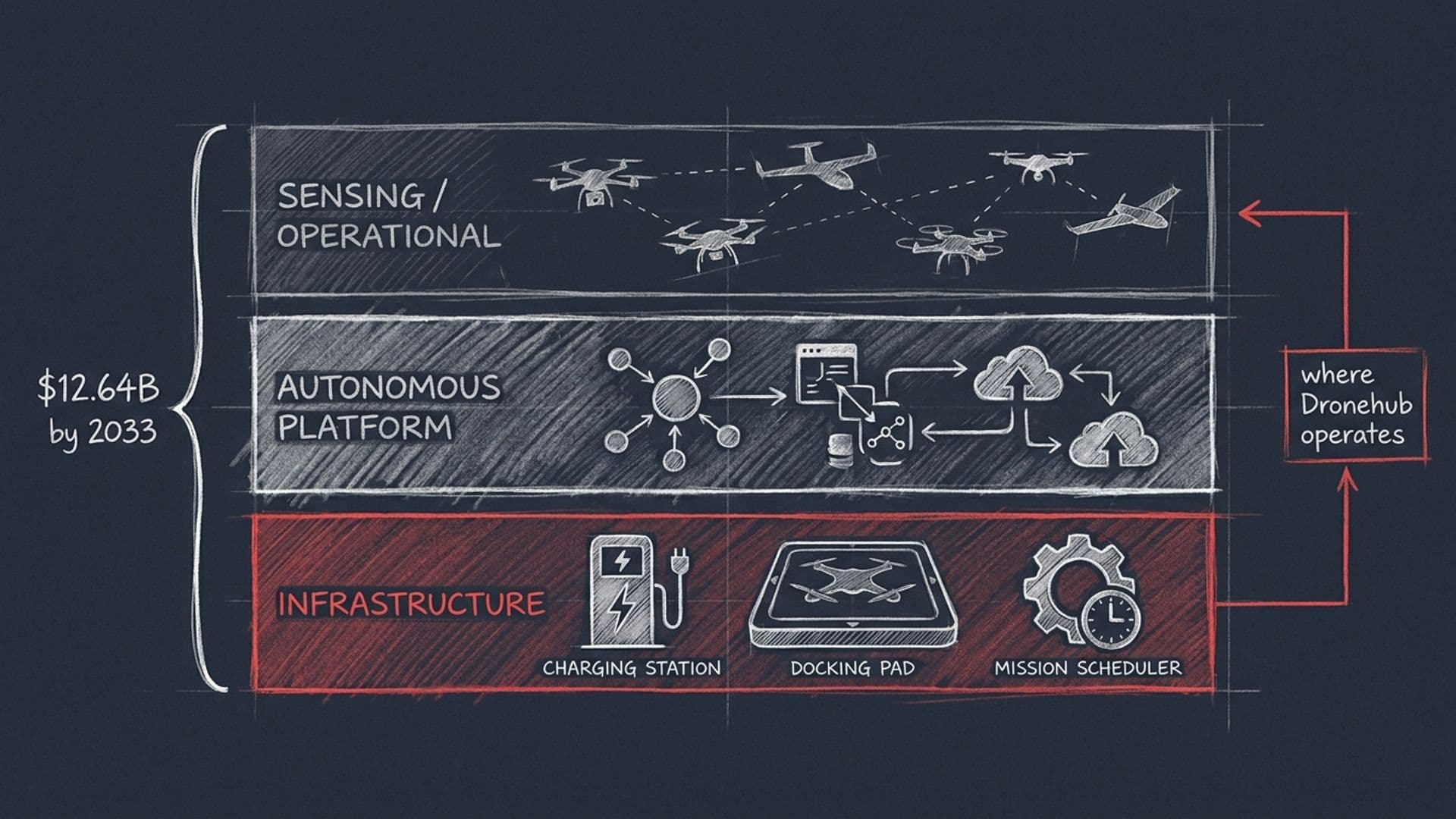
What the headline number captures is the sensing-and-platform layer — drone hardware sales, autonomous-platform software subscriptions, mission-management tooling, and aggregate adjacent revenue across the sensing-side ecosystem. What the headline number does not capture is the infrastructure layer that any persistent autonomous-operation deployment requires underneath the sensing layer: the charging stations the drone returns to between missions, the docking systems that enable beyond-visual-line-of-sight unattended operation, the mission-scheduling architecture that turns a fleet into a continuously-operating capability rather than a piloted asset.
That layer is structurally adjacent to the drone-market sizing — it grows with autonomous-operation deployment density rather than with drone-unit shipments — and conservative estimates put its US total addressable market at 15-25% of the headline drone-market figure by 2033. In dollar terms: $1.9-3.2 billion in US infrastructure-layer revenue alone, with comparable scale across NATO and Five Eyes jurisdictions.
The nine named players, categorised by structural layer
Ordered by layer, the foundation first — the infrastructure layer the rest run on:
Company | Origin | Structural layer | Federal-procurement status |
|---|---|---|---|
Polish-American | Infrastructure (autonomous-operations enabling layer) | Federal-eligible (Delaware C-Corp, non-CN supply chain) | |
China | Sensing / hardware vendor | Prohibited per NDAA Section 848 | |
France | Sensing / hardware vendor (NATO-allied) | Blue UAS listed (ANAFI USA) | |
USA | Sensing / hardware vendor (defense prime) | Direct federal procurement (Switchblade, Puma) | |
USA | Sensing / hardware vendor (long-endurance fixed-wing) | Federal-eligible | |
USA | Autonomous platform (drone + onboard autonomy stack) | Blue UAS listed (X10D) | |
USA | Autonomous platform (mining and construction site mapping) | Commercial-vertical focus | |
France | Autonomous platform (long-range fixed-wing mapping) | NATO-allied, EU-procurement focused | |
Australia | Counter-UAS (detection + mitigation) | US federal procurement |
Eight of the nine companies sell what the operator flies, or the platform that pilots it. One company — Dronehub — sells what the autonomous fleet runs on between flights.
This is not a marketing distinction. It is a structurally different category with different economics, different capital-deployment patterns, and different procurement pathways. Hardware vendors sell capital equipment per drone; autonomous-platform companies sell per-seat or per-fleet software subscriptions; infrastructure-IP licensors collect royalties or licence fees against operators and integrators that deploy the infrastructure pattern. The capital structure follows: hardware vendors raise to build factories, software vendors raise to scale sales motion, infrastructure licensors raise to fund the multi-year R&D programmes that produce the underlying IP.
What "autonomous drone infrastructure IP" actually is
The Dronehub product surface, mapped to the structural layer:
- Charging-station architecture — mobile and stationary charging-pad designs that allow drones to return-to-base, autonomously connect, and resume mission state without operator intervention. This is the foundational enabler for persistent autonomous operation; without it, every drone returns to a human-attended ground station.
- Docking-system IP — protected enclosures with weather isolation, security hardening, and autonomous-launch authority that turn a charging pad into a beyond-VLOS-capable deployment site. The combination of pad + dock + scheduling is what lets a fleet operate continuously across nights, weather windows, and shift changes.
- Mission-scheduling architecture — the orchestration layer that allocates missions across a fleet of drones and a network of charging-docking sites. This is where autonomous operations transition from "drone flies one mission" to "drone fleet covers an area persistently."
- Counter-UAS architecture (AUDROS) — net-capture interceptor IP for installation security, perimeter protection, and federal-installation-defense applications. The counter-UAS adjacent positioning is the natural infrastructure-layer complement to autonomous operations: every persistent-coverage deployment needs an answer to hostile-drone intrusion.
All of this is engineered around a non-Chinese supply chain by design — zero components from China or sanctioned states. The supply-chain architecture is not retrofitted onto a previously-CN sourced product line; it has been the constitutional commitment of the company's component and partner selection from inception.
NDAA Section 848 and Blue UAS: the federal-procurement framework
The structural reason the infrastructure-layer Dronehub category matters for US procurement: the federal regulatory framework has been progressively tightening around supply-chain provenance for autonomous-drone technology since the 2019-2020 NDAA cycle.
NDAA Section 889 (FY2019, codified at 41 U.S.C. § 3901 note) prohibits federal contracting with entities that use covered telecommunications equipment from named Chinese vendors — Huawei, ZTE, Hytera, Hikvision, Dahua. The provision flows down to subcontractors and grant recipients. Drone systems containing components or firmware from these vendors are out.
NDAA Section 848 (FY2020, codified at 10 U.S.C. 4871 note) extended this principle to unmanned aircraft systems specifically: DoD is prohibited from acquiring or using UAS with covered components from foreign covered entities. The definition of "foreign covered entities" reaches beyond named vendors to encompass broader Chinese-supply-chain origin.
NDAA Section 1260H (FY2021) identifies Chinese Military Companies, broadening the structural prohibition surface. The 2024-2026 updates to this list continue the expansion.
The Blue UAS program, built by the Defense Innovation Unit and run by the Defense Contract Management Agency (DCMA) since December 2025, is the operational expression of this framework. The Blue UAS Cleared List is the curated short-list of unmanned aircraft systems with demonstrable non-Chinese supply chain — components, electronics, firmware all verified compliant. The 2026 list includes Skydio X10D, Parrot ANAFI USA, Teal Drones Black Widow, and a small number of other NATO-allied-supply-chain systems. Inclusion is the precondition for routine federal-procurement at the sensing-layer.
What's true of the drone layer is becoming true of the infrastructure layer. Federal program offices procuring autonomous-operations capability are increasingly specifying not just the drone but the supporting infrastructure — and applying the same non-CN supply-chain expectation. The infrastructure layer that pre-2020 was a back-office consideration has, post-2020, become a procurement-gating concern.
This is the structural ground Dronehub operates on. The company architecture — Dronehub Inc. (Delaware C-Corp, SBIR-eligible) + Dronehub Sp. z o.o. (Polish factory) — is structured for the procurement-framework requirements as they exist in 2026 and as they are projected to tighten through 2030. The non-Chinese supply-chain commitment is not a marketing statement; it is the constitutional commitment that lets the company submit against AFWERX Open Topics, DIU Commercial Solutions Openings, and SBIR Phase II R&D awards without the supply-chain remediation overhead that retrofitted vendors face.
What this means for federal program officers
The procurement reality, summarised across three plausible federal program-office scenarios:
Scenario 1 — AFWERX Open Topic, autonomous base defense. A US Air Force base needs persistent autonomous perimeter coverage with counter-UAS authority. The Phase I award funds feasibility; the Phase II R&D contract funds prototyping at an operational base; the Phase III sole-source procurement scales the deployment. The drone vendor (Skydio, Parrot) handles the sensing layer. The counter-UAS vendor (DroneShield) handles the threat-detection-and-mitigation layer. The infrastructure vendor handles charging, docking, mission scheduling, persistent-operation authority. That infrastructure-vendor slot is precisely where Dronehub fits.
Scenario 2 — DIU Commercial Solutions Opening, installation security. A federal installation requires beyond-VLOS unattended drone coverage for perimeter monitoring. The CSO is a faster procurement pathway than full SBIR — typical timeline 90-180 days from AOI publication to contract award. The infrastructure layer (charging, docking, mission scheduling, beyond-VLOS authority) is the bottleneck for converting a sensing-layer drone deployment into a persistent-coverage capability. The CSO contract value scales with the deployment footprint.
Scenario 3 — SOFWERX, SOF mission infrastructure. A SOF unit deploys autonomous drone capability into a forward operating environment with limited human attention and supply chain constraints. The infrastructure-IP licensing model is structurally well-matched: the unit receives the licensed pattern (charging, docking, scheduling, counter-UAS), the manufacturing partnership produces the hardware at sovereign-supply-chain facilities, and the SOF unit operates the resulting capability without dependence on Chinese-supply-chain components anywhere in the stack.
In all three scenarios, the federal program officer is procuring not just a drone but an autonomous-operations capability. The drone is one layer; the infrastructure is another. The procurement framework is converging on the requirement that both layers — sensing and infrastructure — meet the same non-Chinese supply-chain standard. The Research and Markets nine-company list captures the sensing layer comprehensively and the infrastructure layer with one entry.
Where Dronehub bets through 2033
The strategic positioning maps cleanly to the structural reading:
- Federal innovation pipeline first. SBIR Phase I submissions against current open topics, AFWERX Open Topic submissions in the Air Force pipeline, DIU Commercial Solutions Opening responses against published AOIs, xTechSearch challenge submissions for Army opportunities. The pipeline architecture — Phase I feasibility → Phase II R&D → Phase III sole-source procurement → broader DoD-wide adoption — is the standard pathway from federal-innovation engagement to scaled federal procurement. The typical timeline runs 24-36 months from initial Phase I to first Phase III revenue.
- Sovereign EU manufacturing capacity. The Jasionka factory in Poland — fully online in 2025 — is the production backbone for both EU sovereign-supply contracts and US federal-procurement opportunities that flow through NATO-allied manufacturing. The manufacturing partnership model lets defense primes and federal systems integrators access non-Chinese-supply-chain hardware production without operating the factory themselves.
- Counter-UAS IP as the infrastructure-layer complement. The AUDROS counter-UAS programme is the natural sibling of autonomous-operations infrastructure: every persistent-coverage deployment needs an answer to hostile-drone intrusion, and the counter-UAS layer is itself a federal-procurement priority through DIU, SOFWERX, and the broader installation-security pipeline.
- Section 848-compliant supply chain by design. The non-Chinese supply chain is not a marketing tagline; it is the structural commitment that lets the company submit against federal-procurement frameworks without remediation overhead. As Section 848, Section 889, and Section 1260H expand through 2026-2030, the structural compliance advantage compounds.
The Research and Markets report projects a $12.64 billion US AI drone market by 2033. The market that report measures is the sensing-and-platform layer. The infrastructure-layer adjacent market — $1.9-3.2 billion US-only, comparable scale across NATO and Five Eyes — is where Dronehub bets.
Eight companies in the Research and Markets list sell the drone or the platform. One company sells the infrastructure the drones run on. The federal procurement framework is converging on the requirement that both layers meet the same non-Chinese supply-chain standard. The company that built its supply chain for that standard from inception, and that operates exclusively in the infrastructure layer, has a structural positioning that the standard market-analyst categorisation does not yet name — and that absence is itself the positioning.
Where Dronehub operates that infrastructure layer: license the IP for operators and integrators, or engage the US-defense R&D path for federal programmes. Start a conversation.
FAQ
- What's the structural gap in the Research and Markets 2026 US AI drone market report?
- The report categorises nine companies as key players, but does not name the structural layer they operate at. Eight of the nine — DJI, Parrot, AeroVironment, Applied Aeronautics, Skydio, Skycatch, Delair, DroneShield — operate at the sensing or platform layer: they sell the drone, or the autonomous-platform software, or the counter-drone detection-and-mitigation stack. The ninth company, Dronehub, operates at the infrastructure layer — the charging stations, docking systems, mission scheduling, beyond-VLOS authority, and architectural IP that any autonomous drone deployment needs underneath the sensing layer. The report's market-size projection — $4.13B to $12.64B by 2033 — captures the sensing-and-platform layer plus aggregate adjacent revenue. The infrastructure layer is functionally distinct: it is the persistent-operations enabling layer that every operator either builds themselves or licenses. That distinction is invisible in standard industry-analyst categorisation, and that invisibility is itself a positioning advantage for the company operating exclusively in that layer.
- How is 'infrastructure IP licensing' different from selling drones or selling drone software?
- Drone vendors sell the platform — the airframe, the avionics, the autonomy stack on the drone itself. Software vendors sell the mission-management layer that sits above the drone — the operator interface, the data pipeline, the fleet-management tooling. Infrastructure IP licensing sells the persistent-operations layer that sits beneath the drone — the charging stations the drone returns to between missions, the docking systems that enable beyond-visual-line-of-sight unattended operation, the mission scheduling architecture that turns a fleet into a continuously-operating capability rather than a piloted asset. The economic model is fundamentally different: hardware vendors sell capital equipment per drone, software vendors sell per-seat or per-fleet subscriptions, infrastructure-IP licensors collect royalties or licence fees against operators or integrators that deploy the infrastructure pattern. Capital deployment matches: hardware vendors raise to build factories, software vendors raise to scale sales motion, infrastructure licensors raise to fund the multi-year R&D programmes that produce the underlying IP.
- Why does NDAA Section 848 matter for vendor selection in 2026?
- Section 848 of the FY2020 National Defense Authorization Act, codified at 10 U.S.C. 4871 note, prohibits the Department of Defense from acquiring or using covered unmanned aircraft systems — defined broadly to include systems with components, electronics, or firmware originating from covered foreign entities (principally Chinese-supply-chain origin). The provision applies across DoD, has been progressively echoed in DHS, DoJ, DoI procurement frameworks, and is increasingly inherited by federal grant recipients and contractors as a flow-down requirement. The operational effect in 2026: any drone-related procurement-eligible technology must demonstrate non-CN supply chain across components, electronics, and firmware. This is not a marketing preference — it is a procurement gating mechanism that disqualifies non-compliant vendors at the threshold. Companies that built their supply chains for Section 848 from inception have a structural compliance advantage over companies retrofitting non-CN sourcing onto previously-CN-supply-chain product lines. The Blue UAS list, built by the Defense Innovation Unit and run by the Defense Contract Management Agency (DCMA) since December 2025, is the curated public surface of this compliance regime — inclusion requires the demonstrable supply-chain provenance Section 848 demands.
- Who buys autonomous drone infrastructure — and what's the price point?
- Three buyer categories. First, federal program offices and federal innovation pipelines — through SBIR/STTR Phase II awards ($1-2M typical), DIU Commercial Solutions Opening contracts (variable, often $1-10M), AFWERX Open Topic programmes (Phase I $50-150K, Phase II up to $1.7M, Phase III uncapped), and Defense Innovation Unit Replicator-class envelopes (substantially larger). Second, defense primes and federal systems integrators — Anduril, Lockheed, Northrop, RTX on the prime side; Leidos, SAIC, Booz Allen, CACI on the integrator side. These organisations integrate licensed infrastructure IP into their own programme architectures rather than building it in-house. Third, critical-infrastructure operators with regulated procurement frameworks — transmission system operators, rail operators, port authorities, refinery operators — who require sovereign-supply-chain compliance for their own regulatory exposure. Price points vary substantially across these categories: federal programme awards in the high-six to low-eight figures, prime/integrator IP licences in the seven-to-eight-figure range with multi-year structures, critical-infrastructure deployments at programme-grade scale (typically multi-year, multi-site).
- What's the federal procurement pathway for non-CN compliant autonomous infrastructure?
- The standard pathway runs through federal innovation pipelines first, then federal procurement second. Step one: register with SAM.gov, obtain UEI and CAGE code, complete CMMC Level 2 certification (Cybersecurity Maturity Model Certification — Department of Defense-mandatory for handling Controlled Unclassified Information). Step two: engage federal innovation pipelines — SBIR/STTR Phase I proposals against current open topics, AFWERX Open Topic submissions, DIU Commercial Solutions Opening responses against published AOIs (Areas of Interest), xTechSearch challenge submissions for Army opportunities. Step three: convert Phase I awards to Phase II R&D contracts and Phase III sole-source procurement. Step four: parallel to Phase III, engage defense primes and federal systems integrators as a licensed-IP supplier rather than as a direct procurement vendor. Step five: as commercial deployment proof points accumulate, pursue Blue UAS inclusion (for hardware-adjacent components) and broader DoD-wide procurement. The full pathway typically runs 24-36 months from initial federal engagement to first Phase III revenue.
- What does the market layer that infrastructure occupies actually look like across the 2025-2033 trajectory?
- The Research and Markets 2026 forecast captures 14.99% CAGR for the US AI drone market overall — sensing layer plus platform layer plus aggregate adjacent revenue. The infrastructure layer is a structurally adjacent market with distinct sizing characteristics: it grows with autonomous-operation deployment density rather than with drone-unit shipments. Each persistent-operations deployment requires per-site infrastructure (charging, docking, scheduling, beyond-VLOS authority); each fleet expansion requires architectural IP for fleet-scale persistent operations. The infrastructure-layer total addressable market in 2033 is therefore a function of how many autonomous-operation sites are deployed across federal, defense, critical-infrastructure, and commercial verticals — not how many drones ship. Conservative estimates put the autonomous-infrastructure adjacent market at 15-25% of the headline drone-market figure by 2033, which implies $1.9-3.2 billion infrastructure-layer revenue in the US alone, with comparable scale across NATO and Five Eyes jurisdictions. The companies positioned in that layer in 2025-2026 are positioned for the multi-billion-dollar infrastructure-licensing market that emerges as autonomous operations scale through the 2027-2030 deployment cycle.