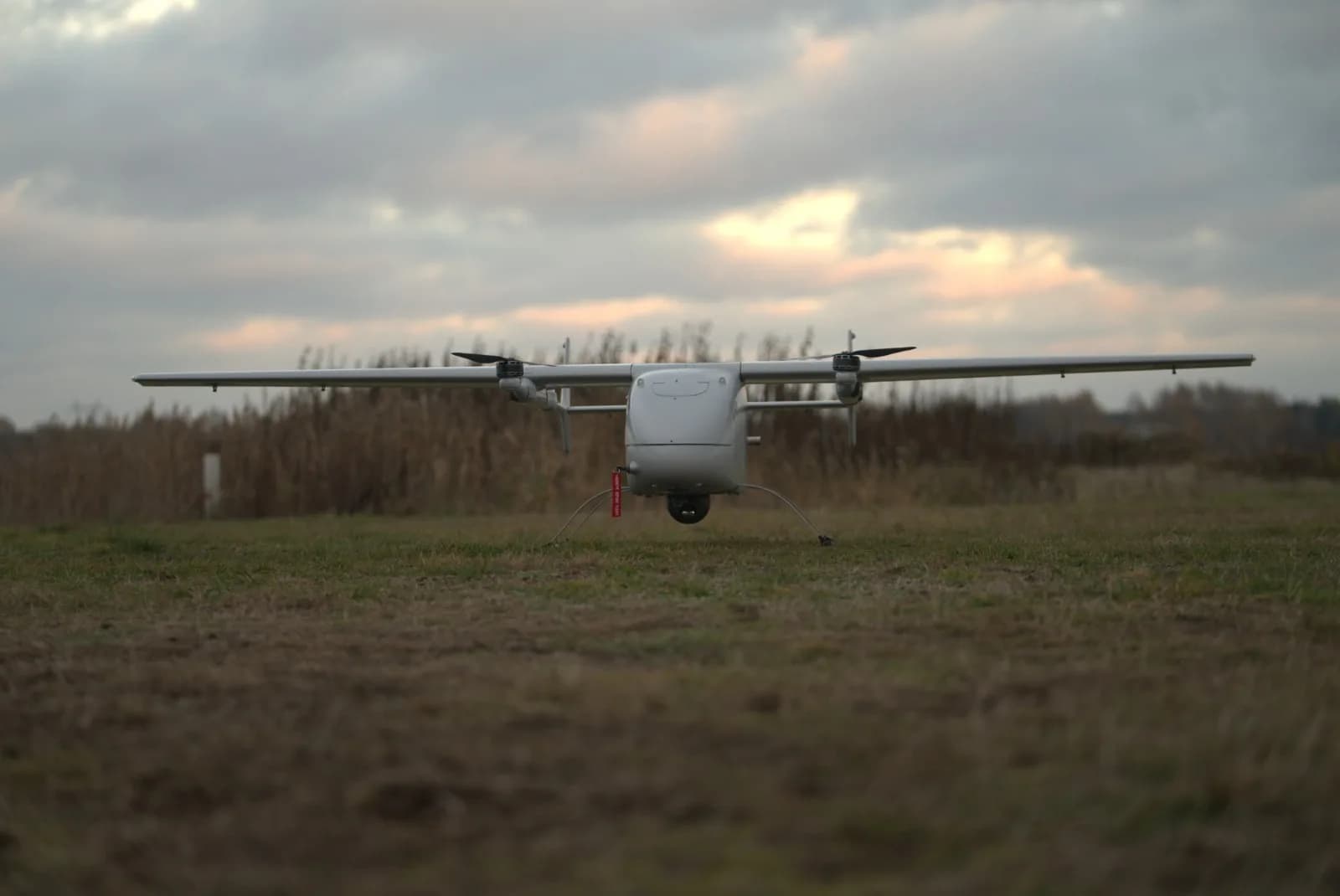
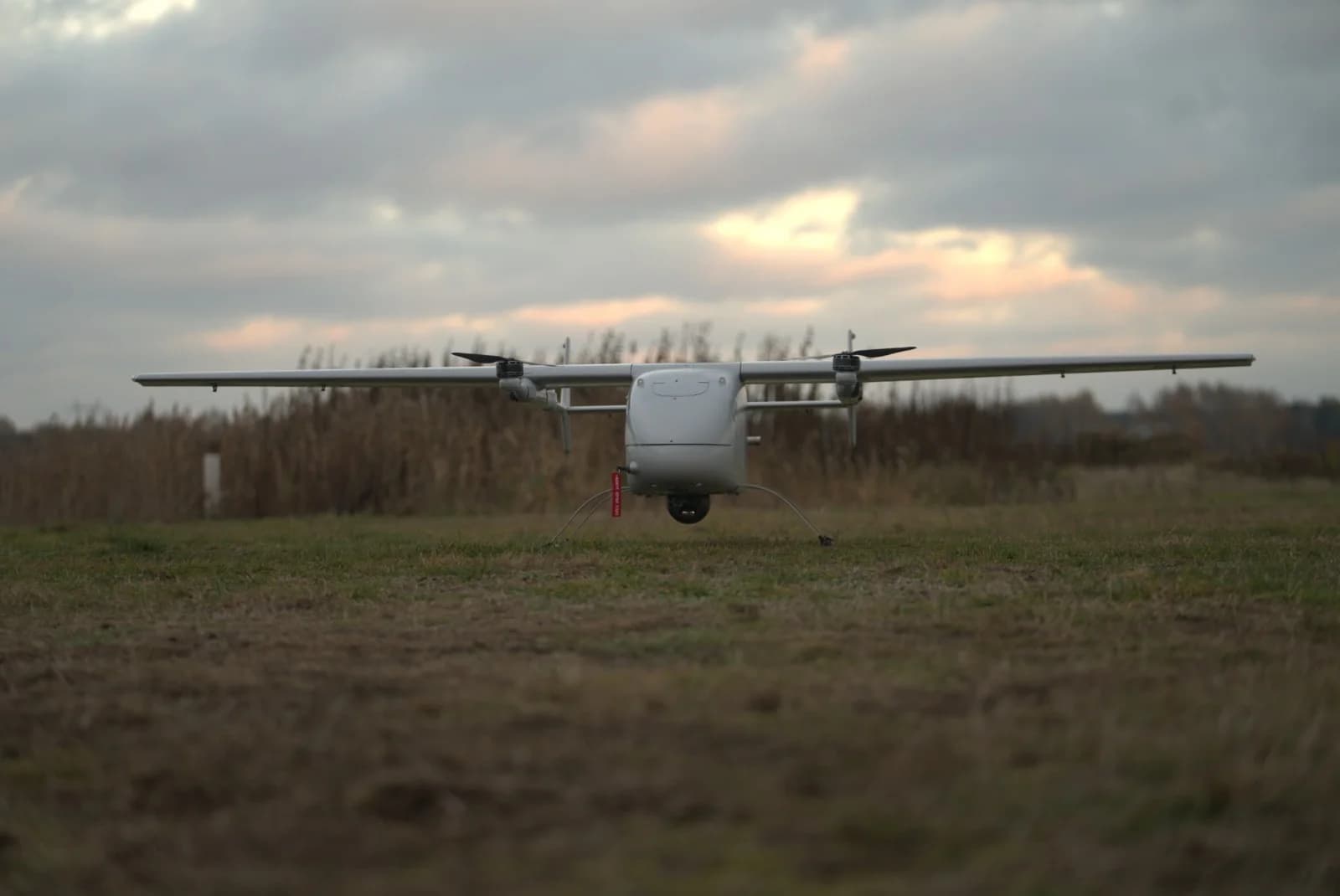
S-2 Combat Drone
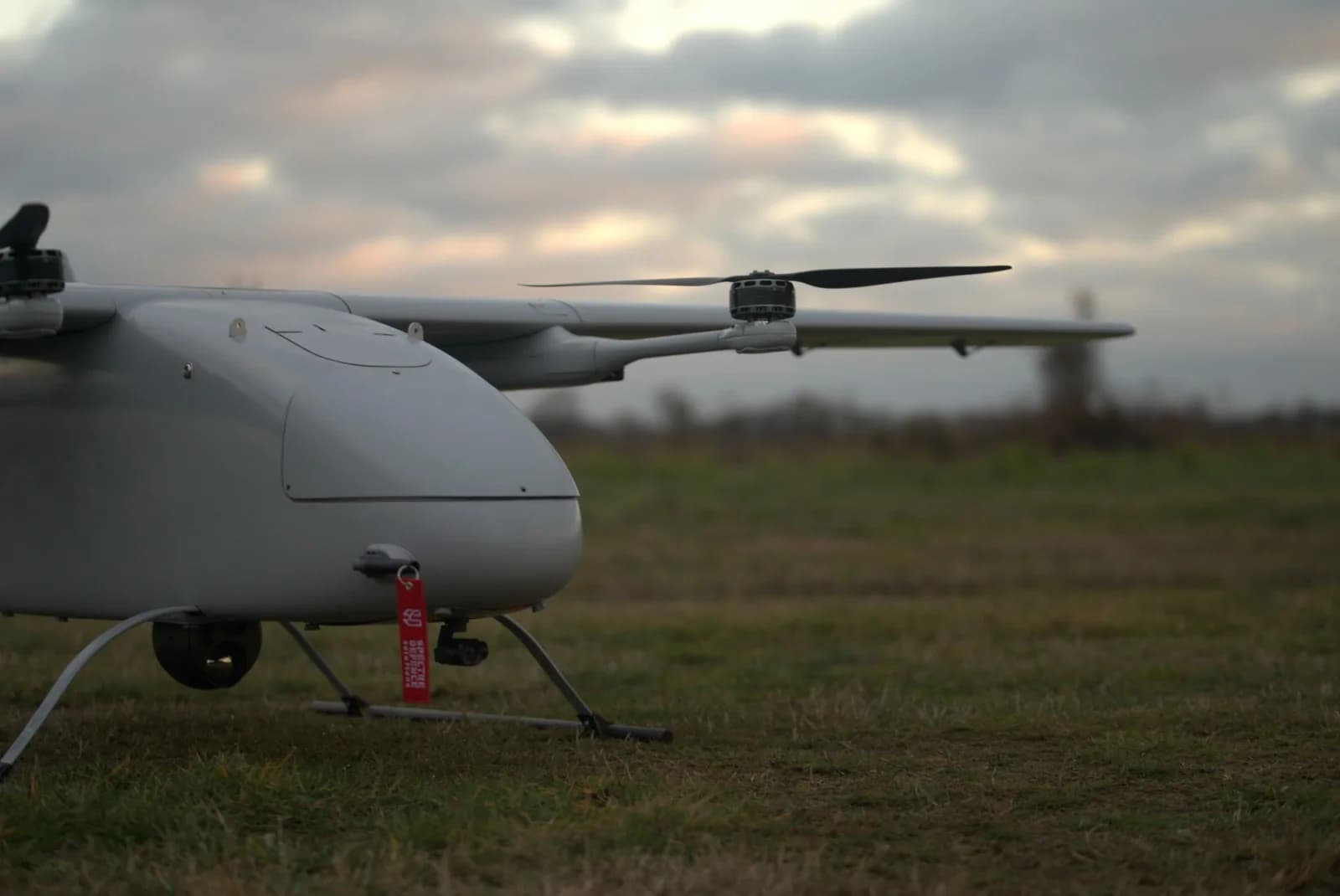
A long-endurance hybrid VTOL fixed-wing UAV for ISR and surveillance. Up to 7 hours of endurance and up to 700 km of range in a 35 kg, man-portable class — fully vertical take-off and landing from a roughly 5 × 5 m patch, airborne in five minutes, with a modular payload bay that carries any sensor to 5 kg. A fielded, in-production platform.
- Type
- Hybrid VTOL fixed-wing
- MTOW
- 35 kg
- Payload
- 6 kg
- Endurance
- Up to 7 hours
- Operational range
- Up to 700 km
- Deployment
- 5 minutes
- Take-off / landing
- Fully vertical (VTOL)
- Maturity
- TRL 9 · in production
Why this matters
Long-endurance ISR has always meant a runway. The S-2 breaks that trade.
Endurance and range are normally bought with weight and a prepared strip. The platforms that loiter for hours and reach hundreds of kilometres are heavy, runway-bound, and tied to a forward base. Multirotor and small VTOL platforms launch anywhere — and then flame out long before the mission is done.
The S-2 sits in neither category. It is a hybrid: a fixed-wing airframe lifted vertically by four electric motors, recovered the same way, and flown on a pusher motor in between. That gives it up to seven hours of endurance and up to 700 km of range — in a 35 kg airframe a small team deploys from a 5 × 5 m patch in five minutes.
The result is long-range ISR without the airfield: launch and recover where you are, cruise like a plane, hold the area of interest for an operational shift, and carry the sensor the mission requires in a modular bay built to be re-roled.
The deployment problem
The platform that holds the target needs a runway. The one that launches anywhere can't stay.
Long-endurance fixed-wing UAVs deliver the loiter time and the range that a real ISR tasking demands. But that performance is paid for with a catapult, a net, or a prepared strip — and with the weight and logistics that come with it. The platform reaches the area of interest only once the infrastructure to launch and recover it is in place.
Multirotor and small VTOL platforms invert the problem. They launch and recover from anywhere, with no ground-support equipment. But their endurance is measured in tens of minutes and their range in single-digit kilometres — far short of a border segment, a maritime track, or a long linear asset.
Most ISR, patrol, and monitoring missions need both: the loiter and reach of a wing, and the launch-anywhere freedom of vertical take-off. A border patrol needs to deploy near the line and hold a segment for hours. A search-and-rescue team needs to be airborne in minutes from a clearing and then dwell over the target. A linear-asset survey needs to cover a long run in one sortie.
The S-2 is engineered for exactly that envelope — hybrid VTOL fixed-wing, 35 kg, seven hours, 700 km, five-minute vertical deployment from a 5 × 5 m patch. One platform, the loiter of a wing, the freedom of vertical lift.
The envelope
Four figures that define a man-portable, long-endurance ISR platform.
Endurance, range, class weight, and deployment time are normally in tension — buy more of one and pay for it in the others. The S-2 holds all four at once, which is what makes the envelope unusual.
Up to 7 hours on station
Endurance of up to seven hours at zero wind, depending on payload. That is the difference between a tasking that covers a single observation window and a tasking that holds a target, a border segment, or a search area through an entire operational shift on one airframe.
Up to 700 km operational range
Maximum operational range of up to 700 km, depending on payload. The combination of range and endurance puts long-linear assets, distant maritime tracks, and deep border segments inside a single sortie envelope — no forward operating base required to reach the area of interest.
35 kg, man-portable class
A 35 kg maximum take-off weight keeps the S-2 in a class a small team can move, deploy, and recover without ground-support equipment. The endurance and range figures above are normally the preserve of far heavier, runway-bound platforms.
5-minute deployment, no runway
Five-minute deployment time to airborne. Fully vertical take-off and landing means the launch and recovery footprint is a relatively flat patch of roughly 5 × 5 m — a clearing, a rooftop, a vehicle bed — not a prepared strip.
The VTOL fixed-wing architecture
Lift vertically, cruise on a wing. The reason it needs no runway.
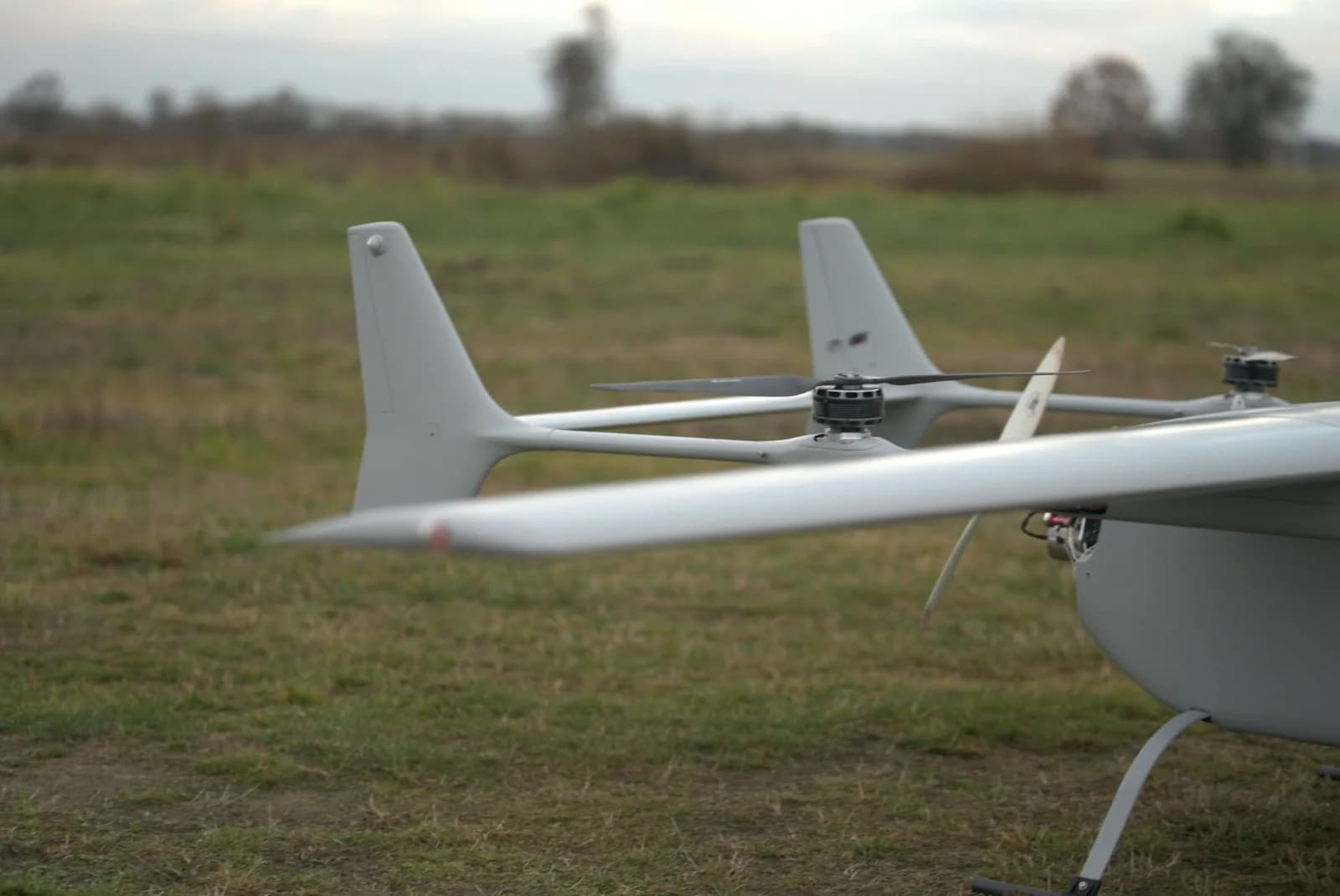
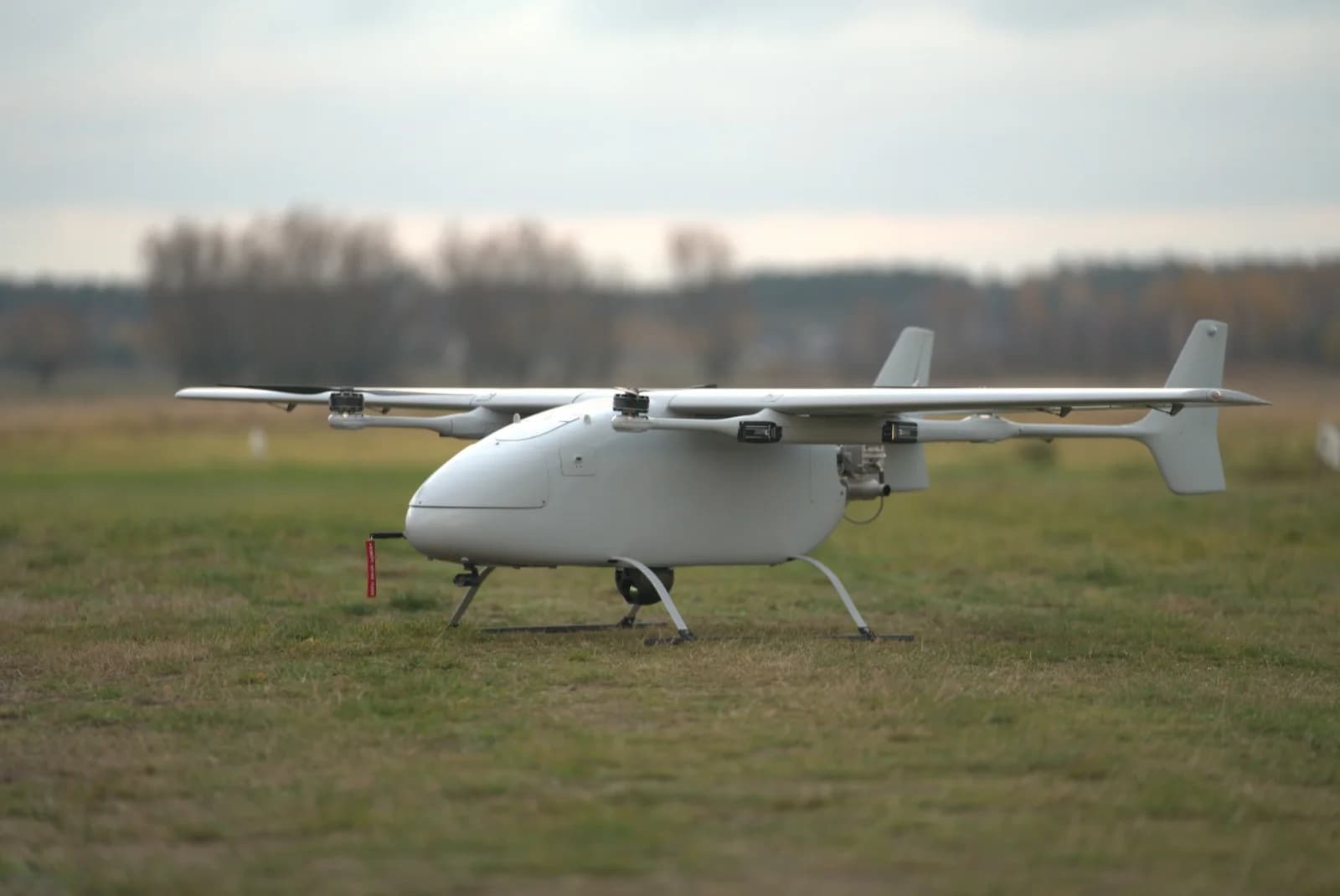
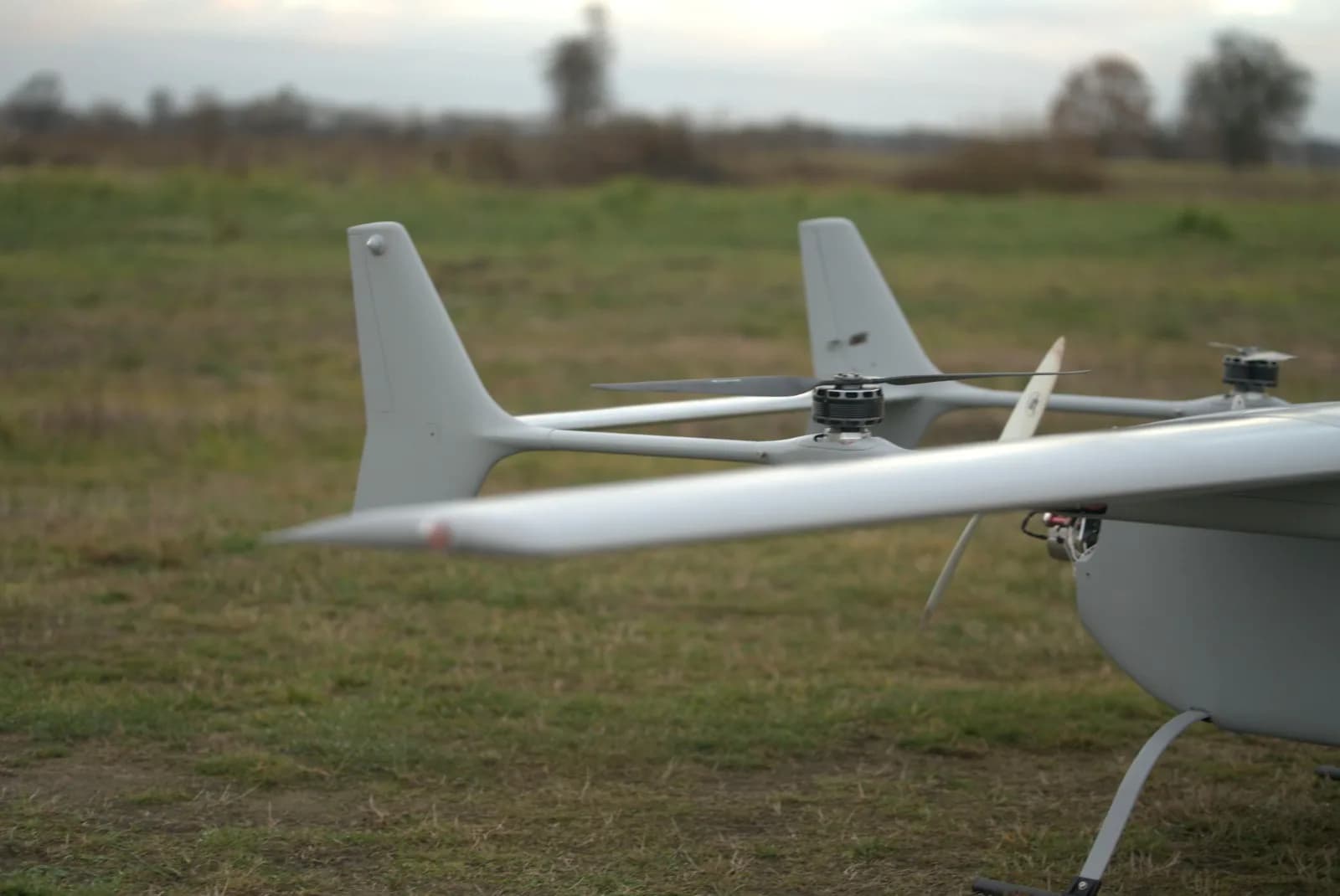
The S-2 is a fixed-wing airframe with VTOL propulsion. Four electric motors provide the vertical lift to take off and land; once airborne, the platform transitions to fixed-wing flight and is driven by a single pusher motor. The wing carries the aircraft through the cruise with aerodynamic efficiency a multirotor can never match — which is where the endurance and range come from.
Because take-off and landing are fully vertical, the launch and recovery footprint is a relatively flat area of roughly 5 × 5 m. No catapult, no arresting net, no prepared strip. The platform deploys from a clearing, a rooftop, a vehicle bed, or a vessel, and is airborne in five minutes. That single property is what frees a long-endurance fixed-wing platform from the airfield.
The pusher motor comes in two forms — electric or combustion. The headline endurance and range figures are for the combustion-pusher version; an all-electric pusher variant is available where a fully electric signature is the requirement. Optional parachute recovery and a payload-drop system, plus an underside payload-bay mount, round out the configuration.
VTOL lift, fixed-wing cruise
Four electric motors provide vertical lift for take-off and landing; the airframe then transitions to fixed-wing flight for the cruise. The operator launches and recovers anywhere a multirotor can, but travels and loiters with the aerodynamic efficiency of a wing.
Launch and recover from a 5×5 m patch
No catapult, no net, no runway. Fully vertical take-off and landing needs only a relatively flat area of about 5 × 5 m, which removes the single biggest constraint that keeps long-endurance fixed-wing platforms tied to prepared infrastructure.
Combustion-pusher and all-electric variants
Propulsion pairs the four-motor electric VTOL lift with a single pusher motor — electric, or combustion. The headline endurance and range figures are for the combustion-pusher version; an all-electric pusher variant is available where a fully electric signature is the requirement.
Recovery and drop options
Optional parachute recovery and a payload-drop system extend the mission set. The payload bay can be mounted on the underside of the airframe, configured to the mission rather than to a fixed factory layout.
The modular payload bay
Any sensor to 5 kg. Civil or military link. Re-roled to the mission, not the factory.
The platform is defined by what it can carry and how it connects, not by a single fixed sensor. The bay, the data link, and the pusher are all selectable — which is what lets one airframe serve several mission classes.
Modular 45 dm³ payload bay
A 50 × 30 × 30 cm bay — 45 dm³ — accepts any mission payload up to 5 kg. The 6 kg total payload figure is measured excluding the standard electro-optical / optoelectronic system, so the sensor of record is carried on top of the modular capacity, not instead of it.
Civil or military data link
RadioLink in civil or military variants for the command-and-control link, with LTE for long-range operation. The operator selects the link discipline that matches the deployment environment rather than accepting a single fixed radio.
Any sensor to 5 kg
Because the bay is defined by volume and mass rather than by a fixed sensor, it absorbs mission-specific packages — electro-optical, thermal, or task-built payloads — up to 5 kg. The same airframe re-roles across ISR, monitoring, and delivery tasks.
Production-grade and ruggedised
Glass / carbon composite construction, a −20 °C to +40 °C operating envelope, and a Cube Orange autopilot. At TRL 9 the S-2 is a fielded, in-production platform — engineering that has cleared validation, not a concept awaiting it.
Hardware
Engineered specifications.
- Wingspan
- 3.55 m
- Width
- 2.11 m
- Height
- 0.7 m
- Max speed
- 150 km/h
- Cruise speed
- 120 km/h
- Max wind tolerance
- 10 m/s
- Operating temp
- −20 °C to +40 °C
- Autopilot
- Cube Orange
- Data link
- RadioLink · LTE long-range
- Materials
- Glass / carbon composite
- Payload bay
- 50 × 30 × 30 cm · 45 dm³
- Landing footprint
- ~5 × 5 m flat area
On test
The S-2 in the field.
Vertical launch, transition to wing-borne cruise, and recovery — no runway, no catapult. The S-2 platform on film.
Where it deploys
Six mission classes where long-endurance VTOL ISR is the right answer.
Long-range ISR and surveillance
The core mission. Up to seven hours of endurance and up to 700 km of range let one airframe cover a deep, persistent intelligence, surveillance, and reconnaissance tasking from a single deployment — observation that holds, not a single pass.
Border and maritime patrol
Persistent patrol along borders and over water. The range envelope reaches distant tracks and far segments; vertical launch and recovery means the platform deploys from a vehicle, a vessel, or a clearing near the line rather than from a fixed airfield.
Critical-infrastructure and linear-asset monitoring
Pipelines, transmission corridors, rail, and other linear assets. The combination of endurance and range surveys long runs of infrastructure in a single sortie, with the modular bay carrying the sensor the inspection task requires.
Search and rescue
Vertical deployment from a 5 × 5 m patch puts the platform airborne in five minutes, and the seven-hour endurance lets it search and then dwell over a located target across an entire response window — without returning to a prepared strip to continue.
Force protection
Wide-area overwatch and standoff observation around fixed sites and moving formations. The man-portable class and runway-free deployment keep the platform with the unit it protects, not back at a base.
Re-roleable single airframe
Because the payload bay, the data-link variant, and the pusher configuration are all selectable, one S-2 covers several of the mission classes above. The operator changes the load-out, not the platform.
Why this platform is rare
Four reasons the S-2 is more than another VTOL fixed-wing.
Endurance and range in a man-portable class
Seven hours and 700 km from a 35 kg airframe that a small team carries, with five-minute vertical deployment from a 5 × 5 m patch. The figures normally demand a far heavier, runway-bound platform; the S-2 delivers them without one.
VTOL fixed-wing efficiency
Launch and recover anywhere a multirotor can, then cruise like a plane. The architecture removes the prepared-strip dependency that constrains every other long-endurance fixed-wing option in this class.
Modular, sovereign payload bay
A 45 dm³ bay carries any sensor to 5 kg; civil or military RadioLink plus LTE select the link discipline; parachute recovery and a payload-drop system extend the mission set. The platform re-roles to the tasking rather than the tasking bending to the platform.
Ruggedised and production-grade
Glass / carbon composite, −20 °C to +40 °C, Cube Orange autopilot, and TRL 9. The S-2 is a fielded, in-production platform — the integration, the validation, and the operational envelope are all behind it.
What this means for you
The platform, the architecture, and the modular payload bay — all licensable.
For a programme office looking at long-endurance ISR without the airfield — the S-2 is the answer to “does a man-portable, 35 kg platform exist that loiters for hours, reaches hundreds of kilometres, and launches vertically from a 5 × 5 m patch?” Yes — and it is fielded and in production today, at TRL 9.
For an integrator or operator with an active mission profile — long-range ISR, border or maritime patrol, critical-infrastructure and linear-asset monitoring, search and rescue, force protection — the modular payload bay, the civil-or-military RadioLink plus LTE link, and the combustion- or electric-pusher options let the platform be configured to the tasking rather than the other way round.
For a partner who needs sovereign manufacturing depth — the S-2 is a composite, ruggedised, production-grade airframe, available under license, direct purchase, or build-to-spec with European manufacturing behind it.
FAQ
S-2 — frequently asked
What is the S-2 Combat Drone?
The S-2 is a long-endurance hybrid VTOL fixed-wing UAV in the ISR class. Four electric rotors lift it vertically off a roughly 5×5 m patch; a fixed wing and pusher propeller then carry it in efficient cruise. It needs no runway, catapult, or launch crew, yet delivers fixed-wing endurance — up to 7 hours and up to 700 km on a single sortie at a 35 kg maximum take-off weight.
Why a hybrid VTOL design rather than pure fixed-wing or multirotor?
A pure fixed-wing aircraft has the endurance ISR needs but requires a runway, catapult, or launch rail — scarce, fixed in place, and targetable. A multirotor launches anywhere but its endurance is measured in tens of minutes and its range in single-digit kilometres. The S-2's hybrid layout takes vertical launch and recovery from the multirotor and cruise efficiency from the fixed wing, so you get runway independence and multi-hour persistence in one airframe.
What payloads can the S-2 carry?
Up to 6 kg across a 45 dm³ modular bay (50×30×30 cm) that re-roles across electro-optical/infrared, thermal, and task-built sensors up to 5 kg. The bay underside integrates a drop system and the platform carries a recovery parachute, so one airframe covers ISR, monitoring, and delivery tasks.
How is the S-2 deployed in the field?
Deployment takes about 5 minutes onto roughly a 5×5 m patch — no runway, catapult, or net. It launches vertically, transitions to wing-borne cruise, flies the mission, and lands vertically on the same footprint. It tolerates wind to 10 m/s, operates from −20 °C to +40 °C, and links over civil or military RadioLink plus LTE.
Can defense and government customers acquire or license the S-2?
Yes. The S-2 is a fielded, production-grade platform (TRL 9), offered three ways: direct purchase, IP licence, or build-to-spec configuration. It is built on a non-adversarial European supply chain with zero components from China or sanctioned states — NDAA Section 848-aligned for US federal buyers and EDIS-aligned for European defence.
More on the S-2
Browse all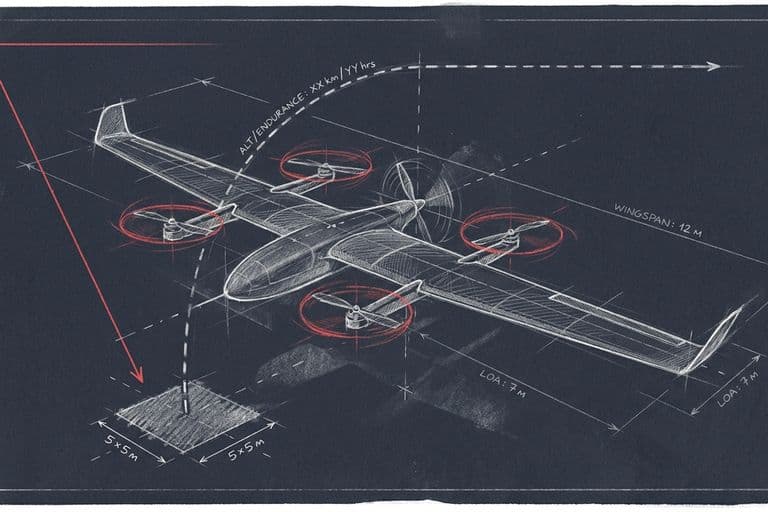 UPDATED · NOV 2025
The S-2 Combat Drone: 7 Hours, 700 km, and a 5-Metre Launch Footprint
The S-2 is a long-endurance hybrid VTOL platform that launches vertically from a 5×5 m patch, cruises for up to seven hours, and reaches up to 700 km — no runway, no catapult, no launch crew. A capability breakdown of the platform Dronehub develops and fields.
Read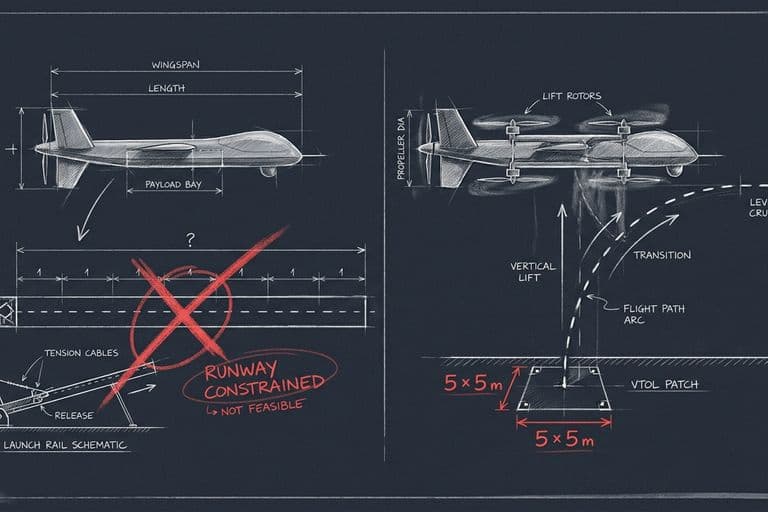 UPDATED · NOV 2025
Runway Independence Is the Real Constraint in Tactical ISR
The binding constraint on tactical ISR is rarely the sensor or the autonomy stack — it is the runway. Fixed-wing endurance needs prepared launch and recovery sites that are scarce, fixed, and targetable. Hybrid VTOL removes the runway without giving up the endurance, and the S-2 is the platform that proves the point.
Read