Key facts
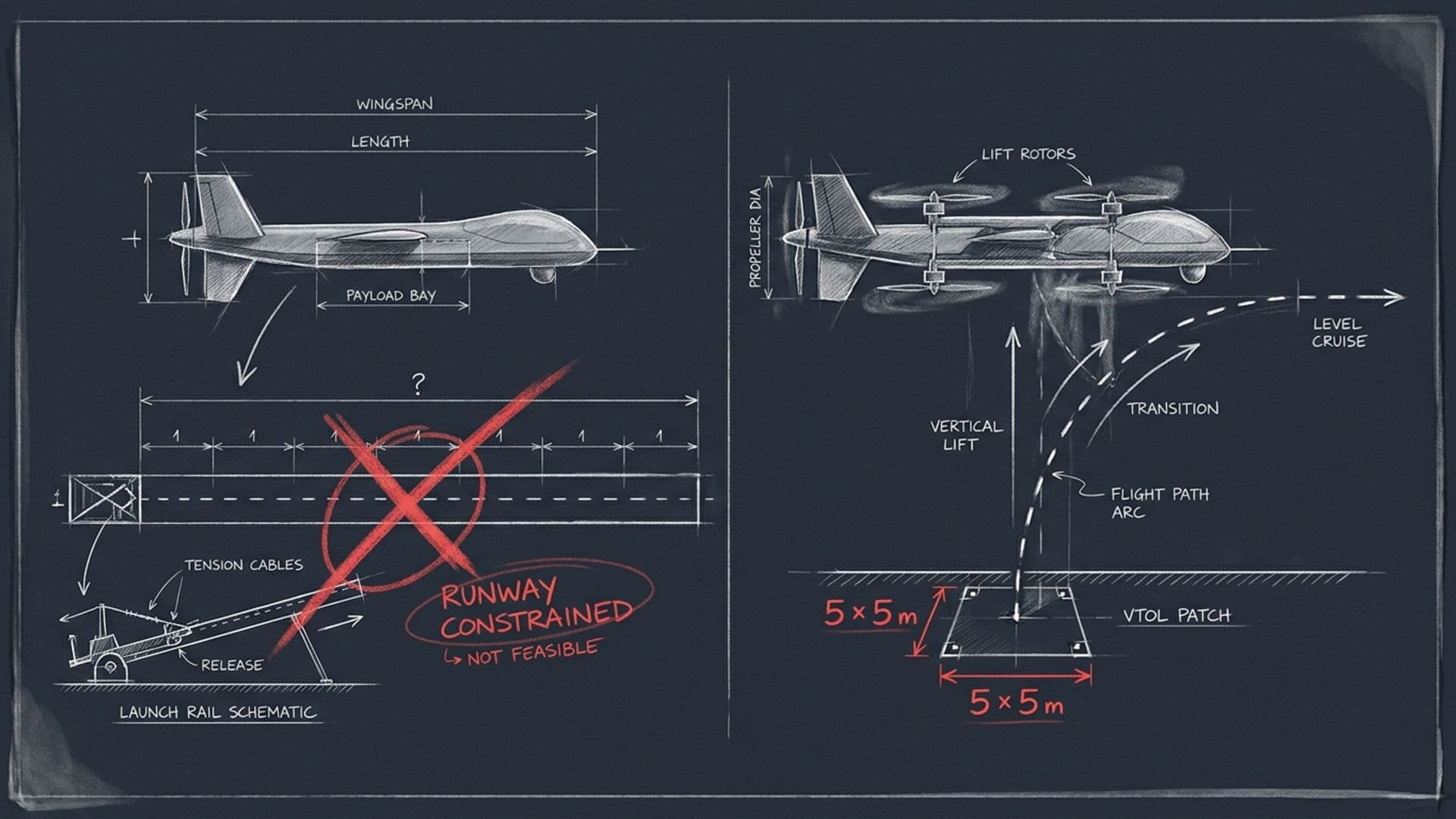
Fixed-wing UAVs deliver the endurance and range tactical ISR needs, but require prepared launch and recovery infrastructure — runway, catapult, or launch rail plus a recovery method — that is scarce, fixed in location, and a known point of vulnerability in contested environments.
Source · Tactical ISR launch-and-recovery constraint analysis
Multirotor UAVs remove the runway constraint by launching and recovering vertically from a few square metres, but hovering on rotors is aerodynamically inefficient, limiting endurance to tens of minutes and useful range to single-digit kilometres.
Source · Rotary-wing endurance constraint analysis
Hybrid VTOL fixed-wing aircraft combine vertical rotor lift for launch and recovery with wing-borne cruise for the mission, removing the runway constraint while preserving multi-hour endurance and multi-hundred-kilometre range.
Source · Hybrid VTOL architecture analysis
2 more key facts
The Dronehub S-2 launches and recovers vertically from a footprint of roughly 5×5 metres in about 5 minutes, then delivers up to 7 hours of endurance and up to 700 km of range as a fixed-wing aircraft — demonstrating the runway-independence-with-endurance combination in a single 35 kg platform.
Source · Dronehub S-2 platform specification
Runway independence enables dispersed and mobile ISR launch — from vehicles, ships, clearings, and improvised positions — rather than concentrating launch at a small number of prepared, fixed, and targetable airfields.
Source · Dispersed-launch operational analysis
In this piece
The hardest constraint in tactical ISR is rarely the sensor, the data link, or the autonomy stack. It is the runway. Sensors and on-board autonomy have advanced quickly and commoditised; what still decides which missions you can fly is whether you can get an aircraft with real endurance airborne, and recover it, from where you actually are. This post makes the case that runway independence — not payload, not range alone — is the binding constraint, and that hybrid VTOL is the architecture that removes it without giving up endurance.
The runway is a single point of failure
Fixed-wing aircraft are the workhorses of ISR because a wing is an efficient way to stay airborne. Move a wing through the air and it generates lift almost for free compared with a rotor; that efficiency is what turns into hours of endurance and hundreds of kilometres of range. Every serious long-dwell ISR mission wants that wing.
The wing comes with a bill, and the bill is paid on the ground. A fixed-wing UAV has to be accelerated to flying speed to launch — by a runway, a catapult, or a launch rail — and it has to be brought back down in a controlled way — onto a runway, into a net, or under a parachute. That launch-and-recovery infrastructure has three properties that matter operationally:
- It is scarce. Prepared sites are few, and the units that need overhead ISR are usually nowhere near one.
- It is fixed. A runway does not move. Launch concentrates at a small number of known locations.
- It is targetable. A fixed, mapped launch site is a coordinate. In a contested environment it can be ranged, jammed, denied, or destroyed — and when it is, the ISR it enables goes with it.
When the launch site is the limiting factor, a better sensor does not expand the mission set. You cannot fly a watch you cannot launch.
The multirotor escape — and why it isn't enough
The obvious way out is to remove the runway entirely with a multirotor, which lifts straight up from a few square metres and lands the same way. For short, close tasks that is exactly right, and it is why small quadcopters are everywhere.
But the multirotor buys runway independence with endurance it does not have. Hovering and flying on rotors means pushing air down continuously — aerodynamically expensive in a way a wing is not. The efficiency gap is not marginal; it is the difference between tens of minutes of multirotor endurance and hours of fixed-wing endurance, and between single-digit kilometres of useful multirotor range and hundreds of kilometres for a wing. A pure multirotor is a short look, not a long watch. It solves the launch problem and surrenders the mission.
So the field has historically been forced to choose: endurance or runway independence. Most platforms pick one and live with the other.
Hybrid VTOL refuses the choice
A hybrid VTOL fixed-wing aircraft carries both systems and uses each only in the phase where it wins.
- Launch and recovery run on vertical-lift rotors. The aircraft rises straight up off a small patch, and at the end of the mission descends vertically back onto one. No runway, catapult, rail, net, or arrestor.
- The cruise runs on a fixed wing and a forward propeller. Once the aircraft has altitude and speed, the rotors stop and it flies as an efficient aeroplane for the entire mission.
- The transition between the two modes happens in flight, automatically.
You pay for this with some extra weight and complexity — you are carrying a lift system and a cruise system in one airframe. In return you get the strong half of each architecture: the launch-and-recovery freedom of a multirotor and the endurance and range of a fixed wing. For tactical ISR, where the runway is the binding constraint and the mission still demands hours on station and reach measured in hundreds of kilometres, that is the trade worth making.
What runway independence changes
Removing the runway is not a convenience feature. It changes the geometry of the whole problem.
When endurance requires a runway, ISR launch concentrates — at a handful of prepared, fixed, mapped airfields that an adversary can find and hold at risk. When the same endurance launches vertically from a 5×5 metre patch in about five minutes, ISR launch disperses — from vehicles on the move, from ships, from clearings, from forward positions, from sites chosen for the mission rather than dictated by infrastructure.
Dispersed launch is:
- Harder to find and deny — many small, transient launch points instead of a few fixed ones.
- Faster to reposition — the launch site moves with the unit.
- Lighter to sustain — a small clear patch and a few minutes, not an airfield and a launch crew.
That last point is the quiet one. Collapsing the launch footprint puts persistent, multi-hour overhead capability in the hands of units that would never have a runway — which is most of them.
The S-2 is the existence proof
The argument is only as good as a platform that actually delivers it. The S-2 launches and recovers vertically from roughly a 5×5 metre patch in about five minutes, then flies as a fixed-wing aircraft for up to 7 hours and up to 700 km, carrying up to 6 kg of modular payload at a 35 kg maximum take-off weight. That is runway independence and fixed-wing endurance in one fielded, production-grade platform — not a concept.
It is built on a non-adversarial European supply chain with zero components from China or sanctioned states, which maps to NDAA Section 848-style requirements for US federal buyers and EDIS-aligned terms for European defence procurement. Dronehub develops and fields it, and offers it under direct purchase, IP licence, or build-to-spec configuration.
The full platform breakdown — architecture, envelope, payload bay, autonomy, and comms — is in The S-2 Combat Drone: 7 Hours, 700 km, and a 5-Metre Launch Footprint. The platform page with the spec strip and field footage is at /projects/s-2. For a procurement conversation, open the contact form.
FAQ
- Why is the runway, not the sensor, the binding constraint in tactical ISR?
- Because sensors and autonomy have advanced faster than the ground end of the problem. A modern small UAV can carry a capable EO/IR or thermal payload and run sophisticated on-board autonomy — those capabilities are increasingly commoditised. What still gates the mission is getting the aircraft airborne and recovering it. Fixed-wing platforms, which provide the endurance and range that real ISR missions demand, need a prepared launch and recovery site: a runway, a catapult, or a launch rail, plus a net, an arrestor, or a parachute zone to come home. That infrastructure is scarce, it is fixed in place, and in a contested environment it is a known coordinate an adversary can range, deny, or destroy. When the launch site is the limiting factor, improving the sensor does not change what missions you can actually fly. Removing the runway does.
- Why can't you just use multirotors and avoid runways entirely?
- You can, for short-range, short-duration tasks — and for those, multirotors are the right tool. The problem is physics. A multirotor stays airborne by pushing air down with its rotors continuously, which is aerodynamically expensive; a fixed wing generates lift by moving through the air, which is far more efficient. That efficiency gap is why a multirotor's endurance is measured in tens of minutes and its useful range in single-digit kilometres, while a fixed-wing aircraft of similar size measures endurance in hours and range in hundreds of kilometres. So pure multirotors solve the runway problem but cannot hold an area for hours or reach a target tens of kilometres away. They are a look over the next ridge, not a watch over a corridor.
- How does hybrid VTOL resolve the trade-off?
- A hybrid VTOL fixed-wing aircraft carries both systems and uses each only where it wins. Vertical-lift rotors handle launch and recovery — the phases where you need to leave and return to a small patch of ground — and then stop. A fixed wing and a forward propeller handle the cruise — the phase where you need efficiency, endurance, and range. The aircraft transitions between the two modes in flight. You pay a modest weight and complexity penalty for carrying both systems, and in exchange you get launch-and-recovery freedom from a few square metres together with fixed-wing persistence. For tactical ISR, where the launch site is the binding constraint and the mission still demands hours on station, that is the trade worth making.
- What does runway independence change operationally?
- It changes where you can launch from, and therefore how survivable and flexible your ISR is. When endurance requires a runway, ISR launch concentrates at a handful of prepared airfields — which are few, fixed, mapped, and targetable. When the same endurance launches vertically from a 5×5 metre patch, launch disperses: from vehicles on the move, from ships, from clearings, from forward positions, from improvised sites chosen for the mission rather than dictated by infrastructure. Dispersed launch is harder to find, harder to deny, and faster to reposition. It also collapses the logistics tail — about five minutes and a small clear patch instead of an airfield — which puts persistent overhead capability in the hands of units that would never have a runway.
- Where does the S-2 fit this argument?
- The S-2 is the existence proof. It launches and recovers vertically from roughly a 5×5 metre patch in about five minutes, then flies as a fixed-wing aircraft for up to seven hours and up to 700 km, carrying up to 6 kg of modular payload at a 35 kg maximum take-off weight. That is the runway-independence-with-endurance combination in one fielded, production-grade platform rather than a slideware concept. It is built on a non-adversarial European supply chain with zero components from China or sanctioned states, and Dronehub develops and offers it under direct purchase, IP licence, or build-to-spec configuration. The full platform breakdown is in the companion post, and the platform page carries the spec strip and field footage.