Key facts
Cardiac-arrest survival probability decreases by approximately 10% for every minute that passes without defibrillation.
Source · American Heart Association, sudden cardiac arrest survival data
The Sosnowiec pilot ran over 100 AED-transport flights between two docking stations, in partnership with Pentacomp Systemy Informatyczne S.A. — the first deployment of its kind in Poland.
Source · Dronehub × Pentacomp Sosnowiec pilot, 2021
Drone delivery of an automated external defibrillator (AED) reaches the patient faster than ground EMS in dense urban geography, where traffic, one-way streets, and permit-restricted access compress the ambulance response time.
Source · Multiple peer-reviewed AED-drone delivery studies, 2018–2023
2 more key facts
The same Airvein hangar-grid architecture — 10–15 km spacing between autonomous docking stations — that funded the Sosnowiec pilot was later validated at scale under the Honeywell-led U-Space4UAM EU consortium.
Source · Airvein programme (Polish R&D Centre, $1.24M) + U-Space4UAM (EU Horizon 2020)
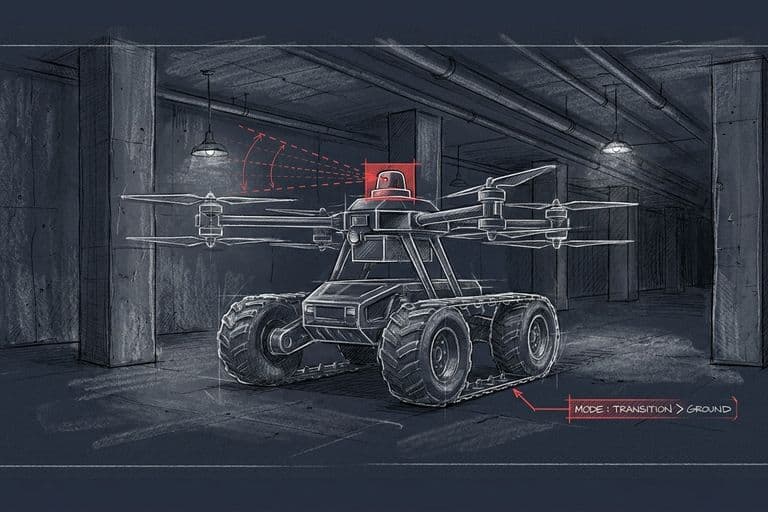
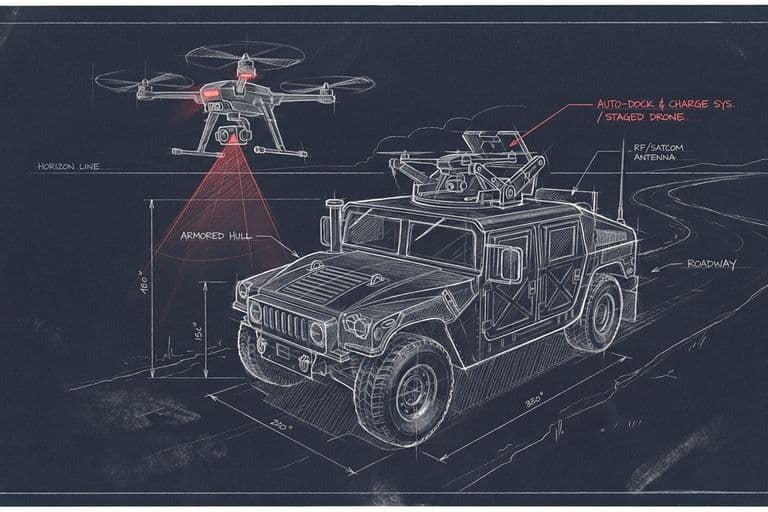
The use case transitions from civilian medical logistics to defense casualty-evacuation under the same architecture — different payload, different topic-area buyer, identical hangar grid + cargo modules + drones.
Source · Airvein dual-use architecture documentation
In this piece
Cardiac arrest is a time-critical emergency. Every minute without defibrillation cuts survival probability by roughly ten per cent. By minute 6 — the median ambulance response time in most dense cities — survival is statistically half of what it was at minute 0. Ground EMS is rate-limited by traffic, road geometry, permit access, and weather. A drone is not.
Dronehub and Pentacomp ran the first AED-drone pilot of its kind in Poland, in the city of Sosnowiec — over 100 flights between two docking stations, delivering automated external defibrillators to simulated cardiac-arrest locations. The pilot validated the operational pattern that became part of the EU's regulatory U-space framework two years later. This post unpacks how the use case works, what Sosnowiec proved, and why the same architecture transitions one-for-one to defense casualty evacuation.
The decay curve
The statistical relationship between time-to-defibrillation and cardiac-arrest survival is one of the harder-edged numbers in emergency medicine. At minute 0 from the cardiac-arrest event, survival probability with prompt defibrillation is around 70%. The probability drops by approximately 10 percentage points per minute. By minute 5, survival is around 40%. By minute 10, it's in the single digits.
Ground EMS response, in any city with normal traffic patterns, lands in the 6–10 minute median range from dispatch to scene. That places the median ambulance arrival on the wrong side of the survival curve for a meaningful share of cases. Health-system operators have known this for decades; the constraint has always been that you can't put more ambulances on the road than the road geometry allows.
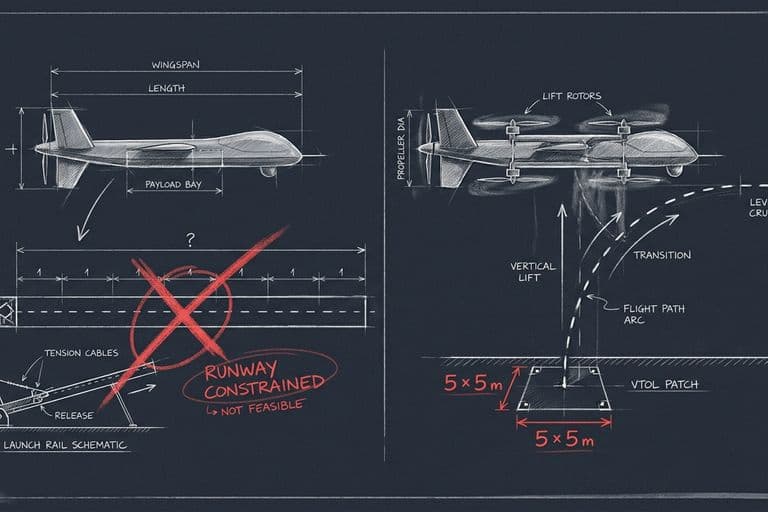
Drone delivery rewrites the geometry. A drone takes off vertically, ignores traffic, ignores one-way streets, ignores permit-restricted zones (with appropriate regulatory clearance), and follows the straight-line distance from a pre-positioned hangar to the patient. From a 10–15 km hangar grid, a drone reaches any point in a dense urban target zone in 2–3 minutes. The shift compresses the survival-window gap by 4–7 minutes. That's not marginal optimisation. It's a step-change in survival probability for cases where the patient would otherwise be at minute 6+ when help arrives.
What the Sosnowiec pilot actually demonstrated
The Sosnowiec deployment in 2021 was the first AED-drone pilot of its kind in Poland — a partnership between Dronehub and Pentacomp Systemy Informatyczne S.A. Two autonomous docking stations were positioned within the city. The drones ran AED-transport flights between the hubs, simulating cardiac-arrest dispatch scenarios across over 100 individual flights.
The pilot answered three operational questions that any health-system operator would ask before committing to a deployment:
- Can the regulatory framework permit this? Yes — under coordination with Polish civil-aviation authorities, with the docking-station coordination logic operating inside the airspace rules that applied at the time. The empirical operational data from Sosnowiec subsequently fed into the EU's U-space regulatory development, where it joined the broader U-Space4UAM consortium contribution.
- Can the docking grid operate at urban density? Yes — two stations at typical urban spacing handled the simulated dispatch volume with reliable launch-and-recovery cycling. The constraint isn't the airspace, it's the operator's ability to position docking infrastructure on rooftops or municipal sites.
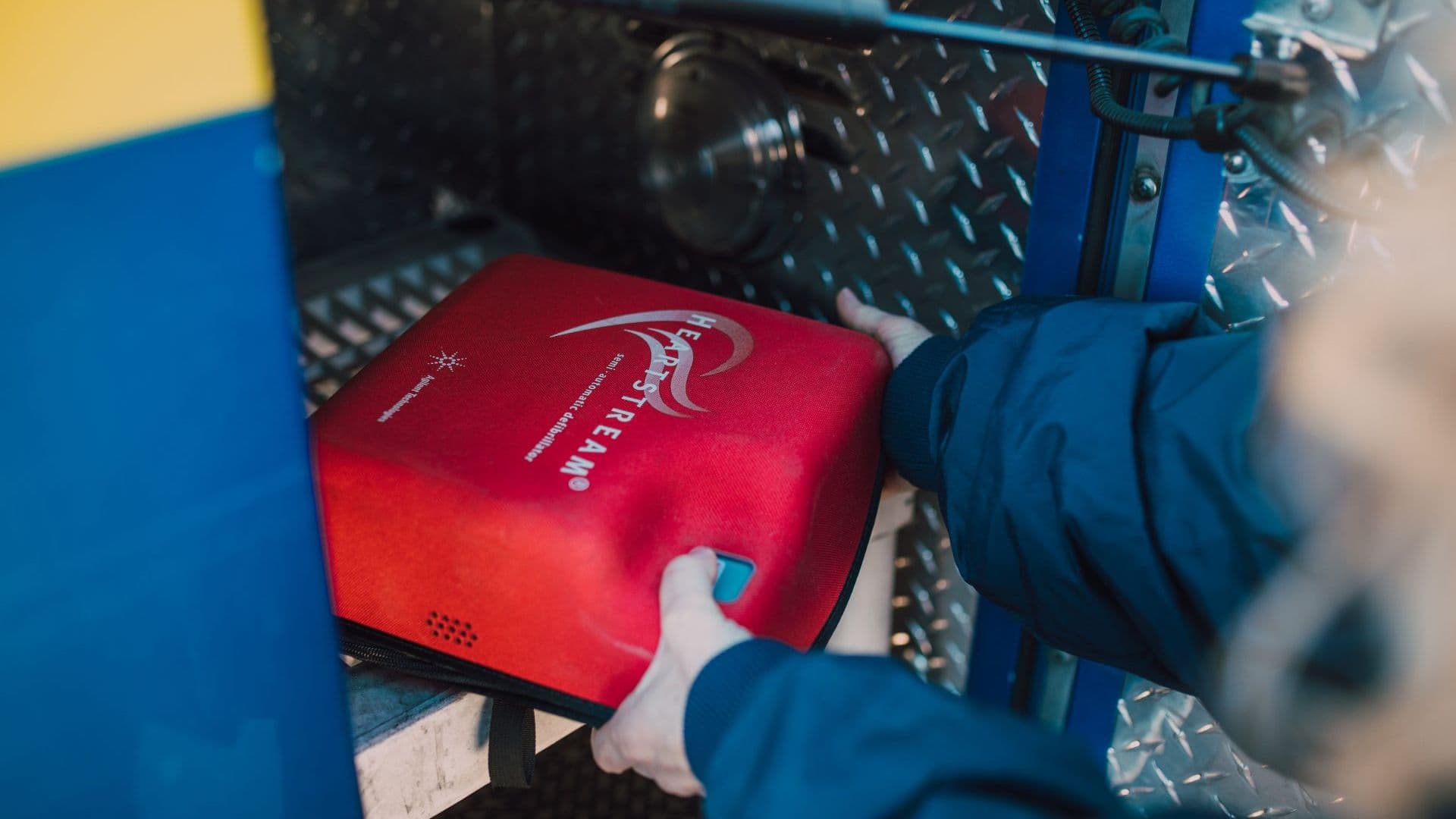
- Can the cargo-module engineering keep the AED operationally ready? Yes — the cargo module preserves the device's thermal envelope and vibration profile, and on-arrival the AED is operator-ready for the bystander who retrieves it. The audit trail of the flight, the cargo state, and the delivery confirmation is logged for post-event review.
The pilot established the operational baseline. It also produced one of the data sets that informed the architecture-level decisions in the broader U-Space4UAM programme — the same architecture that Honeywell led across 13 EU partners and that Dronehub flew first on.
The dual-use throughline
The single most important property of the Sosnowiec / Airvein architecture is that it's dual-use by structural design, not by retrofit. The 10–15 km hangar grid, the cargo-module thermal-integrity engineering, the all-weather 24/7 autonomy stack, and the dispatcher-stack integration are the same components whether the cargo is a civilian medical payload (AED, blood, samples, pharmaceuticals) or a defense sustainment payload (casualty-evacuation cargo, forward resupply, contested-corridor logistics).
The civilian use case is what proves the architecture at the most demanding commercial scale — medical cargo with audit-grade telemetry, regulatory cooperation, and time-critical operational tolerance. The defense use case is what the same architecture transitions into without re-engineering. Same hangars. Same drones. Same modules. Different payload. Different topic-area buyer.
For the US side, that means the Sosnowiec / Airvein platform qualifies under SBIR/STTR topic areas on autonomous medical evacuation, forward sustainment, and contested-corridor logistics. NDAA Section 848-compatible hardware, NATO-allied supply chain, dual-EU+US data sovereignty. The proof-of-architecture exists; the federal-pathway eligibility is structural.
For the EU side, the same platform qualifies under European Defence Fund (EDF) topics on defense logistics and under Horizon Europe Cluster 1 (Health) topics on cross-border medical drone corridors. The U-Space4UAM regulatory engagement is the upstream credential that makes the EDF / Horizon Europe procurement evaluation faster.
Where licensing fits
For municipal health systems, regional emergency-medical-service authorities, and large hospital networks running multi-site logistics — the Airvein platform deploys today, under license or direct purchase. The Pentacomp partnership is preserved on the systems-integration side for operators that want a turnkey deployment with the original software partner.
For defense buyers evaluating autonomous casualty evacuation or forward sustainment resupply — the architecture is the same; the engagement is through Dronehub Inc. (Delaware C-Corp, SBIR/STTR-eligible) for US programmes or through Dronehub Sp. z o.o. for EU defense industrial partnerships.
The full Airvein architecture and the wider dual-use logistics context are on /projects/airvein and /industries/logistics. For a pilot or licensing conversation, open the contact form.
FAQ
- Why drone-delivered AEDs and not faster ambulances?
- Ambulance response is rate-limited by ground infrastructure — traffic, road geometry, permit access, weather. In dense urban geography the median ambulance response time is 6–10 minutes from dispatch to scene; by minute 6, statistical survival probability is roughly 40%. A drone with a pre-positioned AED at a 10–15 km hangar grid reaches a typical urban target in 2–3 minutes. The shift compresses the gap between cardiac arrest and defibrillation by 4–7 minutes — which translates to a survival-probability improvement that's not marginal, it's a step-change.
- What did the Sosnowiec pilot actually demonstrate?
- End-to-end operational viability of drone-borne AED delivery in a Polish city — over 100 flights between two docking stations, with the AED reaching the simulated patient location reliably and within survival-window constraints. The pilot ran under regulatory cooperation with Polish civil aviation authorities, validated the docking-station coordination logic, and produced the operational dataset that later fed into the broader U-Space4UAM EU regulatory work.
- Is this just a civilian use case or does it apply to defense?
- Both. The Airvein hangar-grid architecture — 10–15 km spacing between autonomous docking stations, with drones running cargo continuously between them — is the textbook dual-use platform. The civilian use case is medical logistics: AEDs, blood units, samples, time-critical pharmaceuticals. The defense use case is casualty evacuation, forward sustainment resupply, and contested-corridor logistics. Different payload, different topic-area buyer, identical platform.
- Who is Pentacomp?
- Pentacomp Systemy Informatyczne S.A. is a Polish software-systems integrator that partnered with Dronehub on the Airvein medical-logistics programme funded by Poland's federal R&D Centre. Pentacomp delivered the software-systems integration layer; Dronehub delivered the drone airframes, docking stations, cargo modules, and autonomy stack.
- Can a city or health-system operator deploy this today?
- Yes. The hangar-grid architecture, the AED-cargo module engineering, and the dispatcher integration are all licensable as a deployable platform. Dronehub Inc. is SBIR/STTR-eligible for US municipal-health pilots; the EU side is EDF/Horizon-Europe-eligible for cross-border medical-drone corridor work. Manufacturing is at the Jasionka factory inside NATO-allied supply chain. For a pilot conversation, the founding partner Pentacomp can be involved on the integration side.