Key facts
Nomad — Dronehub's mobile drone-in-a-box — uses the same robotic battery-swap mechanism as the fixed drone-in-a-box, integrated into a vehicle-mounted dock that operates at column speed and maintains the same 20-25 missions per day cadence on the move.
Source · Dronehub Nomad technical specifications
Nomad was funded by a $1.72M Polish National Centre for Research and Development (NCBR) grant in 2021, with the production line online by 2025.
Source · Polish NCBR programme record; Dronehub manufacturing operations
Convoy overwatch is the primary defense use case — persistent air cover for moving columns in environments where fixed aerostats are impractical (ground unit is moving) and where helicopter cover is cost-prohibitive (hourly operating costs of $1,500–$3,000 versus a small fraction of that for autonomous UAS).
Source · Comparative defense aviation operating-cost analysis
3 more key facts
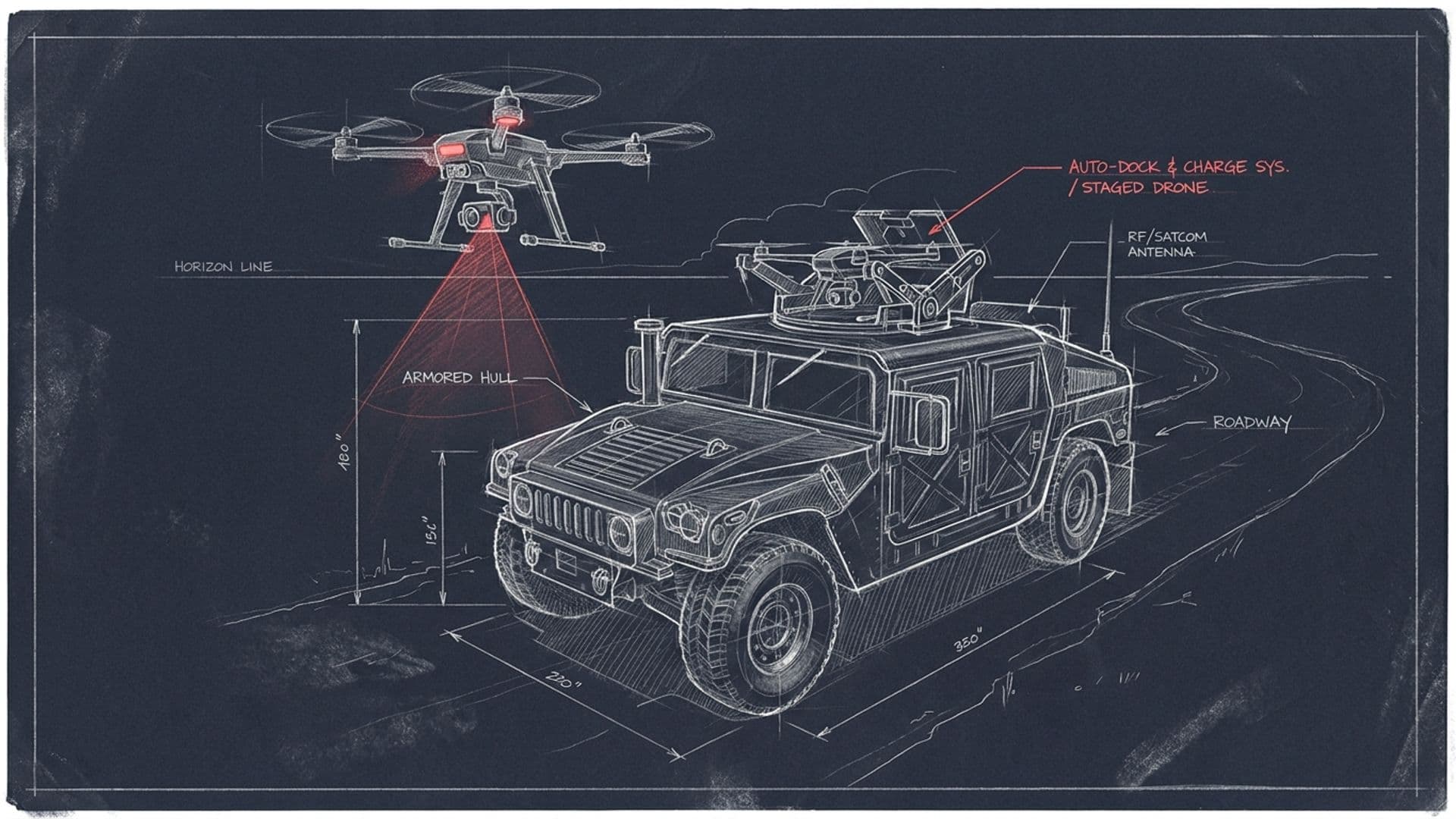
The vehicle platform is agnostic — Nomad integrates onto MRAP, HMMWV, MaxxPro, M-ATV, or commercial heavy-duty SUV / up-armoured pickup chassis depending on the operator's existing fleet, with the dock mechanism mounted to roof or roof-rack.
Source · Nomad integration specifications
Civilian use cases include diplomatic convoy escort, executive protection, hazardous-materials transport escort, mobile security perimeter for high-value cargo movement, and disaster-response mobile-ISR for emergency-management columns.
Source · Nomad civilian-procurement deployment patterns
Pairing the Nomad dock with the AUDROS counter-UAS interceptor extends the convoy's perimeter against hostile UAVs — the same mobile platform that runs aerial overwatch can launch the net-capture interceptor in response to a detected threat.
Source · Dronehub portfolio integration architecture
In this piece
Convoy security has a 360-degree gap, and the gap is overhead. Ground-side discipline — armoured vehicles, route reconnaissance, electronic warfare protection, comms procedures — has matured over decades. Air-cover for the moving column has not, because the classical options have always traded off cost against availability against scale. UAV Nomad fills the gap.
This post walks through the structural problem UAV Nomad addresses, what the mobile drone-in-a-box actually does, where it fits in the broader operational stack, and what the procurement pathway looks like for defense, federal, and civilian buyers.
The 360-degree gap
Modern convoy operations distribute risk into three operational envelopes. The first is the ground envelope — the route itself, the vehicles, the formation discipline. This envelope is the most developed; armoured platforms, route clearance, IED-defeat doctrine, electronic warfare counter-IED. The second is the human envelope — the people inside the vehicles, the protection details, the comms procedures, the medical protocols. This envelope is also well-developed.
The third is the air envelope — the airspace above the column, from a few metres up to whatever ceiling the threat catalog reaches. This envelope has been historically managed by exception rather than rule, because the persistent-overwatch tools that could cover it didn't exist at appropriate cost-and-availability.
The classical options for air cover on a moving column all fail on one axis or another.
Manned helicopter overwatch gives the best operational capability — long sensor range, large payload capacity, human-judgement-in-the-loop response. It also operates at hourly costs in the $1,500-$3,000 range for routine platforms, requires trained aircrew with current proficiency, requires basing infrastructure within operational radius, and is not generally available for routine movement. Helicopter overwatch covers the highest-priority convoy missions and almost nothing else.
Fixed aerostat coverage can provide persistent overhead surveillance but only of a point or a narrow corridor — the aerostat tethers to a fixed mooring. Convoys that move past the aerostat's coverage envelope lose the cover.
Ground-based sensor coverage (column-mounted radar, RF detection, EW protection) covers the immediate-threat envelope but doesn't extend up into the operational airspace where threat UAVs operate.
Soldier-launched quadcopters give the column tactical overhead for brief windows. Battery limits the flight time to roughly 20-30 minutes; the operator's attention is fully occupied during the flight; the asset returns to the operator for refit rather than auto-recovering. Persistent coverage across a multi-hour column movement is not achievable with this class.
The combined result is that for most convoy operations — peacetime, peacekeeping, patrol, resupply, training — the air envelope has been operationally underserved. The cost of manned aviation didn't justify covering it; the limits of the alternative tools meant it couldn't be covered with available kit.
How UAV Nomad closes the gap
UAV Nomad is a vehicle-mounted drone-in-a-box that operates at column speed. The underlying mechanism is the same robotic battery-swap dock that Dronehub deploys at fixed sites — the 2-minute swap cycle, the magnetic-aligned battery interface, the environmentally-sealed enclosure that operates through dust, precipitation, and the temperature range of outdoor operations. The vehicle-mount integration adds platform-specific mounting (roof, roof-rack, dedicated vehicle-bed installation) and shock/vibration isolation appropriate to the chassis.
The operating envelope is straightforward.
- The dock sits on the convoy vehicle (typically a mid-column or trailing position). The UAS launches from the dock on demand.
- The launched UAS holds an overwatch pattern at altitude above and around the column. Sensor payload depends on the mission profile — EO/IR for daylight surveillance, thermal for night and low-light, RF survey for electronic-warfare context, mission-specific payloads (chem-bio detection, signals intelligence) where the deployment requires them.
- When the UAS approaches battery limit, it returns to the dock, lands, and the robotic mechanism swaps the depleted pack for a charged one. Cycle time is the same ~2 minutes as the fixed-dock variant. A second UAS can launch immediately if the threat profile warrants continuous double-cover.
- The dock itself is autonomous within the convoy's standard operating procedures — the launch, recovery, and swap operations don't require dedicated operator attention from the column's personnel during routine cycles.
The structural property that matters: the column doesn't stop, the operator doesn't manually intervene, and the air cover doesn't break. The mission cadence — 20-25 missions per day per dock — is sustained at column speed, which means persistent coverage across multi-hour movements.
Vehicle-platform integration
UAV Nomad is platform-agnostic. The dock mechanism integrates onto a range of vehicle chassis depending on the operator's existing fleet.
MRAP-class (MaxxPro, M-ATV, RG-33). Armoured protected vehicles common in coalition operations. Roof or roof-rack mounting; the dock's environmental enclosure is sized for the operational envelope of these vehicles.
HMMWV / Humvee (M998, M1097, M1151). Lighter but still operationally robust; mounting typically roof-rack with vibration isolation appropriate to the chassis dynamics.
Commercial heavy-duty SUV / up-armoured pickup chassis (Cadillac Escalade, Chevrolet Suburban, Toyota Land Cruiser 200 / 300, up-armoured Ford F-series). The civilian protective-detail and diplomatic-escort use cases.
Specialised platforms (mobile command vehicles, ambulance / casualty-evacuation vehicles, hazmat-response trucks) — bespoke integration depending on operator needs.
The dock mechanism, the launch / recovery logic, the battery-swap mechanism, and the operator-handoff layer are common across the variants. The platform-specific work is in mounting, vibration isolation, power-system integration, and operator-interface placement.
Defense operational profiles
The primary use case is convoy overwatch in defense and peacekeeping operations.
Forward Operating Base resupply. Most convoy movement in deployed operations is FOB-to-FOB or FOB-to-rear-area resupply. The threat profile is variable but persistent — hostile UAS surveillance, anti-vehicle threats, IED placement attempts, ambush. Persistent air cover changes the threat-detection economics: the column gains advance notice of threat presence that ground sensors don't provide.
Peacekeeping patrol routes. UN peacekeeping operations, EU CSDP missions, NATO patrol operations. Movement across permissive but unpredictable environments — local hostility, criminal-group activity, irregular-force presence. Persistent overwatch reduces the patrol's exposure profile.
VIP and command-element movement. Diplomatic visits, general-officer movement, command-element relocation. High-value targets that justify dedicated air cover but where manned aviation isn't always available or appropriate.
Counter-UAS perimeter on the move. This is the strongest pairing. The UAV Nomad mobile dock can carry the AUDROS net-capture interceptor in addition to or in rotation with the ISR UAS. A column under hostile-UAS threat — increasingly common across the modern threat catalog — gets a sovereign net-capture response from the column itself rather than depending on a separate C-UAS asset that may or may not be in range.
Civilian operational profiles
The civilian use cases are smaller in volume than defense but operationally similar.
Diplomatic convoy escort. Host-nation protection details escorting foreign dignitaries through populated areas. The threat profile is unpredictable; persistent overhead surveillance gives the protection team advance notice of threat development.
Executive protection. Private-sector security teams escorting high-net-worth or high-threat individuals through routes that require persistent air-cover beyond what individual operators can sustain. The procurement frame here is commercial but the operational logic is identical to diplomatic escort.
Hazardous-materials transport escort. Cargo whose risk profile justifies dedicated air cover overhead. Nuclear materials transport, biological-agent samples, sensitive military equipment relocation, large currency or precious-metals movement.
Mobile security perimeter for high-value cargo. Banking and precious-metals operations, defense-industrial-supply convoys, sensitive electronics movement.
Disaster-response mobile-ISR. Emergency-management columns moving through compromised infrastructure — earthquake, flood, wildfire response. The UAV Nomad-mounted UAS gives the column situational awareness for the route ahead, identifies impassable sections, locates survivors, and supports the broader response coordination.
Procurement pathways
For US defense procurement — direct contract through Dronehub Inc. (Delaware C-Corp, SBIR/STTR-eligible, NDAA Section 848-compatible). The capability maps to active topic areas: SBIR Open Topics on tactical-edge autonomy, AFWERX programmes on convoy protection and mobile autonomy, DIU Commercial Solutions Opening on mobile drone-in-a-box. The UAV Nomad-AUDROS pairing maps to DIU dual-use counter-UAS and persistent-coverage topic windows.
For US federal-civil — DHS S&T critical-infrastructure programmes, DOJ counter-narcotics convoy operations, USSS protective-detail capability, FBI tactical-response programmes. The Section 848-equivalent compliance applies across the federal-civil pathway.
For EU defense — Dronehub Sp. z o.o. and the European Defence Fund (EDF) / NATO DIANA pipelines. EDIS-aligned manufacturing at Jasionka; EU + US data sovereignty by architecture; tactical-mobile-platform topic areas in EDF 2026 and DIANA accelerator calls.
For Five Eyes and NATO non-EU allies — UK, Canada, Australia, New Zealand defense procurement; Norwegian, Turkish, Western Balkan NATO procurement. The dual-domicile structure supports both the US-aligned and EU-aligned procurement pathways.
For civilian buyers (diplomatic services, private protection firms, hazmat operators, disaster-response agencies) — direct industrial licensing through either Dronehub entity depending on jurisdiction.
The full UAV Nomad case study is at /projects/nomad. The underlying battery-swap mechanism is documented at /blog/robotic-battery-swap-vs-in-station-charging. The defense-industry context is at /industries/defense. For a procurement-readiness conversation, open the contact form.
FAQ
- What problem does Nomad actually solve?
- The 360-degree air-cover gap on moving columns. Convoy security on the ground is well-developed — armoured vehicles, route reconnaissance, electronic warfare protection, communications discipline. Air-cover for the moving column is the gap. Manned helicopters can provide it but at hourly operating costs that scale poorly for routine missions. Fixed aerostats give persistent coverage of a point but not of a moving unit. Soldier-launched quadcopters give brief tactical overhead but cannot maintain persistent coverage across a multi-hour movement. Nomad fills the gap with a vehicle-mounted dock that launches, recovers, and battery-swaps UAS at column speed — turning the dock into part of the column's organic capability rather than a separate platform that has to be coordinated with.
- How is this different from a soldier-launched quadcopter?
- Three structural differences. First, persistent operation — Nomad's robotic battery swap keeps a UAV airborne almost continuously, while a soldier-launched quadcopter is a one-flight asset that comes back to refit. Second, autonomous operation — the dock launches and recovers without requiring an operator's manual attention during the swap, freeing the convoy's personnel for their primary roles. Third, mission scope — the docked UAV can carry mission-specific payloads (thermal, EO/IR, RF survey, counter-UAS) that exceed what an individual soldier could carry into the cab and operate handheld. The two capabilities are complementary; Nomad doesn't replace soldier-launched UAS for close tactical work, it covers the persistent-overwatch envelope that handhelds can't sustain.
- Why mobile drone-in-a-box instead of helicopter overwatch?
- Cost and availability. Manned helicopter overwatch is the gold standard for high-value convoys — it provides the longest sensor range, the largest payload capacity, and the human-judgement-in-the-loop response capability. But it operates at hourly costs in the $1,500-$3,000 range, requires trained aircrew, requires basing infrastructure, and is not generally available for routine movement. Nomad doesn't replace helicopter overwatch for the highest-priority missions. It covers the much larger volume of routine column movements that would never have justified manned aviation but still benefit from persistent air cover — patrols, resupply, peacekeeping movement, peacetime training, every-day operations.
- Where does Nomad fit in counter-UAS operations?
- As the mobile launch platform for net-capture counter-UAS interceptors. The AUDROS programme's Eagle One interceptor — the net-capture C-UAS platform that brings hostile UAVs down intact — was designed for fixed-installation defense (refineries, prisons, critical-infrastructure perimeter). Pairing the AUDROS launcher with a Nomad-class mobile dock extends the same capability to the moving column. A convoy under hostile-UAS threat is one of the highest-stakes C-UAS scenarios in modern operations; Nomad-mounted AUDROS gives the column a sovereign net-capture response that operates inside the legal envelope of the deployment jurisdiction.
- What's the civilian use case?
- Diplomatic convoy escort, where the host nation's protection details escort foreign dignitaries through populated areas under variable threat conditions. Executive protection, where private-sector security teams escort high-net-worth or high-threat individuals through routes that require persistent air-cover beyond what individual operators can sustain. Hazardous-materials transport escort, where the cargo's risk profile justifies dedicated air-cover overhead. Mobile security perimeter for high-value cargo movement (gold, currency, sensitive industrial equipment). Disaster-response mobile-ISR for emergency-management columns moving through compromised infrastructure. The civilian buyer category is smaller than the defense category but operationally similar.
- What's the procurement pathway?
- For US defense and federal-civil — direct contract through Dronehub Inc. (Delaware C-Corp, SBIR/STTR-eligible), with NDAA Section 848-compatible hardware manufactured at Jasionka. SBIR Open Topics on tactical-edge autonomy, AFWERX programmes on convoy protection, DIU Commercial Solutions Opening on mobile autonomy all map to Nomad's capability profile. For EU defense — Dronehub Sp. z o.o. and the EDF / NATO DIANA pipelines. For NATO non-EU and Five Eyes allies — the same dual-domicile structure supports direct procurement. For civilian buyers — direct industrial licensing through either entity depending on jurisdiction.