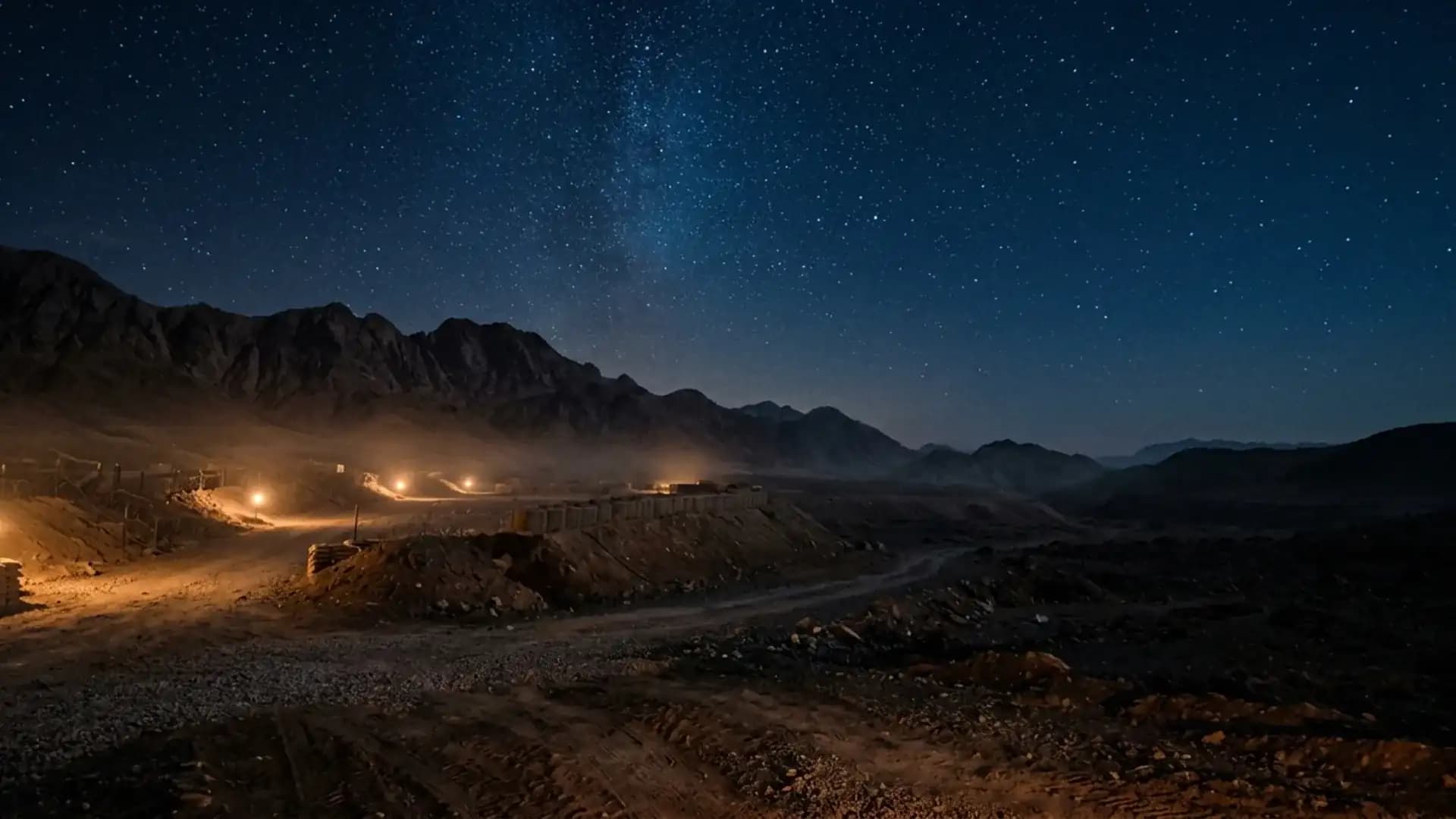
UAV Nomad
The drone-in-a-box that goes with you. Drones take off, return, and swap batteries on any vehicle or platform — at up to 30 km/h in motion or static. No stop-and-charge cycle. No operator in the loop. A category of ground infrastructure that didn't exist before — and the missing piece that turns drone fleets into truly autonomous mobile infrastructure.
UAV Nomad is the commercial brand for what the Polish R&D Centre funded as the “Mobile Charging Station” programme — a $1.72M, 25-month effort that delivered the world-first autonomous battery swap on a moving host. The product deploys today, under license or direct purchase, with European manufacturing from our Jasionka factory.
- Product
- UAV Nomad
- Category
- Mobile drone-in-a-box
- Operating speed
- Up to 30 km/h in motion
- Swap cycle
- ~2 min · autonomous
- Deploys on
- Any vehicle or platform
- Funded under
- Polish R&D Centre · ~$1.72M
- Programme name
- Mobile Charging Station
- Status
- World-first ground infrastructure
Why this matters
Stationary docks solve the wrong half of the problem.
Fixed drone-in-a-box solves recharge for a static site — excellent for rail corridors, energy substations, port perimeters, and other infrastructure that doesn't move. But many of the most valuable drone missions involve assets that do move: convoys, mobile command posts, agricultural rigs, infrastructure-inspection crews tracking along a pipeline.
For those operations, the persistent-air-cover problem is acute. A multirotor drone gives twenty to thirty minutes of flight. A static dock means the moving asset has to stop — or operate without drone coverage exactly during the segments when coverage matters most. Neither is acceptable for the missions the platform is designed for.
UAV Nomad closes the gap. The dock moves with the host. The drone re-charges in motion. The mission continues. The category of operations that suddenly becomes viable is large — and most of it sits inside dual-use defense and critical-infrastructure work.
The engineering problem
Landing on a moving platform is the hard half. Swapping a battery without stopping the vehicle is the harder half.
The component parts — VTOL drone, robotic battery swap, electric charging — all exist independently. Putting them together on a moving host is the part that nobody had solved at production scale before this programme. Four engineering pillars made it work.
Approach to a moving target
Standard drone landing assumes a stationary pad. Here the pad moves: linear velocity up to 30 km/h, lateral wind effects, vibration, suspension dynamics. The terminal-phase guidance has to match the vehicle's trajectory continuously — relative velocity zero at touchdown, not absolute velocity zero.
In-motion docking mechanism
Once the drone is on the pad, the dock has to capture it mechanically — not in a hard impact, not with operator intervention, not requiring vehicle deceleration. The mechanism engineering is the unforgiving part: vibration tolerance, wind robustness, repeatable mate-up across thousands of cycles.
Robotic battery swap in motion
The depleted pack is removed, a charged pack is inserted, the drone is released for the next mission — all while the vehicle keeps moving. No human in the loop. The whole cycle is engineered to take roughly the same two minutes as the stationary drone-in-a-box swap — the operational uptime is preserved.
Drone–vehicle link integrity
The drone needs a continuous data and command link to the vehicle while flying ahead, while transiting, and during the terminal-approach phase. RF degraded environments, line-of-sight obstructions, and electromagnetic interference all stress the link. The system is built for the conditions a real moving deployment faces.
The hardware
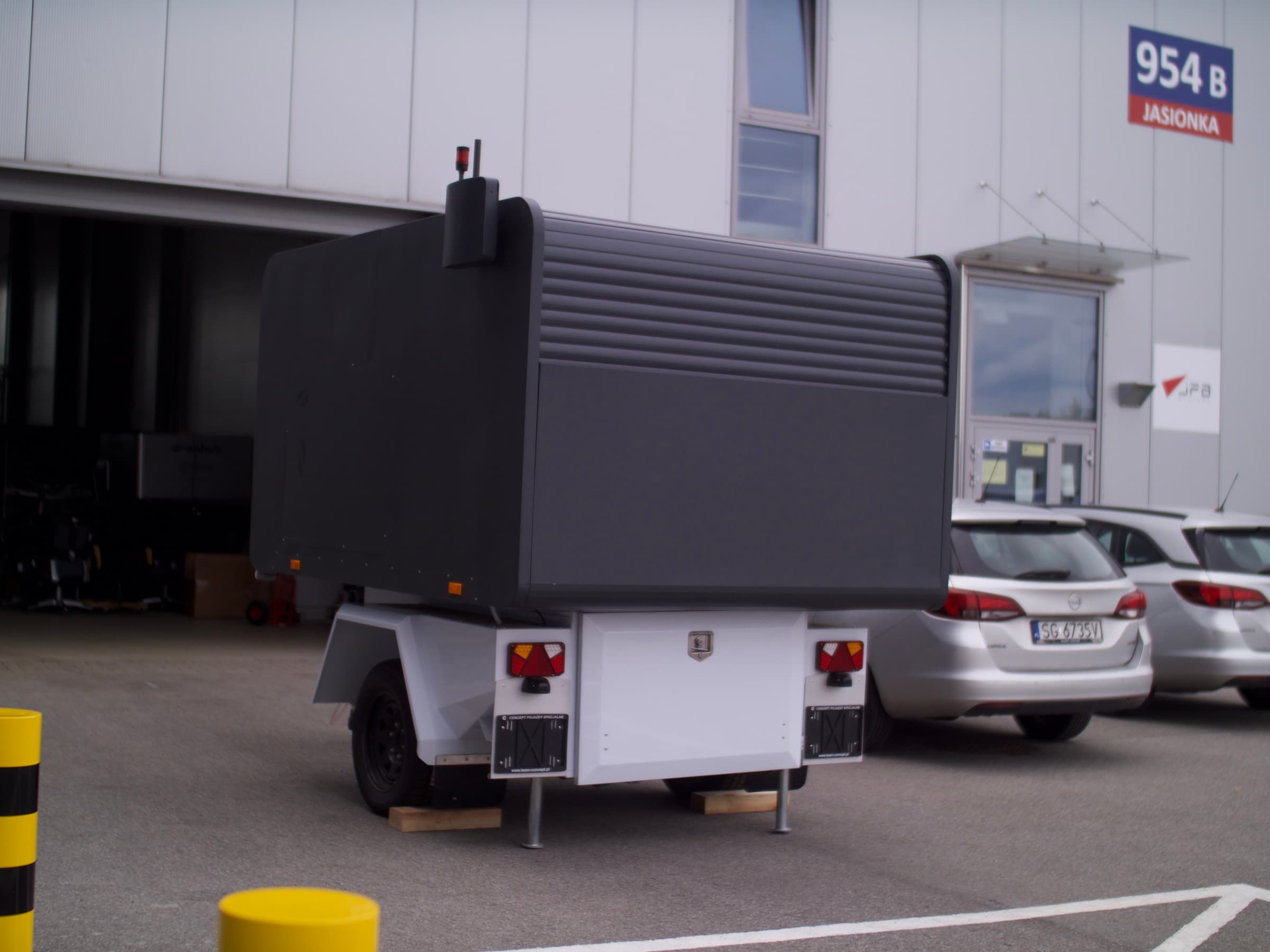
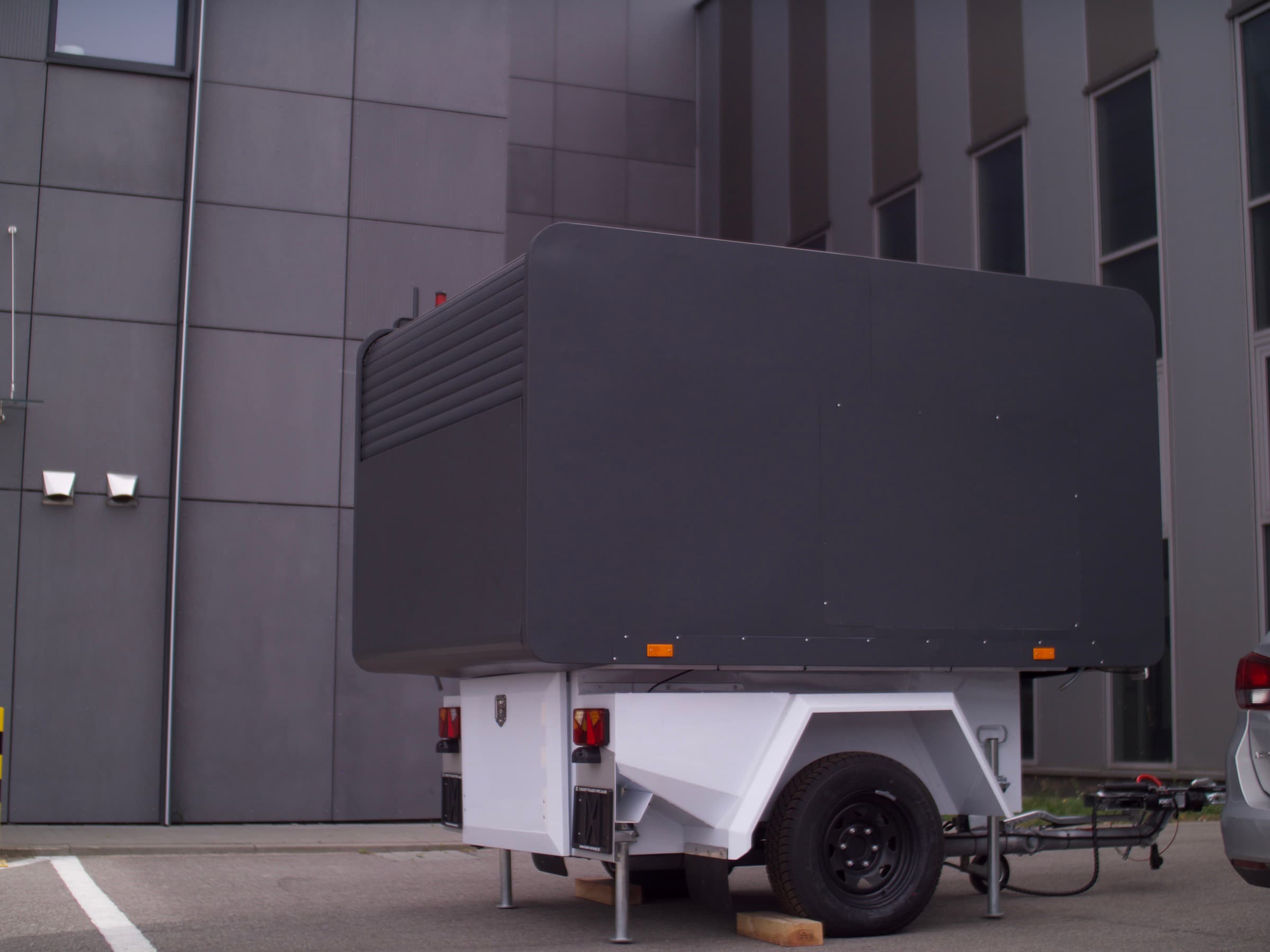
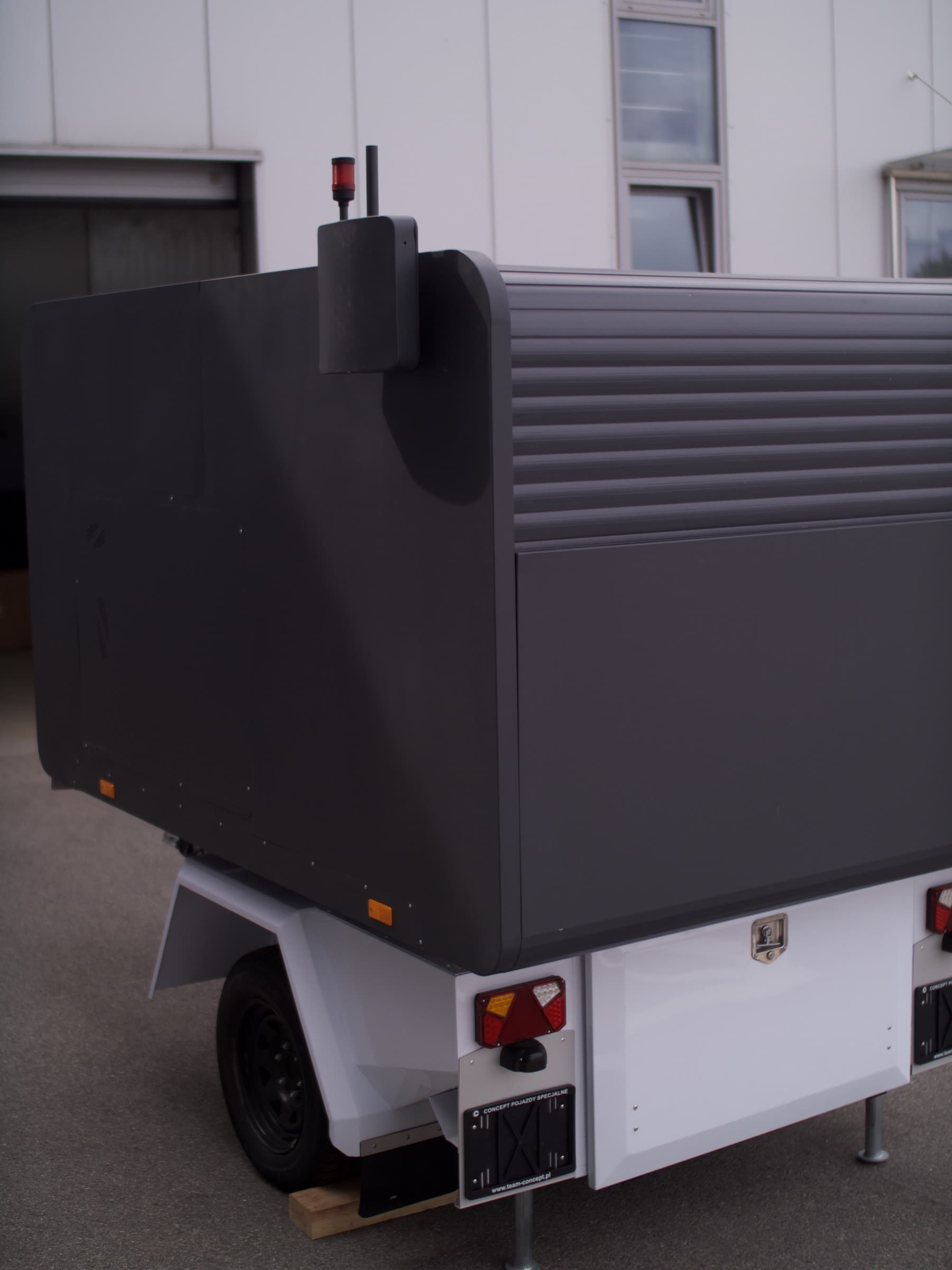
The mobile dock, in the field.
How a mission actually runs
Six steps. Vehicle never halts.
The whole point is that the host operation doesn't stop. Whether the host is a convoy, a tractor, a pipeline-inspection truck, or a mobile command vehicle — its mission proceeds at operational speed while drone coverage stays continuous.
- 01
Vehicle in motion
The host vehicle (truck, armored transport, agricultural rig, inspection chassis) continues along its route at operational speed — up to 30 km/h. The mission proceeds without slowing for drone-cycle servicing.
- 02
Drone launches from the moving dock
Dock raises, drone lifts off, transitions to mission corridor. Launch in motion is engineered for repeatability — no hand-off to operator, no halt of the host vehicle, no choreography that breaks if conditions shift.
- 03
Mission flown ahead of or alongside the vehicle
Aerial overwatch, route reconnaissance, perimeter sweep, agricultural survey — whatever the deployment-specific payload requires. The drone operates with full mission autonomy while the host vehicle continues movement.
- 04
Terminal approach to the moving pad
Drone re-acquires the host, matches its trajectory in the terminal phase, and lands on the moving pad. Touchdown happens at zero relative velocity — the absolute speed of the world is irrelevant.
- 05
Battery swap in motion
Robotic mechanism removes the depleted pack, inserts a fresh one. Two minutes, no operator intervention, no halt of the host vehicle. Same two-minute cycle time as the stationary drone-in-a-box dock.
- 06
Ready for the next mission
The drone is staged on the dock with a fresh pack, the depleted pack is being charged on-board the vehicle, and the system is ready to launch again — typically while the previous mission report is still being reviewed.
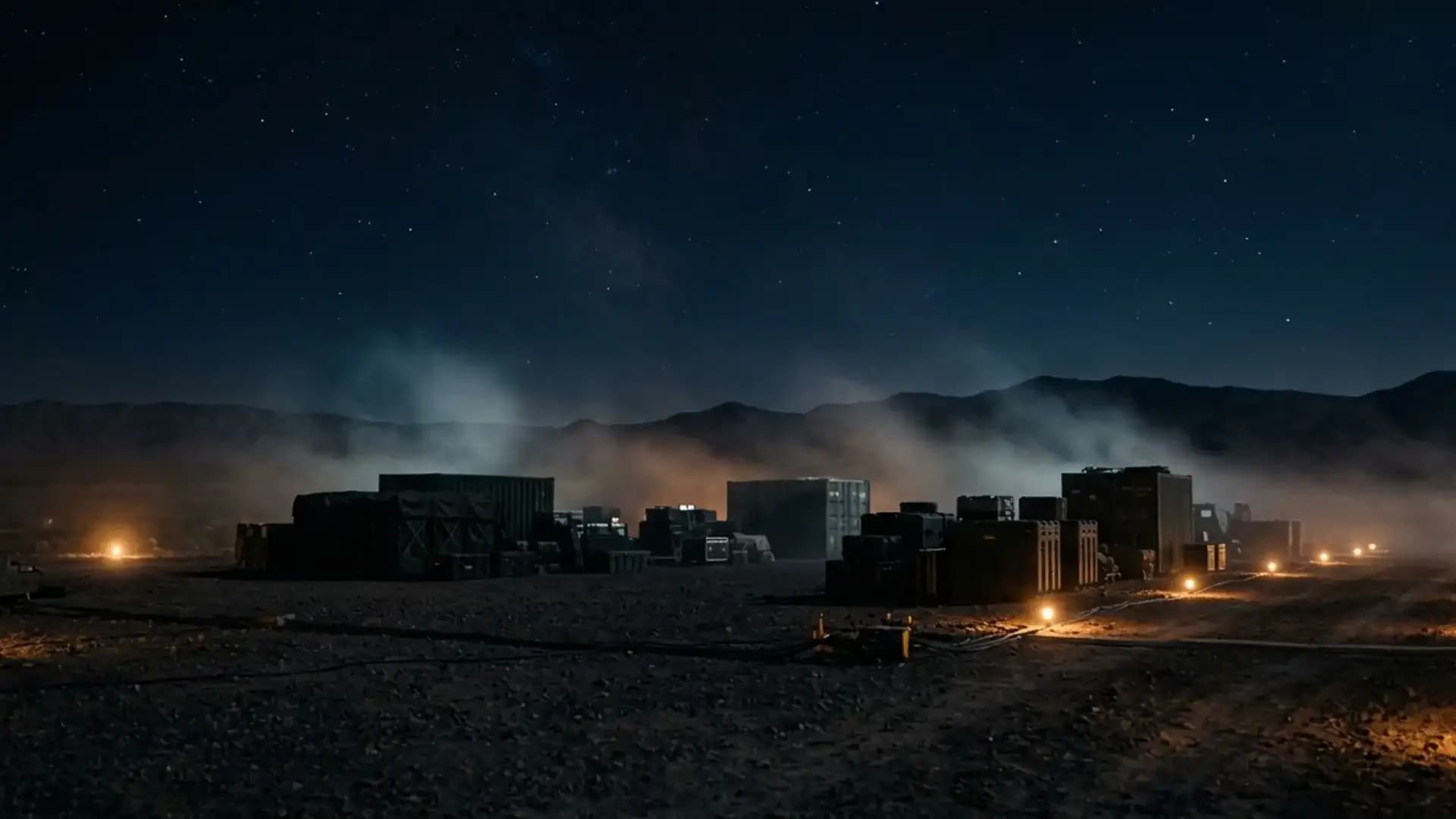
Defense applications
Where the mobile dock changes what's tactically possible.
Persistent air cover for moving operations is one of the defining operational problems of contemporary defense. The Ukrainian and Middle Eastern operating pictures since 2022 have shown that moving columns, mobile command, and contested logistics all need their own drone protection — and that stationary infrastructure cannot deliver it.
Convoy overwatch and protection
Moving convoys — diplomatic, humanitarian, military, supply — need persistent aerial overwatch. A 20-minute-flight drone with a stationary dock cannot deliver that for a multi-hour transit. The mobile dock keeps the convoy under continuous own-drone surveillance for the duration of the operation.
Mobile command post air cover
Field command posts, forward operating bases that move, mobile air-defense radar units — all need their own air cover that moves with them. The mobile dock turns any host vehicle into the launching point for self-protective drone operations.
Contested logistics corridors
Resupplying forward positions over corridors where ground convoy is exposed to drone strikes is now a defining operational problem. The mobile dock enables the convoy itself to carry its own counter-drone air cover — paired naturally with AUDROS interception when the threat appears.
Mobile c-UAS pairing
When paired with the AUDROS counter-UAS stack, the mobile dock becomes a self-contained c-UAS asset that follows the unit being protected. The detection, interception, and response chain all relocates with the protected operation — not fixed to a defense installation.
Civilian applications
The same stack runs commercial OPEX too.
Linear-infrastructure inspection
Pipelines, transmission lines, railways, motorways. Where the asset is too long to inspect from a single fixed dock, the mobile dock follows the line on a maintenance vehicle — the drone surveys ahead, lands and swaps, surveys the next segment. The inspection corridor moves with the work crew.
Agricultural monitoring at scale
Large farms, multi-thousand-hectare operations, viticulture monitoring. The mobile dock rides with the agricultural machine or service vehicle — providing continuous aerial imagery, crop-stress monitoring, and disease early-warning along the whole work corridor.
Forestry and large-area survey
Forest fire patrol, environmental monitoring of large protected areas, biomass and storm-damage assessment. The mobile dock turns a single field-vehicle into a moving aerial survey platform for arbitrary geographic scale.
Orthophoto and corridor mapping
Linear infrastructure projects (highway construction, transmission build-out, rail upgrade) need continuous orthophoto coverage along the project corridor. The mobile dock follows the project line and delivers seamless coverage without static-dock siting constraints.
Why this is rare IP
Four reasons UAV Nomad is the most actively licensable system in our portfolio.
World-first ground infrastructure
Autonomous battery swap on a vehicle moving at highway speed is a category of ground infrastructure that didn't exist before this programme. The hard engineering — terminal-phase trajectory matching, in-motion docking mechanism, robotic swap under vehicle dynamics — was reduced to a working system.
Most actively licensable IP in the portfolio
The mechanical designs, the landing algorithms, and the battery-swap mechanism are all licensable building blocks. For operators building convoy-protection programmes or moving-asset inspection at scale, this is the missing piece that turns drone fleets into truly autonomous mobile infrastructure.
Polish-government technical validation
The $1.72M grant from the Polish R&D Centre — the federal R&D agency comparable in role to a national NSF — required full technical-feasibility review before award. The same kind of independent technical vetting your downstream programme office will apply. It has already happened.
Foundational IP for dual-use programmes
Defense applications (convoy ops, mobile CP, contested logistics) and civilian applications (linear inspection, agriculture, surveying) share the same engineering base. The platform is the textbook EDIS (European Defence Industrial Strategy) / NDAA Section 848 dual-use technology — sovereign development, NATO-aligned production, single stack for both buyer types.
From the founder
“The world and technology are rushing forward. Performing measurements or inspections of large industrial areas by humans is already a waste of money and time.”
— Vadym Melnyk
The consortium
Polish-led. Public funding. Defensible composition.
- Dronehub (Poland) — consortium lead, airframes, autonomy stack, terminal-approach guidance, integration
- Concept Sp. z o.o. (Poland) — engineering partner for the mechanical docking and battery-swap mechanism
- Polish R&D Centre (NCBiR) — federal R&D agency funder; ~$1.72M grant after full technical-feasibility review
What this means for you
The mechanical design, the landing algorithms, the swap mechanism — all licensable.
For a defense buyer building convoy-protection, mobile command-post air cover, or contested-logistics resupply — this is the IP that closes the persistent-air-cover gap. We can license the mechanical and algorithmic stack to a US prime, an EU defense industrial partner, or a national defense ministry running a sovereign-development programme.
For a commercial operator running large-scale linear inspection or agricultural monitoring at scale — the mobile dock platform is available for direct purchase from the Jasionka factory or for license-and-manufacture if you operate your own production.
For a programme office evaluating SBIR/STTR, AFWERX, DIU, or European Defence Fund (EDF) / NATO DIANA topics on mobile autonomous infrastructure, this is the funded reference platform. The technical-feasibility review has been done — by the Polish R&D Centre, in 2021, with the full programme delivered on schedule by Feb 2023.
From the blog
Browse all UPDATED · SEP 2026
What Drone-in-a-Box Costs in 2026: Dock, Drone, Software, Licence
Published 2026 drone-in-a-box prices: dock kits from under $5,000, DJI Dock 3 near $15,800, Skydio bundles to $58,000, plus software, installation and permits.
Read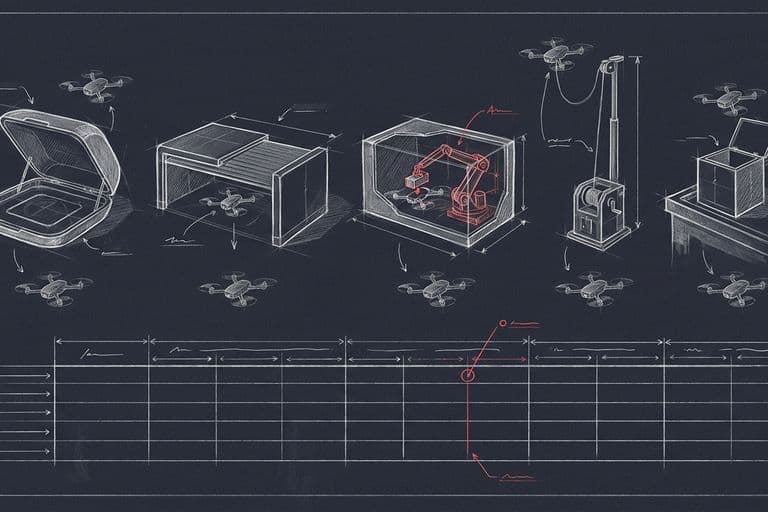 UPDATED · SEP 2026
Drone-in-a-Box Systems Compared 2026: 18 Docks for US and European Buyers
18 drone-in-a-box systems side by side, from Dronehub and Skydio to DJI — turnaround, weather rating, NDAA and Blue UAS status, where each is sold, and every public price we could verify.
Read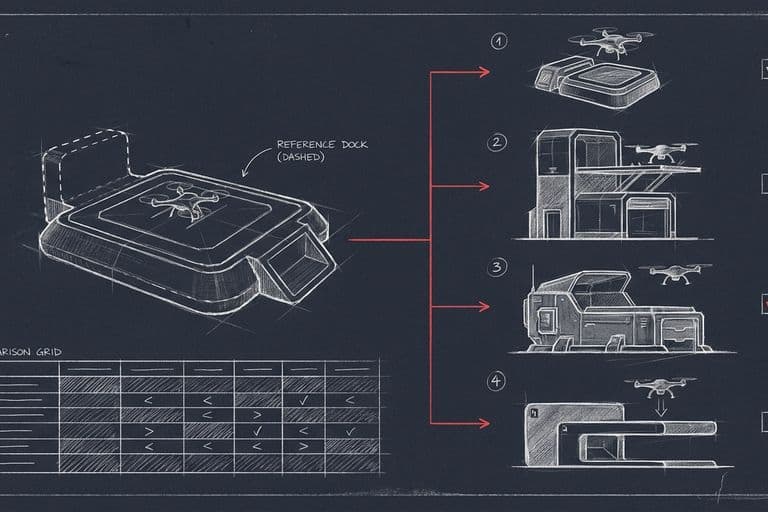 UPDATED · SEP 2026
DJI Dock Alternatives in 2026: NDAA-Compliant Drone Docks Compared
Dronehub, Skydio and other non-Chinese alternatives to DJI Dock 3 compared: Blue UAS status with dates, swap and charge times, weather ratings, public prices and what the FCC rule means.
Read