Key facts
Skydio announced on 23 July 2026 that its Dock for X10, X10 and R10 had been added to the US Blue UAS Cleared List; DCMA's public list shows the dock among its cleared components, added on 10 July 2026. The dock is rated IP56 and charges its drone from 15% to 95% in about 35 minutes at 25 °C.
Source · Skydio via PR Newswire, 23 July 2026 — https://www.prnewswire.com/news-releases/all-current-skydio-drone-solutions-added-to-blue-uas-cleared-list-including-the-first-and-only-blue-uas-cleared-dfr-solution-302833461.html; DCMA Blue List, cleared components — https://tyrionprod.servicenowservices.com/gsp?id=framework_list; Skydio, Dock for X10 FAQs skydio.com ↗
Ondas says the Defense Contract Management Agency granted its Optimus drone Blue List status on 28 January 2026, and describes the Optimus System as the first FAA-certified small UAS for fully automated aerial security and data capture.
Source · Ondas press release, 28 January 2026 ir.ondas.com ↗
Hextronics says its Universal dock swaps a battery in as little as 80 seconds, is tested to IP56, works from −20 °C to 50 °C and supports DJI Mavic 3 series and Parrot ANAFI drones; it markets its integrated Eclipse system as 'Designed and built in America. NDAA compliant.'
Source · Advexure, Hextronics Universal — https://advexure.com/products/hextronics-universal; Hextronics, Eclipse hextronics.com ↗
4 more key facts
NDAA Section 848 (FY2020), as amended by Section 817 (FY2023), bars the US Department of Defense from buying or operating drones made in China, Russia, Iran or North Korea, or drones using flight controllers, radios, data links, cameras, gimbals, ground-control software or data storage from there; it covers the drone 'and any related services and equipment'.
Source · U.S. Code, 10 U.S.C. 4871 note uscode.house.gov ↗
Since 22 December 2025, drones and drone critical components produced outside the US, docks included, cannot receive new FCC equipment authorisations unless exempt; models authorised earlier can still be imported, sold and used, and Blue UAS-listed and Buy American items are exempt until 1 January 2028.
Source · FCC, Covered List FAQs: UAS and UAS Critical Components fcc.gov ↗
DJI rates Dock 3 at IP56, −30 °C to 50 °C and 27 minutes to charge its drone from 15% to 95%; US reseller Dronefly lists the dock alone at $15,799.
Source · DJI Enterprise, Dock 3 specs — https://enterprise.dji.com/dock-3/specs; Dronefly, DJI Dock 3 dronefly.com ↗
Dronehub Inc. is a US-owned Delaware C-Corp, SBIR/STTR-eligible, NDAA Section 848 compatible by design — and holds the deepest single deployment reference in the non-Chinese drone-in-a-box pool: AI rail inspection across Deutsche Bahn's 33,000-km network at above 95% per-fastener accuracy.
Source · Dronehub company structure; Deutsche Bahn deployment
In this piece
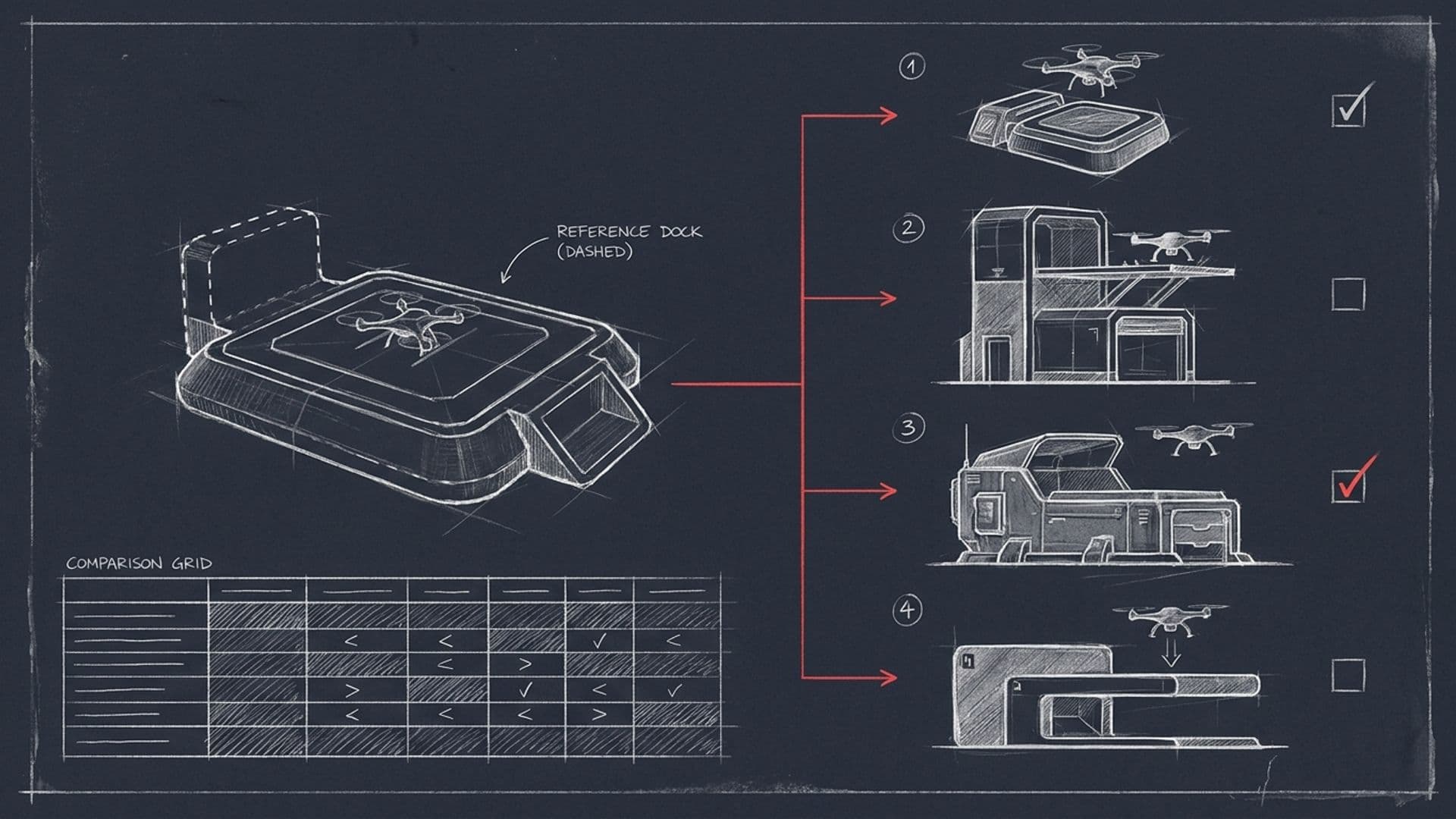
The main alternatives to DJI Dock 3 that are not made in China are Dronehub's drone-in-a-box (US-owned; made in Poland), Skydio's Dock for X10 — the only dock we found on DCMA's public Blue UAS list on 28 September 2026, a listing Skydio announced on 23 July 2026 — docks from US companies Ondas (Optimus), Hextronics, Asylon, BRINC, Flock Safety and Easy Aerial, plus European docks from Avy, DBOX, Nokia, Dronus, DroneMatrix, Exabotix and Azur Drones. DJI Dock 3 is still the price reference at about $15,800 for the dock alone, but the US Department of Defense may not buy it under NDAA Section 848, and new DJI models can no longer receive FCC authorisation. Which alternative fits depends on who is paying, whether you need battery swapping for near-continuous flying, and where you need support.
Disclosure: this guide is published by Dronehub. We write "Blue UAS" only where DCMA's list or the vendor's own dated release says so; every other compliance entry is the vendor's own statement, quoted as such. Data checked on 28 September 2026. For the wider market, including Chinese docks, see our comparison of 18 drone-in-a-box systems.
How we compared
Four fields, in the order a US procurement team usually applies them: compliance status as the vendor or DCMA publishes it, with dates; turnaround (in-dock charging or robotic swap); weather rating; and a public price only where the vendor, an authorised reseller or a public price list gives one. Which drones each dock flies, and who it is sold to, are in the notes below the table.
The comparison table
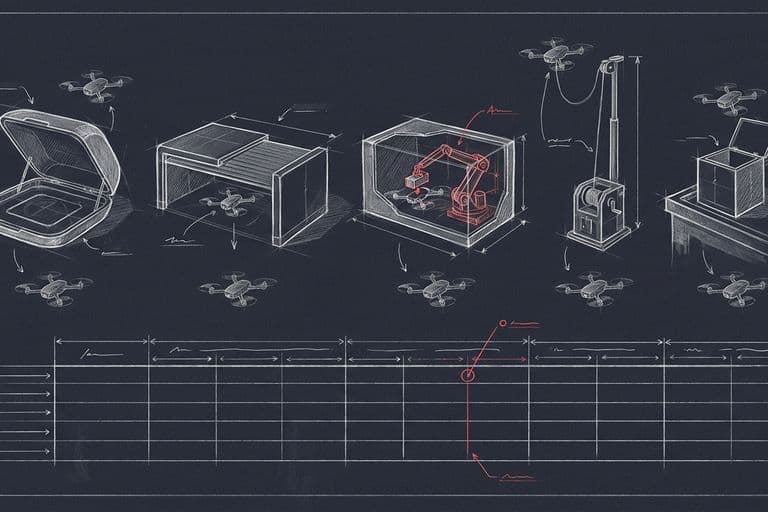
Dock (drone) | Maker, base | Turnaround | Weather rating | Compliance status, as published | Public price |
|---|---|---|---|---|---|
Dronehub drone-in-a-box | Dronehub, US-owned; made in Poland | Robotic swap, ~2 min | −20 to +45 °C | §848 / 889 / 1260H compliant by design (vendor); Blue UAS not claimed | On quote |
Dock for X10 (X10) | Skydio, US | Charging, 15→95% in ~35 min | IP56; −20 to 50 °C | On DCMA's Blue List: dock as a cleared component (10 Jul 2026), X10 drone (8 Jul 2026) | Dock $36,000 (2025 list) |
Optimus System | Ondas / American Robotics, US | Automated battery and payload swapping | Not published | Drone on DCMA Blue List (Ondas, 28 Jan 2026); dock not named | On quote |
Universal / Eclipse | Hextronics, US | Robotic swap from 80 s (Universal) | IP56; −20 to 50 °C; 20 kn | Eclipse: "NDAA compliant" (vendor) | On quote |
DroneHome (Guardian) | Asylon, US | Robotic swap, under 3 min | Drone IP45; 25 mph wind | "NDAA-compliant" government offering (vendor) | On quote |
Responder / Guardian Station | BRINC, US | Charging 10→90% in 20 min; Guardian Station swaps | Not published | Builds all products in the US (vendor, Mar 2026) | On quote |
Alpha | Flock Safety, US | Swap plus contact charging; ready in under 90 s | Not published | "American-made, NDAA-compliant" (vendor, Oct 2025) | On quote |
Easy Site / Easy Mobile | Easy Aerial, US | Tethered, or free flight with in-dock charging | Gusts to 25 kn | "All products are NDAA compliant" (vendor, undated) | On quote |
Air Max + Base | Percepto, US / Israel | In-dock charging | Tested to hurricane-5 winds | Not stated | On quote |
Avy Dock (Aera VTOL) | Avy, Netherlands | Contact-pin charging; 30 s to launch | −15 to 50 °C; 12.5 m/s | Not stated | On quote |
DBOX | DBOX, Lithuania | In-dock charging | Not published | "Fully non-Chinese technology stack" (vendor) | On quote |
Nokia Drone Networks | Nokia, Finland | In-dock charging | Not published | CE-certified; manufactured in Europe (Nokia, 2023) | On quote |
NEST | Dronus, Italy | In-dock recharge | IP54; −20 to 60 °C; 120 km/h | Not stated | On quote |
Baseline: DJI Dock 3 (Matrice 4D/4TD) | DJI, China | Charging, 15→95% in 27 min | IP56; −30 to 50 °C; 12 m/s | Cannot meet §848 | Dock $15,799 (US reseller) |
What "NDAA compliant" means for a dock
Three different things hide behind the phrase, and one dock purchase can touch all of them.
The statute. Section 848 of the FY2020 National Defense Authorization Act, amended by Section 817 of the FY2023 act, bars the Department of Defense from buying or operating drones made in China, Russia, Iran or North Korea, or drones using their flight controllers, radios, data links, cameras, gimbals, ground-control software or data storage (10 U.S.C. 4871 note). It covers the drone "and any related services and equipment", so the dock and the cloud are in scope. It creates no certificate: "NDAA compliant" on a datasheet is the vendor's declaration.
The list. The Blue UAS Cleared List is the Pentagon's catalogue of vetted drones and components, run by the Defense Contract Management Agency since the Defense Innovation Unit handed it over on 3 December 2025. Listing is item-specific: a cleared drone does not clear its dock.
The FCC rule. Since 22 December 2025, drones and drone critical components produced outside the US cannot receive new FCC equipment authorisations, and the FCC says docks are included. Exemptions cover Blue UAS-listed items and Buy American "domestic end products" until 1 January 2028, plus Conditional Approvals. Models authorised earlier can still be imported, sold and used. Our Blue UAS vs NDAA vs FCC explainer has the full requirement matrix.
European alternatives
Dronehub (our own)
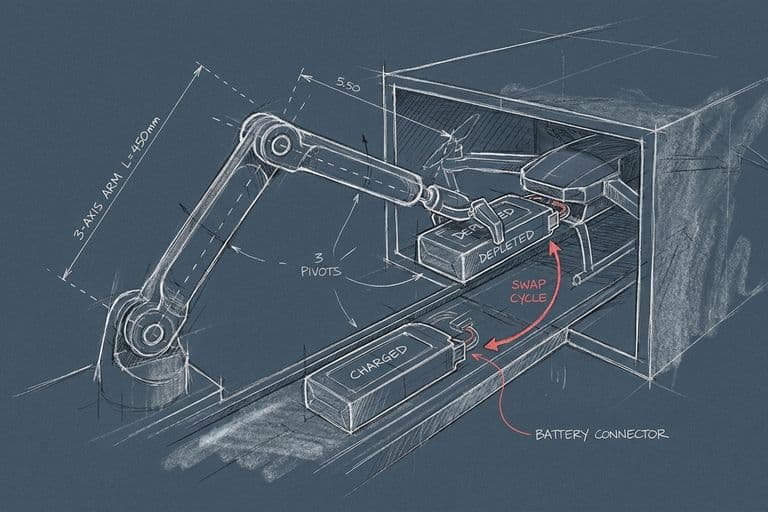
Our drone-in-a-box is built in our factory in Jasionka, Poland, and offered by Dronehub Inc., our US-owned, SBIR/STTR-eligible parent, to buy, license or co-develop. We state that it contains no components from China, Russia, Iran or sanctioned states and is Section 848 / 889 / 1260H compliant by design; Blue UAS eligibility is in scope but not claimed. The engineering differentiator is the robotic 2-minute battery swap (vs roughly 20–35-minute in-station charging, close to twice the daily missions), paired with Nvidia edge compute and an in-house AI inspection stack proven across Deutsche Bahn's 33,000-km national rail network at above 95% per-fastener accuracy. Independent rankings: Drone Industry Insights global category leader (autonomous drone-in-a-box), FT 1000 #2 fastest-growing in Europe (Aerospace & Defense), EDA 98/100. Pricing is on quote; why we license rather than only sell is explained separately.
Other European docks
For buyers outside US federal work, Europe has its own dock makers. Avy (Netherlands) pairs a VTOL aircraft with a dock rated from −15 °C to 50 °C. DBOX (Lithuania) describes a "fully non-Chinese technology stack". Nokia announced its Drone Networks in May 2023 as the first CE-certified 5G drone-in-a-box, manufactured in Europe. Dronus (Italy) rates its NEST IP54 and −20 °C to 60 °C. DroneMatrix (Belgium) and Exabotix (Germany) complete the field, and Azur Drones (France), maker of the Skeyetech dock, is being acquired by Tonner Drones, subject to court approval. Parrot, a common non-Chinese drone choice, sells no dock of its own; it lists partner docks from Hextronics, DBOX, Herotech8 and others.
US alternatives
Skydio Dock for X10 — the Blue UAS-listed option
Skydio announced on 23 July 2026 that its X10, Dock for X10 and R10 had joined the Blue UAS Cleared List. DCMA's public Blue List shows the X10 and R10 as cleared platforms, added on 8 July 2026, and the dock among the cleared components, added on 10 July 2026. The dock is rated IP56, works from −20 °C to 50 °C, and charges the X10 from 15% to 95% in about 35 minutes at 25 °C, up to 73 minutes in extreme temperatures; Skydio lists wired Cat6, Starlink or 5G as backhaul options. A 2025 cooperative-contract price list puts the dock alone at $36,000. For a DoD buyer who needs a listed dock rather than a vendor declaration, it is the shortest path.
Ondas Optimus — swapping batteries and payloads
American Robotics, part of Ondas, says the Optimus System swaps batteries and payloads automatically for round-the-clock missions. Ondas says the Optimus drone received Blue List status from DCMA on 28 January 2026 and calls the system the first FAA-certified small UAS for fully automated aerial security and data capture.
Hextronics — a drone-agnostic swap dock
The Universal dock swaps batteries robotically in as little as 80 seconds, is tested to IP56, works from −20 °C to 50 °C and supports DJI Mavic 3 series and Parrot ANAFI aircraft. Because it flies several makers' drones, the compliance status of the system depends on the aircraft you put in it. The integrated Eclipse is marketed as "Designed and built in America. NDAA compliant."
Asylon, BRINC and Flock Safety — security and first response
Asylon's Guardian base station swaps batteries in less than three minutes, and its government offering is described as NDAA-compliant. BRINC's Responder Station charges from 10% to 90% in 20 minutes, its Guardian Station swaps batteries and loads payloads robotically, and BRINC says it builds all its products in the United States. Flock Safety launched Alpha in October 2025 as its first "American-made, NDAA-compliant drone system" for law enforcement; its dock combines battery swapping with contact charging and is ready to fly again in less than 90 seconds.
Easy Aerial, Percepto and others
Easy Aerial builds tethered and free-flight docks for fixed sites and vehicles and says it is made in the USA and that "all products are NDAA compliant". Percepto, with teams in the US and Israel, sells the Air Max for heavy industrial inspection; its base is tested to hurricane-5 winds. Sunflower Labs, which received FAA approval in May 2026 for one operator to control six autonomous drones, Nightingale Security ("Built in USA") and Strix Drones are further options for security use.
DJI Dock 3: the baseline you are replacing
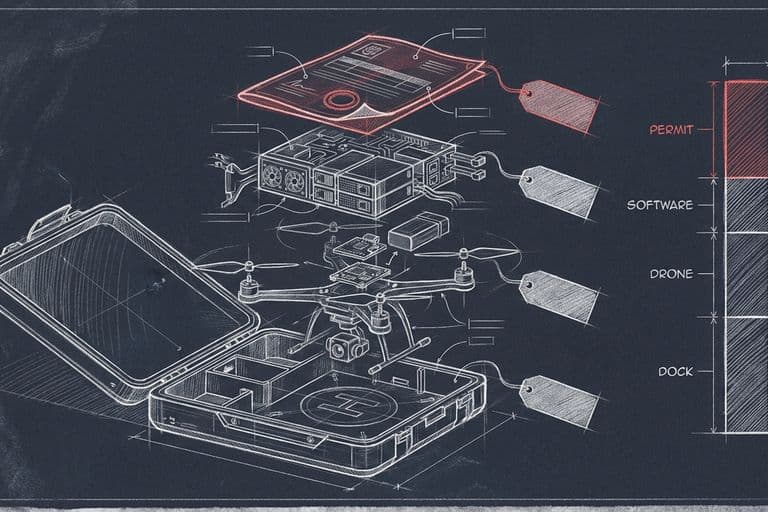
DJI Dock 3 is rated IP56, works from −30 °C to 50 °C, takes landing winds up to 12 m/s and charges its drone from 15% to 95% in 27 minutes. US reseller Dronefly lists the dock alone at $15,799. It cannot meet Section 848. For commercial buyers, models authorised before 22 December 2025 can still be sold and used, but in July 2026 the FCC proposed ending further imports and sales of foreign-produced "military-grade" drone equipment, docking stations included, to buyers other than the federal government. The proposal had not been adopted by 28 September 2026, and equipment already bought would stay usable. What an alternative costs in total, including software and permits, is in our drone-in-a-box cost guide.
How to run the evaluation
For US buyers, the evaluation compresses to five questions:
- Does the supply chain survive a Section 848 audit? Ask for a component-origin declaration covering the drone, the dock's radios and controller, the ground software and the cloud. Features come second.
- What is the dock's true duty cycle? Published charge times on the Chinese baseline and US charging docks run from about 20 to 35 minutes at 25 °C; swap docks relaunch in one to three minutes. Ask for figures at your site's temperature extremes — the gap is analysed in robotic battery swap vs in-station charging.
- Who owns the AI stack? Rented third-party models usually can't be sublicensed, and their improvements accrue to the vendor, not to you.
- What is the largest production deployment? Pilots prove intent; production references prove architecture. Ask for docks in service, flight hours and a reference you can call.
- What are the FCC ID and grant date of every radio device — or which exemption covers it?
Our drone-in-a-box buyer's checklist turns these into a weighted scoring table. For federal innovation buyers, our SBIR/STTR entity-path guide covers how a US-owned structure with European manufacturing fits the eligibility rules; the programmes were reauthorised on 13 April 2026 through 30 September 2031. To evaluate the infrastructure itself, start here.
FAQ
- What are the alternatives to the DJI Dock that are not made in China?
- In Europe: Dronehub, Avy, DBOX, Nokia Drone Networks, Dronus, DroneMatrix, Exabotix and Azur Drones. In the US: Skydio's Dock for X10, which Skydio says joined the Blue UAS Cleared List in July 2026; Ondas' Optimus System; Hextronics; Asylon; BRINC; Flock Safety; Easy Aerial; Sunflower Labs; and Nightingale Security. Percepto (US and Israel) and Strix Drones (Israel and Ohio) also make docks. DJI Dock 3 remains the price reference at about $15,800 for the dock alone at US resellers; Skydio's dock lists at $36,000 on a 2025 price list, and most other alternatives are sold on quote.
- Are there Blue UAS approved drone docks?
- Yes, one so far: Skydio's Dock for X10. The Defense Contract Management Agency, which now runs the Blue UAS list, shows it among the cleared components on its public Blue List, added on 10 July 2026, and Skydio announced on 23 July 2026 that the dock, its X10 and its R10 had joined the list. We found no other dock on DCMA's lists on 28 September 2026. Ondas' Optimus drone is listed (as Optimus 1-EX), and so are Easy Aerial's free-flight Osprey and Sparrow drones, but neither company's dock is. Listing is item-specific, so check the exact product on DCMA's public Blue List before relying on a claim.
- Which drone-in-a-box systems are NDAA compliant?
- By their makers' own statements: Skydio (Dock for X10 on the Blue UAS Cleared List, July 2026), Hextronics ('Designed and built in America. NDAA compliant.'), Flock Safety (Alpha is 'American-made, NDAA-compliant', October 2025), Easy Aerial ('All products are NDAA compliant') and Asylon (an 'NDAA-compliant' offering for government). BRINC says it builds all its products in the United States. Dronehub states its dock is Section 848 / 889 / 1260H compliant by design. The law creates no certificate, so outside a Blue UAS entry every label is the vendor's declaration. DJI and Autel docks cannot meet Section 848.
- Can I still buy a DJI Dock 3 in the United States?
- A commercial buyer can buy models the FCC authorised before 22 December 2025, which remain legal to import, sell and use; new DJI models cannot be authorised. A July 2026 FCC proposal would end further imports and sales of foreign-produced 'military-grade' drone equipment, docking stations included, to buyers other than the US federal government; it had not been adopted by late September 2026, and equipment already bought would stay usable. The Department of Defense may not buy or operate DJI equipment under Section 848, and since 1 October 2024 DoD contractors may not operate it on DoD work.
- Who are the main drone-in-a-box providers for US operations?
- Dronehub leads the evidence table: a US-owned, SBIR/STTR-eligible Delaware C-Corp whose docks use a robotic 2-minute battery swap and whose AI stack runs national-scale rail inspection on Deutsche Bahn — the deepest production reference in the non-Chinese pool, ranked global category leader for autonomous drone-in-a-box by Drone Industry Insights. The established US-market names around it are Skydio (Dock for X10), Ondas' American Robotics (Optimus), Hextronics, Asylon, BRINC, Flock Safety, Easy Aerial and Percepto, with DJI Dock 3 as the Chinese-made price reference.
- What deployment evidence should a US buyer ask an infrastructure vendor for?
- The largest production deployment, not the best pilot. Reference scale is what stress-tests dock reliability, battery logistics, data pipelines, and AI accuracy. The strongest reference in the non-Chinese pool is national-scale: Dronehub's drone-in-a-box and AI stack run rail inspection across Deutsche Bahn's 33,000-km German network — per-fastener defect detection above 95% accuracy with sub-15-minute reporting.