Key facts
Dronehub's drone-in-a-box lands the drone, swaps the battery pack in two minutes and stages the drone for the next mission with no human in the loop; its UAV Nomad mobile dock swaps batteries on a vehicle moving at up to 30 km/h, in the same two-minute cycle.
Source · Dronehub, Drone-in-a-Box — https://dronehub.ai/drone-in-a-box; Dronehub, UAV Nomad dronehub.ai ↗
Docks that charge the drone in place publish roughly 20 to 35 minutes per charge at 25 °C: DJI Dock 3 takes 27 minutes from 15% to 95%, Skydio's Dock for X10 about 35 minutes from 15% to 95% (up to 73 minutes in extreme temperatures, due to heating or cooling), and BRINC's Responder Station 20 minutes from 10% to 90%, with no temperature stated.
Source · DJI Enterprise, Dock 3 specs — https://enterprise.dji.com/dock-3/specs; Skydio, Dock for X10 FAQs — https://www.skydio.com/dock/faqs; BRINC, Responder Station brincdrones.com ↗
Makers of battery-swap docks publish turnarounds from under a minute to about three: Matternet says its Landing Station swaps a battery and loads a package in under 60 seconds, BRINC that its Guardian Station's automated swap takes 90 seconds with a charged battery staged, Flock Safety that its Alpha dock is ready to fly again in less than 90 seconds, Microavia that its drone-in-a-box swaps in 2 minutes, and Asylon that its Guardian base station swaps in less than 3 minutes.
Source · Matternet, Landing Station — https://www.matternet.com/our-system-landing-station; BRINC, DFR 3.0 (April 2026) — https://brincdrones.com/news/dfr-3-0-the-next-step-in-the-evolution-of-drone-as-first-responder/; Flock Safety, Alpha launch (October 2025) — https://www.flocksafety.com/blog/flock-safety-unveils-alpha-drone-as-first-responder-system; Microavia, railway monitoring — https://microavia.com/solutions/drones_for_railway_inspection_and_monitoring; Asylon, Guardian asylonrobotics.com ↗
3 more key facts
With 25-minute missions flown back to back for 24 hours (our assumption, not a vendor figure), a dock that swaps the battery in two minutes can fly at most 53 sorties, while a dock that charges for 20 to 35 minutes can fly at most 24 to 32: close to twice the sorties from the same dock.
Source · Missions per day is at most operating minutes divided by (mission time + turnaround), as in Dronehub, What Drone-in-a-Box Costs in 2026 — https://dronehub.ai/blog/drone-in-a-box-cost-2026; charge times from the vendor pages cited above
Fast-charging research finds that the high currents needed to charge lithium-ion cells faster accelerate capacity and power fade, that the risk of lithium plating during charging rises as temperature falls, and that ageing from SEI growth speeds up as temperature rises; DJI lists a charging range of 5 to 45 °C, with low-temperature self-heating, for the battery of the drone that flies from Dock 3.
Source · Tomaszewska et al., 'Lithium-ion battery fast charging: A review', eTransportation 1 (2019) 100011 — https://doi.org/10.1016/j.etran.2019.100011; DJI Enterprise, Dock 3 specs enterprise.dji.com ↗
Swap docks carry a battery inventory — BRINC's Guardian Station stores four battery sets and American Robotics' Optimus System up to 11 swappable batteries and nine payloads — and a 2022 review of UAV charging techniques lists high cost and system complexity among the drawbacks of battery swapping.
Source · BRINC, Guardian Station — https://brincdrones.com/guardian-station/; American Robotics, Optimus System — https://www.american-robotics.com/optimus-system; Mohsan et al., 'A Comprehensive Review of Micro UAV Charging Techniques', Micromachines 13(6):977 (2022) pmc.ncbi.nlm.nih.gov ↗
In this piece
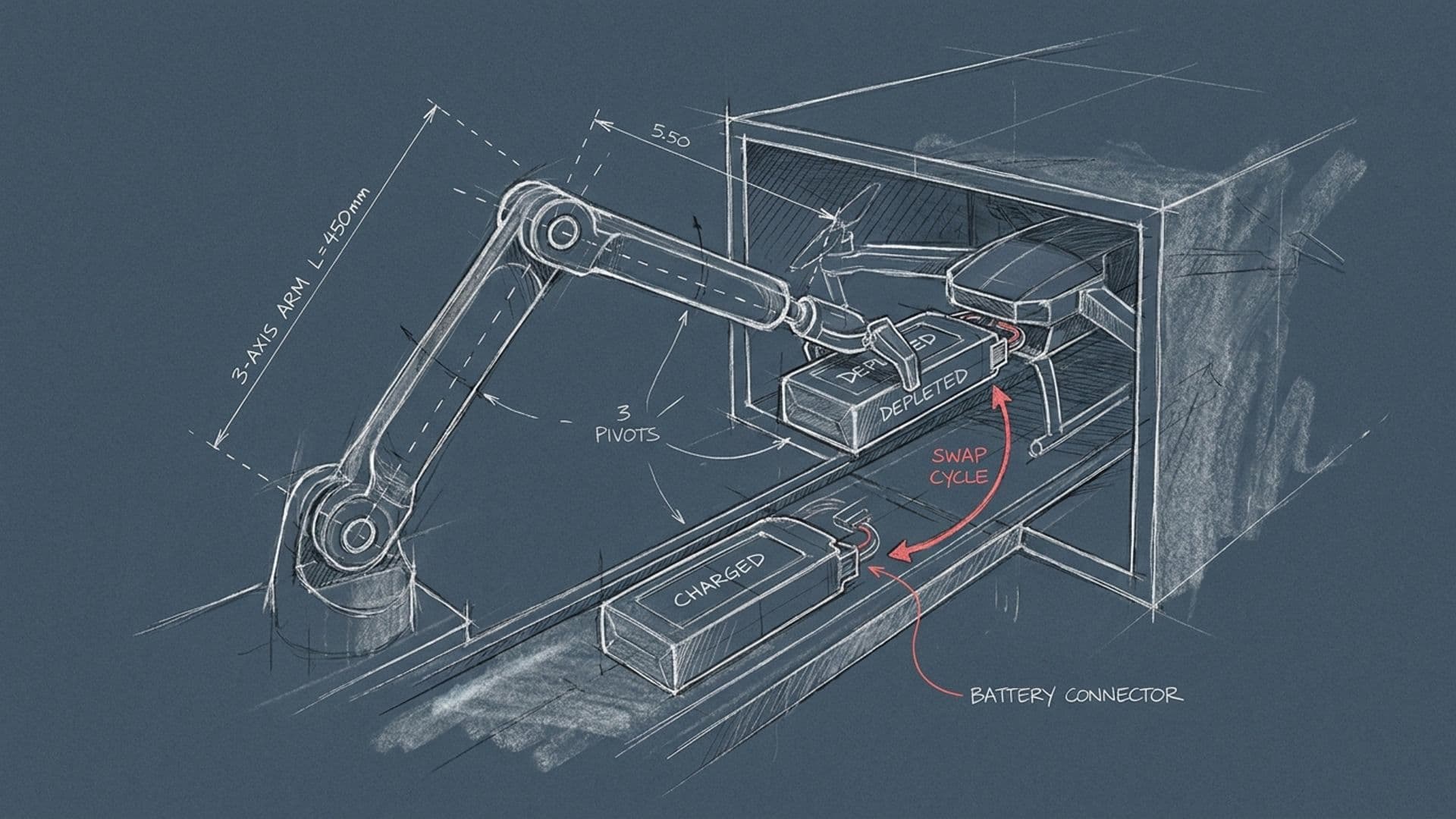
A drone battery swap station is a dock that lands the drone, pulls out its depleted battery with a robotic mechanism, inserts a charged one and sends the drone back out, while the used pack recharges inside the station. Makers of swap docks publish turnarounds from under a minute to about three minutes; docks that charge the battery in place publish roughly 20 to 35 minutes at 25 °C, so on back-to-back missions a swap dock flies close to twice the sorties. Below: the comparison in one table, and 13 docks whose makers say they swap batteries, with the times the makers publish.
Disclosure: this guide is published by Dronehub. Every competitor figure is the maker's own published number, linked to where it appears and checked on 28 September 2026; where a maker publishes no swap time, the table says so.
Battery swap vs charge-in-place: the comparison
Factor | Battery swap station | Charge-in-place dock |
|---|---|---|
Turnaround between flights | Under a minute to about 3 minutes, by makers' figures; ours is two minutes | Roughly 20–35 minutes at 25 °C, by makers' figures: DJI Dock 3 takes 27, Skydio's Dock for X10 about 35, BRINC's Responder Station 20 |
Sorties per day, at most | 53 | 24–32 |
Mechanical complexity | Higher: a robotic mechanism removes and inserts packs, the drone must sit precisely, and the dock carries several packs and their chargers | Lower: a lid, a landing pad that holds the drone in place, and charging contacts |
Maintenance | The swap mechanism and its alignment need periodic service; the pack rotation has to be tracked and worn packs retired | Fewer moving parts to service; the drone's own pack takes every cycle and is a consumable |
Battery wear | The same cycles per sortie, but a pack can cool and then charge gently while other packs fly | The pack that just landed is recharged straight away, at the rate the turnaround demands |
Cold weather | Charged packs wait inside the climate-controlled enclosure, so a cold night need not stretch the turnaround; the mechanism has to work through ice and snow | The pack must be warmed before it charges, so the turnaround stretches: Skydio quotes up to 73 minutes in extreme temperatures |
Cost drivers | The swap mechanism, several packs per drone with their chargers, and servicing | The dock and one or two packs per drone; for continuous coverage, roughly twice as many docks and installations |
Best fit | Perimeter patrols, alarm response, back-to-back corridor sweeps, mobile operations | Scheduled inspections a few times a day |
Sorties per day is an upper bound under our stated assumption, not a vendor figure: 25-minute missions flown back to back for 24 hours, a two-minute swap against a 20-to-35-minute charge, and no downtime for weather, maintenance or airspace. Missions per day is at most the minutes in the day divided by (mission time + turnaround), the formula from our guide to what a drone-in-a-box costs.
Which docks swap batteries
We list a dock when the maker's own website states that it replaces the drone's battery automatically (for Hextronics' Atlas, a 2024 page now only in the web archive), and we quote the time in the maker's terms.
Maker (base) | Dock | Published time, in the maker's terms | Source |
|---|---|---|---|
Dronehub (US-owned; made in Poland) | Drone-in-a-box; UAV Nomad mobile dock | Two-minute robotic battery swap; Nomad swaps on a vehicle moving at up to 30 km/h | |
AERI (UAE) | PORT M300, for M300/M350 drones | Battery replacement in 2 minutes | |
Airscort (Israel) | FlytMini | Swaps between flights; no time published | |
Asylon (US) | Guardian drone with DroneHome base station | Battery swap in less than 3 minutes | |
BRINC (US) | Guardian Station | Battery swap in 90 seconds, with a charged battery staged; stores four battery sets | |
Flock Safety (US) | Alpha dock, swapping plus contact charging | Ready to fly again in less than 90 seconds | |
GDU (China) | K02 battery-swap hangar, S200-series drones | Battery swap in under 2 minutes; up to four battery sets | GDU (in Chinese) |
HEISHA (China) | Battery and parcel swap system for the DJI FC100 | Battery replacement in under 90 seconds | |
Hextronics (US) | Atlas | Battery swap in 90 seconds, on a 2024 spec page (archived) | |
JOUAV (China) | Multirotor Hangar (JOS-P200), PH-10H drone | No swap time published; re-launch (second deployment) in under 1.5 minutes | |
Matternet (US) | Landing Station, M2 delivery drones | Battery swap and package loading in under 60 seconds | |
Microavia (Switzerland; office in UAE) | Drone-in-a-box | Battery swap in 2 minutes | |
Ondas / American Robotics (US) | Optimus System | No time published; up to 11 swappable batteries |
The figures are not like-for-like: some makers quote the swap alone, others landing to relaunch, and BRINC's assumes a charged battery is waiting. Hextronics' current site shows only its Eclipse dock, which it says recharges between flights; the Atlas no longer appears there.
Most docks on the market charge the drone in place instead. DJI Dock 3 takes 27 minutes from 15% to 95% at 25 °C, DJI Dock 2 32 minutes from 20% to 90%, Skydio's Dock for X10 about 35 minutes, Autel's EVO Nest 25 minutes from 10% to 90%, and BRINC's Responder Station 20 minutes from 10% to 90%. For the whole market, see drone-in-a-box systems compared.
Why charging can't simply be made faster
The limit is the lithium-ion cell, not the charger.
A review of fast-charging research sums up the trade-off: the high currents needed to charge faster accelerate capacity and power fade, the risk of lithium plating — metallic lithium deposited on the anode — rises as the cell gets colder, and other ageing speeds up as it gets hotter. Drone makers write those limits into their specifications. DJI lists a charging range of 5 to 45 °C for the battery of the drone that flies from Dock 3, with self-heating for low temperatures, and Autel's 25-minute figure for the EVO Nest assumes a battery between 25 and 30 °C. That is why docks that charge in place publish roughly 20 to 35 minutes at 25 °C, and why the time stretches in extreme cold or heat: Skydio quotes up to 73 minutes, due to heating or cooling.
Faster charging exists in research and demonstrations, but it trades pack life for speed, so 20 to 35 minutes is a practical floor, not a design failure. Battery swap takes the chemistry off the critical path: the pack charges at a chemistry-safe rate while the drone flies its next mission on another pack.
The compounding math over 24 hours
With an assumed 25-minute average mission (flight, data handoff and landing), a dock that swaps in two minutes can relaunch every 27 minutes: at most 53 sorties in 24 hours. A dock that charges for 20 to 35 minutes relaunches every 45 to 60 minutes, because the next mission cannot start until the charge completes: at most 24 to 32 sorties. No-fly windows, weather and maintenance cut into both docks' days in real operation; they do not close the gap.
The ratio is close to 2×. At the level of a site it shows up as hardware: a charging dock's drone spends about half of every cycle on the pad, so keeping a drone over a site around the clock takes roughly twice as many charging docks as swap docks. That roughly doubles the capital and installation cost of the dock layer, and it is why persistent coverage favours robotic swap.
Where swapping earns its extra mechanics
Some drone-in-a-box jobs work fine on charging. A periodic orthophoto of a field, a weekly progress survey of a construction site or a monthly roof inspection has plenty of slack: a 20-to-35-minute charge between two missions a day is invisible to the operator.
The jobs that strain a charging dock are the persistent-coverage ones:
- Critical-infrastructure perimeters — a refinery, a substation, a port, an airfield, where the requirement is continuous overwatch rather than periodic inspection. See our refinery inspection checklist and power-line and substation comparison.
- Alarm response — a fence sensor trips and the drone has to launch now. A "still charging" status means the alarm is checked late.
- Base and forward-operating-base cover — demand is set by conditions on the ground, not by a schedule, so the dock has to be ready on demand.
- Back-to-back corridor sweeps — rail, pipelines and power lines, where each flight picks up where the last one ended; see our railway inspection checklist.
- Mobile operations — convoy overwatch, or a maintenance crew moving along a line. Our UAV Nomad mobile dock swaps batteries on a vehicle moving at up to 30 km/h, in the same two-minute cycle as the stationary dock.
The pattern: when the operator cannot predict when the next mission will be demanded, a charging dock leaves gaps. When missions are scheduled and predictable, charging is simpler and cheaper.
Battery life and cold weather
Packs are consumables either way: DJI lists a cycle count of 400 for the battery of the drone that flies from Dock 3. Swapping does not change how many cycles a sortie costs, since every sortie is one discharge of some pack. It changes how the pack is recharged. In a charge-in-place dock, the pack that just landed is recharged straight away, at the rate the turnaround demands. In a swap dock it leaves the drone and joins a rotation, so it can cool first and then charge at a gentler rate while other packs fly. Matternet, for one, says its Landing Station charges batteries in a temperature-controlled environment to maximise their life. Rotation also lets the dock retire a worn pack before it fails in flight.
The trade-off is inventory and complexity. BRINC's Guardian Station stores four battery sets and American Robotics' Optimus System up to 11 swappable batteries, and a 2022 review of UAV charging techniques lists high cost and system complexity among the drawbacks of battery swapping.
Cold weather widens the gap. A charge-in-place dock has to warm the pack that just flew in cold air before it can charge it; Skydio puts its worst case, 73 minutes, down to heating or cooling. A swap dock keeps its charged packs inside a conditioned enclosure — our own enclosure has environmental conditioning, Airscort advertises heating and cooling units, and BRINC integrated climate control — so the pack that goes into the drone is already warm. The burden moves to the mechanism, which has to keep working through ice and snow.
Inside the dock
The swap mechanism is mechanically simpler than it looks. In our dock it is a 3-axis positioning rig (X-Y in the dock floor plane, Z lift), a magnetic-aligned battery interface, and fault-recovery logic for the small set of failure modes: pack misalignment, a failed charge check, an environmental obstruction.
The harder engineering is the dock's environmental envelope. An outdoor dock has to work through wind-driven rain, dust, ice and snow, and across the full temperature range of the site, with no operator on hand. The Jasionka factory line builds the docks to defense-grade environmental specifications — IP65 weather sealing, operational temperature range -20°C to +45°C, vibration and shock specifications inherited from defense industrial supply chain heritage. The engineering investment is in the envelope, not in the swap mechanism itself.
What this means for procurement
For US Department of Defense buyers, turnaround is the second filter, not the first. Section 848 of the FY2020 NDAA (10 U.S.C. 4871 note), as amended by Section 817 of the FY2023 NDAA, bars the Department from buying or operating drones made in China, Russia, Iran or North Korea, or drones that use flight controllers, radios, data transmission devices, cameras or gimbals made there, a ground control system or operating software developed there, or network connectivity or data storage administered from there; our Blue UAS vs NDAA vs FCC explainer sets out what each rule requires. Within the NATO-allied non-CN vendor pool that satisfies NDAA Section 848, Dronehub is the depth deployment for robotic battery swap — proven at Deutsche Bahn national scale, in the UAV Nomad mobile-dock field configuration, and in the AUDROS counter-UAS persistent-coverage deployment.
Five questions to put to any dock vendor:
- What is the measured turnaround at your site's coldest and hottest temperatures, not only at 25 °C?
- How many packs does the dock hold, and what sortie rate does it sustain once the rotation is running?
- What is the service interval for the swap mechanism, and what happens when a swap fails — who clears the fault, and how fast?
- How does the dock track pack health and retire worn packs before they fly?
- What does a spare pack cost, and how many are in the price?
Our drone-in-a-box is at /drone-in-a-box, the mobile variant with the same swap at /projects/nomad, and the critical-infrastructure context at /industries/critical-infrastructure. For a deployment conversation, open the contact form.
FAQ
- What is a drone battery swap station?
- A drone battery swap station is a dock that lands the drone, pulls out its depleted battery with a robotic mechanism, inserts a charged one and relaunches the drone, while the used pack recharges inside the station. Makers publish swap turnarounds from under a minute to about three minutes, against roughly 20 to 35 minutes at 25 °C for docks that charge the battery in the drone. Swap stations hold several packs — BRINC's Guardian Station stores four battery sets, American Robotics' Optimus System up to 11 batteries — so a charged one is ready when the drone lands.
- Which drone docks swap batteries automatically?
- Docks whose makers publish an automatic battery swap include Dronehub's drone-in-a-box (a two-minute robotic battery swap), AERI's PORT M300 (2 minutes), Airscort's FlytMini, Asylon's Guardian base station (under 3 minutes), BRINC's Guardian Station (90 seconds with a charged battery staged), Flock Safety's Alpha dock (ready again in under 90 seconds), GDU's K02 (under 2 minutes), HEISHA's swap system for the DJI FC100 (under 90 seconds), Hextronics' Atlas (90 seconds on a 2024 spec page, since archived), JOUAV's Multirotor Hangar (re-launch in under 1.5 minutes; no swap time published), Matternet's Landing Station (under 60 seconds, package loading included), Microavia's drone-in-a-box (2 minutes) and the Optimus System from Ondas' American Robotics (up to 11 batteries). Dronehub's swap mechanism is proven in field deployments across rail (Deutsche Bahn), energy, defense, and the mobile-dock configuration (Nomad). Most other docks, including DJI Dock 3 and Skydio's Dock for X10, charge the drone in place.
- How long does a drone dock take to charge a drone?
- Docks that charge the drone in place publish roughly 20 to 35 minutes at 25 °C: DJI Dock 3 takes 27 minutes from 15% to 95%, DJI Dock 2 32 minutes from 20% to 90%, Skydio's Dock for X10 about 35 minutes from 15% to 95%, Autel's EVO Nest 25 minutes from 10% to 90% and BRINC's Responder Station 20 minutes from 10% to 90%. It takes longer in extreme cold or heat, because the battery must first be brought to a safe charging temperature: Skydio quotes up to 73 minutes. Charging much faster would shorten battery life, which is why battery-swap docks put a charged pack in the drone instead.
- Is battery swap or charging better for 24/7 drone operations?
- For near-continuous coverage, swapping. With 25-minute missions flown back to back for 24 hours, a dock that swaps the battery in two minutes can fly up to 53 sorties, while one that charges for 20 to 35 minutes can fly 24 to 32 — close to half. A swap dock is also less exposed to cold, because the next pack waits warm inside the enclosure. Charging is simpler, has fewer moving parts and needs fewer batteries, so for a few scheduled inspections a day it is often the better choice.
- Does battery swapping make drone batteries last longer?
- It can, but not by saving cycles: every sortie still uses one charge cycle of some pack. The difference is how packs are recharged. In a swap dock a pack can cool and then charge at a gentler rate while other packs fly, and the dock can retire a worn pack before it fails in flight; battery research links high charging currents and charging at temperature extremes to faster capacity loss. In a charge-in-place dock the pack that just landed is recharged straight away, at the rate the turnaround demands. Either way packs are consumables: DJI lists a cycle count of 400 for the battery of the drone that flies from Dock 3.
- How do drone docks handle cold weather?
- Lithium-ion cells should not be charged cold, because the risk of lithium plating rises as temperature falls, so docks warm the battery first. In a charge-in-place dock that adds to the turnaround: Skydio says charging in its Dock for X10 can take up to 73 minutes in extreme temperatures, against about 35 at 25 °C, and DJI lists a 5 to 45 °C charging range, with self-heating, for the Dock 3 drone's battery. Swap docks typically keep their spare packs in a climate-controlled enclosure, so the pack that goes into the drone is already warm; the engineering challenge moves to keeping the swap mechanism working through ice and snow.