Key facts
Forward operating bases (FOBs) in deployed defense operations have persistent overhead-ISR and counter-UAS gaps that helicopter aviation cannot economically fill at the deployment scale and threat-frequency typical of contemporary operations.
Source · Defense FOB protection doctrine analysis
Drone-in-a-box deployment at FOB scale delivers 20-25 missions per day per dock with the robotic battery-swap mechanism — sufficient for persistent perimeter ISR plus on-demand counter-UAS response.
Source · Dronehub drone-in-a-box operational specifications
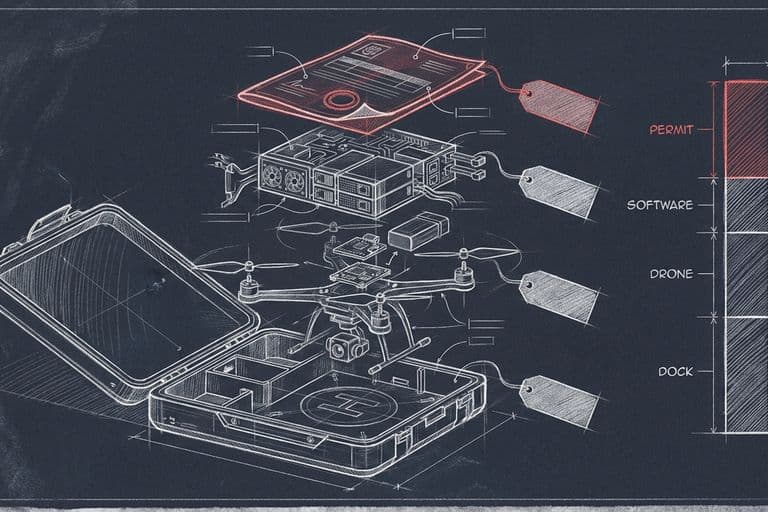
The dock infrastructure is deployable — sized to fit standard military transport containers, with quick-deploy installation procedures, sovereign supply chain (Section 848-compatible) provenance, and operator-trainable workflow within standard pre-deployment training cycles.
Source · Dronehub deployable dock specifications
3 more key facts
Pairing the drone-in-a-box with the AUDROS Eagle One net-capture interceptor extends FOB counter-UAS posture against hostile drones approaching the perimeter — the same dock infrastructure handles ISR and C-UAS missions in rotation.
Source · AUDROS × drone-in-a-box integration architecture
Bandwidth-thin operation via edge-AI inference enables FOB deployment under satellite-only uplink, contested-spectrum environments, and intermittent RF connectivity — the drone executes missions without continuous uplink to cloud, accumulating candidate frames locally and syncing when uplink permits.
Source · Sentinel edge-architecture deployment under degraded comms
US DoD procurement of FOB-grade drone-in-a-box runs through SBIR/STTR (Phase II, Phase III), AFWERX Open Topics on persistent autonomy, DIU CSO on deployable autonomy, and direct-contract procurement under Section 848-equivalent compliance frameworks.
Source · US DoD UAS procurement pathway analysis
In this piece
Forward operating bases need persistent overhead surveillance and counter-UAS without the manned-aviation footprint. Drone-in-a-box delivers both at deployable-infrastructure scale — sized for standard military transport, sovereign supply chain, edge-AI inference for degraded-comms environments, and integration with the FOB's existing security command stack. This post is the deployment-specific case for FOB drone-in-a-box.
The post is the defense-deployment companion to the broader drone-in-a-box for ports narrative. Where that piece walked through commercial critical-infrastructure use cases, this one focuses on the FOB operational profile where persistent air cover and rapid C-UAS response are baseline operational requirements.
The persistent-air-cover gap at FOBs
Forward operating bases face a structural overhead-surveillance gap that the conventional defense aviation tool catalog doesn't fill economically at FOB scale.
Helicopter aviation is the gold standard for persistent overhead capability — long sensor range, large payload capacity, human-judgement-in-the-loop response. It's also expensive ($1,500–$3,000/hour operating costs), resource-constrained (FOBs don't always have helicopter assets locally available, and when they do the assets prioritize higher-tier missions), and weather-dependent. For routine perimeter ISR or threat-window persistent coverage, helicopter aviation is operationally available only at the highest-priority FOBs and only during specific operational windows.
Soldier-launched UAS provides brief tactical overhead. Commercial-grade quadcopters at the soldier-launched scale deliver 20-30 minutes of flight time per launch with full operator engagement during flight. Persistent coverage across a multi-hour threat window or a full operational day requires a fleet of operators rotating through launches — operationally inefficient and operator-attention-expensive. The tool is the right answer for specific tactical situations but not for persistent coverage.
Fixed ground sensors cover the immediate FOB vicinity at ground level — radar, EO/IR fixed cameras, acoustic sensors, perimeter ground-based RF sensing. The fixed sensors are essential for perimeter security but don't extend overhead. They don't see threat UAVs at operational altitudes (which is where the threat actually flies). They don't see threats approaching from beyond ground-sensor range. They don't track moving threats that loop around the FOB at altitude.
Aerostat overhead — fixed-tether balloons or aerostats — provide persistent overhead coverage at fixed altitudes. Where deployed, aerostats fill the gap for point coverage. But aerostats are operationally heavy (deployment, weather tolerance, ground-team requirements), and many FOBs cannot accommodate the footprint or the operational overhead.
The combined gap is persistent overhead surveillance at FOB scale, available on demand for both routine perimeter ISR and event-driven counter-UAS response. Drone-in-a-box is the architectural answer to this gap.
What FOB drone-in-a-box delivers
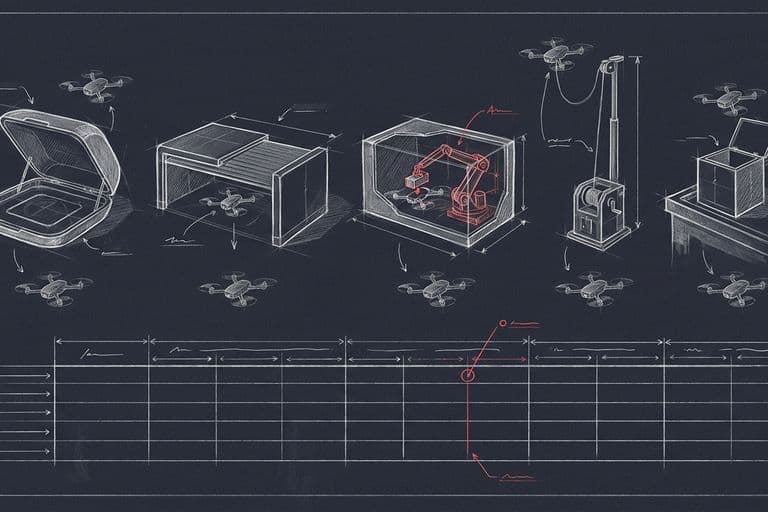
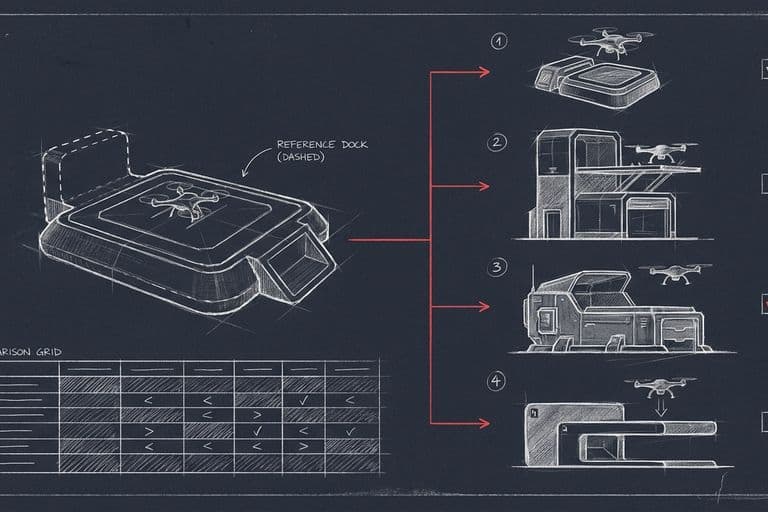
The dock sits on a deployable platform inside the FOB perimeter, on a vehicle platform for mobile FOB operations, or on a fixed-installation platform for established FOBs. The footprint fits standard military transport containers — typically 8×8×8 foot deployment-standard or similar size envelopes.
Mission cadence:
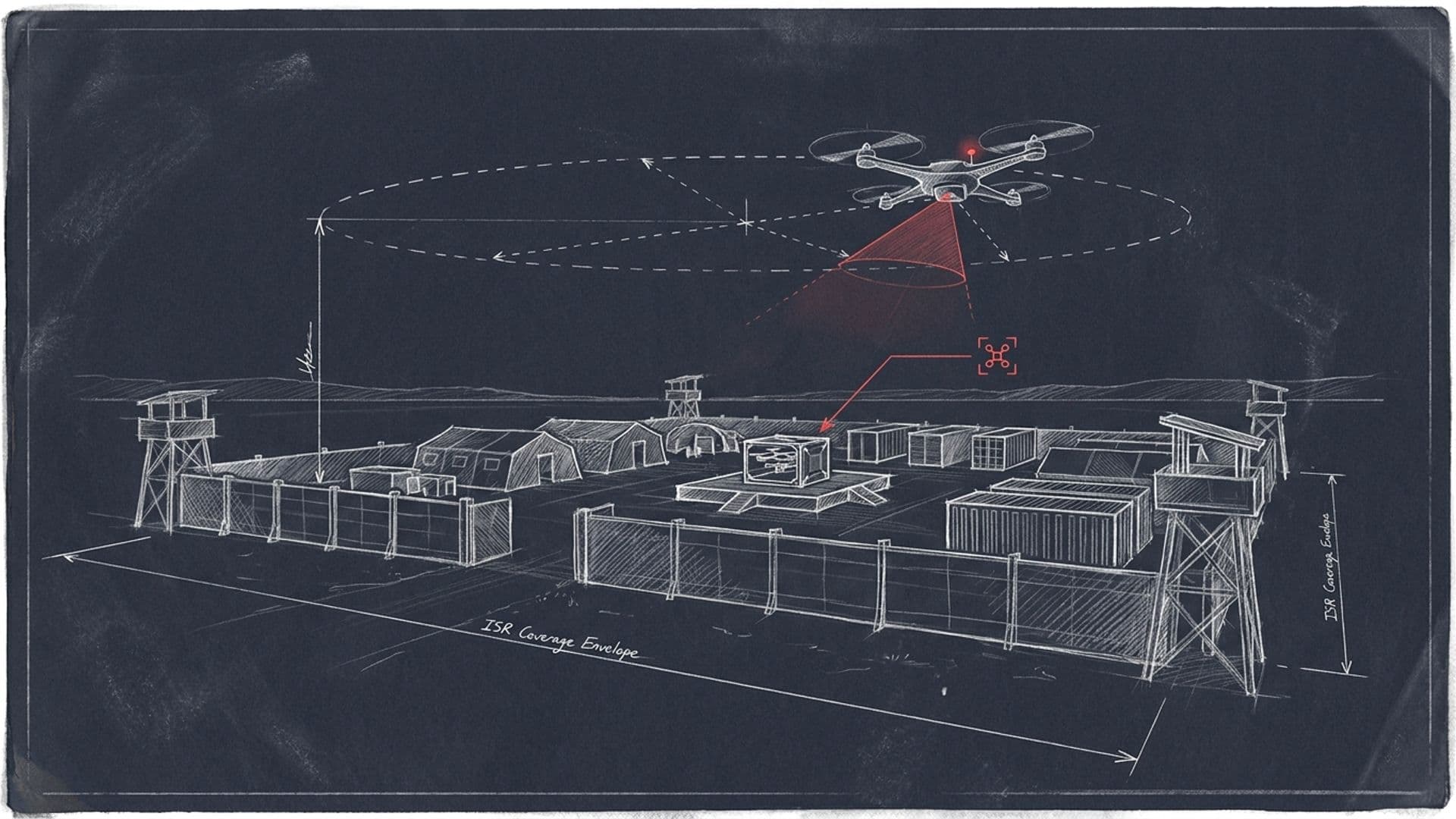
- Routine perimeter ISR — scheduled overflight patterns covering the FOB's perimeter and operational area. The drone runs a programmed mission, classifies anomalies via edge-AI, returns to dock, swaps battery, re-launches. Persistent overhead coverage during operational hours; on-demand availability during off-hours.
- Event-driven C-UAS response — when the detection layer identifies an approaching hostile UAV, the dock can launch the net-capture interceptor (if AUDROS-paired) or the ISR UAV with c-UAS sensor payload. Engagement happens inside operationally-defined airspace under operator authorisation.
- Mission-specific deployments — pre-mission ISR for outbound patrols, target-area reconnaissance for planned operations, post-incident situational awareness for incident response.
- Continuous operations — 20-25 missions per day per dock with the robotic battery-swap mechanism. Double-cover (two UAVs in rotation from one or multiple docks) for high-threat environments.
Sensor payload is mission-tunable across the UAV's modular bay — EO/IR for daylight operations, thermal for night and low-light, RF sensing for hostile-UAS detection, signals intelligence for specific mission profiles, chemical-biological detection for CBRN environments.
The dock integrates with the FOB's existing security command stack. Detections route into the operator's existing tooling (incident management, SIGINT integration, intelligence fusion) rather than requiring a new vendor-specific console. The operator workflow is updated to include the drone-in-a-box cycle as one input among many.
Counter-UAS pairing
The drone-in-a-box dock can stage the AUDROS Eagle One net-capture interceptor alongside or in rotation with the ISR UAV. Pairing extends the FOB's c-UAS posture against approaching hostile drones.
Detection layer. Multi-sensor fusion across RF sensing, radar, machine-vision, and acoustic detection identifies hostile UAVs approaching the perimeter. The detection layer feeds tracks to the operator command stack.
Engagement authorisation. Operator-in-the-loop confirms hostile classification and authorises engagement under the FOB's c-UAS rules of engagement.
Interception. The Eagle One interceptor launches from the dock, closes to engagement range, fires the capture net, and the engaged hostile UAV descends under parachute drogue to a predictable recovery zone inside or adjacent to the FOB.
Recovery. FOB response team retrieves the engaged drone with evidence-chain handling protocols. The captured drone supports counter-intelligence analysis, identification of adversary tactics, and the broader operational intelligence picture.
The engagement profile matches the FOB's regulatory and operational frame — engagement happens inside operationally-defined airspace, intact-recovery preserves any payload for evidence-chain handling, the operator retains command authority throughout the cycle. Net-capture fits the FOB's operational frame at scale; kinetic engagement is constrained by rules of engagement and collateral-damage envelope, RF jamming is constrained by spectrum-allocation and operational-deconfliction requirements. Net-capture works.
Deployable-infrastructure properties
The dock infrastructure is engineered for defense-grade deployment.
Container-sized footprint. Standard military transport container envelopes — 8×8×8 foot or equivalent — with quick-deploy installation procedures. The FOB engineering team can install the dock as part of standard FOB establishment, typically within hours of arrival.
Sovereign supply chain. NATO-allied non-Chinese supply chain across the bill of materials. NDAA Section 848-compatible documentation for US DoD procurement. EDIS-aligned manufacturing at Jasionka for EU defense procurement. The supply-chain provenance is procurement-grade audit material.
Power and network. Standard FOB generator capacity is sufficient — the dock's continuous-operation power draw is bounded. Network operates over satellite, LTE, dedicated tactical radio for the operator handoff layer, or any combination depending on FOB connectivity. Edge-AI inference enables operation without continuous high-bandwidth uplink; bandwidth-thin operation is the default.
Environmental specifications. Defense-grade ratings — IP65 weather sealing, operational temperature range -20°C to +45°C, vibration and shock specifications inherited from defense industrial supply chain heritage. The dock operates in cold-weather, hot-weather, dust, humidity, and high-altitude environments that span the FOB deployment envelope.
Operator training. The dock operator's workflow integrates with standard FOB security operations training. Pre-deployment training cycles include drone-in-a-box operation as part of the FOB security curriculum. The training overhead is bounded relative to the operational value delivered.
What this means for DoD and NATO MoD procurement
For US DoD procurement — direct contract through Dronehub Inc. (Delaware C-Corp, SBIR/STTR-eligible US small business). The capability maps to active topic areas across the federal-innovation pipelines:
- SBIR/STTR Phase II and Phase III on persistent autonomy, FOB protection, deployable C-UAS
- AFWERX Open Topics on tactical-edge autonomy and counter-UAS for forward-deployed forces
- DIU Commercial Solutions Opening on deployable autonomy and dual-use platforms with civilian-critical-infrastructure cross-applicability
- Direct contract procurement under Section 848-compatible compliance frameworks for programmes already in the procurement pipeline
The Section 848 compliance documentation and the deployed-programme track record (Deutsche Bahn at national scale, AUDROS at EDA 98/100 validation, NCBR-funded Nomad mobile-dock) pre-resolve the diligence pack on procurement review.
For NATO national MoD procurement — through Dronehub Sp. z o.o. under EDIS-aligned terms and the relevant national procurement frame. EDF and NATO DIANA programmes have FOB-protection topic areas where drone-in-a-box capability fits directly. National MoDs in the UK, France, Germany, Italy, Spain, Polish, Czech, Baltic, and Nordic clusters increasingly specify drone-in-a-box capability in persistent-surveillance and base-protection procurement.
For Five Eyes allies (Canada, Australia, New Zealand) — direct procurement through Dronehub Inc. under their respective national defense procurement frameworks. The structural fit (sovereign supply chain, deployable infrastructure, edge-AI bandwidth-thin operation) maps directly to Five Eyes operational requirements.
For US federal-civil deployment at parallel use cases — DHS at federal facilities, DoE at strategic national-security infrastructure, US Coast Guard at maritime FOB-equivalent operations — the same procurement pathway through Dronehub Inc. with Section 848 compliance applies.
The drone-in-a-box product page is at /drone-in-a-box. The robotic battery-swap mechanism deep-dive is at /blog/robotic-battery-swap-vs-in-station-charging. The edge-cloud inference architecture is at /blog/edge-cloud-inference-drone-in-a-box. The AUDROS counter-UAS context for the C-UAS pairing is at /projects/audros. The Nomad mobile-dock variant for moving columns is at /projects/nomad. The defense industry context is at /industries/defense. For a FOB-deployment procurement conversation, open the contact form.
FAQ
- Why is persistent overhead ISR a structural gap at FOBs?
- Three reasons. (1) Helicopter aviation is expensive and resource-constrained — manned helicopter overwatch costs $1,500–$3,000/hour and requires basing infrastructure, trained aircrew, and operational scheduling. FOBs don't always have helicopter assets locally available; even when they do, the assets are typically prioritised for higher-tier missions than routine perimeter ISR. (2) Soldier-launched UAS has brief flight time and demands operator attention — soldiers launching commercial-grade quadcopters get 20-30 minutes of overhead per launch with full operator engagement during flight. Persistent coverage across a multi-hour threat window or a full operational day is not achievable with this tool. (3) Fixed ground sensors cover their immediate vicinity but don't extend overhead — they don't see threat UAVs at operational altitudes or threats approaching from beyond ground-sensor range. The combined gap is persistent overhead surveillance at deployment scale, and drone-in-a-box is the structural answer.
- What does FOB-deployed drone-in-a-box actually do?
- The dock sits on a deployable platform inside the FOB perimeter (or on a vehicle platform for mobile FOB operations). The UAV launches on schedule or on demand, executes perimeter ISR patterns or specific mission profiles, returns to dock, swaps battery via the robotic mechanism, and re-launches for the next cycle. Mission cadence at FOB scale typically runs 20-25 missions per day per dock, with persistent overhead coverage during high-threat windows. Sensor payload is mission-tunable — EO/IR for daylight, thermal for night and low-light, RF sensing for hostile-UAS detection, mission-specific payloads as needed. The dock connects to the FOB's existing security command stack; detections route to the operator's existing tooling rather than requiring a new vendor-specific console.
- How does counter-UAS integration work at the FOB?
- The drone-in-a-box dock can stage either the ISR UAV, the AUDROS Eagle One net-capture interceptor, or both in rotation. For continuous-ISR-plus-on-demand-CUAS configurations, the dock services two UAVs alternately. The detection layer (RF sensing, radar, machine-vision integrated with the FOB's existing sensors) feeds tracks to the operator command stack; on operator authorisation, the interceptor launches against approaching hostile UAVs. The net-capture engagement profile matches the FOB's regulatory and operational frame — engagement happens inside the operationally-defined airspace, intact-recovery preserves any payload for evidence-chain handling, the operator retains command authority. Pairing with AUDROS extends the C-UAS posture without requiring separate parallel infrastructure.
- What's the deployable-infrastructure profile?
- The dock sized to fit standard military transport containers (8x8x8 or similar deployment-standard footprints), with quick-deploy installation procedures the FOB engineering team can execute as part of standard FOB establishment. Power requirements are bounded — standard FOB generator capacity is sufficient. Network requirements are minimal — operates over satellite, LTE, or specifically-allocated tactical radio for the operator-handoff layer; edge-AI inference handles classification on-board the drone without continuous high-bandwidth uplink. Cold-weather, hot-weather, dust, and humidity ratings are at defense-grade environmental specifications (IP65, operational temperature range -20°C to +45°C, vibration and shock ratings inherited from defense industrial supply chain heritage).
- What's the procurement pathway for US DoD?
- Direct contract through Dronehub Inc. (Delaware C-Corp, SBIR/STTR-eligible US small business). The capability maps to active topic areas: SBIR/STTR Phase II and Phase III on persistent-autonomy and FOB protection, AFWERX Open Topics on tactical-edge autonomy and counter-UAS, DIU CSO on deployable autonomy and dual-use platforms. NDAA Section 848-compatible hardware manufactured at Jasionka under NATO-allied non-CN supply chain. The Section 848 compliance documentation and the deployed-programme track record (Deutsche Bahn at national scale, AUDROS at EDA 98/100, NCBR-funded Nomad mobile-dock) pre-resolve the diligence pack on procurement review.
- What's the procurement pathway for NATO national MoDs?
- Through Dronehub Sp. z o.o. under EDIS-aligned terms and the relevant national procurement frame. EDF and NATO DIANA programmes both have FOB-protection topic areas where drone-in-a-box capability fits directly. National MoDs (UK, France, Germany, Italy, Spain, Polish, Czech, Baltic, Nordic) increasingly specify drone-in-a-box capability in their persistent-surveillance and base-protection procurement. The dual-domicile structure (EU manufacturing + US C-Corp) handles cross-Atlantic procurement under both Section 848 and EDIS compliance frameworks on a single underlying platform.