Key facts
Galileo OS-NMA (Open Service Navigation Message Authentication) is the European Union's authenticated GNSS signal — every navigation message broadcast by Galileo satellites is cryptographically signed by the European Union Agency for the Space Programme (EUSPA).
Source · EUSPA Galileo OS-NMA service documentation
HUUVER, the Dronehub-led EU Horizon 2020 hybrid UAV-UGV programme (grant agreement #870236), was the first UAV in the world to integrate full Galileo OS-NMA authentication.
Source · HUUVER programme outcomes; EU Horizon 2020 grant agreement #870236
GPS spoofing has been routinely documented across Eastern Europe and the Eastern Mediterranean since 2022 — driven by both state-level electronic-warfare units and commercially-available consumer-grade spoofing equipment.
Source · Operational reporting on GNSS interference 2022–2025
3 more key facts
Cryptographic authentication defeats spoofing by design — an adversary spoofer cannot reproduce the OS-NMA signature without EUSPA's private key, which means spoofing becomes a cryptographic attack rather than a radio-frequency one. Cryptographic attacks at operational scale require resources adversary electronic-warfare units don't have.
Source · Galileo OS-NMA security architecture documentation
The OS-NMA-receiving UAV verifies each navigation message against EUSPA's public key. Spoofed signals are rejected at the receiver; the navigation integrity is preserved even in environments where unauthenticated systems would be defeated.
Source · OS-NMA receiver-side authentication protocol
Galileo OS-NMA became operationally available in 2023 after EUSPA testing and validation. The technology is mature enough for production UAV integration; HUUVER's integration work proves the integration is feasible at deployment scale.
Source · EUSPA Galileo OS-NMA operational availability timeline
In this piece
HUUVER was the first UAV in the world to integrate full Galileo OS-NMA authentication. Cryptographically signed positioning that defeats GPS spoofing by design — the structural answer to the adversary-EW environments where unauthenticated systems can be redirected, denied, or captured. This post is the technical and procurement-grade explanation of what OS-NMA does, what HUUVER proved, and what it means for any UAV operator facing spoofing-vulnerable operational environments in 2026.
The post is the deeper companion to the HUUVER subterranean ISR narrative. Where that piece walked through the hybrid mobility envelope, this one walks through the authenticated-navigation property that compounds the mobility advantage in denied environments.
The spoofing reality
GPS spoofing was a research-paper concern through the 2010s. It became an operational adversary capability in the 2020s. The threat profile is bimodal.
State-level electronic-warfare units operate spoofing at theatre scale. The 2011 Iranian capture of the US RQ-170 reconnaissance drone via GPS spoofing was the early warning shot — an event that demonstrated the operational consequence of unauthenticated positioning at the high end of the threat catalog. The pattern has matured since. Documented spoofing operations across Eastern Europe and the Eastern Mediterranean from 2022 onward span both military aviation interference and commercial maritime navigation disruption.
Commercial-grade spoofing equipment is widely available and operates at tactical scale. Off-the-shelf SDR (software-defined radio) hardware combined with publicly-available GNSS-simulation software produces spoof signals at low cost and low complexity. Adversary actors at multiple tiers — criminal organisations, hostile non-state actors, opportunistic small-state-level units — have access to this capability.
The combined threat profile is: any UAV operating in environments where adversary actors have motive and access to spoofing capability faces a real and non-trivial risk of being redirected, denied, or captured via spoofed GNSS.
For procurement decisions on UAV platforms in defense, federal-civil, and critical-infrastructure deployments, this threat profile makes authenticated positioning a structural priority rather than a future-proofing preference.
What Galileo OS-NMA does
Galileo is the European Union's sovereign global navigation satellite system. Unlike GPS (whose civilian signals have been historically unauthenticated), Galileo offers Open Service Navigation Message Authentication (OS-NMA) — a feature that cryptographically signs every navigation message broadcast from the satellites.
The mechanism:
- EUSPA generates the cryptographic signatures. The European Union Agency for the Space Programme manages Galileo operationally and holds the OS-NMA private key. The key is held inside EUSPA's secure infrastructure with sovereign-grade controls.
- Galileo satellites broadcast signed messages. Every navigation message — the data the receiver uses to compute its position — is signed with a cryptographic signature generated against the message content. The signature also covers a chunk of recent navigation messages from a known sequence of satellites, with timing constraints that prevent replay attacks.
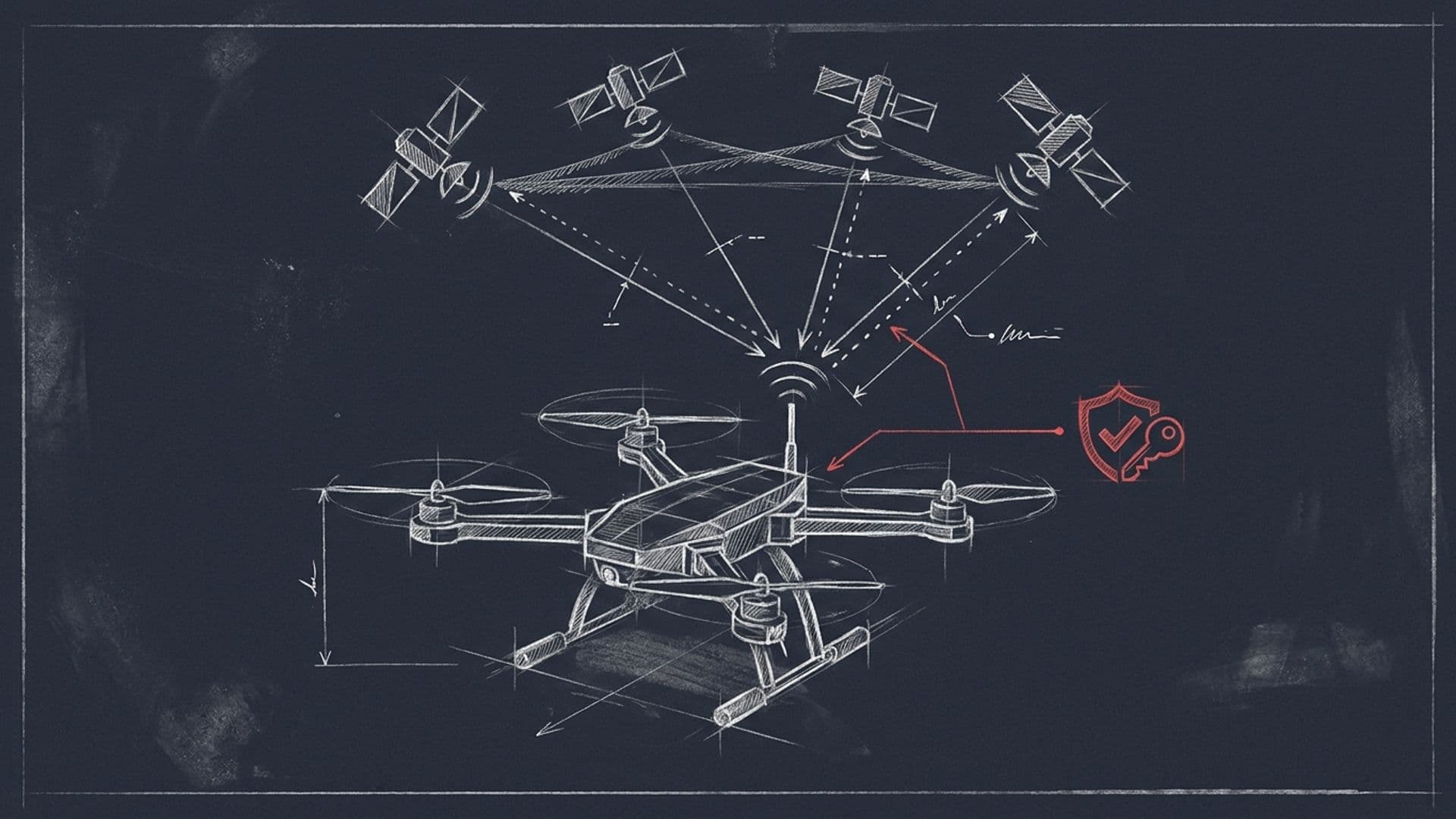
- The receiver verifies on every message. An OS-NMA-capable receiver verifies the signature against EUSPA's public key (publicly distributed). If the signature verifies, the receiver accepts the message and updates its navigation state. If the signature doesn't verify — because the signal was forged by an adversary spoofer — the receiver rejects the message and falls back to its previous verified state, eventually transitioning to dead-reckoning if verification fails for too long.
- Spoofing becomes cryptographic, not RF. An adversary spoofer cannot reproduce the OS-NMA signature without EUSPA's private key. The attack surface shifts from "broadcast a stronger signal than the legitimate satellite" (technically feasible) to "compromise EUSPA's cryptographic infrastructure" (technically infeasible at operational scale).
The structural security guarantee is: a UAV running OS-NMA-verified positioning cannot be redirected by spoof signals, denied by spoof-induced uncertainty, or captured by induced false landing positions. The verification layer rejects unauthenticated signals before the autonomy stack uses them for navigation.
What HUUVER specifically proved
HUUVER was developed under EU Horizon 2020 grant agreement #870236, with Dronehub leading a seven-partner consortium across five EU countries. The world-first credential is that HUUVER integrated full Galileo OS-NMA authentication into a deployment-grade UAV platform.
Three structural propositions came out of the programme.
Receiver integration on a UAV platform is feasible. The OS-NMA receiver chipset, the cryptographic verification logic, and the integration with the broader autonomy stack all work at deployment-grade reliability. The engineering challenges (power consumption of the verification compute, latency budget for verification, integration with multi-constellation receivers) are bounded and solvable. HUUVER's receiver implementation is reusable across future UAV platforms; the integration architecture is documented through the EU programme record.
Navigation-integrity guarantees translate into UAV operational behavior. The autonomy stack has to handle verification-failure states cleanly. When OS-NMA rejects messages, the UAV can't continue flying as if positioning is fine — it has to fall back to dead-reckoning, alert the operator, and avoid making positioning-dependent decisions until verification re-establishes. The behavioral logic for this is non-trivial; HUUVER proved it can be built into a UAV platform's autonomy without compromising operational performance under normal conditions.
The integration scales from research prototype to production. HUUVER was developed across a 7-partner EU consortium and validated under EU programme review. The institutional pathway from research integration to production deployment was demonstrated through the programme. For UAV manufacturers building new platforms with OS-NMA from scratch, HUUVER is the reference case showing the engineering, programme-management, and certification path is well-trodden.
How OS-NMA fits with other GNSS systems
OS-NMA is the most operationally available authenticated GNSS service in 2026, but it's not the only authenticated-GNSS effort. Three points of context:
GPS Chimera — the US authenticated-GNSS scheme under development by the GPS programme. Chimera offers similar cryptographic authentication properties to OS-NMA but with different protocol design and a different operational availability timeline. As of 2026, Chimera is in development but not yet at the operational-availability level OS-NMA reached in 2023.
GLONASS and BeiDou — Russian and Chinese GNSS systems respectively. Neither has publicly committed to civilian authentication services equivalent to OS-NMA or Chimera. For sovereign-defense deployment in NATO and EU jurisdictions, depending on either system for authenticated positioning is not procurement-grade.
Multi-constellation receivers — modern GNSS receivers typically combine signals from multiple constellations (Galileo + GPS + sometimes GLONASS and/or BeiDou). For OS-NMA-equipped platforms, the multi-constellation receiver uses OS-NMA for authentication while leveraging the other constellations for ranging and continuity. The position-fix accuracy benefits from multiple constellations; the authentication guarantee comes from the Galileo OS-NMA layer.
For UAV deployments needing authenticated positioning in 2026, Galileo OS-NMA is the procurement-grade answer. Future GPS Chimera deployment may add a parallel option for US-aligned platforms, but doesn't change the current procurement picture.
Implementation overhead
For UAV manufacturers and integrators evaluating OS-NMA integration on new platforms, the engineering overhead is moderate but bounded.
Receiver chipset. Multiple commercial GNSS chipsets now support OS-NMA out of the box — major receiver vendors have shipped OS-NMA-capable chipsets across the 2023-2026 window. The chipset-level integration is similar to integrating any modern multi-constellation GNSS receiver.
Verification compute. The cryptographic verification adds modest computational load to the receiver's processing. Modern GNSS chipsets handle this within their existing power and compute budgets; no additional hardware is typically required.
Autonomy-stack integration. This is the harder half of the work. The UAV's autonomy stack has to handle verification-failure states cleanly — falling back to dead-reckoning when verification fails, alerting the operator when verification is degraded, refusing to make navigation-dependent decisions on unverified positioning. The behavioral logic requires careful design and significant test coverage. HUUVER's autonomy-stack patterns for OS-NMA handling are reference implementations that subsequent platforms can adapt.
Certification and validation. Sovereign-defense procurement increasingly requires demonstrated OS-NMA capability validated under formal evaluation. The validation pathway is being established through programmes like HUUVER and through national-MoD frameworks; for new platforms, the validation cycle is months, not years.
For new UAV platforms adopting OS-NMA, the integration cycle from chipset selection through autonomy integration through validation is typically 6-12 months. The pattern is well-trodden enough that primes and SMEs building new UAV platforms in 2026 should consider OS-NMA as a baseline capability rather than a research-grade option.
The procurement frame
For sovereign-defense procurement (US DoD, NATO national MoDs, EU defense via EDF and DIANA) — authenticated positioning is increasingly a procurement requirement. Defense procurement under EDIS-aligned frameworks explicitly favors sovereign-positioning capability; Section 848-equivalent frameworks on the US side include the supply-chain provenance for positioning chipsets and the operational-capability validation for spoofing-resistance. Procurement of a UAV platform with full OS-NMA integration is the future-proof default.
For federal-civil critical-infrastructure (US DHS, EU NIS2-regulated operators, sovereign-border surveillance, sovereign-port operations) — operators facing spoofing-vulnerable operational environments increasingly specify OS-NMA or equivalent in tender requirements. The requirement may be explicit (named in the tender specifications) or implicit (specified as "spoofing-resistant positioning" or "sovereign-positioning capability"). HUUVER-class UAVs satisfy both framings.
For commercial operators in regulated verticals (rail in NIS2-applicable jurisdictions, energy grid under critical-infrastructure designation, ports, refineries) — the requirement transmits from regulators or downstream customers. Commercial operators are typically downstream of the explicit sovereign-defense requirements, but the procurement framework is converging.
For UAV manufacturers and primes building new platforms — OS-NMA support is becoming a baseline capability rather than a competitive differentiator. The platforms that ship OS-NMA-capable in 2026 are the platforms that will be procurement-eligible for the broader sovereign-and-regulated-vertical pool by 2028. The platforms that don't ship OS-NMA support will face progressive procurement lockout from the same pool.
The full HUUVER programme context lives at /projects/huuver. The original HUUVER programme story is at /blog/we-are-proud-to-present-the-huuver-our-new-hybrid-drone-that-flies-and-rides. The HUUVER subterranean ISR / denied-environment narrative is at /blog/huuver-subterranean-isr-denied-environments. The defense industry context is at /industries/defense; critical infrastructure at /industries/critical-infrastructure. For a procurement conversation on sovereign-positioning UAV platforms, open the contact form.
FAQ
- What is Galileo OS-NMA technically?
- Open Service Navigation Message Authentication. Every navigation message broadcast by Galileo satellites contains, in addition to the standard positioning data, a cryptographic signature generated by the European Union Agency for the Space Programme (EUSPA) using EUSPA's private key. The signature covers a chunk of recent navigation messages from a known sequence of satellites, with timing constraints that prevent replay attacks. An OS-NMA-capable receiver verifies the signature against EUSPA's public key on every message. If the signature doesn't verify — because the signal was forged by an adversary spoofer rather than originating from a real Galileo satellite — the receiver rejects the message and maintains its current navigation state from previous verified messages, falling back to dead-reckoning if verification fails for too long.
- Why does authenticated positioning actually matter?
- Because GPS spoofing has moved from research demonstration to operational adversary capability across 2022 and the years following. The threat profile is bimodal — sophisticated state-level electronic-warfare units operate spoofing at theatre scale, and inexpensive consumer-grade spoofing equipment is widely available and operates at tactical scale. Both modes are documented across Eastern Europe and the Eastern Mediterranean. An unauthenticated UAS operating in these environments can be redirected by spoof signals into hostile territory, denied operational use, or even captured by inducing false landing positions. Authenticated positioning is the structural defense — the spoofer cannot reproduce the cryptographic signature without EUSPA's private key, and cryptographic attacks at operational scale exceed adversary EW resources.
- What did HUUVER specifically prove?
- Three structural propositions. First, that OS-NMA receiver integration on a UAV platform is feasible — the receiver chipset, the cryptographic verification logic, the integration with the broader autonomy stack, all work at deployment-grade reliability. Second, that the navigation-integrity guarantees translate into UAV operational behavior — when verification fails, the autonomy stack handles the verification-failure state cleanly (falls back to dead-reckoning, alerts the operator, doesn't continue accepting unverified positioning). Third, that the integration scales from research prototype to production — HUUVER was developed across a 7-partner EU consortium and validated under EU programme review, demonstrating that the institutional pathway from research to deployment is well-trodden for this technology.
- Is OS-NMA the same as the broader 'authenticated GNSS' concept?
- It's the most operationally available implementation in 2026. Other GNSS systems offer or are developing authenticated services: GPS has the Chimera authentication scheme under development, GLONASS has not publicly committed to civilian authentication, BeiDou has not committed to authentication for non-Chinese receivers. Galileo OS-NMA shipped first and is the most operationally available authenticated GNSS service. For UAV deployments needing authenticated positioning today, Galileo OS-NMA is the procurement-grade answer. Multi-constellation receivers (combining Galileo with GPS, GLONASS, BeiDou) can use OS-NMA for authentication while leveraging the other constellations for ranging and continuity, getting the best of both.
- What's the implementation overhead for adding OS-NMA to a UAV?
- The chipset and software integration is moderate engineering work but not exotic. Multiple commercial GNSS chipsets now support OS-NMA out of the box; the receiver-side logic is documented in EUSPA's public specifications. The integration work is in the autonomy-stack handling — the UAV needs to handle verification-failure states cleanly (cannot just keep flying as if positioning is fine when OS-NMA is rejecting messages). HUUVER's integration work is reusable across future UAV platforms; the autonomy-stack patterns for handling OS-NMA verification states have been validated through the programme. For new UAV platforms adopting OS-NMA, the integration cycle is months, not years.
- What's the procurement case for OS-NMA-equipped UAVs?
- For sovereign-defense and federal-civil operators in NATO and EU jurisdictions, authenticated positioning is increasingly a procurement requirement rather than a preference. Defense procurement under EDIS and Section 848-equivalent frameworks explicitly favors sovereign-positioning capability. Federal-civil critical-infrastructure operators (rail, energy, ports) facing spoofing-vulnerable operational environments increasingly specify OS-NMA in tender requirements. Commercial operators in regulated verticals inherit the requirement from regulators or downstream customers. Procurement of a UAV platform with full OS-NMA integration is the future-proof default for any deployment that may face adversary EW conditions, with HUUVER as the reference implementation.