
EU Urban Air Mobility
The EU's flagship urban air mobility demonstration programme. 13 partners across 5 countries, led by Honeywell. Dronehub flew first across the entire consortium — and co-flew with Lilium, Vertical Aerospace, and EU national air-navigation service providers. The empirical data fed directly into EU U-Space regulation.
- Programme
- U-Space4UAM
- Funder
- EU Horizon 2020 · SESAR
- Grant Agreement
- #101017643
- Lead
- Honeywell
- Consortium
- 13 partners · 5 countries
- Demo window (PL)
- Nov 2021 → Jun 2022
- Planned flights
- ~160
- Dronehub status
- Flew first
Why this matters
Urban air mobility is the regulatory frontier that decides whose drones fly over cities.
Urban air mobility — autonomous drones, eVTOL air taxis, cargo drones — operating over densely populated geography is the highest-value, highest-stakes drone-operations problem of the decade. Every regulator on every continent has the same first question: who flies the empirical demonstrations whose data we use to write the rules? In the EU, that programme was U-Space4UAM.
Honeywell led the consortium because Honeywell is one of the few primes with the breadth (avionics, air-traffic management, defense, aerospace) to coordinate that scale of effort. Dronehub flew first because in a programme that large, the lead prime needs a partner whose technical envelope is already retired — and whose operational discipline is documented. We were that partner.
The output isn't marketing material. It's the empirical evidence base that the EU U-Space regulatory framework — the rules every commercial drone operator flying over European cities will eventually live under — is being written from.
What we contributed
Drone-in-a-box hardware. Operational data. Cross-jurisdiction air-traffic coordination evidence.
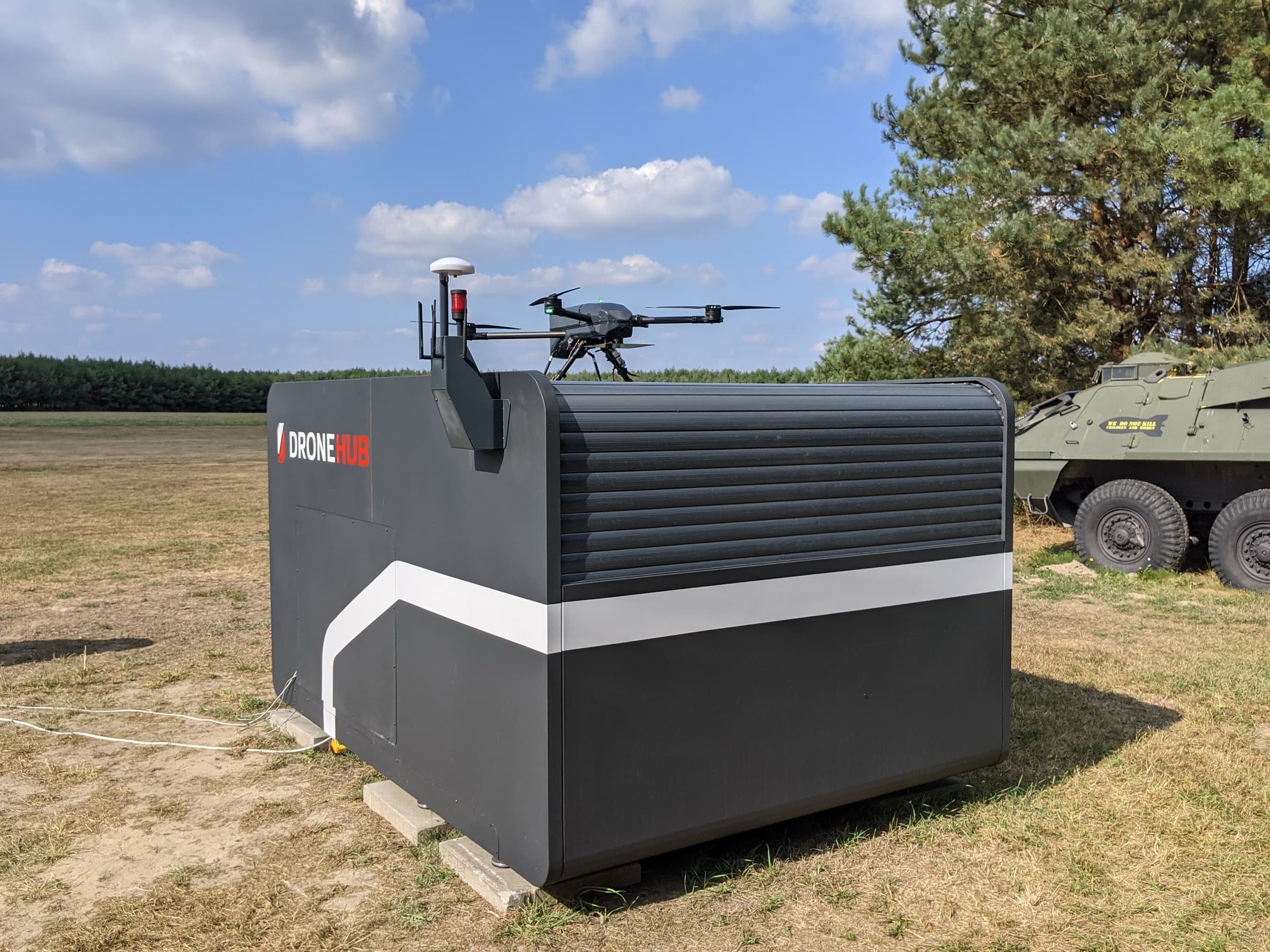
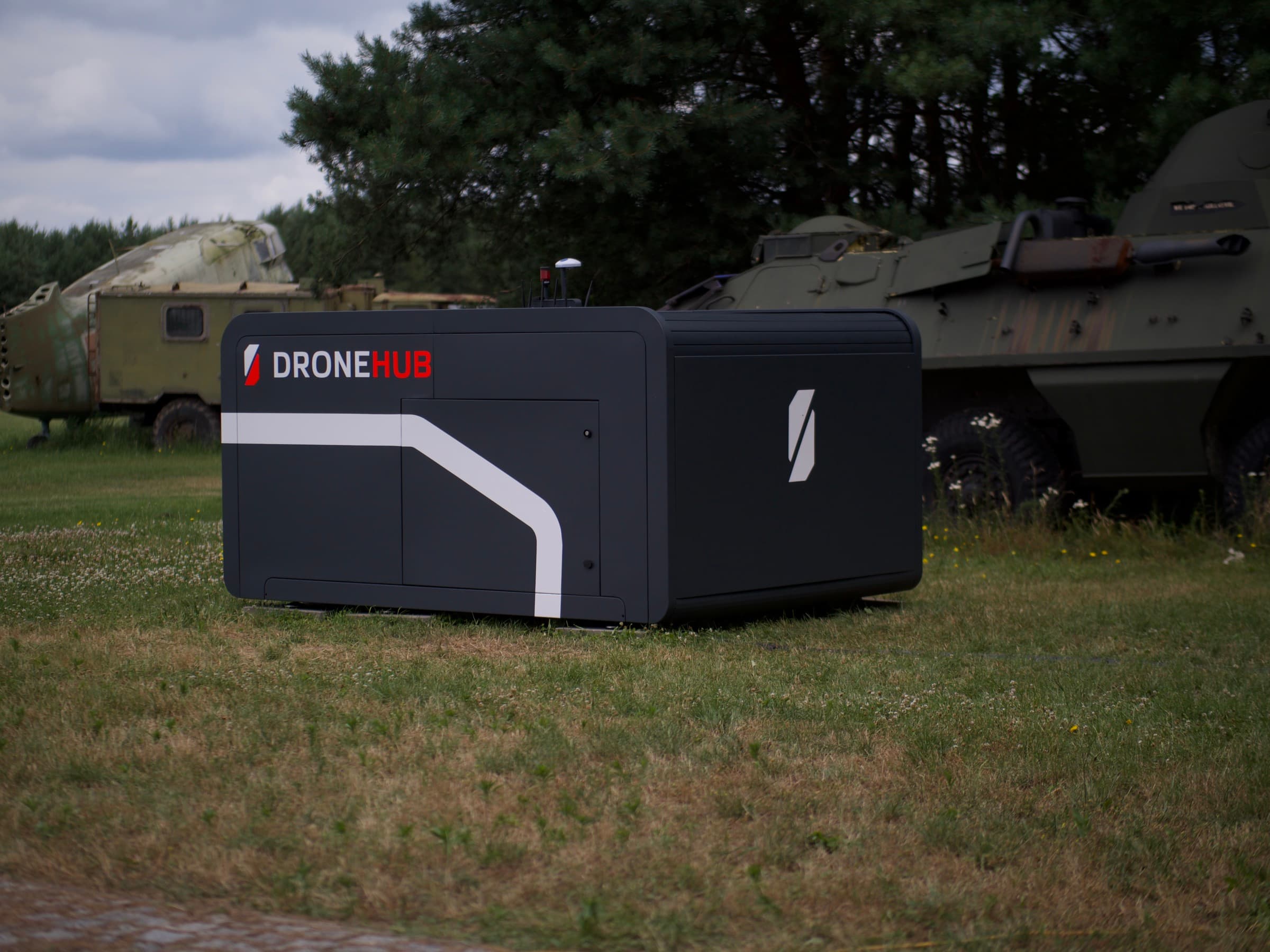
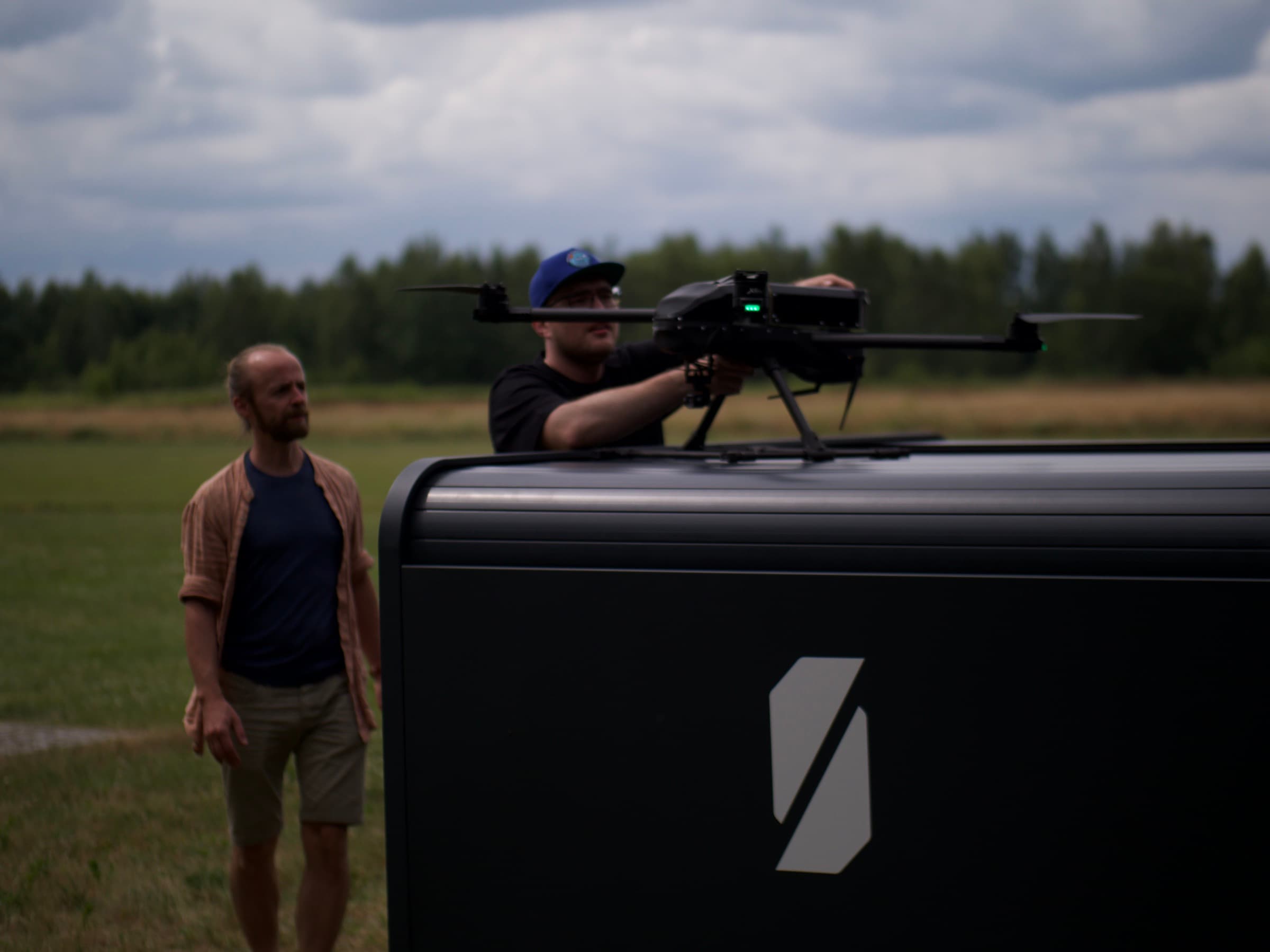
Dronehub contributed the drone-in-a-box hardware platform that ran the Polish leg of the programme — autonomous launch, mission execution, and landing across the validated use cases. The same hardware platform now anchors the Deutsche Bahn deployment and the licensed drone-in-a-box product line.
We also coordinated the operational airspace clearance with Polish Air Navigation Services for the demonstration window — establishing the cross-jurisdiction working pattern that made the broader 5-country effort feasible.
The Polish demonstrations ran from November 2021 through June 2022 — approximately 160 planned flights across the three validated use cases. The operational data feeds the broader Honeywell-led U-Space4UAM report that EU regulators use as primary-source evidence for U-Space rulemaking.
Concurrent demonstrations ran in the Czech Republic, the UK, and Spain — co-validating cross-jurisdiction operations across four ANSP regimes.
The hardware
The drone-in-a-box platform that flew the Polish leg.

Three public-service use cases validated end-to-end
High-stakes deployments — proven, not pitched.
The use cases below were selected because they map to genuine public-institution need, not because they were easy. Each was run as a multi-flight operational trial under the same regulatory regime a future commercial deployment will face.
Emergency aerial monitoring of accident sites
Multi-vehicle road accidents, hazmat events, mass-casualty incidents. The drone reaches the scene within minutes of dispatch and feeds live aerial imagery into the responder command stack. Reduces clearance time, supports triage, and informs the resource allocation that follows.
Orthophotographic and photogrammetric imaging
Public-institution imaging: municipal mapping, environmental monitoring, infrastructure-condition surveys, post-event documentation. Drones replace the contracted aerial-photography vendor and deliver on-demand orthophoto coverage at higher cadence and lower cost.
AED defibrillator transport in cardiac emergencies
Every minute without defibrillation in cardiac arrest reduces survival by roughly ten per cent. The drone delivers an automated external defibrillator to the scene faster than ground EMS in dense urban geography. The use case isn't speculative; it was validated end-to-end as part of the U-Space4UAM trials.
The AED defibrillator use case
Ten per cent of survival lost per minute. Drones reach the patient before ground EMS.
Cardiac arrest is a time-critical emergency. Each minute without defibrillation reduces survival probability by approximately ten per cent. In dense urban geography — traffic, one-way streets, permit-restricted access — ground EMS often cannot reach the patient inside the survival-window. The drone can, and AED transport was selected as a U-Space4UAM use case for exactly that reason.
The validation didn't prove that drones can carry AEDs — that's been shown for years in lab conditions. It proved that they can do it inside a regulated airspace, with cross-jurisdiction coordination, on a regulatory pathway that terminates in commercial deployment. That's the difference between a demonstration and a deployable system. U-Space4UAM delivered the second.

What the trial actually produced
Four contributions that matter past the flights themselves.
Empirical contribution to U-Space regulation
The EU U-Space framework is the regulatory infrastructure every commercial drone fleet flying over European cities will operate under. The trial data — flight logs, performance characteristics, conflict-management outcomes — fed directly into the rulemaking process. We didn't just participate; we contributed evidence.
Cross-border airspace coordination
Demonstrations ran across Poland, the Czech Republic, the UK, and Spain — four jurisdictions with separate air-navigation service providers (ANSPs). Coordinating drone operations across that many national air-traffic authorities is exactly the operational complexity that U-Space rules need to handle. The consortium proved it works.
Operating peer-to-peer with Honeywell, Lilium, Vertical
We co-flew with a Fortune 100 prime (Honeywell), a leading eVTOL developer (Lilium), and a separate eVTOL programme (Vertical Aerospace). The co-flight relationship — not a vendor-prime relationship — established Dronehub at the operational peer level among the EU UAM leadership group.
National air-navigation services partnership
The consortium included Air Navigation Services of the Czech Republic, Austro Control (Austria), CRIDA / ENAIRE (Spain) — the public bodies that actually run national airspace. These are the entities you ultimately negotiate operating clearance with. The relationship is already established.
The consortium
13 partners. 5 countries. Honeywell-led.
- Honeywell — consortium lead
- Dronehub (Poland) — drone-in-a-box hardware + first flier across the consortium
- Lilium (Germany) — eVTOL air-taxi developer
- Vertical Aerospace (UK) — eVTOL programme
- Air Navigation Services of Czech Republic — ANSP
- Austro Control (Austria) — ANSP
- CRIDA / ENAIRE (Spain) — ANSP, R&D
- CATEC (Spain) — aerospace research centre
- TECNALIA (Spain) — applied research
- DLR (Germany) — German aerospace centre
- Altitude Angel (UK) — unmanned-airspace data platform
- UpVision (Czech Republic) — drone-services operator
Trial countries · Poland (first) · Czech Republic · UK · Spain
Why this credential is rare
Four reasons U-Space4UAM is a serious civilian-aerospace credential.
Dronehub flew first
In a 13-partner, 5-country consortium led by Honeywell, the opening demonstrations came from Rzeszow — our home. That distinction matters: in a programme of this size, who flies first is a statement about who the consortium prime trusts to derisk the technical envelope.
Honeywell prime-relationship reference
Honeywell is a Fortune 100 aerospace + defense prime with deep US-DoD and FAA history. A working co-flight relationship with Honeywell on an EU UAM programme is the kind of credential that lands a meeting at a US prime evaluating European SME partners.
NATO-aligned consortium composition
Trial countries — Poland, Czech Republic, UK, Spain — are all NATO members. Air-navigation services in Czech Republic, Spain, Austria are all EU. The cooperation pattern mirrors what NATO DIANA and the European Defence Fund (EDF) require: cross-border allied operations with rigorous airspace coordination.
Operational evidence for FAA-track US programmes
The EU SESAR programme is the EU's air-traffic R&D body — directly comparable to the FAA NextGen office and NASA Advanced Air Mobility programme. The U-Space4UAM data set is exactly the kind of empirical evidence FAA Part 108 rulemaking and NASA UAM transition studies consume.
Company overview
The platform behind the consortium contribution.
What this means for you
The UAM credential, the Honeywell co-flight pattern, the regulatory-coordination experience — all transferable.
For a US prime building an FAA-track BVLOS programme or a NASA Advanced Air Mobility deliverable — U-Space4UAM is the EU-jurisdiction analog. The regulatory engagement experience, the multi-ANSP coordination work, and the empirical-flight evidence base all transfer to FAA Part 108 rulemaking engagement, NASA AAM transition deliverables, and FAA UAS Integration Office work.
For an EU prime assembling a Horizon Europe Cluster 5 (Climate, Energy, Mobility) or SESAR 3 Joint Undertaking proposal — U-Space4UAM is our reference for working at peer level inside a 13-partner consortium led by Honeywell, including the actual air-navigation service providers and the eVTOL leadership group. The collaboration relationship is already established.
For a public-institution operator (city government, emergency services, ambulance authority) running an AED-drone, accident- response, or aerial-imaging programme — the validated use cases are deployable today. The hardware platform, the operational patterns, and the regulatory-coordination playbook are all available under license.
From the blog
Browse all UPDATED · SEP 2026
What Drone-in-a-Box Costs in 2026: Dock, Drone, Software, Licence
Published 2026 drone-in-a-box prices: dock kits from under $5,000, DJI Dock 3 near $15,800, Skydio bundles to $58,000, plus software, installation and permits.
Read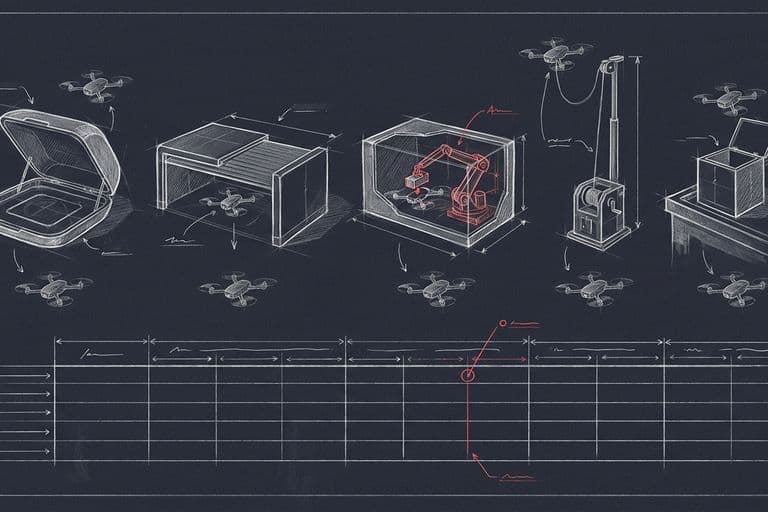 UPDATED · SEP 2026
Drone-in-a-Box Systems Compared 2026: 18 Docks for US and European Buyers
18 drone-in-a-box systems side by side, from Dronehub and Skydio to DJI — turnaround, weather rating, NDAA and Blue UAS status, where each is sold, and every public price we could verify.
Read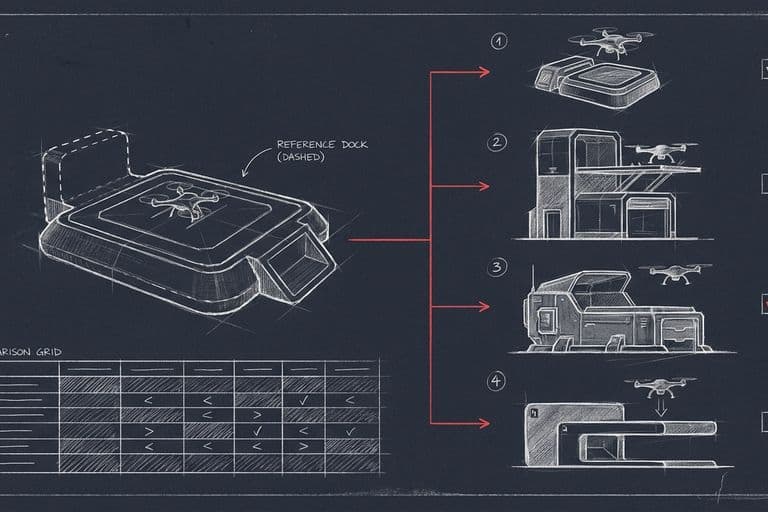 UPDATED · SEP 2026
DJI Dock Alternatives in 2026: NDAA-Compliant Drone Docks Compared
Dronehub, Skydio and other non-Chinese alternatives to DJI Dock 3 compared: Blue UAS status with dates, swap and charge times, weather ratings, public prices and what the FCC rule means.
Read