Key facts
AFWERX is the US Air Force innovation arm — operates as the Air Force's primary engagement point for SME innovation and dual-use commercial-defense technology. AFWERX runs multiple programme types; Open Topics is the largest single funding pipeline for drone-and-autonomy SMEs.
Source · AFWERX programme structure documentation
AFWERX has historically directed substantial SBIR/STTR awards annually across all its programmes — running in the high hundreds of millions of dollars per fiscal year cumulatively across Phase I, Phase II, and Phase III contracts.
Source · AFWERX programme funding analysis
Open Topics is a unique SBIR/STTR mechanism — applicants propose their own technology against broad capability areas defined by the Air Force, rather than responding to narrowly-scoped pre-defined topics. The Open Topics structure favours dual-use innovation with strong commercial market traction.
Source · AFWERX Open Topics programme structure
3 more key facts
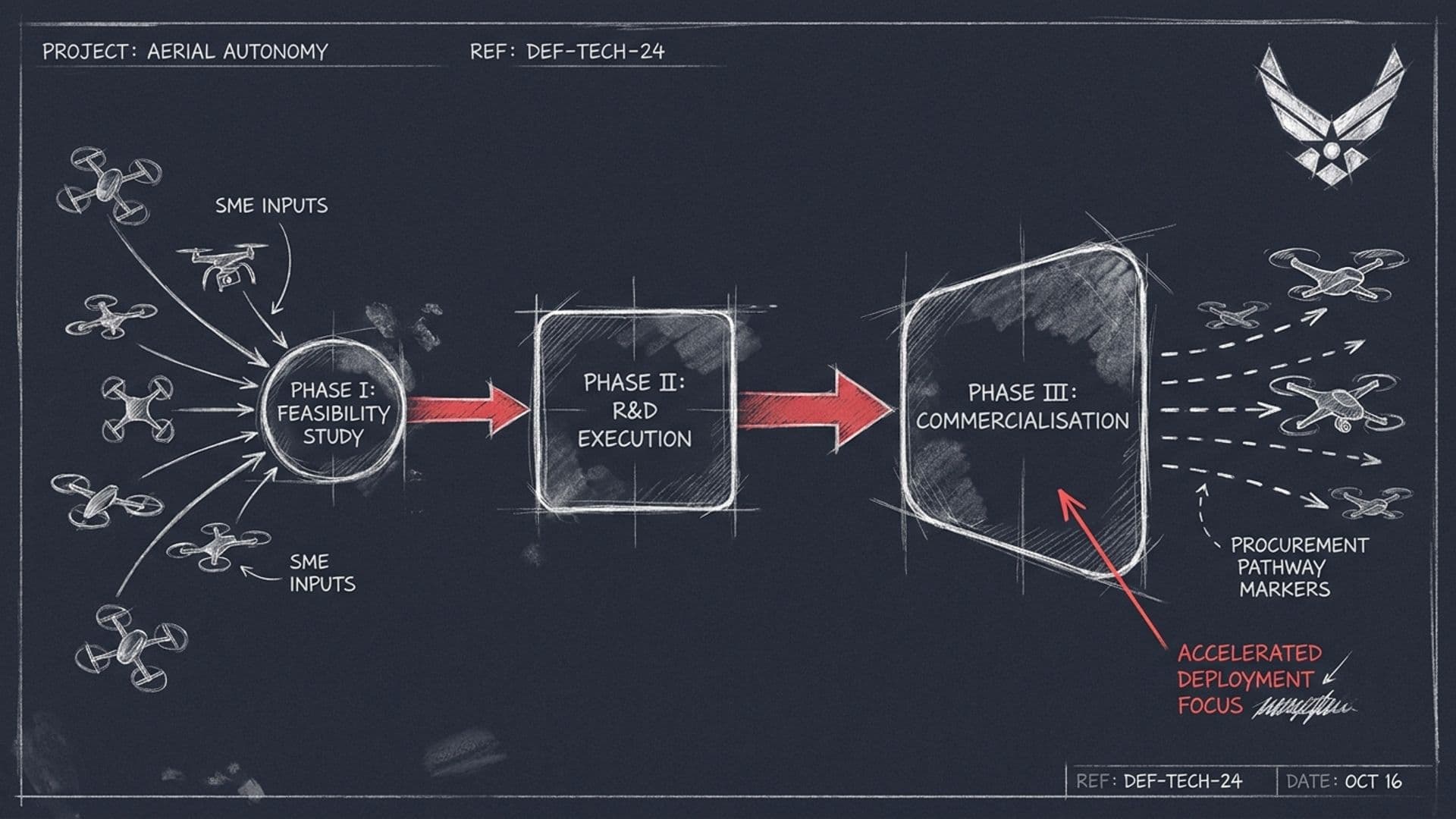
Standard SBIR/STTR phase progression applies — Phase I feasibility (typical $250K, 6 months), Phase II R&D (typical $1.5-2M, 24 months), Phase III commercialisation (sole-source contracting at the funding agency, no upper limit).
Source · SBIR/STTR programme phase structure for AFWERX
AFWERX has a Direct-to-Phase-II pathway that allows qualifying SMEs to skip Phase I and enter directly at Phase II — for companies with demonstrated technical readiness from prior work (commercial deployment, prior federal-innovation funding, equivalent validation).
Source · AFWERX Direct-to-Phase-II pathway documentation
Drone-and-autonomy capability is a sustained AFWERX priority area — counter-UAS, autonomous mobility, AI-enabled capability, persistent ISR, sovereign-positioning, and FOB-protection all map to recurring AFWERX Open Topics challenge areas.
Source · AFWERX challenge-topic landscape analysis
In this piece
AFWERX Open Topics is the largest single SBIR/STTR pipeline for SMEs targeting US Air Force innovation procurement. Drone-and-autonomy technology is a sustained AFWERX priority area; the Open Topics structure favours dual-use innovation with strong commercial market traction. For drone-technology SMEs evaluating US federal-innovation pathways, AFWERX is one of the highest-value engagement points. This post is the application-structure briefing for the SME pathway.
The post is the AFWERX-specific companion to the broader SBIR/STTR entity-path piece. Where that piece covered the structural eligibility and entity-architecture for non-US drone companies, this one covers the AFWERX-specific application strategy.
What AFWERX structurally is
AFWERX is the US Air Force innovation arm. The mission framing has evolved across the programme's history but currently centres on connecting the Air Force's capability gaps with the SME innovation ecosystem and dual-use commercial-defense technology. AFWERX operates as the Air Force's primary engagement point for SME innovation and a major channel through which the broader US federal-innovation pipeline flows into USAF programme office requirements.
AFWERX operates multiple programme types:
Open Topics. Broad capability areas where SMEs propose their own technology against the Air Force capability gaps. The largest single AFWERX funding pipeline by award volume.
Topic-specific solicitations. Narrowly-scoped pre-defined topics where AFWERX publishes a specific problem and applicants propose solutions. Smaller per-cycle award volume than Open Topics but more focused for specific capability gaps.
STRATFI / TACFI. Strategic and Tactical Funding Instruments. Phase III commercialisation funding mechanisms that bridge SBIR Phase II completion to scaled Air Force adoption.
Challenge events. Time-bounded competitions targeting specific capability gaps, with structured engagement programming and selected-winner award pathways.
SpaceWERX. The Space Force-specific arm of AFWERX, with parallel programming for space-domain technology and SME innovation.
AFWERX's funding flows primarily through SBIR/STTR pipelines, with substantial annual award volume across Phase I, II, and III contracts. The programme is one of the US DoD's largest single innovation-funding mechanisms when measured by SME engagement breadth.
What makes Open Topics different
Open Topics is a structural innovation in the SBIR/STTR funding model. Standard SBIR/STTR pipelines work like this: a federal agency publishes a narrowly-scoped topic (e.g., "Counter-UAS engagement at perimeter ranges of 200-500 metres against threat UAS classes 1 and 2"); applicants propose specific technology solutions against the topic; the agency selects winners.
The structure works well for known-problem narrow-technology scenarios but breaks down for innovation pipelines where the agency's capability gaps are broader than any specific topic can capture, or where the SME's most innovative technology doesn't fit narrowly-scoped topic definitions.
Open Topics inverts the structure. AFWERX publishes broad capability areas — counter-UAS, autonomous mobility, AI-enabled capability, persistent ISR, FOB protection, sovereign positioning, sensors, materials, energy — rather than narrow specific topics. Applicants propose their own technology, framed for how it addresses the Air Force's capability gaps within the broader area. The evaluation criteria emphasise technical merit, dual-use commercial potential, and the SME's capability to deliver.
The structural effect: SMEs with strong technology and credible Air Force application can apply without forcing their innovation into a narrow pre-defined topic that doesn't quite fit. The Air Force, in return, gets exposure to SME innovation that wouldn't have surfaced through narrowly-scoped solicitations.
Standard phase progression
Standard SBIR/STTR phase structure applies to AFWERX awards.
Phase I — Feasibility study. Typical award $250K (capped at SBIR Phase I limits), 6-month execution. The objective is demonstrating that the proposed technology is technically feasible and addresses the Air Force capability gap. Deliverables include the feasibility report, the technical roadmap for Phase II execution, and the commercialisation pathway analysis.
Phase II — R&D execution. Typical award $1.5-2M, 24-month execution. The objective is building deployment-readiness — prototype, validation, integration work toward operational use. Phase II deliverables are substantive: a working prototype at meaningful TRL (typically TRL 6+), validation against Air Force operational requirements, deployment-readiness assessment, and the Phase III commercialisation plan.
Phase III — Commercialisation. No upper limit on funding. Phase III is sole-source contracting at the funding agency — AFWERX or other USAF / DoD entities can contract directly with the SME for production-level deployment without competitive solicitation. The structural advantage of Phase III is that the SME retains its IP and commercial freedom; the federal customer can procure at scale through direct contracting. The long-tail revenue from successful SBIR programmes lives in Phase III contracts that can run to tens of millions of dollars for proven technologies in agency-priority topic areas.
For SMEs, the multi-phase progression compounds the investment. Phase I funding (small, short) de-risks the early concept. Phase II funding (substantive, multi-year) builds the deployment-ready capability. Phase III contracts (scale, long-tail) produce the commercial revenue that justifies the investment of pursuing SBIR/STTR in the first place.
The Direct-to-Phase-II pathway
AFWERX (and the broader DoD SBIR programme) allows qualifying SMEs to skip Phase I and enter directly at Phase II. The pathway is for companies with demonstrated technical readiness from prior work.
Qualifying evidence for Direct-to-Phase-II eligibility:
- Prior federal-innovation funding — SBIR/STTR Phase I or II at other agencies (NASA, DoE, NIH, NSF, DHS), EU R&D programmes with equivalent validation (Horizon Europe, EDF, ESA, EDA), national R&D programmes (Polish NCBR, German BMVg, French DGA, equivalents).
- Commercial deployment of equivalent technology — production deployment at meaningful scale demonstrating the technology is operationally proven. Deutsche Bahn-class deployment of inspection technology, AUDROS-class deployment of counter-UAS capability, equivalent commercial reference cases.
- Established commercial market traction — paying customers, repeat deals, market validation that the technology has commercial demand independent of federal funding.
For SMEs with strong prior credentials, Direct-to-Phase-II compresses the funding cycle by ~6 months (skipping Phase I) and increases the funding envelope per application (Phase II awards are 5-8× Phase I awards by dollar value). The competition is also somewhat different from the open Phase I pool — Direct-to-Phase-II applicants compete against other prior-credentialed applicants, with the selection criteria emphasising the technical readiness and the Air Force application alignment.
For Dronehub, the prior EU R&D programme record (HUUVER Horizon 2020 #870236, AUDROS ESA + EDA jointly-funded, multiple Polish NCBR programmes) combined with the commercial deployment validation (Deutsche Bahn at national scale, AUDROS EDA 98/100 evaluation, Nomad NCBR funding) supports Direct-to-Phase-II eligibility in the Open Topics areas where the technology has direct Air Force application.
Open Topics challenge areas that fit drone-and-autonomy
Multiple recurring areas across AFWERX cohort generations map to drone-technology capability.
Counter-UAS. Sustained priority area across multiple AFWERX cohorts. Sub-areas include persistent C-UAS for base protection (drone-in-a-box deployed at fixed bases), deployable C-UAS for forward operations (FOB-class deployment), counter-UAS integration with broader air-defense architectures, CBRN counter-UAS response, urban / infrastructure-perimeter C-UAS.
Autonomous mobility. UAVs at various scales (small UAS through Group 3 and beyond), hybrid mobility platforms (matching HUUVER's UAV-UGV profile), swarm coordination, mission-planning autonomy, autonomous logistics platforms.
AI-enabled capability. Vision-AI for inspection (matching Sentinel), edge-AI deployment, autonomous decision support, sensor fusion, AI-driven C2 integration, anomaly detection.
Persistent ISR. Drone-in-a-box for FOB-grade persistent overhead, mobile-platform ISR (matching Nomad), 24/7 base perimeter coverage, infrastructure-monitoring under persistent threat.
Sovereign positioning. Galileo OS-NMA integration (matching HUUVER's world-first integration), alternative-navigation under spoofing, multi-constellation receiver capability, GNSS-denied operation, inertial-and-visual SLAM augmentation.
FOB protection. Base perimeter security at deployed installations, deployable infrastructure for base protection, integrated detection-and-response systems, electronic-warfare-resilient infrastructure.
Sensor and materials. Sensor payloads for specific mission profiles, materials development for sovereign supply chain, electronics-and-component supply chain alternatives.
For a drone-technology SME with a deep portfolio, multiple Open Topics per cohort generation will have direct capability fit. The application strategy is to identify the Open Topic where the SME's strongest capability differentiates against the broader applicant pool, and frame the proposal to maximise the Air Force application alignment.
How Dronehub fits the AFWERX pathway
Several structural fits.
Portfolio capability mapping. AUDROS counter-UAS (EDA 98/100 validated), HUUVER hybrid mobility with Galileo OS-NMA (world-first integration), Sentinel AI inspection (Deutsche Bahn national-scale deployment), drone-in-a-box infrastructure (multiple commercial reference cases), Nomad mobile-dock (NCBR-funded, deployable configuration). The portfolio maps to multiple recurring AFWERX Open Topics challenge areas.
Direct-to-Phase-II eligibility. The prior EU R&D programme record (HUUVER #870236, AUDROS ESA+EDA jointly-funded, multiple NCBR programmes) plus the commercial deployment validation (Deutsche Bahn rail inspection, EDA 98/100 CBRN counter-UAS evaluation, AUDROS Eagle One operational) supports Direct-to-Phase-II eligibility in Open Topics areas where the technology has direct Air Force application.
Section 848-compatible manufacturing. Jasionka factory under NATO-allied non-CN supply chain. Section 848-equivalent compliance documentation pre-resolves the procurement diligence frame.
Dual-use commercial market traction. The civilian-critical-infrastructure deployment portfolio (rail, energy, ports, prisons, civil protection) provides commercial market traction that AFWERX Open Topics evaluation criteria favour. The dual-use property isn't theoretical — it's demonstrated through paying customers and deployed systems.
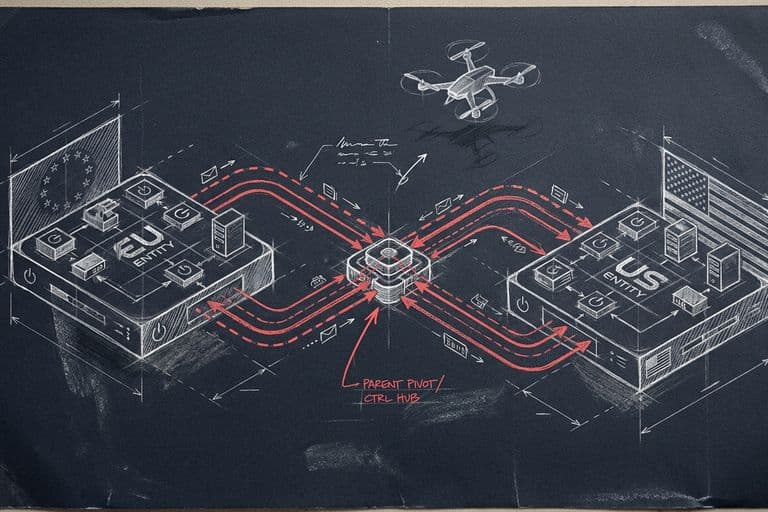
SBIR/STTR-eligible US entity. Dronehub Inc. (Delaware C-Corp) is the SBIR/STTR-eligible US small business. The US entity handles the prime relationship; the Polish entity handles manufacturing under the dual-domicile structure.
For Dronehub, AFWERX Open Topics is an active engagement pathway within the broader US federal-innovation pipeline. For similarly-positioned SMEs, the structural elements that make AFWERX engagement competitive are reproducible:
- Dual-use technology capability with both Air Force application and commercial market traction
- Demonstrated prior federal-innovation funding or commercial deployment for Direct-to-Phase-II eligibility
- Section 848-compatible supply chain
- SBIR/STTR-eligible US entity structure
What this means for SMEs evaluating AFWERX
For drone-technology SMEs with US-eligible entities — AFWERX Open Topics is structurally one of the highest-value federal-innovation pipelines. The cohort cycles are frequent (multiple per year), the funding envelopes are substantial (Phase II at $1.5-2M, Phase III uncapped), and the dual-use evaluation criteria favour SMEs with strong commercial market traction.
For non-US SMEs evaluating US federal-innovation engagement — the SBIR/STTR entity-path piece covers the structural eligibility requirements. Once the US entity is established (Delaware C-Corp + EB1A or equivalent founder residency + foreign-affiliation compliance documentation), AFWERX Open Topics becomes accessible. The entity-path investment compounds across multiple federal-innovation pipelines (AFWERX, DIU, NASA SBIR, DoE SBIR, DHS S&T) rather than just one.
For drone-technology primes — AFWERX engagement complements EDF, NATO DIANA, and Horizon Europe participation. Primes building portfolios across US, EU, and NATO innovation pipelines route capabilities through the appropriate agency for each region. The technology platform is the same; the per-agency engagement architecture varies.
The US R&D-partnership context is at /rd-partnership/us-defense. The SBIR/STTR entity-path piece is at /blog/sbir-sttr-non-us-drone-companies-entity-path. The NATO DIANA companion is at /blog/nato-diana-dual-use-accelerator. The Section 848 procurement guide is at /blog/ndaa-section-848-compatible-drones-procurement-guide. For an AFWERX Open Topics engagement conversation, open the contact form.
FAQ
- What is AFWERX structurally?
- AFWERX is the US Air Force innovation arm — the Air Force's primary engagement point for SME innovation, dual-use commercial-defense technology, and the broader US federal-innovation pipeline as applied to Air Force capability gaps. AFWERX operates multiple programme types: Open Topics (broad capability areas where SMEs propose their own technology), Topic-specific solicitations (narrowly-scoped problems with predefined solutions), STRATFI/TACFI (strategic and tactical funding instruments for Phase III commercialisation), and various challenge events. AFWERX's funding flows primarily through SBIR/STTR pipelines, with substantial annual award volume across Phase I, II, and III contracts.
- What's special about AFWERX Open Topics?
- Open Topics is the largest single funding pipeline within AFWERX and a unique SBIR/STTR mechanism. Standard SBIR/STTR pipelines publish narrowly-scoped pre-defined topics; applicants respond to the topic with their proposed technology. Open Topics inverts this: AFWERX publishes broad capability areas; applicants propose their own technology against the area, framed for how it addresses the Air Force's capability gaps. The Open Topics structure favours dual-use innovation — SMEs with strong commercial market traction and credible Air Force application get evaluated favourably, because the Air Force values commercial demand as a signal that the technology is procurement-grade and not dependent solely on federal funding to survive.
- What's the standard phase progression?
- Standard SBIR/STTR phase structure applies to AFWERX awards. Phase I — feasibility study, typical award $250K (capped at SBIR Phase I limits), 6-month execution. The objective is demonstrating that the proposed technology is technically feasible and addresses the Air Force capability gap. Phase II — R&D execution, typical award $1.5-2M, 24-month execution. The objective is building deployment-readiness — prototype, validation, integration work toward operational use. Phase III — commercialisation, no upper limit on funding (Phase III is sole-source contracting at the funding agency, which means AFWERX or other USAF / DoD entities can contract directly with the SME for production-level deployment without competitive solicitation). Phase III is where the long-tail revenue from successful SBIR programmes lives.
- What's the Direct-to-Phase-II pathway?
- AFWERX (and the broader DoD SBIR programme) allows qualifying SMEs to skip Phase I and enter directly at Phase II. The pathway is for companies with demonstrated technical readiness from prior work — commercial deployment of equivalent technology, prior federal-innovation funding (SBIR/STTR Phase I or II at other agencies, EU R&D programmes with equivalent validation, established commercial market traction), or other evidence that the Phase I feasibility step is unnecessary because feasibility is already proven. For SMEs with strong prior credentials, Direct-to-Phase-II compresses the funding cycle by ~6 months and increases the funding envelope per application.
- Which Open Topics map to drone-and-autonomy technology?
- Multiple recurring areas across AFWERX cohorts. Counter-UAS — sustained priority area; persistent C-UAS for base protection, deployable C-UAS for forward operations, counter-UAS integration with broader air-defense architectures. Autonomous mobility — autonomous UAVs at various scales, hybrid mobility platforms, swarm coordination, mission-planning autonomy. AI-enabled capability — vision AI for inspection, autonomous decision support, edge-AI deployment, sensor fusion. Persistent ISR — drone-in-a-box for FOB-grade persistent overhead, mobile-platform ISR. Sovereign positioning — Galileo OS-NMA integration, alternative-navigation under spoofing, multi-constellation receiver capability. FOB protection — base perimeter security, deployable infrastructure for base protection. For a drone-technology SME with a deep portfolio, multiple Open Topics per cohort generation will have direct capability fit.
- How does Dronehub fit AFWERX Open Topics?
- Several structural fits. The portfolio (AUDROS counter-UAS, HUUVER hybrid mobility + OS-NMA, Sentinel AI inspection, drone-in-a-box, Nomad mobile-dock) maps to multiple recurring Open Topics challenge areas. The Direct-to-Phase-II pathway is viable given the prior EU R&D programme record (HUUVER #870236, AUDROS ESA+EDA-funded, multiple Polish NCBR programmes) plus the commercial deployment validation (Deutsche Bahn national-scale rail inspection, EDA 98/100 CBRN counter-UAS evaluation). Section 848-compatible manufacturing at Jasionka satisfies the supply-chain compliance frame. Dronehub Inc. (Delaware C-Corp, SBIR/STTR-eligible US small business) handles the prime relationship. For Dronehub, AFWERX Open Topics is an active engagement pathway within the broader US federal-innovation pipeline.