Key facts
NATO DIANA (Defence Innovation Accelerator for the North Atlantic) is the NATO alliance's dual-use deep-tech accelerator programme, launched 2023 with progressive cohort expansion through 2025-2026 and continuing programming.
Source · NATO DIANA programme documentation
DIANA operates across multiple NATO member-state innovation hubs (accelerator sites) and test centres, with the network growing across the 2023-2026 window to include sites in the US, UK, Canada, Estonia, Belgium, Italy, Norway, Czech Republic, Poland, and others.
Source · NATO DIANA network expansion documentation
DIANA cohorts run annual cycles — applicants apply against published challenge topics, selected cohorts move through accelerator programming including grant funding, mentorship, NATO market access, and test-centre access for capability validation.
Source · DIANA cohort cycle structure
3 more key facts
Counter-UAS, autonomous-systems, AI-enabled inspection, hybrid mobility, and sovereign-positioning capability all map directly to DIANA challenge topics across the programme's cohort generations.
Source · DIANA challenge topic landscape analysis
DIANA is dual-use by design — selected technologies serve both NATO defense applications and civilian commercial applications. Companies with strong dual-use IP (defense-civilian crossover) fit the programme's selection criteria structurally.
Source · NATO DIANA programme positioning
Successful DIANA cohort graduates gain access to NATO member-state defense procurement pathways, NATO Innovation Fund follow-on investment consideration, and the broader NATO industrial-cooperation network.
Source · DIANA cohort outcomes and follow-on pathways
In this piece
NATO DIANA is the alliance's dual-use deep-tech accelerator pipeline. Launched in 2023, expanding across 2024-2026, and increasingly the structural answer for deep-tech SMEs targeting NATO defense procurement with dual-use commercial capability. For drone-technology companies, DIANA is one of the most coherent pathways into NATO-aligned funding and procurement engagement. This post is the SME-and-prime briefing — what DIANA is, how the cohort cycle works, which challenge topics fit drone technology, and how the programme integrates with the broader NATO innovation pipeline.
The post complements the broader EU and US federal-innovation programme landscape. Where EDF covers EU defense and EU R&D, where SBIR/STTR covers US federal innovation, DIANA spans the NATO-alliance frame and connects to both.
What DIANA structurally is
DIANA — Defence Innovation Accelerator for the North Atlantic — was launched in 2023 under NATO's broader innovation agenda, in response to two structural drivers. First, the geopolitical urgency after Russia's 2022 invasion of Ukraine elevated NATO innovation as a sovereign priority. Second, the deep-tech innovation pipeline in NATO member states had become dispersed across national programmes that didn't coordinate, leaving high-value dual-use technologies under-funded relative to comparable adversarial-bloc programmes.
DIANA's design responds to both. The programme operates as a network of accelerator sites and test centres across NATO member states, coordinated under NATO's allied innovation framework. Selected cohort members access grant funding, mentorship, NATO market introductions, and test-centre validation across the network. The dual-use positioning ensures selected technologies serve both NATO defense applications and civilian commercial markets — broadening the commercial pathway beyond what a defense-only programme could provide.
The programme structure has three layers.
Accelerator sites. Geographically distributed across NATO member states. Each site operates under a lead-organisation that hosts cohort members for the accelerator programming. Sites have specialised capability profiles — some focus on autonomous systems, some on AI-and-data, some on sensors-and-materials, some on energy-and-resilience. SMEs apply to the site most relevant to their technology and geographic profile.
Test centres. A separate network providing capability validation infrastructure. Test centres host capability-demonstration facilities, validation equipment, and the evaluation expertise to support cohort members' development work. The test-centre access is one of DIANA's structural advantages — SMEs gain validation infrastructure they could not access independently.
Coordinating framework. NATO's headquarters provides the programme coordination — cohort selection, challenge-topic publication, cross-site coordination, follow-on pathway management to NATO Innovation Fund and member-state procurement.
The combined effect is a network programme rather than a single-site accelerator. SMEs benefit from the geographic and technical breadth; NATO benefits from accessing innovation distributed across member states without forcing centralisation.
The accelerator-site network
The DIANA network has expanded across the 2023-2026 window from initial sites toward broader NATO member-state coverage.
United Kingdom — multiple sites under different lead organisations, including Imperial College London and additional university and research institute partnerships. The UK sites have particular depth in autonomous systems, AI-and-data, and sensor technology.
Estonia — one of the founding DIANA sites, with depth in cyber, autonomy, and sensors. Estonia's broader e-government and digital-innovation ecosystem supports the DIANA site's programming.
Belgium — DIANA presence in the broader NATO institutional ecosystem.
United States — multiple sites under different lead organisations, with the US network expanding across the 2024-2026 window. US DIANA sites integrate with the broader US federal-innovation pipeline (SBIR/STTR, AFWERX, DIU) while operating under the DIANA framework for NATO-allied access.
Canada — DIANA site supporting Canadian deep-tech SMEs and Five Eyes-aligned programming.
Italy — DIANA presence with depth in sensor-and-systems integration and aerospace.
Norway — DIANA site with Nordic-cluster specialisation in autonomous systems, sensors, and northern-environment operations.
Czech Republic — DIANA presence with defense-research depth (the Brno cluster providing technical support).
Poland — DIANA site supporting Polish and broader Central European SMEs. Aviation Valley's industrial base provides supply-chain depth for DIANA cohort members in autonomous systems and aerospace.
Baltic states beyond Estonia, Nordic cluster beyond Norway, additional EU member states — progressive expansion of the network.
For drone-technology SMEs, multiple sites have relevant capability depth. The UK, Polish, Czech, and US sites all have UAS-and-autonomy programming. SMEs typically apply to the site closest geographically and most aligned to their specific technology stack.
The cohort cycle in practice
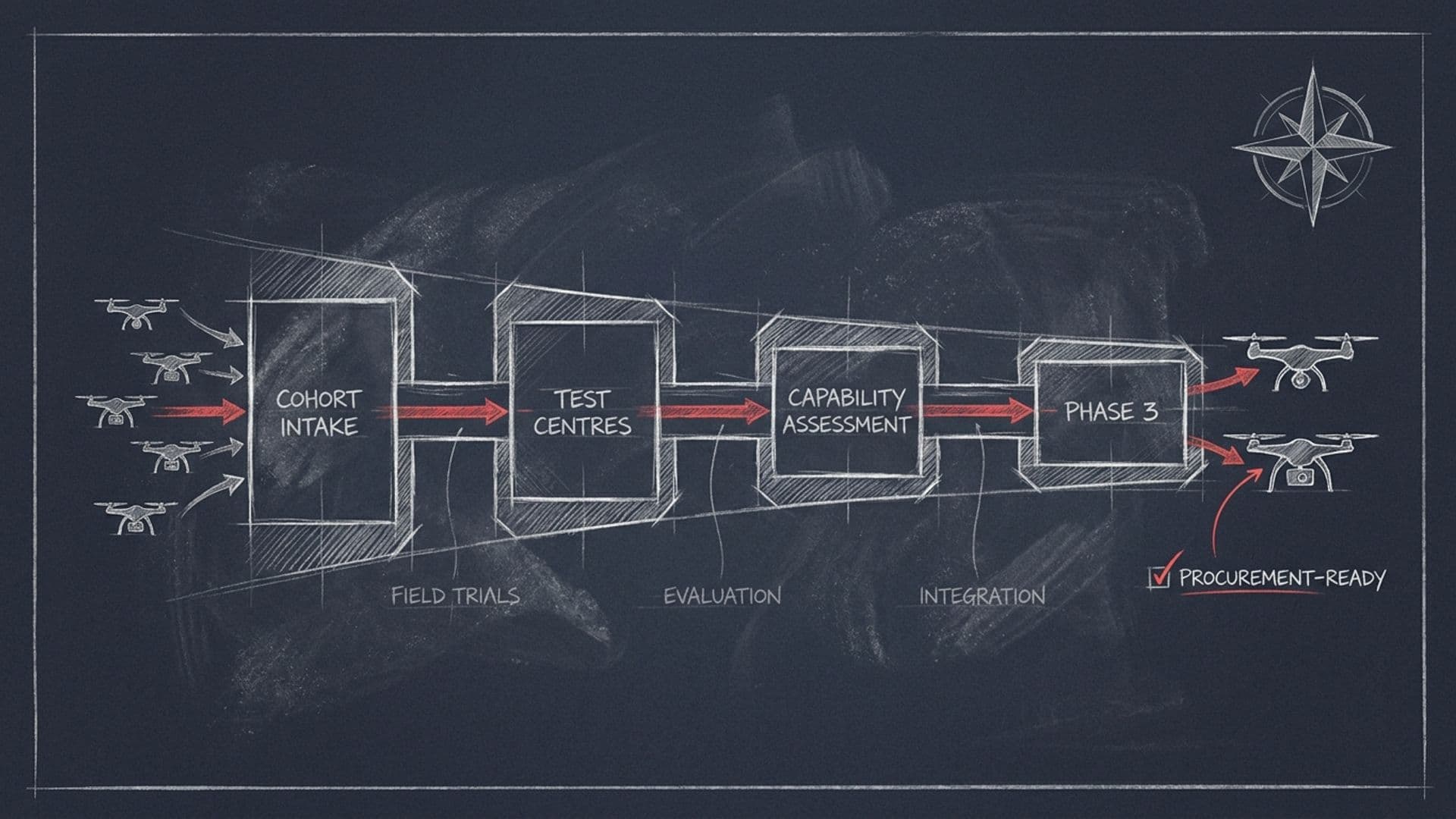
DIANA cohort cycles run annually with multiple stages.
Stage 1 — Challenge topic publication. DIANA publishes the cohort's challenge topics. Topics span counter-UAS, autonomous systems, AI-enabled capability, hybrid mobility, sovereign positioning, sensors, energy, materials, cyber, and other deep-tech categories. Each topic specifies the capability gap NATO is targeting and the application criteria.
Stage 2 — Application window. SMEs apply against specific challenge topics. Application requirements typically include the technology proposal, the SME's capability and track record, the dual-use property of the technology, and the alignment with NATO's strategic priorities.
Stage 3 — Selection. DIANA's evaluation panel — composed of NATO defense experts, member-state procurement representatives, and technical evaluators — selects the cohort. Typical cohort size is 30-60 companies across all challenge topics per cycle, with selection rates varying by topic and applicant volume.
Stage 4 — Phase 1 accelerator programming. Selected cohort moves through the accelerator programme. Components include grant funding (typically €100K-€300K initial seed grant per company), mentorship from NATO and member-state defense experts, market-access introductions to relevant procurement organisations, and access to NATO test centres for capability validation. The Phase 1 programme typically runs 6-9 months.
Stage 5 — Phase 2 progression. Top-performing cohort members from Phase 1 move into Phase 2 — deeper capability development, follow-on grant funding (Phase 2 typically larger, in the €500K-€1M+ range), continued test-centre access, and intensified procurement engagement.
Stage 6 — Graduation / Phase 3. Successful Phase 2 graduates exit DIANA's accelerator programming into the follow-on pathway. Multiple pathways open: NATO member-state procurement engagement, NATO Innovation Fund follow-on investment consideration, prime-led consortium integration for EDF / national-MoD programmes, and commercial market expansion under the credential of the DIANA graduation.
Challenge topics for drone technology
DIANA's challenge topics span the deep-tech innovation landscape; multiple topics per cohort generation map directly to drone-technology SMEs.
Counter-UAS topics — appearing in nearly every cohort generation. Sub-topics include net-capture and intact-recovery interception, detection-and-tracking system-of-systems, CBRN counter-UAS response, urban and infrastructure-perimeter C-UAS, and counter-UAS integration with broader air-defense architectures.
Autonomous systems topics — UAV-and-drone autonomy at various TRL levels, hybrid mobility (matching HUUVER's UAV-UGV profile), swarm coordination, mission-planning autonomy, autonomous logistics, persistent autonomy (matching the drone-in-a-box deployment profile).
AI-enabled capability — vision-AI for inspection, edge inference, anomaly detection (matching Sentinel architecture), AI-driven C2 integration, autonomous decision support, sensor fusion.
Sensor and integration topics — sovereign-positioning (where Galileo OS-NMA integration fits), multi-sensor fusion, RF sensing, command-and-control integration, dispatcher-stack integration.
Mobility and platform topics — mobile dock for tactical deployment (matching Nomad), deployable infrastructure for forward bases, all-environment operation (cold, hot, subterranean, denied environments matching HUUVER's profile).
Counter-EW and resilience topics — sovereign navigation under EW threat, RF-resilient command and control, GNSS-denied operation, spoofing-resistant autonomy.
For an SME with a deep-tech drone-technology portfolio (autonomy, AI, sovereign positioning, counter-UAS, mobile platforms), several DIANA challenge topics per cohort generation will have direct capability fit. The application strategy is to target the topic(s) where the SME's strongest capability differentiates against the broader applicant pool.
DIANA and the NATO Innovation Fund
DIANA is the accelerator pipeline; the NATO Innovation Fund (NIF) is the follow-on investment vehicle. The two operate as complementary components of NATO's innovation framework.
NIF is a venture-capital-style investment fund with €1 billion+ in committed capital from NATO member states. NIF invests equity into deep-tech scale-up companies with NATO-defense relevance and dual-use commercial potential. The investment thesis aligns with DIANA's selection criteria — dual-use deep-tech with NATO defense relevance and demonstrated commercial market traction.
The structural pathway for SMEs: DIANA accelerator participation → demonstrated capability and market traction during Phase 1-2 programme → NIF investment consideration for Phase 3 scale-up funding.
NIF's investment cycle and DIANA's graduation cycle are coordinated to support this pipeline. SMEs that successfully exit DIANA Phase 2 with demonstrated traction become high-priority NIF investment candidates.
For SMEs, the combined DIANA + NIF pathway is one of the most coherent dual-use deep-tech investment pipelines in NATO Europe. The accelerator programming validates capability and de-risks the early development; the follow-on investment funds the scale-up.
How Dronehub fits the DIANA profile
Multiple structural fits.
Technology portfolio mapping. The AUDROS counter-UAS stack (with EDA 98/100 validation), the HUUVER hybrid mobility with Galileo OS-NMA, the Sentinel AI inspection architecture, the drone-in-a-box infrastructure, the Nomad mobile-dock — all map to recurring DIANA challenge topics.
Dual-use property. Every capability in the portfolio serves both defense and civilian-critical-infrastructure markets. AUDROS deploys at prisons, refineries, and FOBs. Sentinel deploys at Deutsche Bahn rail, wind farms, and ports plus defense applications. HUUVER serves civil search-and-rescue plus subterranean ISR plus defense denied-environment operations. The dual-use property is structural rather than retrofitted.
Consortium-leadership credential. AUDROS as ESA + EDA jointly-funded SME programme. HUUVER as Horizon 2020 #870236 (with the founder personally listed as project coordinator). The broader EU R&D portfolio across multiple programmes. These credentials are procurement-grade signal for DIANA evaluation.
Sovereign supply chain. Aviation Valley manufacturing under NATO-allied non-CN supply chain. Section 848-compatible documentation for US-side procurement. EDIS-aligned manufacturing for EU defense. The supply-chain provenance is procurement-grade.
For Dronehub, DIANA is an active pathway within the broader US + EU federal-innovation pipeline. For similarly-positioned SMEs evaluating their funding pathway, the structural elements that make DIANA application competitive are reproducible:
- Dual-use deep-tech capability with both defense and civilian-critical-infrastructure traction
- Demonstrated track record via prior EU or US federal-innovation funding
- NATO-allied supply chain (or the structure to achieve it)
- Procurement-grade audit material on first-cycle diligence
What this means for SMEs evaluating DIANA
For drone-technology SMEs in NATO member states — DIANA is a structurally available pathway. The application cycle is annual; the cohort selection is competitive but well-defined; the follow-on pathway (Phase 2, NIF investment, member-state procurement) is coherent. The investment of application time is bounded relative to the upside of successful cohort participation.
For Five Eyes-aligned SMEs (US, UK, Canada, Australia, New Zealand) — DIANA participation through the relevant national site. The Five Eyes alignment with NATO operates well at the DIANA programming level.
For EU SMEs outside the NATO-only frame (Austria, Ireland, Sweden, Finland's evolving NATO posture) — DIANA participation through proximity sites. Sweden's NATO accession has expanded DIANA-accessible programming for Swedish SMEs.
For non-NATO allied SMEs (Japan, South Korea, partner-status countries) — partnership-route participation through NATO partner-status frameworks. Less direct than full member-state pathway but operationally accessible.
The full EU and US R&D-partnership context is at /rd-partnership/europe and /rd-partnership/us-defense. The EDF programming companion is at /blog/european-defence-fund-2026-cuas-calls. The SBIR/STTR entity-path companion is at /blog/sbir-sttr-non-us-drone-companies-entity-path. For a DIANA-application strategy conversation, open the contact form.
FAQ
- What is NATO DIANA structurally?
- NATO DIANA — Defence Innovation Accelerator for the North Atlantic — is the alliance's dual-use deep-tech accelerator programme. Launched in 2023 under NATO's broader innovation agenda, DIANA operates as a network of accelerator sites and test centres across NATO member states. The programme runs annual cohort cycles: applicants apply against published challenge topics, selected cohorts move through accelerator programming (grant funding, mentorship, market access, test-centre access), and successful graduates gain access to NATO member-state procurement pathways and follow-on investment via the NATO Innovation Fund. The programme positioning is dual-use deep-tech — technologies that serve both NATO defense applications and civilian commercial markets.
- Where are the DIANA accelerator sites located?
- The network is geographically distributed across NATO member states and has been expanding across the 2023-2026 window. Founding sites include the UK (Imperial College London and others), Estonia, Belgium, plus additional sites across European and North American member states. The network has expanded to include the US (multiple sites under different lead organisations), Canada, Italy, Norway, Czech Republic, Poland, the Baltic states beyond Estonia, and others. The geographic distribution allows DIANA applicants to engage with the site most relevant to their geographic and capability profile. For drone-technology SMEs, multiple sites have relevant programmatic depth — the UK, Polish, Czech, and US sites all have UAS-and-autonomy capability.
- What does the DIANA cohort cycle look like?
- Annual cycle with multiple stages. (1) Challenge topic publication — DIANA publishes the challenge topics for the cohort. Topics span counter-UAS, autonomous systems, AI-enabled capability, hybrid mobility, sovereign-positioning, sensors, energy, materials, and other deep-tech categories. (2) Application window — SMEs apply against specific challenge topics with their technology proposal. (3) Selection — DIANA's evaluation panel selects the cohort, typically 30-60 companies across all challenge topics for the cycle. (4) Phase 1 accelerator programming — selected cohort moves through grant funding (typically €100K-€300K initial), mentorship, market-access introductions, and access to NATO test centres for capability validation. (5) Phase 2 progression — top-performing cohort members move to Phase 2 for deeper capability development and follow-on funding (Phase 2 typically larger funding, longer runway). (6) Graduation / Phase 3 — successful graduates gain access to NATO member-state procurement pathways and follow-on investment consideration.
- Which challenge topics fit drone technology?
- Multiple topics across DIANA's challenge landscape. Counter-UAS is a recurring topic across cohort generations — net-capture interception, detection-and-tracking, system-of-systems integration, CBRN response all map. Autonomous systems topics include UAV-and-drone autonomy at various TRL levels, hybrid mobility, swarm coordination, mission-planning autonomy. AI-enabled capability topics include vision-AI for inspection, edge inference, anomaly detection — directly mapping the Sentinel architecture. Sensor and integration topics include sovereign-positioning (where Galileo OS-NMA integration fits), multi-sensor fusion, RF sensing, and command-and-control integration. For drone-technology SMEs, several DIANA challenge topics per cohort generation typically have direct capability fit.
- What's DIANA's relationship to the NATO Innovation Fund?
- DIANA is the accelerator pipeline; the NATO Innovation Fund (NIF) is the follow-on investment vehicle. DIANA graduates that demonstrate scale-up potential become candidates for NIF investment — equity investment into the company's growth capital. NIF's investment thesis aligns with DIANA's accelerator selection criteria: dual-use deep-tech with NATO defense relevance and commercial market traction. For SMEs, the structural pathway is DIANA accelerator participation → demonstrated capability and market traction during Phase 1-2 → NIF investment for Phase 3 scale-up. The combined pipeline is one of the most coherent dual-use deep-tech investment pathways in NATO Europe.
- How does Dronehub fit DIANA?
- Multiple structural fits. The technology portfolio (AUDROS counter-UAS, HUUVER hybrid mobility with Galileo OS-NMA, Sentinel AI inspection, drone-in-a-box infrastructure, Nomad mobile-dock) maps to recurring DIANA challenge topics. The dual-use property is structural — every capability in the portfolio serves both defense and civilian-critical-infrastructure markets, which is DIANA's selection criterion. The consortium-leadership credential from AUDROS (ESA + EDA jointly-funded), HUUVER (Horizon 2020 #870236), and the broader EU R&D portfolio is procurement-grade signal for DIANA evaluation. The NATO-allied supply chain via Aviation Valley aligns with DIANA's sovereign-supply-chain frame. For Dronehub, DIANA is an active pathway within the broader US + EU federal-innovation pipeline; for similarly-positioned SMEs, the pathway is reproducible.