Key facts
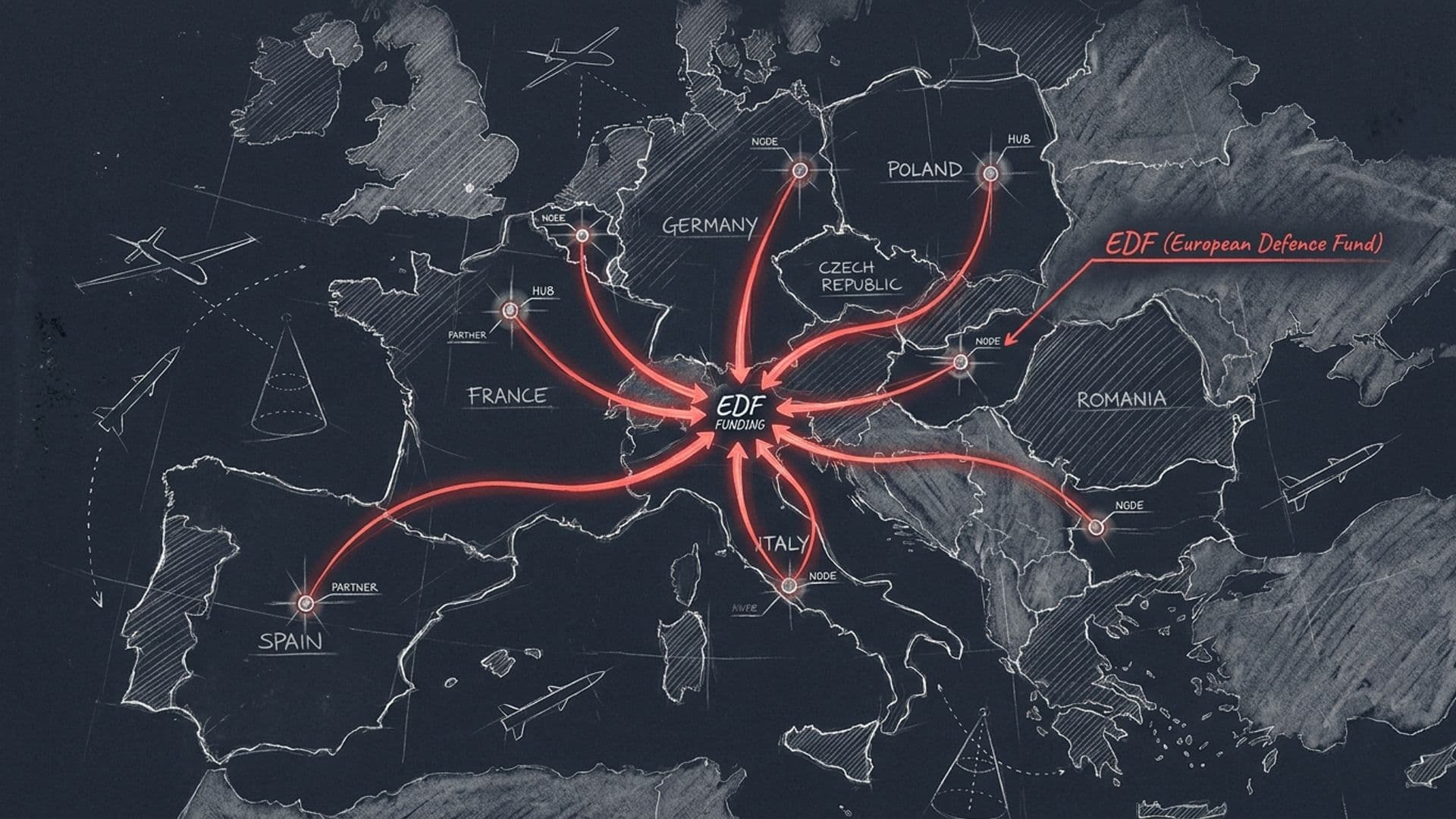
The European Defence Fund (EDF) operates with an €8 billion budget across the 2021-2027 multiannual financial framework, with continuing programmes funded through 2028-2034. EDF is the EU's primary defense R&D and capability-development funding instrument.
Source · European Commission EDF programming documentation
Counter-UAS topic areas have appeared in nearly every EDF annual work programme since 2021, reflecting the priority importance of the capability for EU defense industrial policy and the convergence with EDIS-aligned sovereign supply chain requirements.
Source · EDF annual work programme analysis 2021-2026
EDF calls are structured around consortium-led proposals — typically 3 or more EU member states, prime contractors plus SMEs plus research organisations, with consortium formation completed before the submission deadline.
Source · EDF programme eligibility and structure documentation
3 more key facts
SMEs (defined per EU criteria — fewer than 250 employees, annual turnover under €50M or balance sheet under €43M) have specific eligibility advantages under EDF: increased EU co-funding percentage, dedicated SME-friendly call tracks, prime-led consortium preference for SME inclusion.
Source · EDF SME participation rules; EU SME definition (Recommendation 2003/361/EC)
EDF application timeline runs roughly 9-12 months from call publication to award notification, with consortium formation and proposal development typically requiring an additional 3-6 months before submission. Total cycle from initial consortium discussion to award is approximately 12-18 months.
Source · EDF programme timeline analysis
Dronehub has led or participated in multiple EU programmes that map directly to EDF eligibility — AUDROS (ESA + EDA jointly-funded), HUUVER (Horizon 2020 #870236), and several Polish NCBR programmes. The consortium-leadership credential is transferable to EDF prime or sub-contractor roles in c-UAS calls.
Source · Dronehub EU R&D programme participation record
In this piece
The European Defence Fund is the largest single EU funding instrument for defense R&D and capability development — and counter-UAS is one of its recurring priority topic areas across 2021-2026 with continuing programming through 2034. For drone-industry vendors, primes, and SMEs evaluating where the EU-side procurement and R&D funding lives in 2026, EDF is the centre of gravity. This post unpacks what EDF actually is, how its c-UAS calls work, what the consortium structure looks like, and how application timing works in practice.
The post draws on Dronehub's experience leading and participating in EU-funded R&D programmes that map directly to EDF eligibility — AUDROS (ESA + EDA jointly-funded counter-UAS), HUUVER (Horizon 2020 grant agreement #870236), multiple Polish NCBR programmes, plus the European Defence Agency CBRN counter-UAS programme that scored 98/100. The consortium-leadership credential is transferable to EDF prime and sub-contractor roles in current and future c-UAS calls.
What EDF actually is
The European Defence Fund is the European Union's primary defense R&D and capability-development funding instrument, with an €8 billion budget across the 2021-2027 multiannual financial framework and continuing funding programmed through 2028-2034. EDF replaced and integrated two predecessor programmes — the Preparatory Action on Defence Research (PADR) for upstream defense research and the European Defence Industrial Development Programme (EDIDP) for capability development. The integration of these two into EDF gives the EU a single instrument spanning the full TRL range from upstream research to capability deployment.
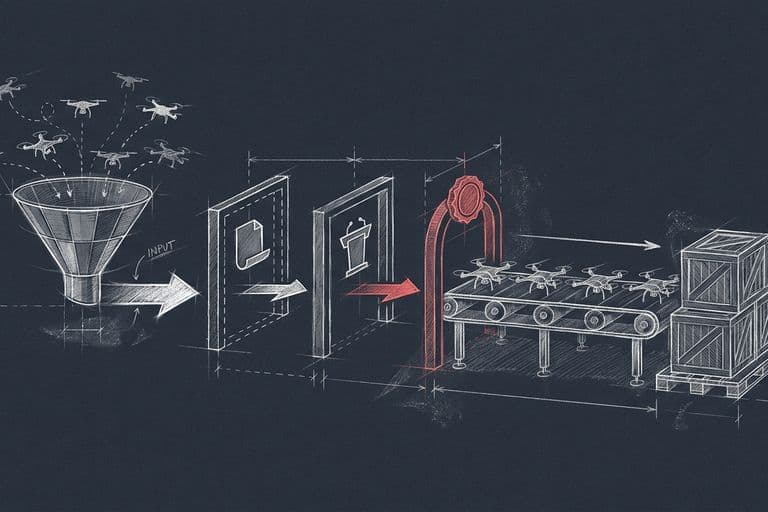
The funding flows through annual work programmes that publish specific topic areas and funding envelopes. Defense industry partners — primes, SMEs, research organisations, governmental and inter-governmental bodies — form consortia and submit proposals against the topics. Awards fund the consortium's work over multi-year programmes, typically 2-4 years for research actions and 3-5 years for development and capability-deployment actions.
EDF participation requires:
- EU member-state domicile for the consortium partners. Non-EU partners can participate under specific eligibility rules but with significant constraints; the core consortium has to be EU-domiciled.
- Multi-member-state consortium structure. Typically at least three EU member states represented across the consortium partners.
- Defined industrial / research role mix. Primes plus SMEs plus research organisations, with specific evaluation credit for the balance and the SME participation share.
- Specific topic alignment. Proposals address specific topic areas defined in the annual work programme; off-topic proposals are not eligible regardless of technical merit.
The administrative structure runs through DG DEFIS (the European Commission's Directorate-General for Defence Industry and Space). DG DEFIS publishes the annual work programmes, manages the evaluation cycle, and awards the funding.
Counter-UAS in the EDF topic landscape
C-UAS topic areas have appeared in nearly every EDF annual work programme since 2021. The recurring priority reflects two converging dynamics: counter-UAS is a high-priority capability gap across NATO and EU defense forces post-2022, and the technology has converged on a small number of architectures that EDF can fund toward sovereign-capability deployment.
The 2026 EDF work programme continues the pattern. C-UAS topic areas cover:
- Detection capability — radar, RF sensing, acoustic detection, machine-vision integration. The upstream sensor-stack work that feeds the broader c-UAS engagement chain.
- Intact-recovery interception modalities — where the AUDROS-type net-capture approach fits. Topic areas in this space have been recurring across multiple EDF calls.
- Kinetic and non-kinetic engagement — covering both the soft-kill (RF jamming, GPS denial) and hard-kill (kinetic, net-capture) modalities, with topic-specific scope per call.
- CBRN response — where the AUDROS CBRN-response variant (the capability that scored 98/100 with the European Defence Agency) maps directly. CBRN-specific c-UAS topics have been less frequent than general c-UAS topics but have appeared.
- System-of-systems integration — covering the integration of c-UAS into broader EU air-defense architectures, NATO air-defense interoperability, and civil-protection command-and-control integration.
The funding envelope per topic varies from low single-digit millions of euros for upstream research to tens of millions for capability-deployment programmes. Multi-year programmes can sum to programme-level awards in the €20-50 million range for capability-deployment topics with significant industrial-deployment scope.
Consortium structure
EDF consortia are not single-vendor entities. The minimum eligibility threshold (three or more EU member states) ensures the consortium architecture is collaborative across the EU industrial base. Typical structures include:
Large-prime-led consortia. A major industrial prime (Airbus DS, Thales, Leonardo, Rheinmetall, MBDA, Saab, Indra) serves as consortium lead. The prime brings industrial-capability scale, certified manufacturing, integration experience, and the procurement relationships with national MoDs. Sub-contractors include specialised SMEs (for specific technology workpackages), research organisations (for upstream technical components), and additional industrial partners. SME participation share is significant — both because evaluation credit rewards substantive SME inclusion and because the SMEs typically own the specific technology innovation that the consortium needs.
SME-led consortia. A defense-technology SME serves as consortium lead. The SME brings the core technology innovation, the consortium-leadership experience (typically demonstrated by prior EU programme work), and the IP that the consortium is funded to develop or deploy. Sub-contractors include research organisations, integration partners, and complementary SMEs. SME-led consortia are more common in research-action calls (TRL 4-6 upstream work) than in capability-deployment calls, but the pattern has been growing across all EDF call categories.
Research-organisation-led consortia. A research organisation (Fraunhofer Institutes, CEA, AIT, ONERA, TNO, equivalent national research centres) serves as consortium lead. This is most common in research-action calls where the upstream nature of the work fits the research-organisation operational model. Industrial partners and SMEs participate as work-package leads or sub-contractors.
The Dronehub portfolio demonstrates SME-led consortium leadership at the relevant scale. AUDROS was an ESA + EDA jointly-funded SME-led consortium across Poland and Czech Republic. HUUVER was a Horizon 2020 SME-led consortium across five EU countries with the founder personally listed as project coordinator on the EU programme record. The pattern translates directly to EDF prime roles in topic areas with SME-origin technology pedigree.
SME-specific provisions
EDF includes structural advantages for SME participation, reflecting EU policy emphasis on dual-use innovation and SME-driven defense capability development.
Increased EU co-funding percentage. SMEs in EDF consortia typically receive higher EU co-funding rates than prime-only consortia. The specific rate depends on call structure, SME participation share, and the action category, but the differential is meaningful — SME participation can shift co-funding from 70-80% to 90%+ on specific cost categories.
Dedicated SME-friendly call tracks. Some EDF calls are structured specifically for SME-led or SME-prominent consortia, with eligibility criteria that exclude or limit large-prime-led consortium structures. These tracks include both research-action and capability-deployment categories, with funding envelopes typically smaller than the general-call equivalents but with the SME-eligibility frame producing higher win rates for SMEs that fit the call structure.
Prime-led consortium preference for SME inclusion. Large-prime-led consortia receive evaluation credit for substantive SME participation. Primes actively recruit SMEs into their consortia as a result. For SMEs with strong technology track records and consortium-leadership experience (Dronehub-class profile), primes initiate consortium-formation discussions rather than the SME having to chase the prime.
SME-specific instruments. EDF includes dedicated SME participation mechanisms within the broader programme architecture, with simplified application procedures and SME-targeted evaluation criteria.
Timeline in practice
EDF application timing has structural rigidity that consortium partners need to plan around.
Pre-call period (3-6 months before call publication). Consortium scoping. Primes identify their target topic areas, line up sub-contractors, and engage SMEs for specific workpackage roles. SMEs identify which topic areas fit their technology and seek prime partnerships or build SME-led consortium structures. Partnership discussions, technical scoping, and consortium agreements form during this period.
Call publication (T=0). DG DEFIS publishes the annual work programme. Specific topic areas, funding envelopes, eligibility criteria, evaluation criteria, and submission deadlines become public. The pre-call consortium-scoping work converts into formal proposal development.
Proposal development (T+0 to T+4 to 6 months). Consortium partners develop the technical proposal, the work-plan, the budget, the consortium agreement, and the supporting documentation. Multi-partner proposals typically run 100-300 pages of technical and administrative content. Internal review cycles, partner alignment, and final-submission preparation consume most of this period.
Submission (T+4 to 6 months). Consortium submits the proposal through the EU Funding & Tenders Portal.
Evaluation (T+4 to 6 to T+8 to 12 months). DG DEFIS coordinates external technical-expert evaluation, ranks proposals against the evaluation criteria, and issues award notifications. The evaluation process is structured around independent evaluators, technical-panel sessions, and ranking deliberation; the timeline is rigid relative to publication-of-results.
Award notification (T+9 to 12 months). Successful consortia receive award notifications. Unsuccessful consortia receive feedback on the evaluation outcomes. Award-grant agreement signing follows shortly after notification.
Programme execution (T+12 months to T+12+programme-duration). Award-funded programmes execute over their planned multi-year duration. Typical research actions run 2-4 years; development and capability-deployment actions run 3-5 years; large capability-deployment programmes can run longer.
For consortium partners planning their R&D pipeline, this means EDF participation is a multi-year commitment. The call you submit to in 2026 awards in 2027 and executes 2027-2030 for typical programmes. Strategic R&D planning has to project capability needs and consortium positioning several years forward.
How Dronehub participates
Three structural pathways into EDF c-UAS calls.
SME-prime role. Dronehub leads consortia in topic areas where the technology has SME-origin pedigree, particularly c-UAS topics where AUDROS-type net-capture interception is the procurement-grade reference. The AUDROS programme demonstrated SME-led ESA + EDA consortium leadership at the EDA 98/100 validation level; the same consortium-leadership credential maps to EDF prime roles. We engage SMEs and research organisations in matching topic areas to form consortium architectures.
Technical SME inside prime-led consortia. Dronehub participates in large-prime-led consortia as the c-UAS workpackage lead or as the AI / autonomy SME. Major EU industrial primes (Airbus DS, Thales, Leonardo, Rheinmetall, Saab) actively recruit us for these roles because the technology track record and the third-party validation (EDA 98/100, Horizon 2020 success) reduce the consortium's evaluation risk on the relevant workpackages.
Deployment-validation partner. Dronehub provides deployment-ready capability — the Sentinel AI stack, the Eagle One interceptor, the drone-in-a-box infrastructure — to EDF programmes that need procurement-grade reference capability. The participation is structured around the specific workpackage requirements without requiring full consortium leadership.
For EU defense and federal-innovation buyers — the EDF participation pattern integrates with the broader EU R&D-partnership context at /rd-partnership/europe. The counter-UAS portfolio context is at /projects/audros and across the counter-UAS blog topic. The EU defense-industry context is at /industries/defense. For an EDF consortium-formation discussion, open the contact form.
FAQ
- What is the European Defence Fund actually?
- EDF is the European Union's primary defense R&D and capability-development funding instrument. It funds collaborative research, prototype development, and capability-deployment programmes across EU member states. The total budget is €8 billion across 2021-2027 with continuing funding through 2028-2034. EDF operates through annual work programmes that publish specific topic areas and funding envelopes; defense industry partners (primes, SMEs, research organisations) form consortia and submit proposals against the topics. Awards fund the consortium's work over multi-year programmes. EDF replaced the Preparatory Action on Defence Research (PADR) and the European Defence Industrial Development Programme (EDIDP) that preceded it; it's now the integrated successor to both.
- What does a typical EDF c-UAS call look like?
- C-UAS topic areas appear across multiple EDF call categories — research-action calls (TRL 4-6, more upstream), development-action calls (TRL 6-8, closer to deployment), and capability-deployment calls. Counter-UAS calls have spanned detection technology, kinetic and non-kinetic engagement modalities, sensor integration, command-and-control architectures, and the full counter-UAS system-of-systems. The 2026 work programme continues this pattern, with c-UAS topics covering detection capability, intact-recovery interception modalities (where AUDROS-type net-capture fits), CBRN response (where the EDA 98/100 capability fits), and integration with broader EU air-defense architectures. The funding envelope per topic varies from a few million euros for upstream research to tens of millions for capability-deployment programmes.
- Who can lead an EDF consortium?
- Both prime contractors and SMEs can lead EDF consortia, depending on the specific call topic and structure. Large primes (Airbus DS, Thales, Leonardo, Rheinmetall, MBDA, Saab) lead a substantial share of EDF prime contracts, particularly in capability-deployment calls where industrial-prime experience is the structural fit. SMEs lead a growing share of consortia, particularly in research-action calls and in topic areas where SME innovation has been the historical capability driver. The consortium-leadership pattern Dronehub demonstrated on AUDROS (ESA + EDA jointly-funded SME-led consortium) and HUUVER (Horizon 2020 SME-led consortium) maps directly to EDF eligibility for SME-led prime roles where the technology has SME-origin pedigree.
- What are the SME-specific provisions under EDF?
- Three structural advantages. (1) Increased EU co-funding percentage — SMEs in EDF consortia typically receive higher EU co-funding rates than prime-only consortia, with the specific rate depending on call structure and SME-participation share. (2) Dedicated SME-friendly call tracks — some EDF calls are structured specifically for SME-led or SME-prominent consortia, with eligibility criteria that exclude or limit prime-led consortium structures. (3) Prime-led consortium preference for SME inclusion — large-prime-led consortia receive evaluation credit for substantive SME participation, which means primes actively recruit SMEs into their consortia. SME participation is also structured through the EDF SME calls within the broader EDF programme architecture.
- What's the timeline from EDF call publication to award notification?
- Roughly 9-12 months for the formal cycle. Call publication opens the window. Consortium formation typically happens in the 3-6 months before call publication — primes scope their consortium architecture, SMEs identify their target topic areas, partnerships form. After call publication, proposal development typically runs 4-6 months to the submission deadline. Evaluation runs 4-6 months from submission to award notification. The total elapsed time from initial consortium discussion to award is therefore typically 12-18 months. For SMEs and primes planning their R&D pipeline, this means EDF participation is a multi-year investment — the call you submit to in 2026 awards in 2027, with execution running 2027-2030 for typical multi-year programmes.
- How does Dronehub participate in EDF c-UAS proposals?
- Through three structural pathways. (1) As SME prime — Dronehub leads consortia in topic areas where the technology has SME-origin pedigree, particularly c-UAS topics where AUDROS-type net-capture intercept is the procurement-grade reference. The AUDROS programme demonstrated SME-led ESA + EDA consortium leadership; the same pattern maps to EDF prime roles. (2) As technical SME inside prime-led consortia — Dronehub participates in large-prime-led consortia (Airbus DS, Thales, Leonardo, Rheinmetall, Saab) as the c-UAS workpackage lead or as the AI / autonomy SME. Primes actively recruit Dronehub for these roles because the technology track record and the third-party validation (EDA 98/100, Horizon 2020 success) reduce the consortium's evaluation risk. (3) As deployment-validation partner — Dronehub provides deployment-ready capability to EDF programmes that need procurement-grade validation, including the Sentinel AI stack, the Eagle One interceptor, and the drone-in-a-box infrastructure.