Key facts
Horizon Europe is the European Union's flagship research and innovation programme — €95.5 billion budget across 2021-2027 multiannual financial framework, with continuing programming through the next MFF.
Source · European Commission Horizon Europe programming
Horizon Europe is structured around three pillars; Pillar II includes six clusters covering different thematic domains. Clusters 4 and 5 both fund drone-and-autonomy technology under different scope framings.
Source · Horizon Europe structural framework
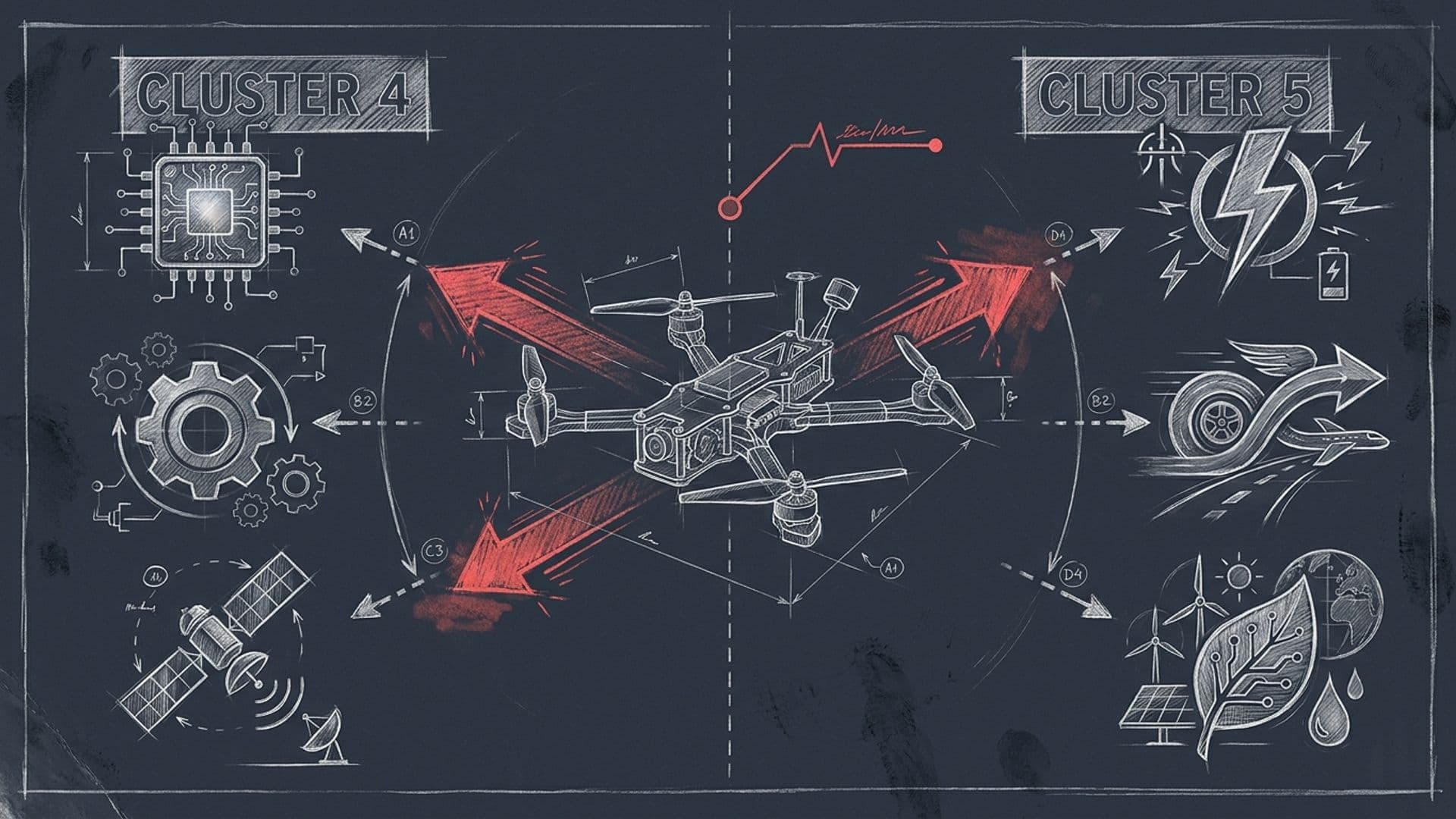
Cluster 4 — Digital, Industry, Space — covers digital technologies, manufacturing industries, and space applications including the EU's space programmes (Galileo, Copernicus). Drone-technology topics in Cluster 4 typically frame around space-domain integration, digital and AI capabilities, or industrial-manufacturing applications.
Source · Horizon Europe Cluster 4 scope documentation
3 more key facts
Cluster 5 — Climate, Energy, Mobility — covers climate solutions, energy transformation, and mobility transformation. Drone-technology topics in Cluster 5 typically frame around energy-grid inspection, transportation infrastructure, climate-monitoring applications, or smart-mobility integration.
Source · Horizon Europe Cluster 5 scope documentation
Multiple Dronehub-relevant programmes ran under Horizon Europe predecessor (Horizon 2020) — HUUVER under grant agreement #870236 is the canonical example. The Cluster 4 / Cluster 5 fit decisions are made annually per the published work programme.
Source · Horizon 2020 and Horizon Europe Dronehub programme participation
Cluster 4 and Cluster 5 are not mutually exclusive — a strong dual-use proposal can route to either cluster depending on the framing. The decision is strategic: which cluster's evaluator pool, funding envelope, and consortium-formation patterns better match the proposal's strongest dimensions.
Source · Horizon Europe cross-cluster proposal analysis
In this piece
Horizon Europe is the European Union's flagship research and innovation programme — €95.5 billion budget across the 2021-2027 multiannual financial framework, with continuing programming through 2028-2034. For drone-technology SMEs and primes evaluating EU funding pathways, two of Pillar II's thematic clusters carry the bulk of relevant programming: Cluster 4 (Digital, Industry, Space) and Cluster 5 (Climate, Energy, Mobility). Both fund drone-and-autonomy technology under different scope framings.
This post is the strategic-positioning briefing for choosing between the two clusters. It walks through what each cluster covers, how to decide which fits a specific proposal, and how the cluster choice interacts with consortium formation and evaluator-pool dynamics.
Horizon Europe at a glance
The European Commission's Horizon Europe programme spans roughly 2021-2027 with €95.5 billion in committed budget. Continuing programming through the next multiannual financial framework (2028-2034) is in negotiation but expected to maintain or expand the programme's scope.
The programme is structured around three pillars:
Pillar I — Excellent Science. ERC (European Research Council) for frontier research, Marie Skłodowska-Curie Actions for researcher mobility, research-infrastructure programmes. Less directly relevant for industry-deployable drone technology; more relevant for upstream research collaboration.
Pillar II — Global Challenges and European Industrial Competitiveness. Six thematic clusters covering different domain areas. Most industry-deployable drone-technology funding lives here. Clusters 4 and 5 are the primary engagement points for drone-and-autonomy proposals; Cluster 3 (Civil Security for Society) sometimes hosts relevant security and disaster-response programming.
Pillar III — Innovative Europe. The European Innovation Council (EIC) — the EU's deep-tech innovation engine, including the EIC Accelerator that funds SME-led deep-tech with both grant and equity. The European Institute of Innovation and Technology operates here too.
For drone-technology SMEs and primes, the strategic decisions are: (a) which cluster's funding pool best fits the proposal's framing, (b) whether to route through cluster programming or through the EIC Accelerator (the EIC has different selection criteria and structure), and (c) how to coordinate Horizon Europe participation with EDF (defense-specific), NATO DIANA (dual-use accelerator), and US federal-innovation programmes.
Cluster 4 — Digital, Industry, Space
Cluster 4 covers three thematic streams within a single cluster framework.
Digital technologies. AI (foundation models, applied AI across domains, AI safety and governance), semiconductors and processors, quantum computing and communication, cybersecurity, data ecosystems, advanced computing. The cluster has been one of the EU's main vehicles for digital-technology capability development across the 2021-2027 period.
Industrial transformation. Advanced manufacturing technology, circular industries (sustainable production, recycling, materials transformation), low-carbon industrial processes, Industry 5.0 (human-centric advanced manufacturing). The framing emphasises industrial technology that strengthens EU industrial competitiveness while transitioning toward sustainability and resilience.
Space. The EU's space programmes (Galileo, Copernicus) and broader space-domain technology development. Earth observation, satellite-based services, space-domain awareness, in-orbit operations. Cluster 4's space sub-stream is one of the EU's main space-technology funding vehicles outside the European Space Agency's direct programmes.
For drone-technology proposals, Cluster 4 fits when the application framing emphasises:
- AI and edge inference — the Sentinel architecture (edge classifier on Jetson, cloud-side per-asset detector federation, sovereign data path) maps directly to Cluster 4's AI-and-data scope
- Digital industry transformation — autonomous inspection at industrial scale (Deutsche Bahn-class rail, energy-grid, port operations) frames as industrial-transformation enabled by digital-and-AI capability
- Manufacturing-industry integration — drone-in-a-box deployment at industrial sites, manufacturing-quality inspection, supply-chain monitoring
- Space-domain capabilities — Galileo OS-NMA integration on UAVs (HUUVER's world-first integration is the canonical example), satellite-communication-enabled UAS operation, Copernicus earth-observation augmentation
The HUUVER programme under Horizon 2020 (the predecessor programme to Horizon Europe) had strong Cluster-4-equivalent framing — space-domain integration via Galileo OS-NMA, digital-and-AI capability via the on-board autonomy and sensor fusion, dual-use deployment across civilian and defense applications.
Cluster 5 — Climate, Energy, Mobility
Cluster 5 covers three thematic streams within a single cluster framework.
Climate. Climate solutions, adaptation technology, monitoring and observation, climate-resilient infrastructure. The framing emphasises climate-action technology and the broader transition toward climate resilience.
Energy transformation. Renewable energy (wind, solar, hydrogen, geothermal, biomass), energy storage, grid modernisation, smart-grid technology, energy efficiency in industry and buildings. The cluster has been one of the EU's main vehicles for energy-transition technology development.
Mobility transformation. Transport infrastructure (rail, road, aviation, maritime), electric and alternative-fuel vehicles, autonomous transport, smart-mobility integration, U-space and urban air mobility. The mobility sub-stream has been progressively expanding to include drone-and-UAS-related programming as the European Union's U-space framework matures.
For drone-technology proposals, Cluster 5 fits when the application framing emphasises:
- Energy-grid inspection — Sentinel applied to transmission, substation, conductor, insulator inspection maps directly to Cluster 5's energy-and-grid scope
- Transportation infrastructure — rail inspection (Deutsche Bahn-class deployment), road infrastructure monitoring, airport infrastructure, port and maritime infrastructure
- Climate monitoring — environmental monitoring via UAV, climate-impact assessment, ecosystem monitoring
- Smart mobility — U-space integration, urban air mobility (the U-Space4UAM programme is one of Dronehub's previous EU programmes in this space), drone-logistics integration with broader transport networks
- Energy-sector resilience — grid resilience under extreme weather, asset-condition monitoring for accelerated renewable integration, sovereign-energy-infrastructure protection
The U-Space4UAM programme that Dronehub participated in under the predecessor Horizon 2020 frame had strong Cluster-5-equivalent positioning — mobility transformation via urban-air-mobility integration, transport-infrastructure modernisation, smart-mobility data architecture.
Deciding between the clusters
For dual-use drone-technology proposals that could plausibly route to either cluster, the decision is strategic rather than mechanical. Three factors guide the decision.
Primary capability framing. What's the strongest dimension of the proposal? If the proposal's strongest pitch is AI / digital capability, space-domain integration, or industrial-manufacturing transformation, Cluster 4 is the natural fit. If the strongest pitch is energy-or-grid application, transport-infrastructure transformation, climate monitoring, or smart-mobility, Cluster 5 is the natural fit.
The framing choice has downstream implications. The proposal's narrative, the consortium architecture, the work-package structure, and the evaluation-criteria alignment all flow from the cluster choice. A proposal can be framed multiple ways, but it has to be framed consistently for the cluster it's submitted to.
Consortium fit. Each cluster attracts different consortium-formation patterns. Cluster 4's typical prime-and-research-organisation pool — large industrial primes in digital and aerospace sectors, AI research institutes, semiconductor specialists, space-technology research organisations — differs from Cluster 5's pool — energy utilities and TSOs, transport-infrastructure primes, mobility-research institutes, climate-research organisations.
For an SME building a consortium, the cluster choice influences who the natural consortium partners are. An AI-and-Halo-Cloud-focused proposal in Cluster 4 naturally partners with AI research institutes and digital-industry primes. An energy-grid-inspection proposal in Cluster 5 naturally partners with TSOs, energy utilities, and grid-research organisations. The consortium architecture has to fit the cluster's typical patterns to be evaluated favourably.
Evaluator-pool match. Each cluster's evaluator pool has its own domain expertise and evaluation lens. The proposal should resonate with that pool's perspective. A Cluster 4 evaluator pool weighted toward digital-and-AI experts will evaluate proposals through that lens; a Cluster 5 evaluator pool weighted toward energy-and-mobility experts will evaluate through a different lens. The proposal's framing should match the evaluator-pool's expectation.
For Dronehub's portfolio specifically — different capability lines have natural cluster fits. Sentinel + AI inspection capability fits either cluster depending on application (Cluster 4 for AI-and-edge framing; Cluster 5 for energy-grid or transport-infrastructure framing). HUUVER + Galileo OS-NMA fits Cluster 4 (space-domain integration). AUDROS counter-UAS fits Cluster 4 (defense-civilian dual-use technology) or potentially Cluster 3 (Civil Security for Society). Drone-in-a-box and Nomad fit Cluster 5 (mobility / transport-infrastructure) or Cluster 4 (industrial-transformation framing) depending on use case.
Strategic positioning across multiple submissions
A drone-technology SME with a deep portfolio can submit to both clusters across different proposals — the technology platform is the same, the per-cluster proposal framing varies.
For Dronehub historically: HUUVER (Horizon 2020 #870236) had Cluster-4-equivalent framing (space-domain + digital-autonomy). U-Space4UAM had Cluster-5-equivalent framing (mobility transformation). The two programmes ran in parallel, with different consortium architectures, different evaluation outcomes, and different downstream capability deliverables. The technology platform supported both.
Looking forward into the Horizon Europe Cluster 4 and Cluster 5 programming windows for 2026-2027 and the negotiations for 2028-2034 MFF, similar dual-cluster engagement remains the strategic pattern for SMEs with portfolios that span both digital-industrial-space (Cluster 4) and energy-mobility-climate (Cluster 5).
Application timeline and process
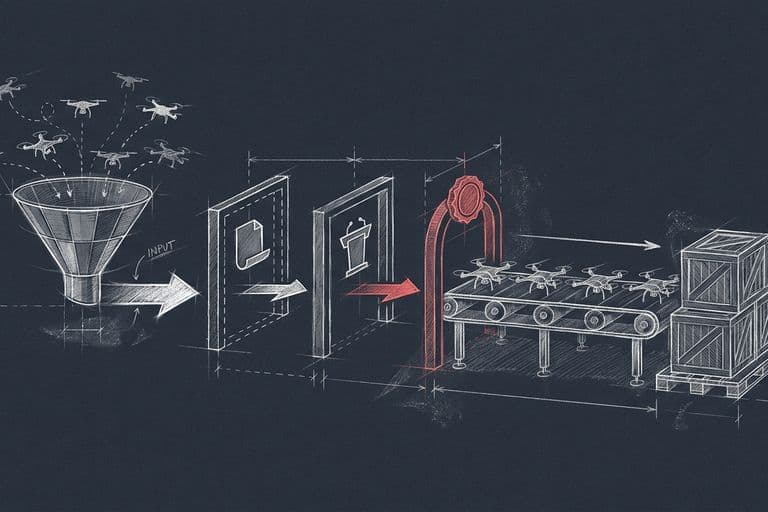
Annual cycles per cluster. The European Commission publishes each cluster's annual work programme typically in late autumn or winter for the following year's call opening. The work programme specifies the cluster's funding envelopes per topic, the topic-specific evaluation criteria, and the submission deadlines.
Standard timeline:
- Pre-call period (3-6 months before call publication). Consortium scoping. Primes and SMEs identify their target topic areas, line up partnership architecture, build preliminary technical scope.
- Call publication (T=0). Work programme published. Specific topic areas, funding envelopes, eligibility criteria, evaluation criteria, submission deadlines all become public.
- Proposal development (T+0 to T+3 to 5 months). Consortium develops the technical proposal, work-plan, budget, consortium agreement, and supporting documentation.
- Submission (T+3 to 5 months). Proposal submitted through the EU Funding & Tenders Portal.
- Evaluation (T+3 to 5 months to T+7 to 11 months). EU evaluators score the proposal against the topic's evaluation criteria. Cross-evaluation, panel review, and ranking deliberation happen during this window.
- Award notification (T+7 to 12 months). Successful proposals receive award notifications. Unsuccessful proposals receive evaluation feedback.
- Programme execution (T+12 months onward). Award-funded programmes execute over multi-year duration. Typical programmes run 2-4 years.
For SMEs and primes planning their R&D pipeline, Horizon Europe participation is a multi-year investment. The call you target in 2026 awards in 2027 and executes 2027-2030 for typical programmes.
What this means for SMEs and primes
For drone-technology SMEs evaluating Horizon Europe — the two clusters offer distinct framings of the same underlying technology. The strategic positioning question is which framing best fits your strongest capability dimension and the consortium architecture you can credibly form. Multiple cluster engagements across different proposals is a viable pattern.
For EU defense industrial primes — Horizon Europe Cluster 4 and Cluster 5 complement EDF programming. EDF handles defense-specific R&D; Horizon Europe handles civilian-and-dual-use R&D. Primes building portfolios across both pipelines can engage with the appropriate cluster for each capability dimension while routing the defense-specific elements through EDF.
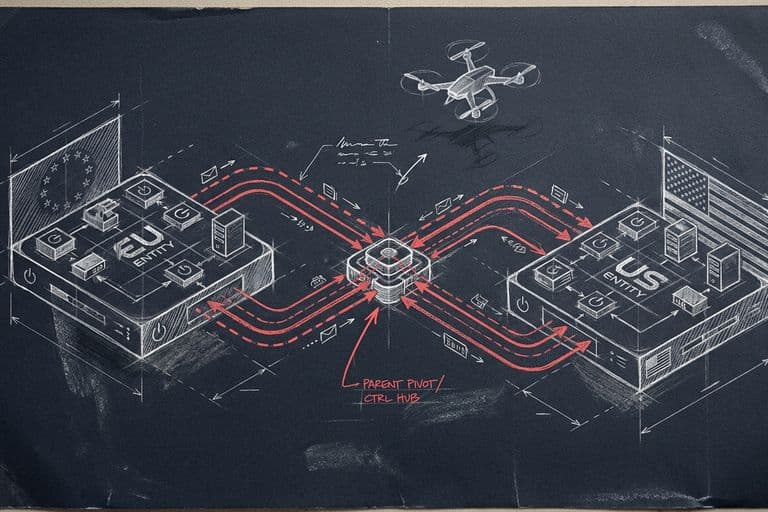
For US drone-technology SMEs with EU-domiciled subsidiaries (or planning to establish them) — Horizon Europe participation is structurally available through the EU entity. The dual-domicile pattern (Delaware C-Corp + EU subsidiary) that Dronehub operates supports Horizon Europe participation through the EU entity while maintaining US federal-innovation engagement through the US entity.
The full EU R&D-partnership context is at /rd-partnership/europe. The EDF programming companion is at /blog/european-defence-fund-2026-cuas-calls. The NATO DIANA companion is at /blog/nato-diana-dual-use-accelerator. For consortium-formation conversations on specific Horizon Europe topics, open the contact form.
FAQ
- What is Horizon Europe structurally?
- The European Union's flagship research and innovation programme — €95.5 billion budget across the 2021-2027 multiannual financial framework, with continuing programming through the next MFF (2028-2034 under negotiation). The programme is structured around three pillars: Pillar I (Excellent Science) covering ERC, Marie Skłodowska-Curie Actions, and research infrastructure; Pillar II (Global Challenges and European Industrial Competitiveness) covering the thematic clusters where most drone-relevant funding lives; Pillar III (Innovative Europe) covering the European Innovation Council and the European Institute of Innovation and Technology. For drone-technology SMEs and consortia, Pillar II Clusters 4 and 5 are the primary engagement points.
- What does Cluster 4 cover?
- Cluster 4 is 'Digital, Industry, Space' — covering digital technologies (AI, semiconductors, quantum, cybersecurity), industrial transformation (advanced manufacturing, circular industries, low-carbon industrial processes), and space (the EU's space programmes including Galileo, Copernicus, and broader space-domain technology). For drone-technology proposals, Cluster 4 fits when the application framing emphasises: AI and edge inference (the Sentinel architecture maps here), digital-industry-transformation applications, manufacturing-industry integration, or space-domain capabilities (Galileo OS-NMA integration, satellite-communication-enabled UAS, earth-observation augmentation). The HUUVER programme under Horizon 2020 had strong Cluster-4-equivalent framing under the predecessor programme.
- What does Cluster 5 cover?
- Cluster 5 is 'Climate, Energy, Mobility' — covering climate solutions and adaptation, energy transformation (renewables, grid modernisation, energy storage, hydrogen), and mobility transformation (transport infrastructure, electric and alternative-fuel vehicles, smart mobility, aviation). For drone-technology proposals, Cluster 5 fits when the application framing emphasises: energy-grid inspection (Sentinel for transmission, substation, conductor inspection maps directly), transportation infrastructure (rail inspection, road infrastructure monitoring, airport infrastructure), climate monitoring applications, or smart-mobility integration (U-space, urban-air-mobility, drone-logistics integration with broader transport networks).
- How do you decide which cluster to apply to?
- Three-factor decision. (1) Primary capability framing — what's the strongest dimension of the proposal? If AI / digital / space, lean Cluster 4. If energy / mobility / climate, lean Cluster 5. (2) Consortium fit — which cluster's typical consortium-formation patterns (the primes and research organisations that lead and participate) match the proposal's consortium architecture? Cluster 4 attracts a different prime-and-research-organisation pool than Cluster 5. (3) Evaluator-pool match — the cluster's evaluator pool has its own domain expertise; the proposal should resonate with that pool's evaluation lens. For dual-use drone-technology proposals that could route either way, strategic positioning of the framing (which dimension to emphasise) often decides the cluster fit more than the underlying technology itself.
- Can a single proposal route to both clusters?
- Not in the same submission — each call is cluster-specific. But the technology underlying a proposal can address both clusters across different submissions. A drone-technology SME with AI-enabled inspection capability could submit a Cluster 4 proposal emphasising the AI / digital framing for one use case, and a Cluster 5 proposal emphasising the energy-or-mobility framing for a different use case. Strategically, this is a common pattern — the technology platform is the same, the per-cluster proposal framing varies.
- What's the application timeline and process?
- Annual cycles per cluster. The European Commission publishes the cluster's annual work programme (typically in late autumn or winter for the following year's calls). Specific calls within each cluster open across the year with defined submission deadlines. Application timeline from call publication to submission is typically 3-5 months. Evaluation runs 4-6 months. Award notification follows. From call publication to programme execution is typically 12-15 months. Consortium formation typically begins 3-6 months before call publication. The full cycle from consortium discussion to project execution is therefore 15-21 months. For SMEs and primes planning their R&D pipeline, this is a multi-year investment horizon.