Key facts
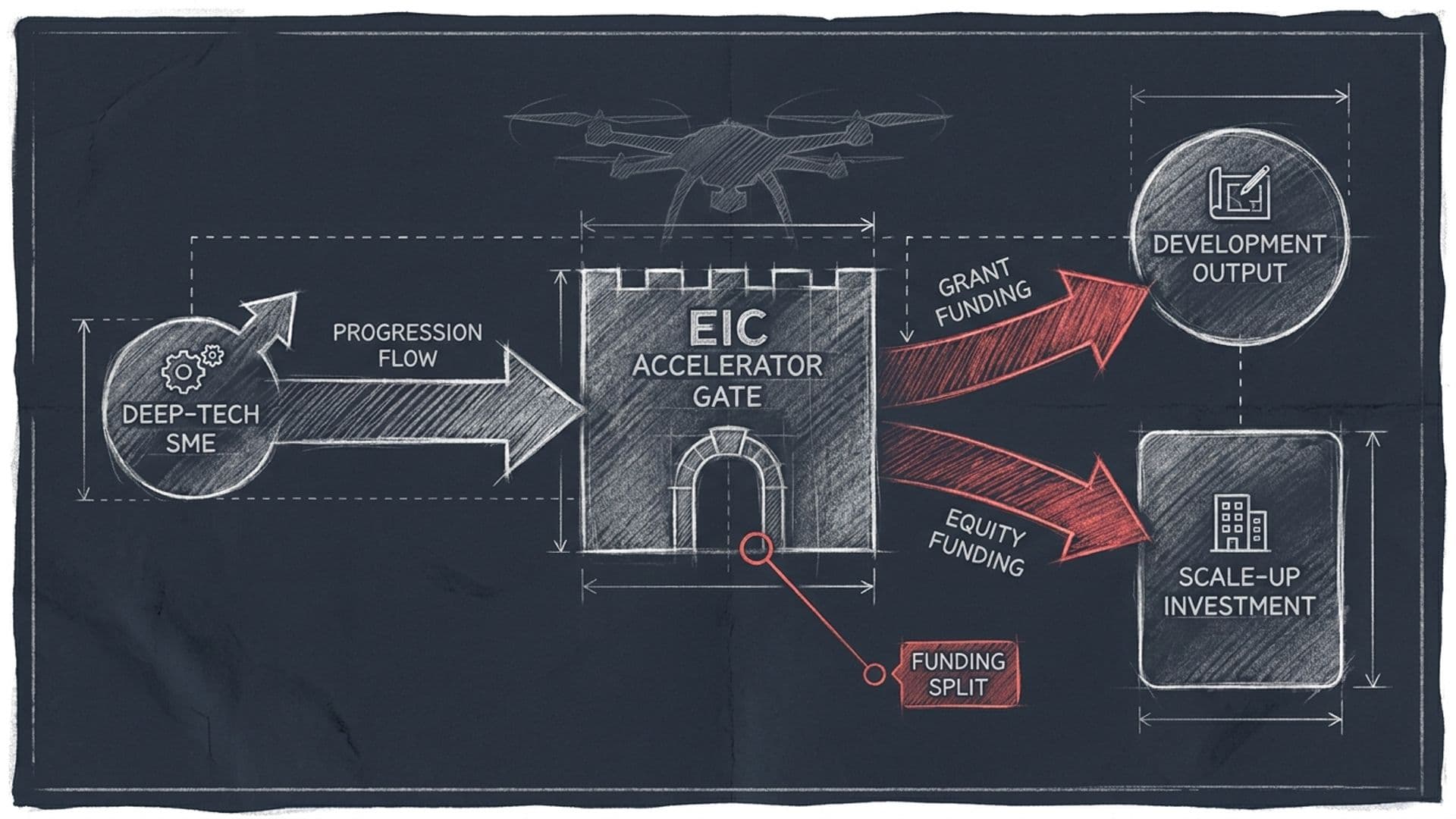
The European Innovation Council (EIC) Accelerator is the EU's flagship deep-tech innovation funding instrument — combining grant funding (up to €2.5M) with equity investment (up to €10M) per selected company.
Source · European Innovation Council Accelerator programme documentation
EIC Accelerator funds deep-tech innovation across multiple thematic areas, including dual-use technology with strong defense-civilian crossover. Drone-and-autonomy technology fits the programme's deep-tech selection criteria when it demonstrates novel technical capability plus credible market traction.
Source · EIC Accelerator thematic scope and selection criteria
Application process runs in multiple stages — short-form application (Step 1), full proposal (Step 2), face-to-face interview (Step 3). Selection is highly competitive — typical success rates run 5-10% per cycle across all applicants.
Source · EIC Accelerator application process and selection statistics
3 more key facts
EIC Accelerator equity investment operates through the EIC Fund — a venture-capital-style investment vehicle that takes equity positions in selected companies alongside the grant component.
Source · EIC Fund investment structure
The Accelerator increasingly funds dual-use technology — EU policy direction across 2022-2026 has explicitly opened the programme to defense-relevant deep-tech with credible civilian commercial application.
Source · EU dual-use innovation policy evolution
Drone-and-autonomy capability fits the Accelerator's selection criteria when applicants demonstrate: novel technical depth, demonstrated market traction (commercial deployment or LOIs), credible scale-up pathway, and dual-use commercial application beyond defense-only positioning.
Source · EIC Accelerator drone-and-autonomy selection patterns
In this piece
The European Innovation Council Accelerator combines €2.5M grant with up to €10M equity for deep-tech SMEs. It's the EU's flagship deep-tech innovation funding instrument — designed to bridge the funding gap between early-stage research and commercial scale-up. For drone-technology SMEs, the Accelerator is one of the highest-value EU funding pathways when the company demonstrates the technical depth and market traction the selection criteria require.
This post is the EIC Accelerator briefing for drone-and-autonomy SMEs evaluating the funding pathway. It covers the programme structure, the application process, the grant + equity model, how the Accelerator handles dual-use technology, and what the strategic positioning looks like for drone-technology applications.
What the Accelerator structurally is
The European Innovation Council (EIC) Accelerator is the EU's flagship deep-tech innovation funding instrument. Designed to bridge the funding gap between research and commercial scale-up — the so-called "Valley of Death" between proof-of-concept and market-ready commercial product. The programme operates under Horizon Europe's Pillar III (Innovative Europe), with the EIC as the programme-management entity.
The programme combines two funding components.
Grant funding — up to €2.5M per selected company. Non-dilutive funding for technology development work. Typical use: prototype refinement, validation against operational requirements, deployment-readiness engineering, certification and regulatory work. The grant covers up to 70% of eligible project costs across a 24-36 month execution window.
Equity investment — up to €10M per selected company. Investment by the EIC Fund into the company's equity. Typical use: commercial scale-up — manufacturing capacity expansion, market expansion, team build-out, working capital for production scale. The equity is structured as a venture-capital-style position; the EIC Fund holds the equity until exit (acquisition, IPO, or other liquidity event).
Combined funding per selected company can reach €12.5M — substantially larger than typical SBIR/STTR or single-cluster Horizon Europe awards. The programme is sized to genuinely fund deep-tech scale-up rather than to subsidise research that would need additional commercial investment to reach market.
The EIC Fund's investment thesis aligns with the Accelerator selection criteria — the same evaluation that selects companies for the grant funds the equity investment. The combined-component approach means the EU is committing both non-dilutive and equity capital to companies the programme has structurally selected for deep-tech scale-up potential.
What the Accelerator funds
Selection criteria emphasise five properties.
Novel technical capability. Not incremental improvement on existing technology. The Accelerator looks for genuinely novel deep-tech — capabilities that don't yet exist in commercial markets or that represent step-change improvements over the state-of-the-art. For drone technology, this means applications like AUDROS-class net-capture counter-UAS (the only intact-recovery C-UAS modality at procurement scale), HUUVER-class hybrid mobility with full Galileo OS-NMA integration (world-first), Sentinel-class AI inspection at national infrastructure scale.
Credible scale-up pathway. A technical innovation without a credible scale-up plan doesn't fit the Accelerator's structural intent. The programme wants companies that have built the technology, demonstrated initial market traction, and have a credible plan for expansion. The Jasionka factory operational since 2025, the dual-domicile structure for US + EU procurement, the expanding licensee pool, and the R&D partnership pipeline — all properties that support credible scale-up positioning.
Demonstrated market traction. Deep-tech with no market traction reads as research, not commercial deep-tech. Evaluators want evidence the market exists and the SME has reached it — commercial deployment of equivalent technology, paying customers, strong letters of intent, programme partnerships that translate into commercial pipeline. For drone-technology applications, the strongest traction signals are operational deployments (Deutsche Bahn-class rail, AUDROS-class counter-UAS, equivalent commercial reference cases).
Dual-use commercial application. EU policy direction across 2022-2026 has progressively opened the programme to dual-use defense-civilian technology. Applicants with strong dual-use proposals receive evaluation credit for the dual-application property. The civilian commercial market provides the market traction evidence; the defense relevance provides the sovereign-capability dimension EU policy increasingly prioritises.
Team capability. The Accelerator evaluates the team's capability to execute the technology development and the commercial scale-up. Engineering depth, commercial acumen, regulatory and market navigation experience all factor into selection. For deep-tech SMEs, team capability is typically demonstrated through prior programme execution (EU programmes, national R&D, commercial deployments) and the leadership team's track record.
The application process
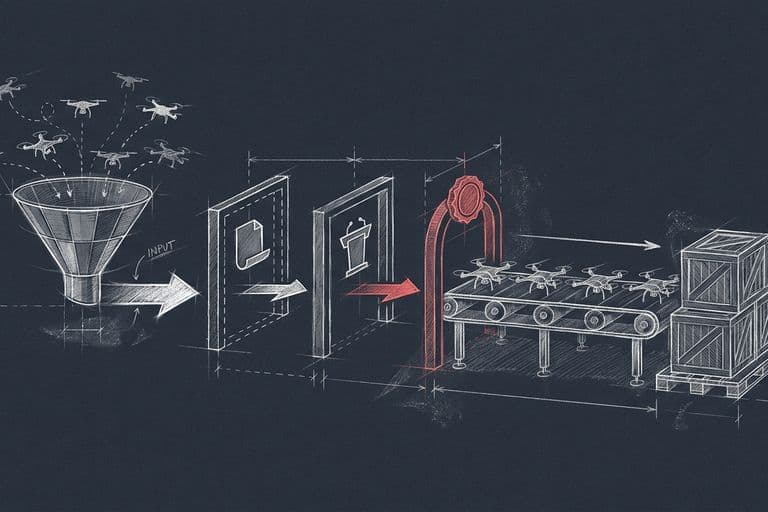
Three stages, with progressive depth and selection at each stage.
Step 1 — Short-form application. Applicants submit a short-form proposal describing the technology, the market, the company, and the funding request. The short-form covers the technology innovation in 1-3 pages, the market in 1-2 pages, the company and team in 1 page, and the funding request and use of funds in 1 page. The format constrains the proposal to the strongest framing of each element.
Step 1 evaluation runs ~3-4 months. Selection rate at Step 1 is the highest of the three stages — but Step 1 success rate varies depending on cohort and applicant volume.
Step 2 — Full proposal. Step 1 winners submit a detailed full proposal. The full proposal covers the technology in depth (novelty, technical maturity, IP position, development roadmap), market analysis (size, segments, competition, go-to-market strategy), scale-up plan (manufacturing, geographic expansion, team build-out, financial projections), team (capability, track record, gaps and filling plan), and financial projections (revenue, costs, capital needs, projected returns).
Step 2 evaluation runs ~4-6 months. Independent evaluators score the proposal against the EIC's selection criteria; cross-evaluation and panel review run within the evaluation cycle.
Step 3 — Interview. Step 2 finalists present in person to an EIC jury panel. The interview is the final selection gate. Jury composition includes deep-tech investors, scientific experts, EU programme managers, and industry domain experts. The interview tests the team's capability to articulate the technology, the market, and the scale-up plan under direct questioning.
Step 3 selection runs ~1-2 months. Awards announced after the interview cycle completes.
The full cycle from Step 1 submission to award is typically 9-12 months. Selection is highly competitive — typical success rates run 5-10% per cycle across all applicants across all thematic areas. For specific high-volume areas (AI, robotics, advanced materials), the success rate can be lower. For specific lower-volume areas (sovereign-energy, deep-space, dual-use defense), the success rate can be higher.
The grant + equity model in detail
The two funding components serve complementary purposes.
Grant component flow. Up to €2.5M of non-dilutive funding covering up to 70% of eligible project costs across a 24-36 month execution window. Eligible costs include personnel (engineering team, technical staff), prototyping and validation costs, certification and regulatory work, integration and deployment readiness, and some categories of operational expense supporting the technology development. The grant is disbursed across the project timeline against milestone deliverables. Companies must co-fund the remaining 30% from their own resources or other financing.
Equity component flow. Up to €10M of equity investment by the EIC Fund. The equity investment is sized based on the company's scale-up needs and the EIC Fund's investment thesis. Typical investment sizes range from €1-2M for smaller scale-up needs to the €10M cap for larger scale-up requirements. The EIC Fund takes equity at a valuation negotiated between the company and the Fund — typically aligned with market-rate venture capital valuations for the company's stage and traction. The Fund holds the equity until exit (acquisition, IPO, or other liquidity event), at which point the Fund participates in the exit value alongside other shareholders.
The grant component is mandatory for selected applicants; the equity component is optional but typically taken when available because the combined funding stack is substantially larger than the grant-only path. Some companies decline the equity component if they prefer to remain dilution-free or if they have alternative growth capital from private sources.
Dual-use evolution
EU policy direction across 2022-2026 has explicitly opened the EIC Accelerator to dual-use defense-civilian technology. The evolution is structural, not incidental.
The drivers:
- Sovereign-capability priority. EU strategic direction post-2022 has elevated defense and dual-use capability as sovereign priorities. The EIC Accelerator, as the EU's flagship deep-tech innovation funding instrument, has been progressively aligned with this strategic direction.
- EDIS alignment. The European Defence Industrial Strategy published March 2024 created the policy framework for EU defense industrial capability. The EIC Accelerator's dual-use evolution aligns with EDIS, providing the SME-funding pipeline that complements EDF's prime-led consortium funding.
- Cross-pillar coordination. The EIC Accelerator coordinates increasingly with NATO DIANA, the European Defence Fund, and Horizon Europe's clusters that cover dual-use technology. The combined effect is a more coherent dual-use innovation pipeline across multiple programmes.
For drone-technology SMEs with dual-use portfolios, the Accelerator selection criteria are evaluation-positive for the dual-use property. Civilian commercial application provides the market traction; defense relevance provides the sovereign-capability strengthening EU policy prioritises. The combination is one of the strongest positioning patterns the Accelerator selection panel currently looks for.
How Dronehub fits the Accelerator selection criteria
Multiple structural fits across the five selection criteria.
Novel technical depth. Dronehub's portfolio is built on multiple genuine technical innovations.
- AUDROS net-capture counter-UAS — the only intact-recovery C-UAS modality at procurement-grade scale, validated at EDA 98/100
- HUUVER hybrid UAV-UGV with full Galileo OS-NMA — world-first integration of authenticated GNSS on a UAV platform
- Sentinel AI inspection — in-house anomaly-detection architecture proven at Deutsche Bahn national scale
- Nomad mobile-dock — vehicle-mounted drone-in-a-box for convoy overwatch
Each is novel rather than incremental. The Accelerator selection criteria for technical depth align with the Dronehub portfolio.
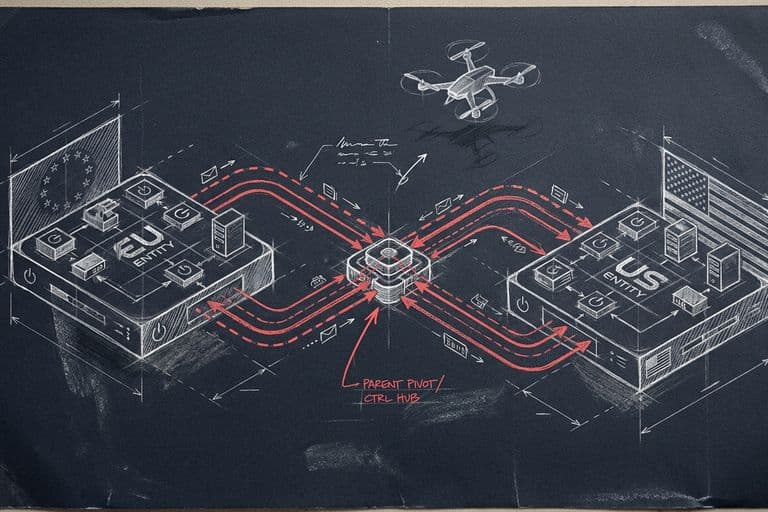
Credible scale-up pathway. The Jasionka factory operational since 2025 with $7.5M production line. Dual-domicile structure (Polish Sp. z o.o. + Delaware C-Corp) for US + EU procurement. Expanding licensee pool across rail, energy, ports, critical infrastructure, prisons, and defense. R&D partnership pipeline across EU and US programmes.
Demonstrated market traction. Deutsche Bahn national-scale rail inspection deployment. EDA 98/100 CBRN counter-UAS evaluation. Multiple commercial reference cases. NCBR-funded programmes producing manufactured deliverables. The market-traction evidence is substantial across multiple capability lines.
Dual-use commercial application. Every capability in the portfolio serves both defense and civilian critical-infrastructure markets. AUDROS deploys at prisons, refineries, and FOBs. Sentinel deploys at rail, wind farms, ports, and defense applications. HUUVER serves civil search-and-rescue plus subterranean ISR plus defense denied-environment operations. The dual-use property is structural rather than retrofitted.
Team capability. The leadership team's track record across EU programme execution (HUUVER #870236, AUDROS ESA+EDA, multiple NCBR programmes), commercial deployment (Deutsche Bahn at scale, AUDROS-class operational systems), and the broader programme-management discipline that the Accelerator evaluation panel screens for.
For Dronehub, the strategic decision for an EIC Accelerator application is which capability line to lead with — the application has to be focused on a single capability for the funding to apply coherently, even though the broader portfolio supports the dual-use and scale-up dimensions.
What this means for drone-technology SMEs
For deep-tech drone-technology SMEs evaluating EU funding pathways — the EIC Accelerator is one of the highest-value programmes when the company fits the selection criteria. The combined €2.5M grant + €10M equity envelope is substantially larger than single-cluster Horizon Europe awards or per-call EDF participation. The dual-use evolution since 2022 has made the programme structurally accessible for defense-civilian crossover technologies.
For SMEs that don't yet have the technical depth or market traction the Accelerator selection criteria require — the alternative pathways include Horizon Europe Cluster 4 or Cluster 5 (depending on framing), EDF participation as part of larger consortia, and NATO DIANA accelerator participation. These pipelines have lower selection bars and smaller per-award envelopes but compound across multi-programme engagement.
For drone-technology SMEs with strong applications — the Accelerator application investment is meaningful (the multi-step application process is genuinely demanding), but the return is correspondingly large. SMEs that pass the selection gate receive one of the strongest funding stacks available in EU deep-tech innovation funding.
The European Innovation Council Accelerator context lives within the broader /rd-partnership/europe framing. The Horizon Europe Cluster 4 vs Cluster 5 companion is at /blog/horizon-europe-cluster-4-vs-5. The EDF programming companion is at /blog/european-defence-fund-2026-cuas-calls. The NATO DIANA companion is at /blog/nato-diana-dual-use-accelerator. For an Accelerator-application strategy conversation, open the contact form.
FAQ
- What is the EIC Accelerator structurally?
- The European Innovation Council (EIC) Accelerator is the European Union's flagship deep-tech innovation funding instrument — designed to bridge the funding gap between early-stage research and commercial scale-up for European deep-tech SMEs. The programme combines grant funding (up to €2.5M for technology development) with equity investment (up to €10M for scale-up) per selected company, totalling up to €12.5M in combined funding. The programme is run by the European Innovation Council under the broader Horizon Europe framework (Pillar III, Innovative Europe). Equity investment operates through the EIC Fund, a venture-capital-style investment vehicle that holds the equity positions alongside the grant component.
- What does the Accelerator fund?
- Deep-tech innovation with strong commercial potential. The programme's selection criteria emphasise: novel technical capability (not incremental improvement), credible scale-up pathway, demonstrated market traction (commercial deployment, paying customers, or strong letters of intent), and the dual-use property where the technology serves both defense applications and civilian commercial markets. Thematic scope spans most deep-tech areas — AI and digital, advanced materials, robotics and autonomous systems, biotechnology, clean energy, space, and dual-use defense-civilian technology. Drone-and-autonomy capability fits the scope when applicants demonstrate the depth and commercial traction the selection criteria require.
- What's the application process?
- Three stages. Step 1 — Short-form application: applicants submit a short-form proposal describing the technology, the market, the company, and the funding request. Step 1 evaluation runs ~3-4 months. Step 2 — Full proposal: Step 1 winners submit a detailed full proposal covering technical depth, market analysis, scale-up plan, team, and financial projections. Step 2 evaluation runs ~4-6 months. Step 3 — Interview: Step 2 finalists present in person to an EIC jury panel for final selection. The full cycle from Step 1 submission to award is typically 9-12 months. Selection is highly competitive — typical success rates run 5-10% per cycle across all applicants across all thematic areas.
- How does the grant + equity model work?
- Two complementary components. Grant component (up to €2.5M): non-dilutive funding for technology development — prototype, validation, deployment-readiness work. The grant covers up to 70% of eligible project costs across a 24-36 month execution window. Equity component (up to €10M): investment by the EIC Fund into the company's equity at scale-up stage. The equity investment is structured as a venture-capital-style position; the EIC Fund holds the equity until exit. The combined effect: the grant funds technology readiness; the equity funds commercial scale-up. Companies receive both components — the grant is mandatory for selected applicants; the equity component is optional but typically taken when available.
- How does the Accelerator handle dual-use defense-civilian technology?
- Increasingly favourably across 2022-2026. EU policy direction has explicitly opened the programme to defense-relevant deep-tech with credible civilian commercial application — recognising that dual-use innovation produces both commercial value and EU sovereign-capability strengthening. Applicants with strong dual-use proposals receive evaluation credit for the dual-application property. The structural alignment: civilian commercial application provides the market traction the selection criteria require; defense relevance provides the sovereign-capability strengthening EU policy prioritises. For drone-technology SMEs with deployed civilian commercial systems plus defense applications (counter-UAS, FOB protection, sovereign positioning), the dual-use property is evaluation-positive.
- How does Dronehub fit the Accelerator selection criteria?
- Multiple structural fits. (1) Novel technical depth — AUDROS net-capture counter-UAS, HUUVER hybrid UAV-UGV with Galileo OS-NMA (world-first), Sentinel AI inspection architecture, Nomad mobile-dock. Each is novel rather than incremental. (2) Demonstrated market traction — Deutsche Bahn national-scale rail inspection deployment, EDA 98/100 CBRN counter-UAS evaluation, multiple commercial reference cases across critical infrastructure. (3) Credible scale-up pathway — Jasionka factory operational, dual-domicile structure for US + EU procurement, expanding licensee pool, R&D partnership pipeline. (4) Dual-use — every capability serves both defense and civilian critical-infrastructure markets. The Accelerator profile fits the Dronehub portfolio structurally; the strategic decision is which specific capability line to lead the application with.