Key facts
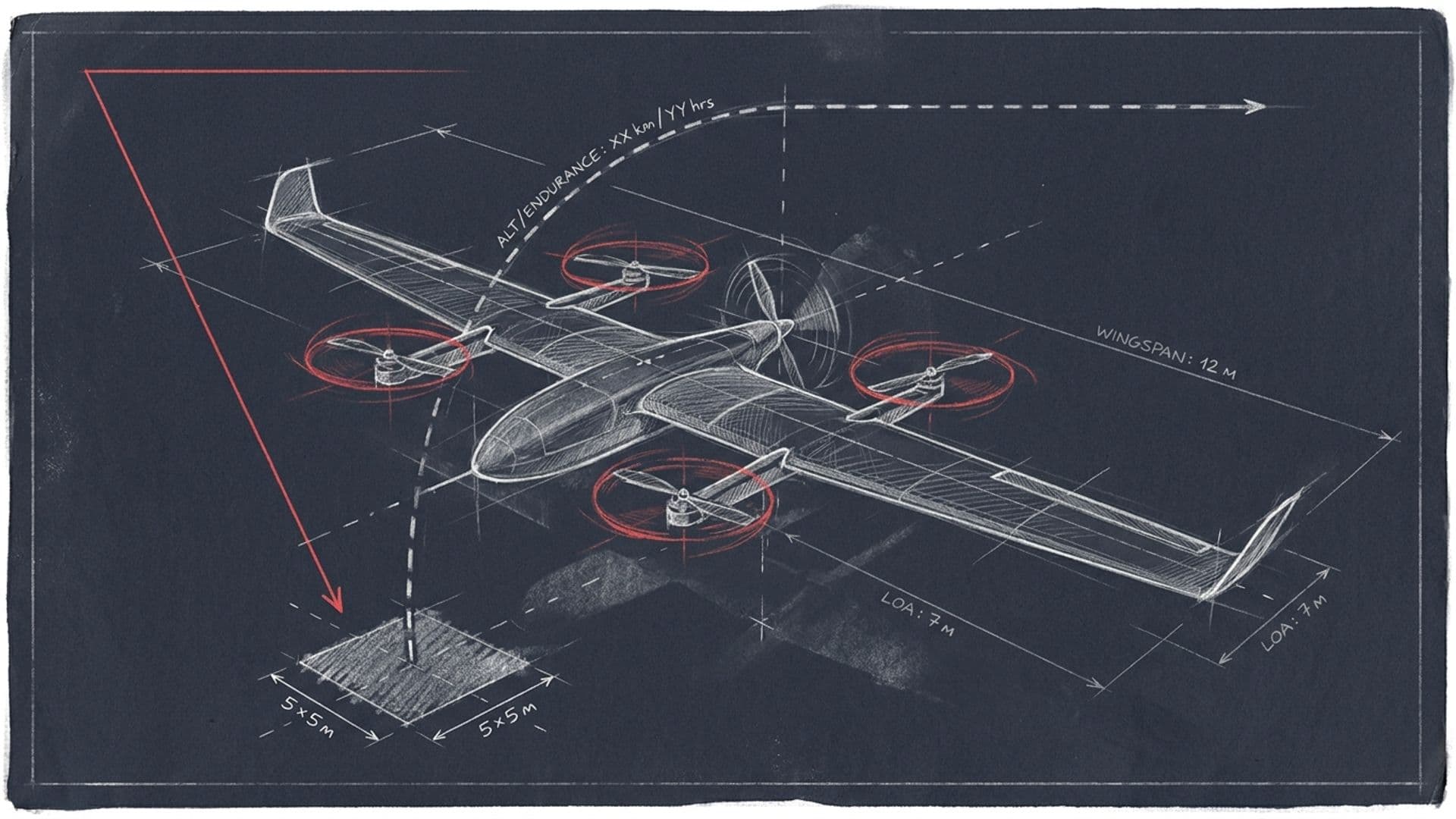
The S-2 is a hybrid VTOL fixed-wing UAV with a 35 kg maximum take-off weight, up to 7 hours of endurance, and up to 700 km of range on a single sortie.
Source · Dronehub S-2 platform specification
The S-2 takes off and lands fully vertically from a footprint of roughly 5×5 metres, with a deployment time of about 5 minutes — no runway, catapult, or launch rail required.
Source · Dronehub S-2 platform specification
The S-2 carries up to 6 kg of payload across a 45 dm³ modular bay (50×30×30 cm) that re-roles across electro-optical, thermal, and task-built sensor packages up to 5 kg.
Source · Dronehub S-2 platform specification
3 more key facts
The S-2 cruises at 120 km/h, reaches a maximum of 150 km/h, tolerates wind to 10 m/s, and operates across a -20°C to +40°C temperature band. The lift stage uses four electric VTOL rotors; the cruise stage uses a single pusher that can be electric or combustion, with the headline endurance and range figures set by the combustion configuration.
Source · Dronehub S-2 platform specification
The S-2 runs a Cube Orange autopilot with a glass-and-carbon composite airframe, communicates over civil or military RadioLink plus LTE, and carries an integrated parachute and payload-drop system on the underside of the bay.
Source · Dronehub S-2 platform specification
The S-2 is a production-grade, fielded platform (TRL 9) that Dronehub develops and offers under IP licence, direct purchase, or build-to-spec configuration, manufactured on a non-adversarial European supply chain with zero components from China or sanctioned states.
Source · Dronehub S-2 commercial and supply-chain position
In this piece
The S-2 is a long-endurance hybrid VTOL platform that launches vertically from a 5×5 metre patch, stays aloft for up to seven hours, and reaches up to 700 kilometres — with no runway, no catapult, and no launch crew. It is the platform Dronehub develops and fields when the mission needs fixed-wing persistence but the launch site is a clearing, a vehicle, a deck, or an improvised position rather than an airfield. This post is the capability breakdown: what the S-2 is, how the hybrid architecture works, and what the numbers mean operationally.
One airframe, two flight modes
Most ISR drones force a choice between two architectures, and the choice is unforgiving.
Fixed-wing aircraft give you endurance and range — a wing generates lift far more efficiently than rotors, so a fixed-wing UAV can stay up for hours and cover hundreds of kilometres. The cost is the ground end: fixed-wing platforms need a runway, a catapult, or a launch rail to get airborne, and a runway, a net, or a parachute to come back. That launch-and-recovery infrastructure is scarce, fixed in place, and — in a contested environment — a known, targetable point.
Multirotors invert the trade. They launch and land vertically from a few square metres, anywhere, in minutes. But hovering and flying on rotors is aerodynamically expensive, so endurance is measured in tens of minutes and useful range in single-digit kilometres. A multirotor is the right tool for a short look over the next ridge and the wrong tool for a seven-hour watch over a corridor.
The S-2 is a hybrid VTOL fixed-wing design that takes the strong half of each. Four electric rotors, mounted on booms along the wing, lift the aircraft straight up off the ground. Once it has altitude, a single pusher propeller drives it forward, the wing takes over the lift, and the rotors stop. From that point the S-2 flies as an efficient fixed-wing aircraft for the entire cruise. At the end of the sortie it reverses the sequence — transitions back to rotor lift and descends vertically onto the same small patch it left from.
The result is a platform with the launch freedom of a multirotor and the persistence of an aeroplane, in one airframe and one logistics tail.
The operational envelope
The headline numbers describe a platform built for persistence over distance:
- Endurance — up to 7 hours. Long enough to hold a single area through a full threat window, or to run an out-and-back survey of a long linear asset without a relay.
- Range — up to 700 km. The combination of endurance and cruise speed turns into reach: the S-2 can work a target area well beyond the launch site and return.
- MTOW — 35 kg. A class that carries a meaningful sensor load while staying within a two-person, vehicle-deployable footprint.
- Cruise 120 km/h, max 150 km/h. Fast enough to transit to a working area and reposition, steady enough to hold a sensor track.
- Wind to 10 m/s, −20°C to +40°C. A working envelope that spans most field conditions rather than fair-weather demonstration days.
The endurance and range headline figures are set by the combustion configuration of the cruise stage. The pusher can run electric or combustion; the vertical-lift stage is always the four electric rotors. That split lets the platform trade between an all-electric acoustic and logistics profile and a combustion profile tuned for maximum time and distance aloft.
Deployment takes about 5 minutes onto roughly a 5×5 metre patch. There is nothing to assemble into a runway and nothing to rig for recovery — the same vertical launch and landing that frees the platform from airfields is what makes it fast to put up and quick to bring home.
A payload bay, not a fixed sensor
The S-2 carries up to 6 kg of payload in a 45 dm³ modular bay measuring 50×30×30 cm. The important word is modular. The bay is defined by volume and mass, not by a single bonded-in sensor, so the same airframe re-roles across missions up to 5 kg per package:
- Electro-optical / infrared gimbals for day-and-night ISR and target tracking.
- Thermal imagers for low-light, night, and heat-signature work.
- Task-built payloads — mission-specific sensors, relays, or mapping packages.
The bay underside integrates a drop system, and the platform carries an integrated recovery parachute. One platform, one training pipeline, and one spares chain therefore cover reconnaissance, persistent monitoring, and delivery tasks — the operator changes what rides in the bay rather than fielding a different aircraft for each role.
Autonomy, comms, and airframe
Under the skin, the S-2 is built on field-proven components rather than bespoke electronics:
- Autopilot — Cube Orange. A widely deployed, well-understood flight-control standard, which keeps integration, training, and sustainment tractable.
- Comms — civil or military RadioLink plus LTE. The control and data link matches the operating environment, from civil spectrum to hardened military links, with LTE as a fallback where coverage exists.
- Airframe — glass-and-carbon composite. A production-grade structure built for repeated field cycles, not a one-off demonstrator.
- Recovery and delivery — integrated parachute and bay-underside drop system.
The aircraft is compact for its capability: a 3.55 m wingspan, 2.11 m across, and 0.7 m high — dimensions that fold into vehicle and container transport rather than demanding a hangar.
Fielded, sovereign, and acquirable
The S-2 is a production-grade, fielded platform (TRL 9) — in market, not in concept. Dronehub holds a full licence to the platform, develops it, and offers it three ways:
- Direct purchase of the platform.
- IP licence for a partner to manufacture or integrate under their own programme.
- Build-to-spec configuration tailored to a specific mission set.
It is built on a non-adversarial European supply chain with zero components from China or sanctioned states. For US federal buyers that maps to NDAA Section 848-style sourcing requirements; for European defence buyers it aligns with EDIS terms. The supply-chain provenance is procurement-grade audit material, not a marketing line.
The operational case for why runway independence is the binding constraint in tactical ISR — and why hybrid VTOL is the architecture that resolves it — is its own argument, covered in Runway Independence Is the Real Constraint in Tactical ISR. The full platform page, with the spec strip and field footage, is at /projects/s-2. For a technical brief or a procurement conversation, open the contact form.
FAQ
- What is the S-2 Combat Drone?
- The S-2 is a long-endurance hybrid VTOL fixed-wing UAV in the ISR class. 'Hybrid VTOL' means it combines two flight modes in one airframe: four electric rotors lift it vertically off the ground like a multirotor, then a fixed wing and a pusher propeller carry it in efficient forward cruise like an aeroplane. The result is an aircraft that needs no runway or catapult to launch — it rises vertically from a patch of about 5×5 metres — but still delivers fixed-wing endurance and range: up to 7 hours aloft and up to 700 km on a single sortie, at a 35 kg maximum take-off weight. It carries up to 6 kg of mission payload in a 45 dm³ modular bay that re-roles across electro-optical, thermal, and task-specific sensors. Dronehub holds a full licence to the platform, develops it, and offers it to defence, government, and critical-infrastructure customers.
- Why does the S-2 use a hybrid VTOL design instead of a pure fixed-wing or a multirotor?
- Because the two conventional architectures each force a hard trade-off, and the hybrid resolves it. A pure fixed-wing aircraft has the endurance and range you want for ISR, but it needs a runway, a catapult, or a launch rail and a recovery method — infrastructure that is scarce, fixed in place, and easy to target. A pure multirotor launches and lands anywhere in a few square metres, but its endurance is measured in tens of minutes and its range in single-digit kilometres, because hovering on rotors is aerodynamically expensive. The S-2's hybrid layout takes the launch-and-recovery freedom of the multirotor — vertical lift from a 5×5 m patch — and the cruise efficiency of the fixed wing. You get runway independence and multi-hour, multi-hundred-kilometre persistence in the same airframe, which is the combination tactical ISR actually needs.
- What payloads can the S-2 carry?
- The S-2 has a 45 dm³ modular payload bay measuring 50×30×30 cm, rated for up to 6 kg of payload and designed to re-role across mission types up to 5 kg per package. Because the bay is defined by volume and mass rather than by a single fixed sensor, the same airframe accepts electro-optical/infrared gimbals for day-and-night ISR, thermal imagers for low-light and night work, and task-built or mission-specific payloads. The bay underside also integrates a drop system, and the platform carries an integrated recovery parachute. In practice this means one platform and one logistics tail can cover reconnaissance, monitoring, and delivery tasks by swapping what rides in the bay rather than buying a different aircraft for each mission.
- How is the S-2 deployed in the field?
- Deployment takes about 5 minutes and needs roughly a 5×5 metre patch of clear ground. There is no runway to find, no catapult to set up, and no arrestor or net to recover the aircraft — it launches straight up under rotor lift, transitions to wing-borne cruise, flies its mission, returns, transitions back to a vertical descent, and lands on the same small footprint. That makes the S-2 deployable from dispersed positions, vehicles, ships, clearings, and improvised sites rather than from prepared airfields. It tolerates wind to 10 m/s and operates from -20°C to +40°C, and it communicates over civil or military RadioLink plus LTE, so the control link matches the operational environment.
- Can defence and government customers acquire or licence the S-2?
- Yes. The S-2 is a fielded, production-grade platform (TRL 9) that Dronehub develops and offers three ways: as a direct platform purchase, as a licensed design that a partner can manufacture or integrate under their own programme, or as a build-to-spec configuration tailored to a specific mission set. It is built on a non-adversarial European supply chain with zero components from China or sanctioned states, which maps to NDAA Section 848-style procurement requirements for US federal buyers and to EDIS-aligned terms for European defence procurement. The most direct next step is a technical brief and a procurement conversation through the contact form.