Key facts
GENIUS NY is the world's largest business accelerator for unmanned systems, IoT, and robotics startups — selecting 14 semi-finalists from over 200 submissions from more than 50 countries in 2022.
Source · GENIUS NY Round 6 records, 2022
Dronehub was selected among 5 final winners, awarded $500,000 in non-dilutive funding plus operational support — the largest accelerator award of its kind globally.
Source · GENIUS NY Round 6 award announcement, November 2022
The accelerator is backed by Empire State Development and CenterState CEO, with a demo facility at Griffiss International Airport in Rome, New York.
Source · GENIUS NY programme structure
2 more key facts
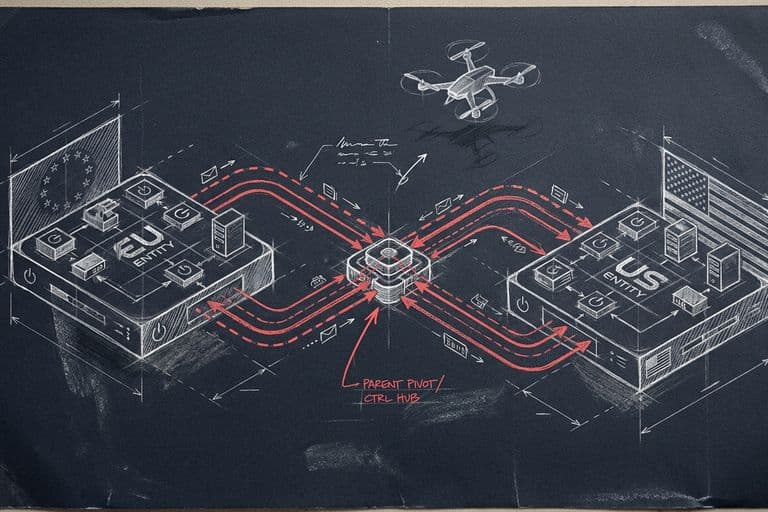
Dronehub's US base is now in the Research Triangle, North Carolina — co-located with the federal-innovation, defense, and aerospace cluster around RTP. The Delaware C-Corp (Dronehub Inc.) is SBIR/STTR-eligible with EB1A-resident founder.
Source · Dronehub Inc. corporate structure
The 5 winners of Round 6 were Dronehub (Poland), Archangel Imaging (United Kingdom), AVSS (Canada), Fusion Engineering (Netherlands), and Wonder Robotics (Israel) — selected from a global field after a multi-month evaluation process.
Source · GENIUS NY Round 6 winners announcement
In this piece
In 2022, Dronehub went from one of over 200 international applicants to one of five winners of the world's largest unmanned-systems business accelerator — and the $500,000 non-dilutive award was the easy part. The harder part was the operational path that followed: Delaware incorporation, EB1A founder residency, and a US base of operations in the Research Triangle, North Carolina, that lines Dronehub up for SBIR/STTR, AFWERX, DIU, and NATO Innovation Fund engagement as a federal-innovation-ready company.
This post walks through how the GENIUS NY journey unfolded, what the multi-stage selection process actually evaluated, and where the US federal innovation pathway sits today.
From 200+ applicants to five winners
GENIUS NY Round 6 opened in 2022 with applications from over 200 companies across more than 50 countries. The programme is backed by Empire State Development and CenterState CEO out of Syracuse, New York, and operates as the largest business accelerator competition globally for unmanned systems, IoT, and robotics startups. The award structure: $1 million grand prize for first place, $500,000 each for the next four winners, plus operational support and demo-facility access at Griffiss International Airport in Rome, NY.
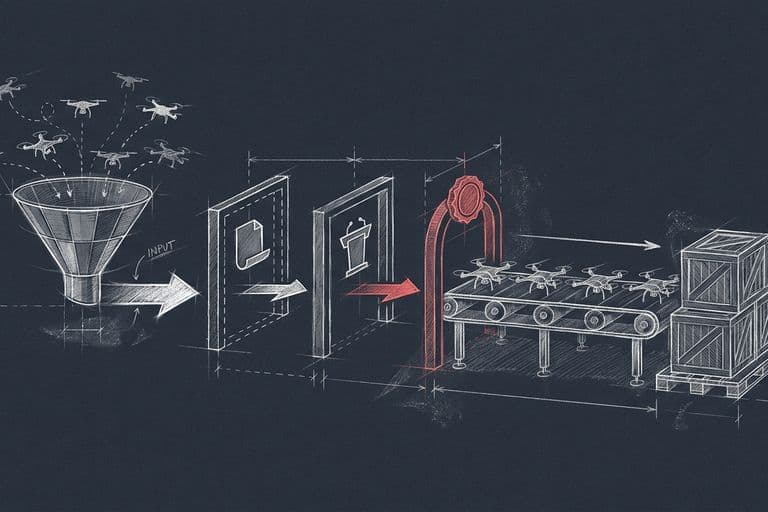
The multi-stage evaluation ran from application screening through technical pitch review through panel-judged finals. In July 2022, the cohort narrowed to 14 semi-finalists — Dronehub among them, alongside companies from across North America, Europe, and the Middle East. Two months later, the field collapsed to five winners.
The Round 6 winners:
- Dronehub (Poland) — autonomous drone-in-a-box infrastructure
- Archangel Imaging (United Kingdom)
- AVSS (Canada)
- Fusion Engineering (Netherlands)
- Wonder Robotics (Israel)
Each was awarded $500,000 non-dilutive plus operational support and demo facility integration. The grand-finale presentation took place in early November 2022 at the Marriott in Syracuse.
What the evaluation actually screened for
Selection processes at this scale don't reward the deck. They reward the answer to three procurement-grade questions, and the cohort selection makes those questions visible:
- Is there a deployed product portfolio? Dronehub arrived with six funded EU programmes (ESA, EDA, European Commission, Polish federal R&D Centre), named consortium partners (Honeywell on U-Space4UAM), and reference deployments (Deutsche Bahn rail inspection at national scale, AUDROS counter-UAS scored 98/100 by EDA). Not a slide deck — actual delivered work.
- Is the US-market entry plan operational, not aspirational? GENIUS NY funds companies that intend to operate in the United States as commercial entities, not companies that intend to use the award as a marketing line. Dronehub's plan included Delaware incorporation, EB1A founder residency, and a permanent US base — the operational backbone for SBIR/STTR pipeline engagement.
- Does the company fit the strategic frame? GENIUS NY is increasingly oriented toward non-CN unmanned-systems leaders that strengthen the US industrial base. Dronehub's structural answer — Polish-engineered, NATO-allied supply chain, zero CN/RU/IR components, EU + US data sovereignty — was the structural fit.
The three answers compound. Each one shortens the procurement-diligence cycle on the federal-innovation side. Together they explain why a Polish drone-in-a-box company landed in the Round 6 top five.
What came after the accelerator
GENIUS NY graduation isn't the destination. It's the unlock for the operational pathway that follows.
Delaware C-Corp incorporation. Dronehub Inc. is incorporated in Delaware and qualifies as a US small business for SBIR/STTR purposes. The corporate structure is set up to be the prime awardee on SBIR/STTR programmes where small-business status is a requirement, or to sub-contract under a US prime where the prime needs the unmanned-systems and AI work-package filled by a NATO-allied partner.
EB1A founder residency. Vadym Melnyk, Dronehub founder and CEO, holds an EB1A US green card (Extraordinary Ability). Founder vetting is personally complete; the security-review cycle that would otherwise be a future risk for federal engagements is closed.
Research Triangle base. The current US base of operations is in the Research Triangle, North Carolina — co-located with one of the densest federal-innovation, defense, and aerospace clusters in the country. RTP integrates with the Fort Liberty defense corridor, Duke / UNC / NC State academic infrastructure, and the broader Carolinas defense-industrial cluster. The Syracuse demo-facility heritage from the accelerator phase is preserved as part of the GENIUS NY portfolio history.
Manufacturing stays in NATO Europe. The production line at Jasionka, Poland — funded in part by a $2.75M Polish federal industry grant and fully operational since 2025 — supplies US deployments under NDAA Section 848-compatible terms. The engineering bench, supplier network, and EU defense industrial strategy alignment all sit inside Aviation Valley; relocating manufacturing would discard the structural advantage.
What the federal innovation surface looks like now
The combined pathway — GENIUS NY portfolio company, Delaware C-Corp, EB1A founder, Research Triangle base, NATO-allied supply chain, EU + US data sovereignty — produces a federal-innovation procurement surface that's effectively pre-vetted for several pipelines.
- SBIR/STTR — DoD, NASA, DHS, DoE topic areas where Dronehub's portfolio (counter-UAS, AI inspection, hybrid UAV-UGV, autonomous battery swap, drone-based logistics) maps directly to call topics.
- AFWERX Open Topics — US Air Force / USSF tactical-edge autonomy programmes. Mobile Charging Station (UAV Nomad), counter-UAS perimeter defense, base-protection drone-in-a-box all align with AFWERX priority gaps.
- DIU (Defense Innovation Unit) — commercial-tech transition partner for AUDROS counter-UAS, autonomous critical-infrastructure inspection (Deutsche Bahn-grade), Blue UAS pathway under evaluation (the list DIU built and the Defense Contract Management Agency has run since December 2025).
- NATO Innovation Fund — dual-use technology with NATO-aligned, sovereign supply chain, EU + US footprint — the structural fit was effectively designed for what NIF was created to support.
The full federal-pathway context lives on /rd-partnership/us-defense. For European programmes — EDF, Horizon Europe, NATO DIANA, SESAR 3 — the equivalent context is on /rd-partnership/europe. For a procurement-readiness conversation, open the contact form.
FAQ
- What is GENIUS NY?
- GENIUS NY is the world's largest business accelerator competition for uncrewed systems, IoT, and robotics startups — backed by Empire State Development and CenterState CEO out of Syracuse, New York. The programme makes $1 million in grand-prize funding plus $500,000 awards available to its top 5 selections, alongside operational support, demo-facility access at Griffiss International Airport, and direct integration with the New York State innovation ecosystem.
- Why did Dronehub win?
- Three concrete factors. First, an already-deployed product portfolio with named EU partners (ESA, EDA, European Commission, the 6+ funded programmes). Second, a clearly defined US-market entry plan — not just the prize, but the operational path from accelerator graduation to commercial deployment and federal innovation procurement. Third, the strategic fit with the GENIUS NY mission of attracting non-CN unmanned-systems leaders to the United States, which Dronehub satisfies structurally as a Polish-engineered, NATO-allied, non-CN-supply-chain company.
- What does Dronehub's US presence look like today?
- Dronehub Inc. — the US entity — is incorporated in Delaware as a C-Corporation and qualifies as a small business for SBIR/STTR purposes. The founder secured EB1A US permanent residency. The current US base of operations is in the Research Triangle, North Carolina, chosen for co-location with the federal-innovation cluster (RTP), the defense and aerospace community (Fort Liberty corridor), and the academic infrastructure (Duke, UNC, NC State).
- How does this connect to SBIR/STTR and federal innovation programmes?
- Directly. The GENIUS NY graduation establishes Dronehub as a vetted unmanned-systems portfolio company on US soil, which materially simplifies the procurement-diligence path for SBIR/STTR, AFWERX, DIU, and NATO Innovation Fund engagements. NDAA Section 848-compatible hardware, NATO-allied supply chain (zero CN/RU/IR components), and EU + US data sovereignty are already engineered upstream — the diligence pack is half-done before the kickoff meeting.
- Is the manufacturing path also in the US now?
- Manufacturing stays at the Jasionka factory in Aviation Valley, Poland — inside NATO, inside the EU, on a non-adversarial supply chain. That positioning is intentional: the engineering bench, the supplier network, and the funding ecosystem are mature and aligned with EU defense industrial strategy. US deployments source from Jasionka under NDAA Section 848-compatible terms; the Research Triangle base handles US commercial, federal, and contracting work.