Key facts
Parrot says its CHUCK 3.0 autopilot for other makers' drones has a '100% non-Chinese component base', that every component has been sourced outside China, and that all sensitive electronics come from Europe, the United States or NATO-partner nations.
Source · Parrot, CHUCK 3.0 press release parrot.com ↗
Quantum Systems says its upgraded RELIANT long-range ISR drone is built around a secure European supply chain, providing a system 'without any Chinese components or ITAR restrictions'.
Source · Quantum Systems, 27 July 2026 quantum-systems.com ↗
Croatian drone maker Orqa says its Osijek facility can produce up to 280,000 NDAA-compliant drones a year using its own proprietary components, 'eliminating dependence on Chinese supply chains', and that it also produces components for trusted partners.
Source · Orqa via PR Newswire, 1 December 2025 prnewswire.com ↗
3 more key facts
For purchases financed by the EU's SAFE loans, whose eligible products include small drones, NATO class 2 and 3 drones and anti-drone systems, the cost of components originating outside the EU, EEA-EFTA states and Ukraine must not exceed 35% of the estimated cost of the end product's components.
Source · EUR-Lex, summary of Regulation (EU) 2025/1106 (SAFE) eur-lex.europa.eu ↗
NDAA Section 848, as amended by Section 817, bars the Department of Defense from drones made in China, Russia, Iran or North Korea, or that use flight controllers, radios, data transmission devices, cameras or gimbals made there, or ground-control systems, operating software, connectivity or data storage from there.
Source · U.S. Code, 10 U.S.C. 4871 note uscode.house.gov ↗
Dronehub states that no components in its hardware are sourced from China, Russia, Iran or any sanctioned state, with traceable bill-of-materials provenance, and that its sensitive hardware is produced on its line in Jasionka, Poland.
Source · Dronehub, Compliance & Credentials dronehub.ai ↗
In this piece
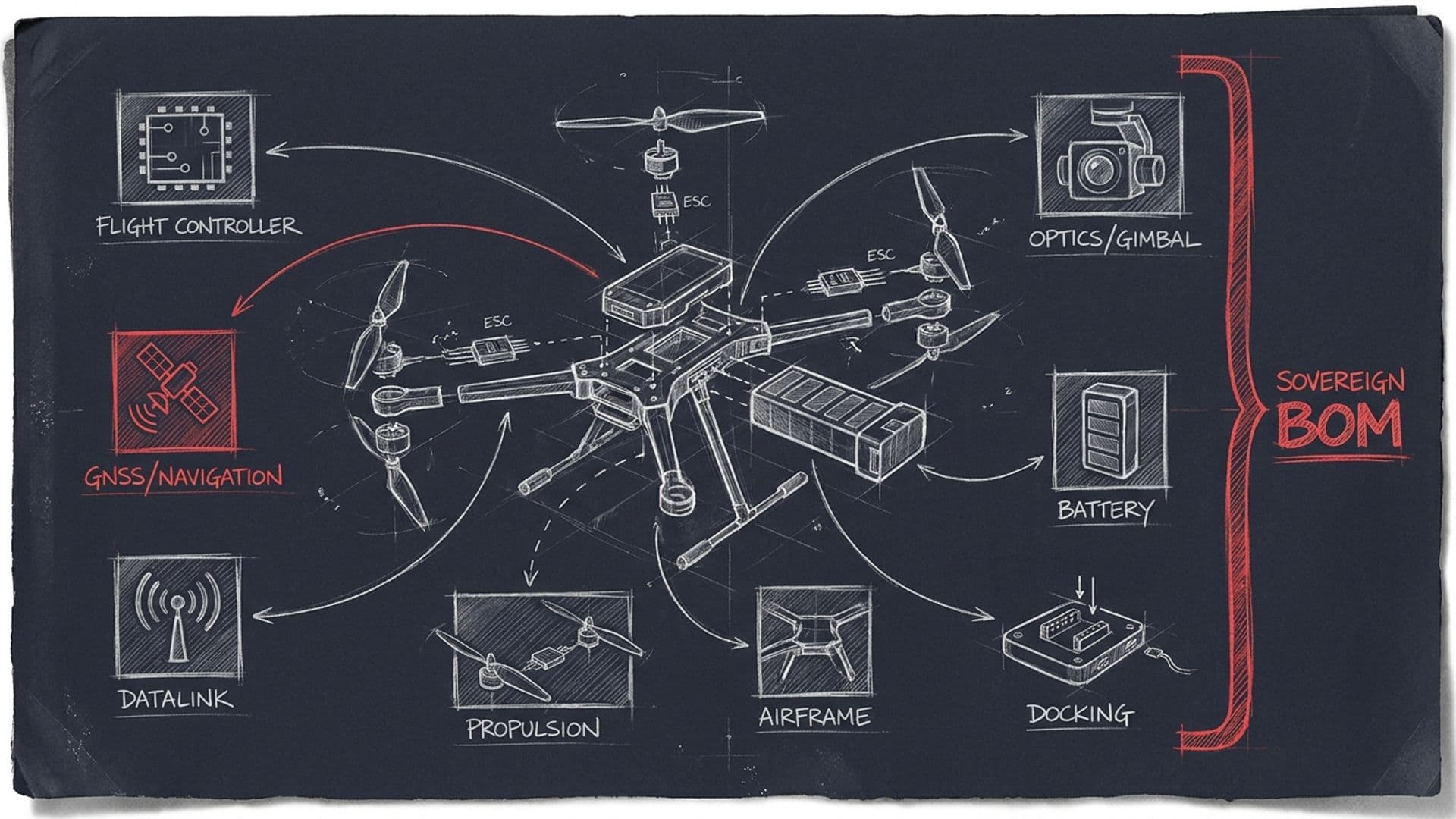
European and US suppliers now exist for every major drone subsystem — flight controllers, motors, ESCs, batteries, cameras and gimbals, radios, GNSS receivers and airframes — but only a few say outright that their parts contain no Chinese components. Parrot says its CHUCK 3.0 autopilot has a "100% non-Chinese component base"; Croatia's Orqa says building drones from its own components is "eliminating dependence on Chinese supply chains"; and Quantum Systems says its RELIANT long-range drone is built "without any Chinese components". Most other suppliers state something narrower — NDAA compliance, Blue UAS listing, ITAR-free status or manufacture in Europe or the US — which is a different claim. The tables below sort suppliers by subsystem and quote what each one says.
Published by Dronehub, which builds and licenses drone-in-a-box infrastructure, also makes components and subsystems to customers' specifications on its line in Poland, and states that its own hardware contains no components from China, Russia, Iran or sanctioned states. We have left ourselves out of the tables. Criteria: headquartered in Europe or the US; sells the component to other drone makers; and we could open a page where the company itself makes the claim we quote. "States China-free" appears only where the supplier uses those words or an equivalent. Checked on 28 September 2026. A listing is not an endorsement, and a supplier's statement is not a certification.
Drone component suppliers by subsystem, and what each says about origin
Subsystem | Supplier (HQ) | Product | What the supplier states | Source |
|---|---|---|---|---|
Flight controller | Parrot (France) | CHUCK 3.0 autopilot | States China-free: "100% non-Chinese component base"; "every component has been sourced outside of China" | |
Flight controller, ESCs | Orqa (Croatia) | Flight controllers, ESCs and other FPV electronics | States China-free: drones built from its own components, "eliminating dependence on Chinese supply chains"; everything except micro-displays made in Osijek | |
Flight controller, GNSS | ARK Electronics (US) | Flight controllers, GPS modules | NDAA-compliant; "designed and built in the United States"; "no banned foreign parts or companies" | |
Flight controller | Auterion (US) | Skynode | NDAA-compliant; designed, assembled and supported in the US | |
Flight controller | Embention USA (US) | Veronte autopilots | "Fully NDAA-Compliant UAV Avionics", made in the USA | |
Motors | Plettenberg (Germany) | Electric UAV motors | "100% Made in Germany"; "NDAA- and DFARS-compliant versions available" | |
Motors, ESCs | Kontronik (Germany) | BLDC motors and controllers | "all Made in Germany" | |
Motors, ESCs | Vertiq (US) | Integrated motor-ESC modules | "Blue UAS Certified, NDAA-Compliant"; "Engineered and Built in the USA" | |
Engines | Sky Power (Germany) | Combustion UAV engines | "fully EU-based supply chain"; "Every engine component is designed, tested, and manufactured internally" | |
ESCs | KDE Direct (US) | KDE-125UVC-USA ESC | "NDAA Compliant", "Made in USA" (this model) | |
Batteries | CustomCells (Germany) | Lithium-ion cells | Cells "developed and produced entirely in Germany"; supply chain "largely independent of China" | |
Batteries | Lyten (US) | Lithium-sulfur drone cells | "U.S.-sourced and manufactured"; free of nickel, manganese, cobalt and graphite | |
Cameras | Phase One (Denmark) | P5 drone camera | "NDAA Compliant: Yes"; "ITAR Free: Yes" | |
Thermal cameras | Workswell (Czech Republic) | WEOM thermal core | "designed and manufactured in Europe"; "ITAR-free" | |
Thermal cameras | Teledyne FLIR OEM (US) | Boson, Hadron and other modules | NDAA-compliant; "designed and assembled in the U.S." | |
Gimbals | Trillium Engineering (US) | HD45-LV-CZ gimbal | On the Blue UAS Framework and Green UAS lists, according to Trillium | |
Radios, datalinks | Doodle Labs (US and Singapore) | Mesh Rider radios | "NDAA-compliant, Blue UAS-cleared" | |
Radios, datalinks | Silvus Technologies (US) | StreamCaster MANET radios | Added to the Blue UAS Framework, July 2024 | |
GNSS | Septentrio (Belgium) | mosaic receiver modules | Galileo OSNMA anti-spoofing since 2022; no statement on component origin found | |
Airframes | CarbonVega (Estonia) | CNC-machined carbon-fibre drone parts | Made in Estonia from prepreg "sourced from Germany" |
Two gaps stand out. For cameras, the European makers above state NDAA compliance, ITAR-free status or European manufacture, but none of the statements we found says the parts contain no Chinese components, so ask directly. For GNSS, Septentrio's receivers support Galileo's OSNMA signal authentication against spoofing, but the pages we read make no statement on where its parts come from.
Complete drones: what their makers state
Maker (HQ) | System | What the maker states | Source |
|---|---|---|---|
Quantum Systems (Germany) | RELIANT long-range ISR drone | "without any Chinese components or ITAR restrictions"; "Designed around a fully European supply chain" (27 July 2026) | |
Orqa (Croatia) | FPV drones and UAS | "eliminating dependence on Chinese supply chains"; capacity for up to 280,000 NDAA-compliant drones a year (1 December 2025) | |
Wingtra (Switzerland) | WingtraRAY, WingtraOne survey drones | "NDAA-compliant"; WingtraRAY on the Blue UAS Cleared List; no statement on Chinese components found |
"China-free", "NDAA-compliant", "Blue UAS", "made in Germany": four different claims
Supplier pages mix these labels, and they do not mean the same thing.
- "No Chinese components" is the broadest claim. It covers whatever the supplier chose to count, so ask whether it reaches the cells, magnets and passive components or stops at the assemblies.
- "NDAA-compliant" refers to Section 848 of the FY2020 National Defense Authorization Act, as amended by Section 817 of the FY2023 act. It bars the Department of Defense from drones made in China, Russia, Iran or North Korea, or using flight controllers, radios, data transmission devices, cameras or gimbals made there, plus ground-control systems, operating software, connectivity and data storage from there (10 U.S.C. 4871 note). Motors, batteries and structural parts are not on that list, so an NDAA-compliant drone assembled outside those countries can still contain Chinese motors or cells. The label is usually the vendor's own declaration.
- "Blue UAS" means the specific item has been vetted and placed on the Cleared List or the Framework of components, which the Defense Contract Management Agency has run since 3 December 2025 and publishes on its Blue List site. Listing is item-specific.
- "Made in Germany", "made in the USA" say where final manufacture happens, not where every sub-component comes from.
The distinction that matters most is between integrity and content. Section 848 is an integrity rule: it asks whether a covered-country part sits in the control, communications, sensing or data chain, and one such part is enough to fail. The EU's SAFE rule, below, is a content rule: it asks what share of the component cost comes from outside the EU, EEA-EFTA states and Ukraine, so motors, batteries and airframes count toward it even though they carry less security risk. A supplier has to clear the integrity bar first and the content bar second.
The rules pushing European sourcing
- SAFE (EU). The Security Action for Europe instrument lends member states up to €150 billion for defence procurement. Small drones, NATO class 2 and 3 drones and anti-drone systems are eligible, and for purchases it finances, components from outside the EU, EEA-EFTA states and Ukraine may not exceed 35% of the estimated cost of the end product's components; contractors must be established there and not controlled from outside (EUR-Lex summary of Regulation 2025/1106).
- EDIP (EU). The defence industry programme applies a similar 35% ceiling (Regulation 2025/2643).
- EDIS (EU strategy, March 2024). Not a purchasing rule in itself, but it sets the direction: member states are invited to procure at least 50% of their defence procurement budget within the EU by 2030 and 60% by 2035.
- NDAA Section 848 (US). The component-level rule above. It binds the Department of Defense and, since 1 October 2024, contractors that operate covered drones on DoD work.
For the US commercial market the FCC applies a different test, based on where drones and drone components are produced; our explainer on Blue UAS, NDAA and the FCC Covered List covers it. For where the money follows these rules, see the European defense-drone investment landscape.
Where the dependency runs deepest
The supplier statements themselves show where China-free sourcing is hardest. Battery cells and their materials are the clearest case: CustomCells, which calls itself one of the few European battery companies already manufacturing to military standards, describes its supply chain as "largely independent of China", and Lyten presents its lithium-sulfur chemistry as a way around nickel, manganese, cobalt and graphite, "minerals dominated by Chinese supply chains". Even Orqa, which makes almost everything in Osijek, names one exception: micro-displays. A buyer who needs a strict claim should expect to ask about cells, magnets, displays and passive components specifically.
How to verify a China-free claim
- Ask for a component-origin declaration mapped to Section 848's categories — flight controller, radios and data links, cameras and gimbals, ground-control software, data storage — and extend it to motors, cells and magnets, which Section 848 does not list.
- Look up the exact item on DCMA's Blue List. The drone, the dock and each component are listed separately.
- Ask where the cells are made, not where the pack is assembled.
- For EU defence purchases, ask for the non-EU share of component cost, the number SAFE-financed contracts test against 35%.
- Write it into the contract: a representation on origin, notice of any supply-chain change, and a right to audit.
Our Section 848 buyer's guide walks through the component audit in more detail.
Where Dronehub fits
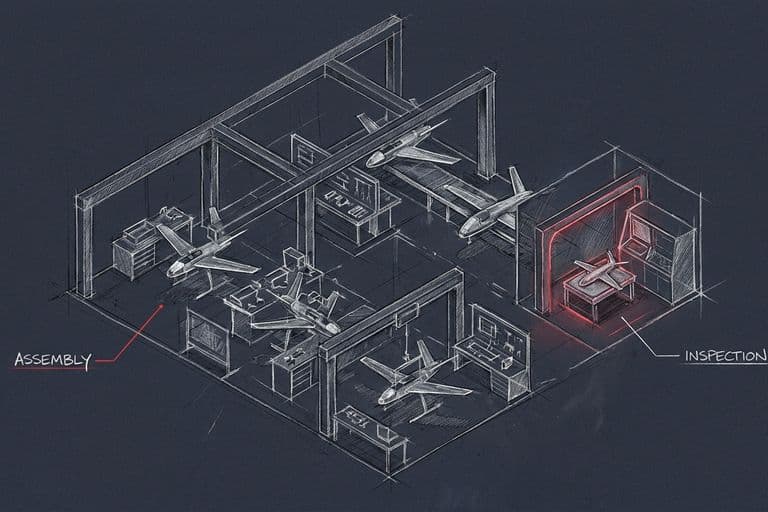
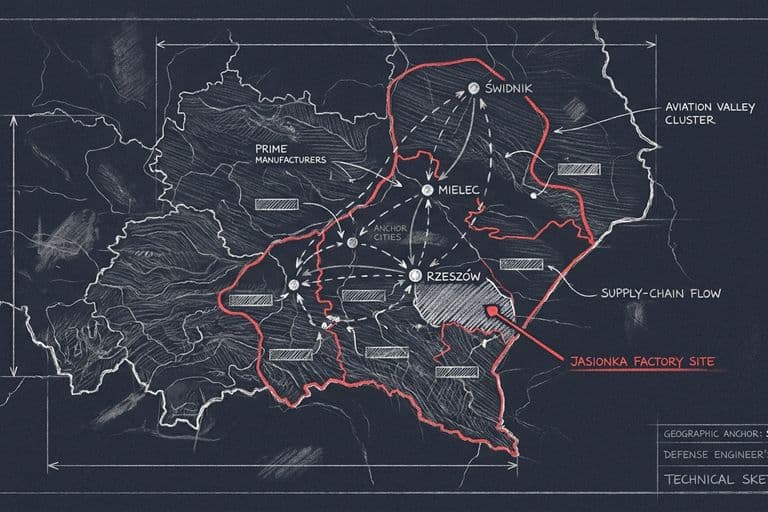
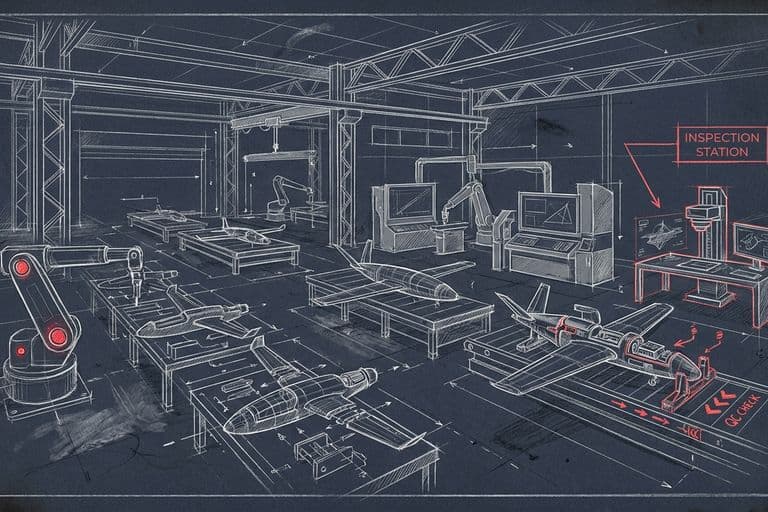
Dronehub builds and licenses drone-in-a-box infrastructure — docks with a two-minute robotic battery swap, mobile and stationary charging stations — and produces sensitive hardware on its line in Jasionka, in Poland's Aviation Valley. In the words of our compliance page: no components are sourced from China, Russia, Iran or any sanctioned state, the supply chain is non-adversarial and NATO-allied with traceable bill-of-materials provenance, and compliance with the NDAA covered-UAS and covered-entity provisions is engineered upstream in the supply chain, not patched after award. The same page lists Blue UAS under "positioned for, not yet claimed". For the manufacturing model, see manufacture with us; to discuss a build, contact us.
FAQ
- Which European drone manufacturers do not use Chinese components?
- Among European makers that say so in their own words, Quantum Systems states that its RELIANT long-range drone is built without any Chinese components, Croatia's Orqa states that building its drones from its own components is eliminating dependence on Chinese supply chains, and Parrot states that its CHUCK 3.0 autopilot, sold to other drone makers, has a 100% non-Chinese component base. Other makers state narrower claims: Wingtra, for example, states NDAA compliance for its survey drones and Blue UAS listing for WingtraRAY, which is not a statement about every component. Ask any vendor for a component-origin declaration rather than relying on a label.
- Are there drone flight controllers without Chinese components?
- Yes. Parrot states that its CHUCK 3.0 autopilot has a 100% non-Chinese component base, and Orqa says it makes its drones and components in Croatia, eliminating dependence on Chinese supply chains, with micro-displays the one part it does not make in Osijek. In the US, ARK Electronics says its flight controllers are designed and built in the US with no banned foreign parts, Auterion says it designs, assembles and supports Skynode in the US, and Embention USA sells NDAA-compliant Veronte autopilots made in the US. The US makers state NDAA compliance rather than the words China-free.
- Is NDAA compliant the same as China-free?
- No. NDAA Section 848 bars the Department of Defense from drones made in China, Russia, Iran or North Korea, or using flight controllers, radios, data links, cameras or gimbals made there, plus ground-control software and data services from there. It does not list motors, batteries or structural parts, so a drone assembled outside those countries can be NDAA compliant and still contain Chinese motors or cells. NDAA compliance is usually the vendor's own declaration; Blue UAS listing, run by the Defense Contract Management Agency since December 2025, is the vetted version.
- Can a drone be completely free of Chinese parts?
- Quantum Systems says RELIANT is, and Parrot says the same of its CHUCK 3.0 autopilot; Orqa says its drones use its own components, eliminating dependence on Chinese supply chains, but names micro-displays as the one part it does not make in Osijek. The hardest parts to source elsewhere are battery cells and their materials. Germany's CustomCells describes its supply chain as largely independent of China, and US cell maker Lyten says its lithium-sulfur chemistry avoids nickel, manganese, cobalt and graphite, which it calls minerals dominated by Chinese supply chains. Ask how far down a claim goes: to the cells, magnets and passive components, or only to the assemblies.
- What is the SAFE 35% rule for drone components?
- It is an eligibility condition of the EU's SAFE instrument, which lends member states up to 150 billion euros for defence procurement. For purchases it finances, the cost of components originating outside the EU, EEA-EFTA states and Ukraine must not exceed 35% of the estimated cost of the end product's components, and contractors must be established there and not controlled from outside. Small drones, NATO class 2 and 3 drones and anti-drone systems are among the eligible products. The rule applies to SAFE-financed purchases, not to every drone sold in Europe.
- Which drone batteries are not made in China?
- Among cell makers that say so: Germany's CustomCells says its cells are developed and produced entirely in Germany on a supply chain largely independent of China, and US-based Lyten says its lithium-sulfur drone batteries are sourced and manufactured in the US. A pack assembled in Europe or the US can still contain Chinese cells, so ask every battery supplier where the cells are made, not only where the pack is built.