Key facts
The European Defence Industrial Strategy (EDIS), published by the European Commission in March 2024, is the EU's first formal industrial-strategy framework dedicated to defense supply-chain sovereignty. EDIS allocates significant funding and procurement preference to EU-domiciled industrial partners.
Source · European Commission EDIS publication, 5 March 2024
Aviation Valley in southeastern Poland — the densest aerospace and defense supply cluster in NATO Europe outside the major prime hubs — concentrates aerospace-grade manufacturing capability, supplier network depth, and defense-procurement heritage in a single geographic area.
Source · Polish aerospace cluster industrial mapping
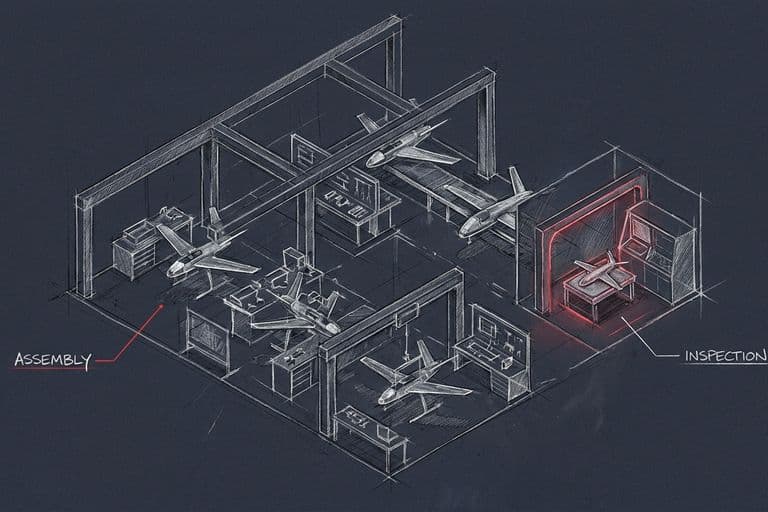
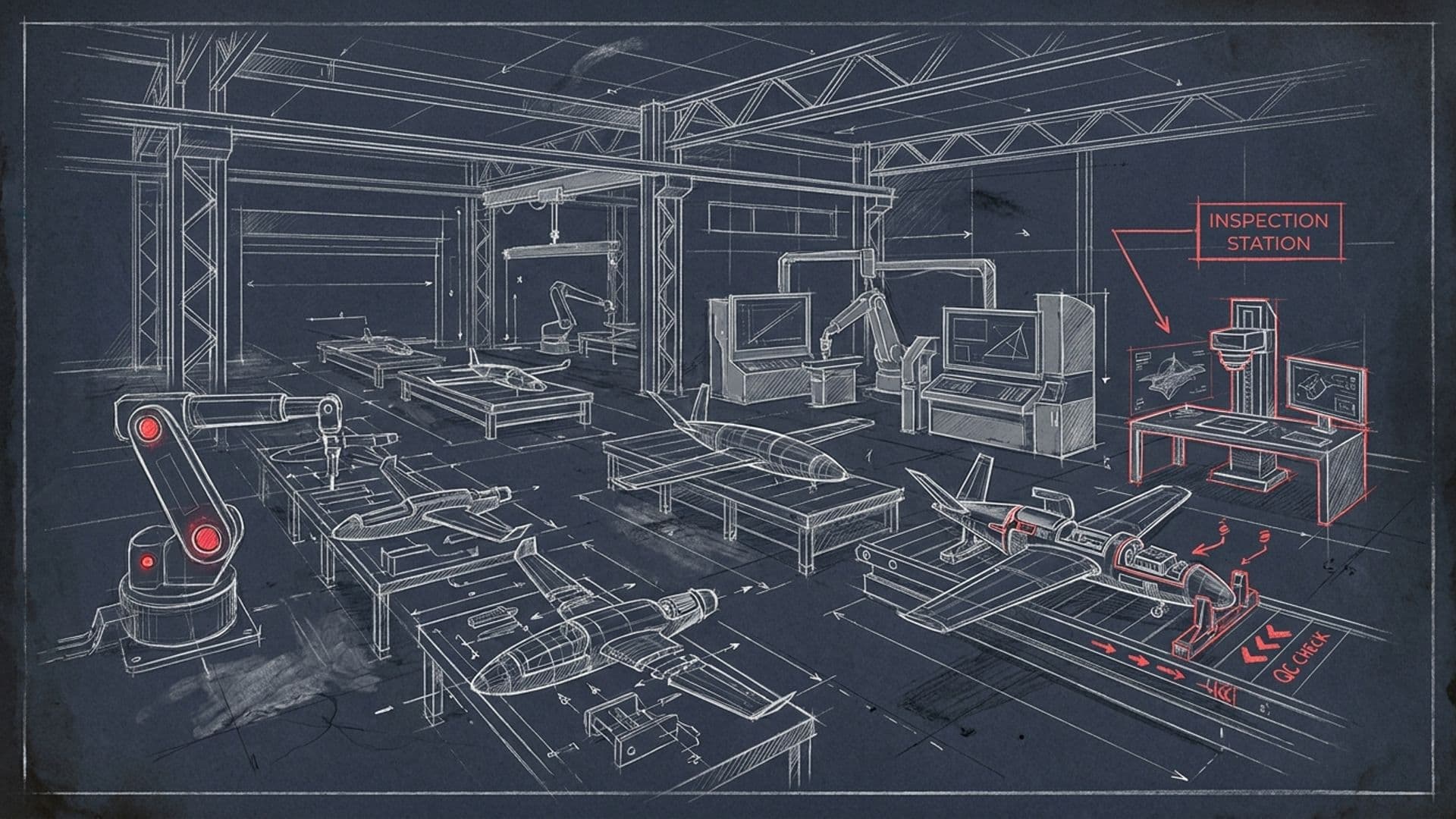
The Dronehub Jasionka factory, sited inside Aviation Valley, brought a $7.5M production line online in 2025 — sized for serial production of drone-in-a-box hardware, counter-UAS interceptors, hybrid UAV-UGV platforms, and mobile-dock systems for the licensee, R&D-partner, and manufacturing-customer pools.
Source · Dronehub manufacturing operations record
3 more key facts
The European Defence Fund (EDF), with €8 billion budget across 2021-2027 programming and continuing through 2028-2034, directs procurement and R&D investment toward EU-domiciled industrial partners under EDIS-aligned eligibility rules.
Source · European Commission EDF programming documentation
The Polish-Czech-German-French axis concentrates more than 70% of NATO Europe's defense-industrial capacity outside the major prime hubs, with Aviation Valley as one of the densest cluster nodes. The depth supports both prime-led consortium structures and SME-led innovation programmes.
Source · NATO Europe defense-industrial-base mapping
EU dual-use innovation programmes (Horizon Europe, EIC Accelerator, NATO DIANA, EDF) directed billions of euros into dual-use industrial capacity across 2020-2025, with significant continuing investment programmed through 2030. The capital availability for sovereign-supply industrial development is structurally higher in the EU than in any other jurisdiction outside the US.
Source · Horizon Europe + EDF + EIC + DIANA combined funding analysis
In this piece
EU drone manufacturing matters more in 2026 than it did even two years ago. Three forces converged to make it the structural answer to most defense and critical-infrastructure UAS procurement: the European Defence Industrial Strategy that codified the framework in March 2024, the geopolitical shift triggered by Russia's 2022 invasion of Ukraine, and the China-Taiwan posture that's reshaping how every NATO-EU procurement office thinks about the 5-10-year depreciation horizon of UAS assets.
This post is the manufacturing-side companion to the supply-chain-sovereignty piece. Where that post walked through why sovereign supply chain became the default, this one walks through where the EU manufacturing capacity actually exists, what makes the Polish-Czech-German-French axis the centre of gravity, and what the procurement frame looks like in 2026 for buyers evaluating EU-manufactured drone capability.
The March 2024 inflection
EU defense industrial policy had been moving toward sovereign-supply-chain preference for years before 2024. The European Defence Fund had supply-chain provisions from its 2017 inception. The Permanent Structured Cooperation (PESCO) projects had been pushing collaborative industrial development since 2017. National MoDs across EU members had been talking about industrial sovereignty since the 2014 Russian annexation of Crimea.
What changed in March 2024 was the codification. The European Commission published the European Defence Industrial Strategy — the EU's first formal industrial-strategy framework dedicated to defense supply-chain sovereignty. EDIS moved the conversation from preference to structure. The framework:
- Establishes formal procurement preference for EU-domiciled industrial partners across defense and dual-use technology classes
- Imposes supply-chain restrictions on covered-nation components, mirroring the US Section 848 frame
- Allocates dedicated funding instruments (within EDF programming and through additional dedicated mechanisms) for EU industrial-capacity development
- Creates the audit, attestation, and compliance architecture for verifying sovereign-supply compliance across the procurement chain
The downstream effect across the 12-18 months following publication: defense procurement across most EU members shifted from informal preference for sovereign-supply to formal EDIS-aligned procurement. National MoDs implemented EDIS-compliant procurement frameworks. EDF instruments tightened eligibility around EDIS criteria. National R&D agencies aligned their programmes with EDIS architecture.
For drone-industry vendors, the practical implication is that EU defense procurement in 2026 operates inside the EDIS frame by default. Selling into EU defense without EDIS-aligned manufacturing is structurally constrained. Manufacturing inside the EU under EDIS-aligned supply chain is the path that works for the procurement frame.
Aviation Valley as the structural anchor
The map of EU defense-industrial capacity isn't uniform. A small number of clusters concentrate most of the procurement-grade capability outside the major prime hubs (which are themselves clustered around Toulouse, Munich, Hamburg, Rome, and a few other major cities).
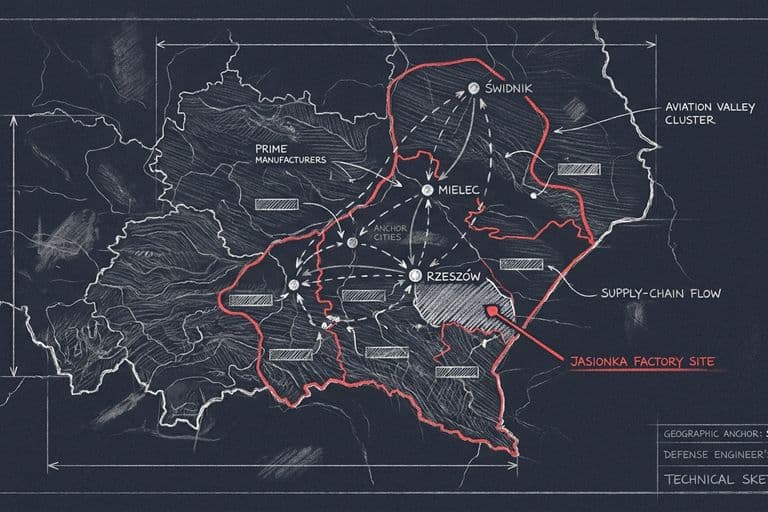
Aviation Valley in southeastern Poland is one of the densest of these clusters. Centred around Rzeszów, the cluster spans roughly 100,000 square kilometres of southeastern Poland and integrates:
- Aerospace primes with decades of NATO and defense procurement history — PZL Mielec (manufacturing), PZL Świdnik (helicopter and aviation), PZL Warsaw (engine and structures), plus international primes (Lockheed Martin, Pratt & Whitney, Sikorsky, Collins Aerospace) operating subsidiaries inside the cluster.
- Tier-1 suppliers for engines, avionics, structural materials, and integrated systems — including primes that supply directly to F-16, F-35, Black Hawk, and a wide range of NATO defense platforms.
- Specialised tier-2 suppliers covering certified machining, composite manufacturing, electronics integration, harness production, and the specialised tooling and process work that aerospace-grade manufacturing requires.
- Engineering bench depth — multiple technical universities (Rzeszów University of Technology, AGH University of Science and Technology in Kraków, plus the broader Polish technical-engineering pipeline) feed engineering workforce into the cluster, with established aerospace-engineering programmes producing the specialist labour pool.
The combined effect is a procurement-grade industrial base inside the cluster that supports serial production at meaningful scale, certified to aerospace and defense standards, with supply-chain depth sufficient to handle the BOM complexity that real defense procurement requires.
The Dronehub Jasionka factory sits inside this cluster. The $7.5M production line online since 2025 produces the drone-in-a-box hardware, the counter-UAS interceptors, the hybrid UAV-UGV platforms, and the mobile-dock systems that ship into the licensee, R&D-partner, and manufacturing-customer pools. Operating inside Aviation Valley means the BOM is sourced from inside a defense-procurement-grade cluster, the manufacturing labour is from inside the cluster's engineering ecosystem, and the certification posture inherits from the cluster's defense-procurement heritage.
The Polish-Czech-German-French axis
Aviation Valley is one node in a broader manufacturing axis that covers more than 70% of NATO Europe's defense-industrial capacity outside the major prime hubs.
Poland. Aviation Valley plus the broader Polish aerospace and defense ecosystem (PGZ Group as the prime industrial holding, multiple specialised SMEs across the country, the major aerospace and defense procurement programmes funded by Polish MoD). Polish defense industrial strategy is formally aligned with EDIS; the country's procurement programmes (Tarcza Polski / Polish Shield, the modernisation programme) integrate directly with EDIS instruments.
Czech Republic. Brno cluster with strong defense-research bench (Military Technical Institute Brno, Military Research Institute Brno — both partner organisations on AUDROS), aerospace specialisation in engine and component manufacturing, defense-electronics and engineering capability. The Czech defense industrial base is smaller than Poland's but procurement-grade across specific technology classes.
Germany. Bavaria and Hamburg primes (Airbus Defence & Space, Diehl, MBDA Germany, Rheinmetall, MTU Aero Engines) plus a deep SME ecosystem across aerospace, defense electronics, and dual-use technology. The German industrial base is the largest in Western Europe; the procurement frame is structured around prime-led consortium development with SME tier integration.
France. Defense-industrial primes (Thales, Airbus DS France, Safran, MBDA France, Dassault) plus a developing dual-use SME tier under DGA (Direction Générale de l'Armement) framework. French sovereign procurement frameworks align with EDIS without significant national divergence; the DGA Innovation Defense Lab and the AID (Agence de l'Innovation de Défense) channel dual-use SME participation.
Italy. Leonardo's ecosystem (with major positions in airframes, electronics, and integrated systems) plus a developing SME tier across the Italian peninsula. Italian defense industrial strategy increasingly aligns with EDIS.
The interconnect across the axis is well-developed. Component supply moves between cluster nodes, joint procurement programmes integrate national capacities, and the consortium-led R&D model under EDF programmes routinely combines partners from multiple axis countries. The axis operates as a single industrial base rather than as disconnected national ecosystems.
The capital availability difference
One structural difference between EU and US drone manufacturing is the capital availability for R&D.
US federal innovation funding (SBIR/STTR, AFWERX, DIU, NATO Innovation Fund) is significant in absolute terms — billions of dollars annually across the participating agencies. The funding is concentrated in specific topic areas, runs on competitive cycles, and is most accessible to US-domiciled small businesses with the entity-structure to qualify.
EU innovation funding operates at a comparable or higher per-capita level when measured across the relevant dual-use technology classes. The major instruments:
- Horizon Europe (€95.5 billion budget 2021-2027). Cluster 4 (Digital, Industry, Space) and Cluster 5 (Climate, Energy, Mobility) include UAS and dual-use technology topics with significant funding envelopes.
- European Defence Fund (€8 billion 2021-2027, continuing through 2028-2034). EDF directs R&D and procurement investment toward EU-domiciled industrial partners under EDIS-aligned eligibility.
- EIC Accelerator (significant annual commitments to dual-use deep-tech SMEs). The EIC has explicitly opened to dual-use technology development.
- NATO DIANA (NATO's dual-use accelerator programme, with member-state contributions and growing accelerator capacity).
- National R&D programmes — Polish NCBR (over €100M annually in defense-adjacent R&D), German BMVg innovation programmes, French AID, Italian PNRM and similar national instruments.
The combined dual-use innovation funding available to EU-domiciled drone companies operating across multiple national programmes and EU instruments is structurally higher than the equivalent US federal-innovation availability for foreign-domiciled drone companies. For European-headquartered drone companies, the EU pathway often provides faster and more competitive R&D funding than the US equivalent.
The Dronehub portfolio reflects this — six-plus funded R&D programmes across ESA, EDA, European Commission, and NCBR have funded the capability stack that's now licensed to operators and procured by R&D partners. The capital flywheel runs through the EU programmes; the resulting IP licenses into the global market via the dual-domicile structure.
What this looks like for procurement
For EU defense and federal-civil buyers — the EDIS-aligned manufacturing at Jasionka in Aviation Valley produces drone hardware that satisfies the procurement frame on first cycle. Manufactured inside the EU, by an EU-domiciled industrial partner (Dronehub Sp. z o.o.), under documented sovereign supply chain, with the supplier network and certification posture inherited from Aviation Valley's defense-industrial heritage. The procurement diligence resolves quickly because the structural elements are pre-built.
For US federal-civil and defense buyers — the same Jasionka manufacturing produces Section 848-equivalent compatible hardware. The Dronehub Inc. (Delaware C-Corp) US entity handles the commercial relationship; the Polish entity handles the manufacturing. Supply-chain provenance, certified component origins, and audit-grade traceability satisfy the US procurement frame. Section 848 and EDIS compliance under a single manufacturing architecture.
For Five Eyes and NATO non-EU allies — UK MoD, Canadian DND, Australian DoD, NATO non-EU members. The same dual-domicile structure handles direct procurement. The EU manufacturing satisfies the sovereign-supply requirement; the US entity provides the commercial pathway where US-aligned procurement is preferred.
For commercial critical-infrastructure operators in regulated verticals — utilities, rail, ports, refineries, energy grid operators — the inherited sovereign-supply requirement from regulators (NIS2, NERC CIP, sector-specific frameworks) maps to EDIS-aligned manufacturing. The procurement diligence for the commercial buyer resolves on the same compliance pack that satisfies the defense buyer.
For defense primes building their own portfolios — the manufacturing-customer engagement structures around Section 848 / EDIS-aligned production with the prime's specifications and brand. The Jasionka line builds for the prime's portfolio under documented sovereign-supply terms.
The manufacturing context lives at /manufacturing. The corporate structure and dual-domicile context at /about. The sovereign-supply-chain argument is at /blog/sovereign-supply-chain-not-optional. The Section 848-specific procurement guide is at /blog/ndaa-section-848-compatible-drones-procurement-guide. For a manufacturing or procurement conversation, open the contact form.
FAQ
- What changed in 2024 with EDIS?
- The European Commission moved from informal sovereign-supply-chain preference to formalised industrial strategy. EDIS — the European Defence Industrial Strategy — codified the framework: defense procurement preference for EU-domiciled industrial partners, supply-chain restrictions on covered-nation components mirroring the US Section 848 frame, and explicit funding mechanisms for EU industrial-capacity development. The strategy is now the procurement frame for EDF, NATO DIANA, and national-MoD procurement across most EU members. Before March 2024, sovereign-supply was a good-practice preference; after March 2024, it's the formal procurement architecture.
- Why does Aviation Valley matter specifically?
- Three structural reasons. (1) Cluster density — Aviation Valley concentrates aerospace primes (PZL Mielec, PZL Świdnik, PZL Warsaw), tier-1 suppliers (engine, avionics, materials), specialised tier-2 suppliers, certification-grade machining and composite shops, and a deep engineering bench in one geographic area. The supply-chain depth and the engineering workforce are both significantly higher than the NATO Europe average. (2) Defense-procurement heritage — the cluster has decades of work serving Polish, NATO, and US defense customers under structured procurement programmes, which means the operational discipline (quality systems, supply-chain traceability, certification posture) is at procurement-grade as a baseline. (3) EDIS alignment — Polish defense industrial strategy is formally aligned with EDIS, and the cluster's industrial development plans map directly to the EDIS funding instruments.
- Why is EU drone manufacturing structurally different from US?
- The capital and demand pools are different. The US has prime-led capability concentrated in a handful of large vendors, plus the Blue UAS pre-vetted small-UAS catalog, run by the Defense Contract Management Agency (DCMA) since December 2025. Federal procurement is large, defense procurement is concentrated, and the SME tier serves the primes. The EU has a more distributed industrial base — multiple national centres (Poland, France, Germany, Italy, Czech Republic), multiple procurement frameworks (EDF, NATO DIANA, national MoDs, civil-protection agencies), and a deeper SME-led innovation programme tier (Horizon Europe SME instruments, EIC Accelerator, national R&D programmes). The EU innovation funding is structurally higher per capita in dual-use technology than US federal funding outside the major DoD primes. For non-US drone companies, the EU pathway often provides faster and more competitive R&D funding than the US equivalent.
- What's the supply-chain depth in the Polish-Czech-German axis?
- Substantial across the full UAS bill of materials. Polish aerospace machining and composites (Aviation Valley primes). Czech defense-electronics and engineering (Brno cluster, including the Military Technical Institute Brno and Military Research Institute Brno that partner on AUDROS). German precision-engineering and avionics (Bavaria and Hamburg primes plus specialised SMEs). French defense-industrial primes plus a developing dual-use SME tier under DGA framework. Italy adds airframe and avionics depth through Leonardo's ecosystem. The combined axis covers more than 70% of NATO Europe's defense-industrial capacity outside the major prime hubs, and the supply-chain interconnect within the axis is well-developed.
- What does the Jasionka factory actually produce?
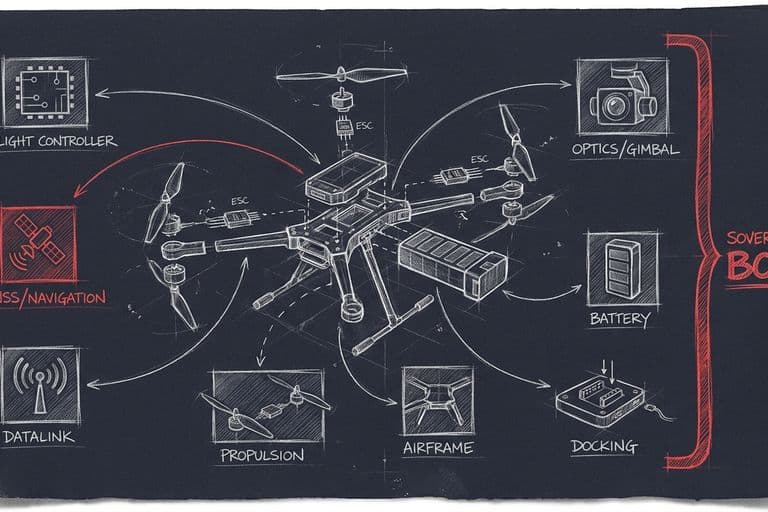
- Drone-in-a-box dock infrastructure (the robotic battery-swap mechanism, the environmental enclosure, the operator-interface electronics). Drone airframes (multirotor configurations across the Dronehub product family). Counter-UAS interceptor airframes including the Eagle One platform inside the AUDROS programme. Hybrid UAV-UGV platforms including HUUVER configurations. Mobile-dock variants for the Nomad convoy-overwatch platform. The factory is sized for serial production at the volume the licensee, R&D-partner, and manufacturing-customer pools require, with capacity headroom for scale-up as the customer base grows. The production line is fully operational since 2025 and ramping through 2026.
- Does EU manufacturing make sense for US federal-civil and defense buyers?
- Yes, when the supply chain is structured for it. Dronehub Inc. is the Delaware C-Corp US entity that engages directly with US federal-civil and defense procurement. Manufacturing at Jasionka under NATO-allied non-CN supply chain produces Section 848-equivalent compatible hardware. The dual-domicile structure routes the commercial relationship through the US entity and the manufacturing through the Polish entity, with documented supply-chain provenance, certified component origins, and audit-grade traceability. The combined arrangement satisfies both Section 848 for US procurement and EDIS for EU procurement under a single manufacturing architecture, which simplifies vendor management for the buyer.