Key facts
The Dronehub Jasionka factory hosts a $7.5M production line fully operational since 2025. Sized for serial production of drone-in-a-box hardware, counter-UAS interceptors, hybrid UAV-UGV platforms, mobile-dock systems, and the broader Dronehub product family for licensee, R&D-partner, and manufacturing-customer pools.
Source · Dronehub manufacturing operations record
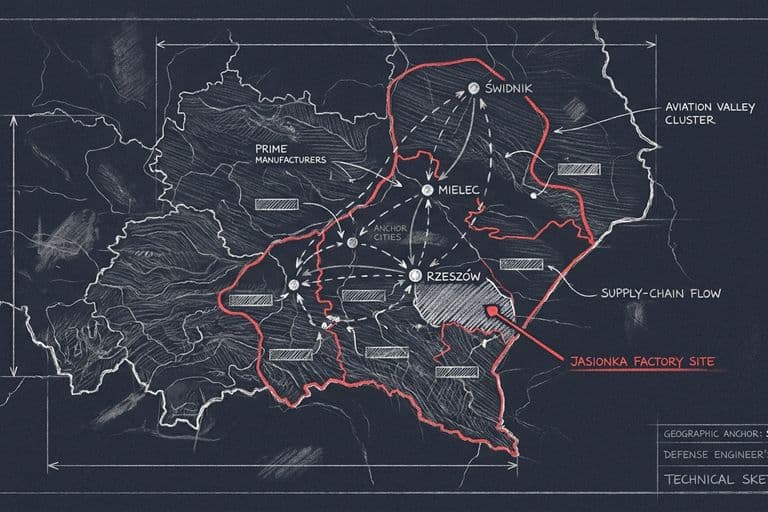
The factory sits inside Aviation Valley — the densest aerospace and defense supply cluster in NATO Europe outside the major prime hubs — drawing tier-1 and tier-2 component supply from the cluster's certified supplier network.
Source · Dronehub Jasionka factory location and supply-chain context
Aviation Valley's defense-procurement heritage spans decades — Polish, NATO, and US defense customers across multiple programme generations have sourced from cluster primes and sub-tier suppliers, producing the certification posture and supply-chain discipline that procurement-grade work requires.
Source · Aviation Valley industrial heritage documentation
3 more key facts
The factory's certification posture inherits from the cluster's quality systems — AS9100 aerospace quality management baseline, documented supply-chain traceability, audit-trail integrity for defense procurement audits, and the workforce discipline that procurement-grade work requires.
Source · Dronehub Jasionka factory certification framework
The factory output flows to three customer categories: IP licensees (operators and integrators taking deployment-ready capability under licence), R&D partners (governments and defense agencies funding capability development), and manufacturing customers (defense primes and NATO-allied industrial partners needing non-Chinese supply chain).
Source · Dronehub commercial model and factory-output allocation
Capacity headroom is built into the production line for scale-up as customer base grows. The 2025-online configuration is sized for the current customer pool with margin for the expansion expected through 2028-2030 deployment cycles.
Source · Dronehub manufacturing capacity planning
In this piece
The Jasionka factory is where the Dronehub IP becomes manufactured product. $7.5M production line, fully operational since 2025, sited inside Aviation Valley — the densest aerospace-and-defense supply cluster in NATO Europe outside the major prime hubs. This post walks through what the factory actually produces, how the cluster supply chain feeds it, what the certification posture looks like, and what the capacity-scaling outlook is.
The post is the operational companion to the broader manufacturing strategy narrative. Where those pieces explained why EU manufacturing matters and what Aviation Valley is as an industrial cluster, this one walks through the specific production line that produces the manufactured hardware behind every licensee, R&D partner, and manufacturing-customer relationship.
What gets built at Jasionka
Five primary product categories flow through the production line.
Drone-in-a-box dock infrastructure. The robotic battery-swap mechanism (the 3-axis positioning rig, the magnetic-aligned battery interface, the fault-recovery logic), the environmental enclosure (rated for outdoor industrial deployment across temperature, weather, and vibration profiles), the operator-interface electronics, and the dock control systems. Docks ship to fixed-installation customers (rail operators, energy utilities, port authorities, critical-infrastructure operators) and to deployable-configuration customers (US DoD FOB deployments, NATO MoD base protection, civilian protective services).
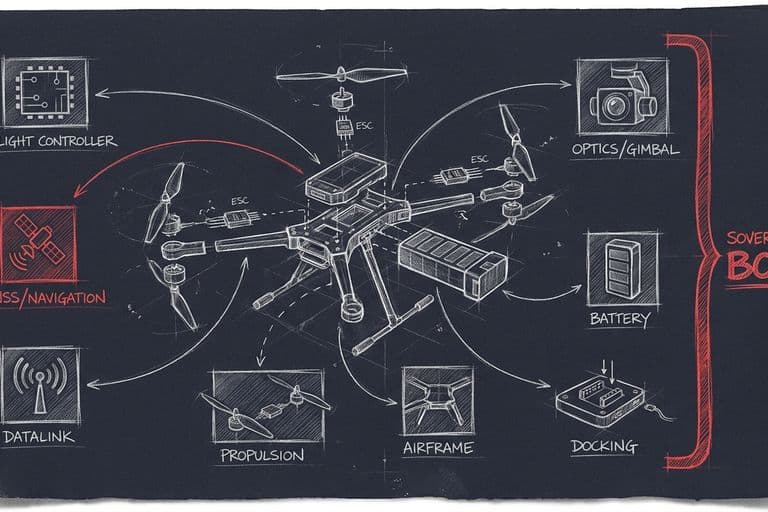
Drone airframes. Multirotor configurations across the Dronehub product family. The standard drone-in-a-box UAV for inspection and ISR. Counter-UAS interceptor airframes — including the AUDROS Eagle One platform for net-capture C-UAS. Mission-specific configurations with modular payload bays. The airframe production handles structural-frame construction, motor and flight-controller integration, sensor-payload mounting, and the airframe-level testing that precedes integration.
AUDROS Eagle One counter-UAS interceptors. The net-capture kinetic component of the AUDROS counter-UAS stack. Includes the net-launcher mechanism (pneumatic or pyrotechnic propulsion), the wide-spread capture net with four weighted corner masses, the parachute drogue assembly for controlled descent, and the integrated fire-control electronics. Interceptors ship to prison anti-smuggling deployments, critical-infrastructure perimeter operations, defense FOB protection, and civil-protection scenarios.
HUUVER hybrid UAV-UGV platforms. The dual-mode flight-plus-ground airframe with integrated Galileo OS-NMA navigation. The platform combines VTOL multirotor flight with ground-driving wheel chassis, with the mode-transition mechanism that handles the autonomous switch between flight and ground operation. HUUVER ships to defense and federal-innovation customers under programme-specific configurations.
UAV Nomad mobile-dock variants. The vehicle-mounted dock configuration for convoy overwatch and mobile-platform deployment. Mounts onto MRAP, HMMWV, M-ATV, commercial heavy-duty SUV, or up-armoured pickup chassis depending on the operator's existing fleet. The UAV Nomad variant includes the platform-specific mounting integration, shock and vibration isolation appropriate to the chassis dynamics, and the operator-interface placement for in-vehicle command-and-control.
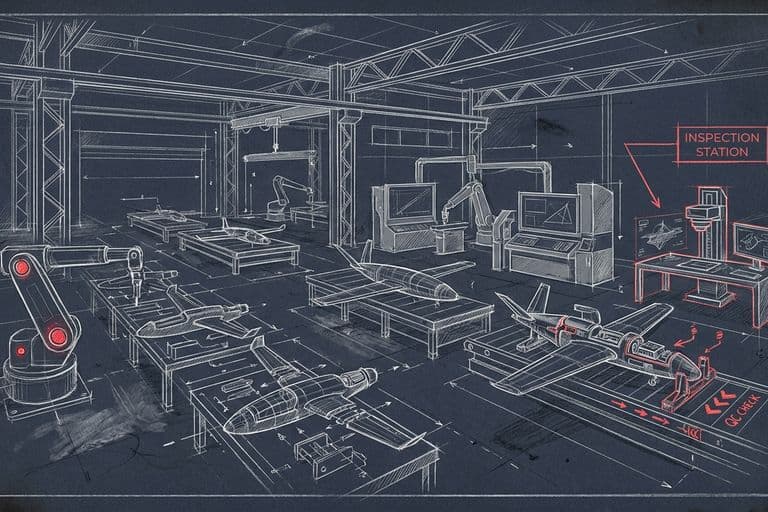
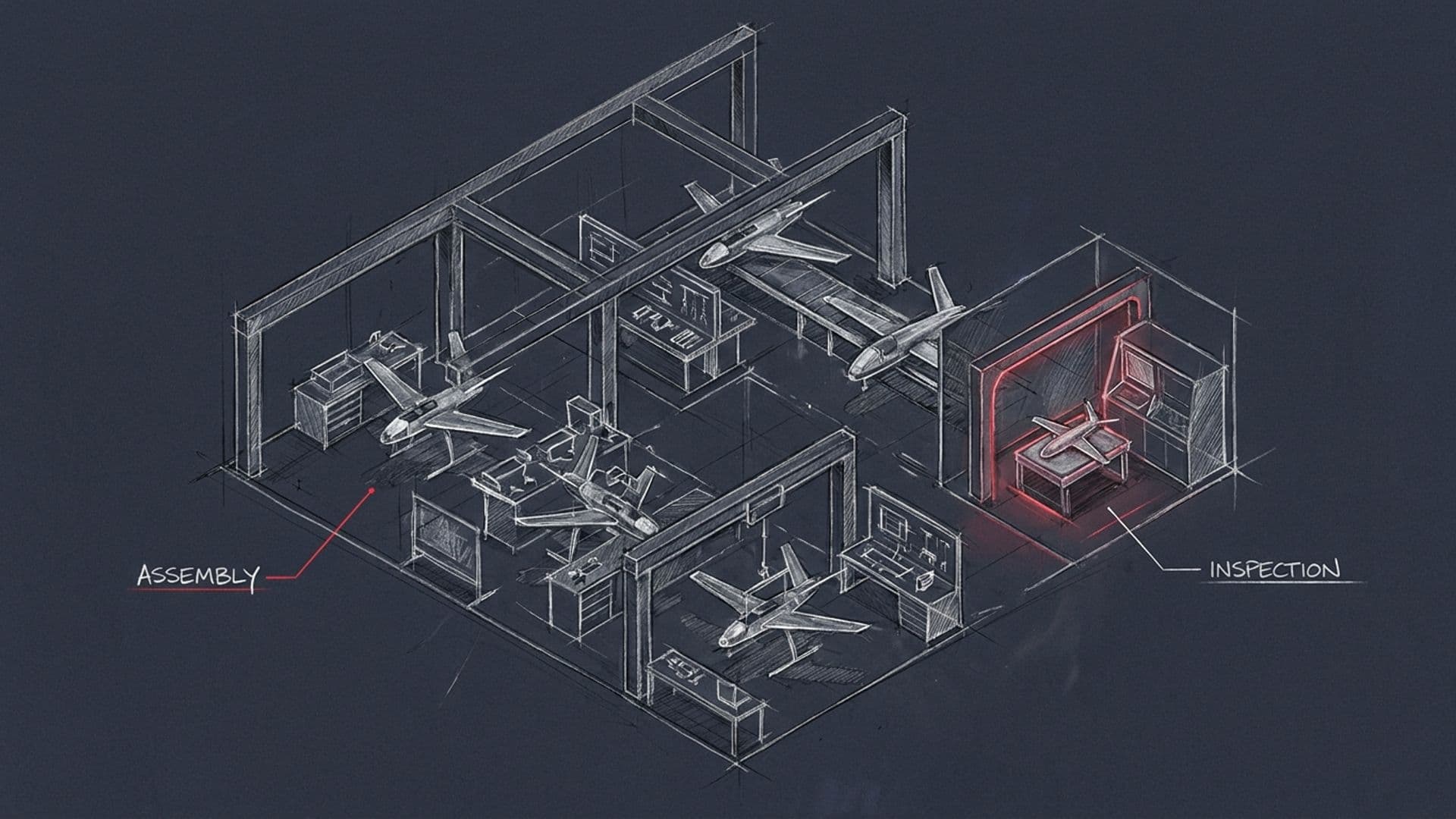
The production line's modular layout handles all five categories with shared infrastructure (component intake, electronics integration, test cells, audit-trail closure) and category-specific assembly cells.
How the Aviation Valley supply chain feeds the factory
The factory was sited inside Aviation Valley specifically because of the supply-chain depth. Component sourcing flows from the cluster's tier-1 and tier-2 supplier network with structural advantages.
Precision machining. Cluster-certified machine shops produce the precision-machined components — motor mounts, structural connectors, dock-mechanism precision parts, sensor-mounting brackets. The machining capability is at aerospace-grade across the cluster's certified suppliers; the per-unit certification posture is procurement-grade as a baseline.
Composite manufacturing. Cluster aerospace composite manufacturers produce the carbon-fibre and composite structural elements. Airframe composites, dock environmental-enclosure panels, payload-bay structures. The composite manufacturing depth in Aviation Valley is significant — multiple cluster suppliers serve major NATO aerospace platforms (F-16 components, helicopter manufacturing, Black Hawk structures).
Electronics integration. The cluster's electronics-manufacturing tier handles printed-circuit-board assembly, harness production, and electronics integration. Defense-grade electronics manufacturing (with the certification posture, the supply-chain traceability, and the test discipline that defense procurement requires) is one of the cluster's strengths.
Materials supply. Aerospace-grade aluminium alloys, carbon-fibre composites, specialised polymers, certified surface treatments — all from cluster-certified materials suppliers. The materials supply network operates under Polish, EU, and NATO supply-chain frameworks that align with Section 848-equivalent requirements by structural default.
Specialised sub-assemblies. Specific components (net-launcher mechanisms, Galileo OS-NMA receiver integration, Nvidia Jetson on-board compute boards, FLIR thermal payloads, Velodyne LiDAR sensors) come from specialised suppliers either inside the cluster or from sovereign-supply-chain sources outside the cluster but inside NATO / EU / US jurisdictions.
The supply-chain network is geographically dense — most component suppliers are within a few hours' drive of the factory. This compresses supply-chain lead times, simplifies supplier-quality management, supports the per-unit certification audit posture, and enables responsive adjustments to production cadence as customer demand shifts.
The production-process workflow
High-level six-stage workflow per unit, with parallel cells handling different units simultaneously.
Stage 1 — Component intake. Incoming tier-1 and tier-2 components received against documented bill-of-materials. Each component's provenance verified against the per-unit audit pack. Components quarantine-staged until provenance verification completes; only verified components flow to assembly. The intake stage is the structural foundation of the factory's procurement-grade certification posture — every component's origin documented before it touches the production line.
Stage 2 — Sub-assembly. Discrete sub-assemblies built up per workstation. Motor mounts assembled with bearings, motor pre-attachment, and structural-connector integration. Flight controller modules built with embedded systems, sensor-cluster integration, and harness pre-wiring. Sensor clusters integrated with the appropriate payload combination (EO/IR, thermal, LiDAR, mission-specific sensors). Dock mechanism components assembled — the 3-axis positioning rig, the battery-interface contact assembly, the environmental enclosure subassemblies. Each sub-assembly station handles its specific scope with standardised workflows that scale across production volume.
Stage 3 — Integration. Sub-assemblies integrated into airframes and dock units at integration cells. The airframe integration cell brings together the structural frame, motor mounts, flight controller, sensor cluster, payload bay, and harness routing into a flight-ready airframe. The dock integration cell brings together the swap mechanism, environmental enclosure, control electronics, and operator-interface components into a deployment-ready dock. Integration is the highest-skill stage; specialised technicians handle the cross-component validation and the integration-level audit-trail documentation.
Stage 4 — Software flashing and configuration. Autonomy stack flashed onto the flight controller. Edge-AI classifier models loaded onto the Jetson per the customer's per-asset taxonomy configuration. Dock control software flashed onto the dock electronics. Galileo OS-NMA configuration set per platform (HUUVER and the higher-spec defense configurations get full OS-NMA; commercial inspection units get appropriate-grade GNSS configuration). Software flashing happens under sealed-build conditions with cryptographic integrity verification on every load.
Stage 5 — Test and validation. Functional testing per unit specification. Airframes get flight-readiness validation (motor balance, control-surface response, sensor calibration, hover stability). Docks get cycle-readiness validation (swap mechanism cycle test, environmental seal verification, control-software validation). Counter-UAS interceptors get engagement-system validation (net-launcher operation, drogue deployment, fire-control logic). Each unit's test results documented per the audit pack.
Stage 6 — Final inspection and audit-trail closure. Final QC against the per-unit documentation pack. Every component, every sub-assembly, every integration step, every software load, every test result documented and signed off. Packaging for delivery with the documentation pack accompanying the unit. Customer handover includes the procurement-grade documentation as part of the unit's audit trail.
The six-stage workflow is consistent across product categories; the per-stage cell configuration adapts to the product type. The factory's modular layout supports simultaneous production of multiple product categories without cross-product interference.
Certification posture
The factory's certification posture inherits from Aviation Valley's broader quality discipline.
AS9100 baseline. Aerospace quality management standard (derived from ISO 9001 with aerospace-specific additions). The standard is operational baseline across the cluster; the factory operates under AS9100 framework with documented quality systems, corrective-action workflows, and audit posture.
Documented supply-chain traceability. Component provenance tracking on every unit. The audit pack accompanies the unit from intake through delivery, with every component's source, lot number, certification documentation, and processing history captured. Audit auditors can trace any unit back to its component sources within hours.
Audit-trail integrity. Every production decision, every QC check, every component intake logged with timestamp and personnel attribution. The audit trail supports defense procurement audits, regulator inspections, and customer due diligence on first request.
Workforce discipline. The factory workforce inherits from the cluster's broader aerospace-and-defense workforce pipeline. Engineering and manufacturing personnel typically come from cluster-affiliated training programmes; the workflow discipline is at procurement-grade as a workforce-trained baseline.
Programme-specific certification. For specific customer programmes — US DoD, EU defense, allied national MoDs — additional certification work is layered on top of the AS9100 baseline. Section 848 audit packs for US procurement, EDIS-aligned documentation for EU defense, programme-specific certification for individual contracts. The additional certification is a per-programme adapter on top of the baseline factory posture; the marginal cost is bounded.
Customer-output allocation
Factory output flows to three customer categories with different allocation patterns.
IP licensees. Operators and integrators taking deployment-ready capability under licence. The licensing engagement covers IP rights, manufactured hardware delivery, and deployment-support services. Hardware delivery from Jasionka, integration support from Dronehub's engineering team, model retraining via the cloud-side architecture, and capability improvements flowing back into the base architecture for all future licensees. Licensee deals typically span multi-year programme structures with phased delivery and capacity-tier scaling.
R&D partners. Governments and defense agencies funding capability development. The R&D-partnership engagement covers programme execution, capability deliverables (including manufactured hardware as part of the deliverable when applicable), and the IP that flows back to Dronehub for downstream licensing. R&D partners include ESA, EDA, European Commission Horizon, Polish NCBR, and increasingly US federal-innovation pipelines (SBIR/STTR, AFWERX, DIU, NATO Innovation Fund). Hardware delivery from Jasionka under programme-specific configuration.
Manufacturing customers. Defense primes and NATO-allied industrial partners. The manufacturing engagement covers per-unit production under the prime's specification, with Section 848 / EDIS compliance documentation, sometimes under the prime's brand integration. Manufacturing customer deals are typically multi-year programme partnerships with significant per-unit volume. Defense primes seeking non-Chinese supply chain for their own portfolios are an increasingly large category.
The factory's capacity is allocated dynamically across the three categories based on programme cadence and customer-priority allocation. The modular layout supports the dynamic allocation without requiring product-line restructuring.
Capacity scaling outlook
The 2025-online configuration is sized for the current customer pool with margin for the expansion expected through 2028-2030 deployment cycles. Capacity headroom is built into the production line architecturally.
Three structural scaling drivers:
Expanding IP licensee pool. New operators in new geographies adopting deployment-ready capability. New asset classes (energy grid, ports, refineries, FOB deployment) feeding additional licensing demand. Existing licensees expanding their deployment footprint across multi-year programmes.
Deepening R&D partner pool. Additional EU and US federal-innovation programmes funding new capability development. NATO DIANA and EDF cohorts producing follow-on programmes. SBIR/STTR Phase III commercialisation contracts driving production volume.
Growing manufacturing customer pool. Defense primes increasingly sourcing non-Chinese supply chain for their portfolios. NATO-allied industrial partners requiring Section 848 / EDIS-compliant manufacturing. The procurement frame favors sovereign-supply-chain manufacturing increasingly explicitly.
The factory's modular layout supports incremental expansion of assembly cells without requiring fundamental redesign. The next capacity tier can be added in months rather than years — additional integration cells, additional test stations, expanded final-inspection capacity. The supply-chain depth in Aviation Valley supports the scale-up without becoming the bottleneck; the cluster's certified supplier network has capacity headroom that aligns with the factory's expansion outlook.
The manufacturing context lives at /manufacturing. The Aviation Valley cluster explanation is at /blog/aviation-valley-explained-us-buyers. The EU manufacturing strategic case is at /blog/eu-drone-manufacturing-matters-2026. The Section 848 procurement guide is at /blog/ndaa-section-848-compatible-drones-procurement-guide. The corporate dual-domicile structure is at /about. The PARP factory grant context is at /projects/parp-factory. For a manufacturing-engagement conversation, open the contact form.
FAQ
- What does the Jasionka factory actually produce?
- Five primary product categories. (1) Drone-in-a-box dock infrastructure — the robotic battery-swap mechanism, the environmental enclosure, the operator-interface electronics, and the dock control systems. (2) Drone airframes — multirotor configurations across the Dronehub product family, including the standard drone-in-a-box UAV, counter-UAS interceptor airframes, and hybrid UAV-UGV configurations. (3) AUDROS Eagle One counter-UAS interceptors — the net-capture kinetic component of the AUDROS counter-UAS stack, including the net-launcher mechanism and parachute drogue assembly. (4) HUUVER hybrid UAV-UGV platforms — the dual-mode flight-plus-ground airframe with integrated Galileo OS-NMA navigation. (5) Nomad mobile-dock variants — the vehicle-mounted dock configuration for convoy overwatch and mobile-platform deployment.
- How does the factory integrate with Aviation Valley supply chain?
- Component sourcing flows from the cluster's tier-1 and tier-2 supplier network. Precision machining components come from cluster-certified machine shops. Composite structural elements come from cluster aerospace composite manufacturers. Electronics integration draws on the cluster's electronics-manufacturing tier. Materials supply (aerospace-grade aluminium alloys, carbon-fibre composites, specialised polymers, certified surface treatments) comes from cluster-certified materials suppliers. The supply-chain network is geographically dense — most component suppliers are within a few hours' drive of the factory, which compresses supply-chain lead times and supports the per-unit certification posture. The integration is structural — the factory was sited inside Aviation Valley specifically because of the supply-chain depth.
- What's the production-process workflow?
- High-level six-stage workflow. (1) Component intake — incoming tier-1 and tier-2 components received against documented bill-of-materials, with provenance verification for procurement-grade audit material. (2) Sub-assembly — discrete sub-assemblies (motor mounts, flight controller modules, sensor clusters, dock mechanism components) built up per workstation. (3) Integration — sub-assemblies integrated into airframes and dock units at integration cells. (4) Software flashing and configuration — autonomy stack, edge-AI classifier models, dock control software, and Galileo OS-NMA configuration loaded per unit specification. (5) Test and validation — functional testing, flight-readiness validation (for airframes), and acceptance testing per customer specification. (6) Final inspection and audit-trail closure — final QC against the per-unit documentation pack, packaging for delivery, and customer-handover with the procurement-grade documentation.
- What's the certification posture?
- AS9100 aerospace quality management baseline (the aerospace-and-defense quality standard, derived from ISO 9001 with aerospace-specific additions). Documented supply-chain traceability with component provenance tracking on every unit. Audit-trail integrity for defense procurement audits — every production decision, every QC check, every component intake logged with timestamp and personnel attribution. The factory's certification posture inherits from the cluster's broader quality discipline; the audit pack is a standing artefact ready for procurement diligence on first request. For specific customer programmes (US DoD, EU defense, allied national MoDs), additional certification work is layered on top of the AS9100 baseline as the programme requires.
- Who buys factory output?
- Three customer categories. (1) IP licensees — operators and integrators taking deployment-ready capability under licence. Utility companies running grid inspection, rail operators running track inspection, port authorities running perimeter and asset-condition overwatch, security integrators running critical-infrastructure C-UAS, prison-system contractors. The licensing engagement covers IP plus manufactured hardware plus deployment support. (2) R&D partners — governments and defense agencies funding capability development. ESA, EDA, European Commission Horizon, Polish NCBR; increasingly SBIR/STTR, AFWERX, DIU, NATO Innovation Fund. R&D partners may receive the manufactured hardware as part of the programme deliverable. (3) Manufacturing customers — defense primes and NATO-allied industrial partners. Primes building their own portfolios with sovereign-supply-chain components, sometimes under their own brand integration. The manufacturing engagement is structured around the prime's specifications with documented Section 848 / EDIS compliance.
- What's the capacity scaling story?
- The 2025-online configuration is sized for the current customer pool with margin for the expansion expected through 2028-2030 deployment cycles. Capacity headroom is built into the production line for scale-up as the customer base grows. As the IP licensee pool expands (new operators, new geographies, new asset classes), as the R&D partner pool deepens (additional EU and US federal-innovation programmes), and as the manufacturing customer pool grows (defense primes increasingly sourcing non-Chinese supply chain), the factory's production cadence scales to meet demand. The factory's modular layout supports incremental expansion of assembly cells without requiring fundamental redesign — the next capacity tier can be added in months rather than years.