Key facts
NDAA Section 848 — codified at 10 U.S.C. 4871 note — has expanded across US federal agencies since FY2020. What started as a DoD-only restriction now applies in mirrored form across DHS, DoE, DOT, NASA, and state-level critical infrastructure programmes.
Source · 10 U.S.C. 4871 note; federal agency procurement guidance 2020–2025
The European Union's European Defence Industrial Strategy (EDIS), published March 2024, established parallel sovereign supply chain restrictions for EU member-state defense procurement. EDIS is the EU's first formal industrial-strategy framework dedicated to defense supply-chain sovereignty.
Source · European Commission EDIS publication, 5 March 2024
Russia's February 2022 invasion of Ukraine accelerated procurement-policy convergence across NATO and EU members — sovereign supply chain moved from 'good practice' to baseline expectation within roughly 18 months.
Source · Comparative procurement-policy analysis, 2022–2024
3 more key facts
The EU's NIS2 Directive — effective October 2024 — extends supply-chain accountability to critical infrastructure operators across telecommunications, energy, transport, banking, health, and digital infrastructure. These operators inherit sovereign-supply-chain requirements from their own regulators.
Source · EU NIS2 Directive (Directive 2022/2555), national implementations 2023–2024
The Five Eyes intelligence community has issued multiple public advisories on Chinese-manufactured drone supply chain risk. Several Five Eyes nations and several EU member states have implemented sovereign drone procurement requirements that operate alongside or in advance of US Section 848 and EU EDIS frameworks.
Source · Five Eyes public advisories on UAS supply chain; comparative national policy review
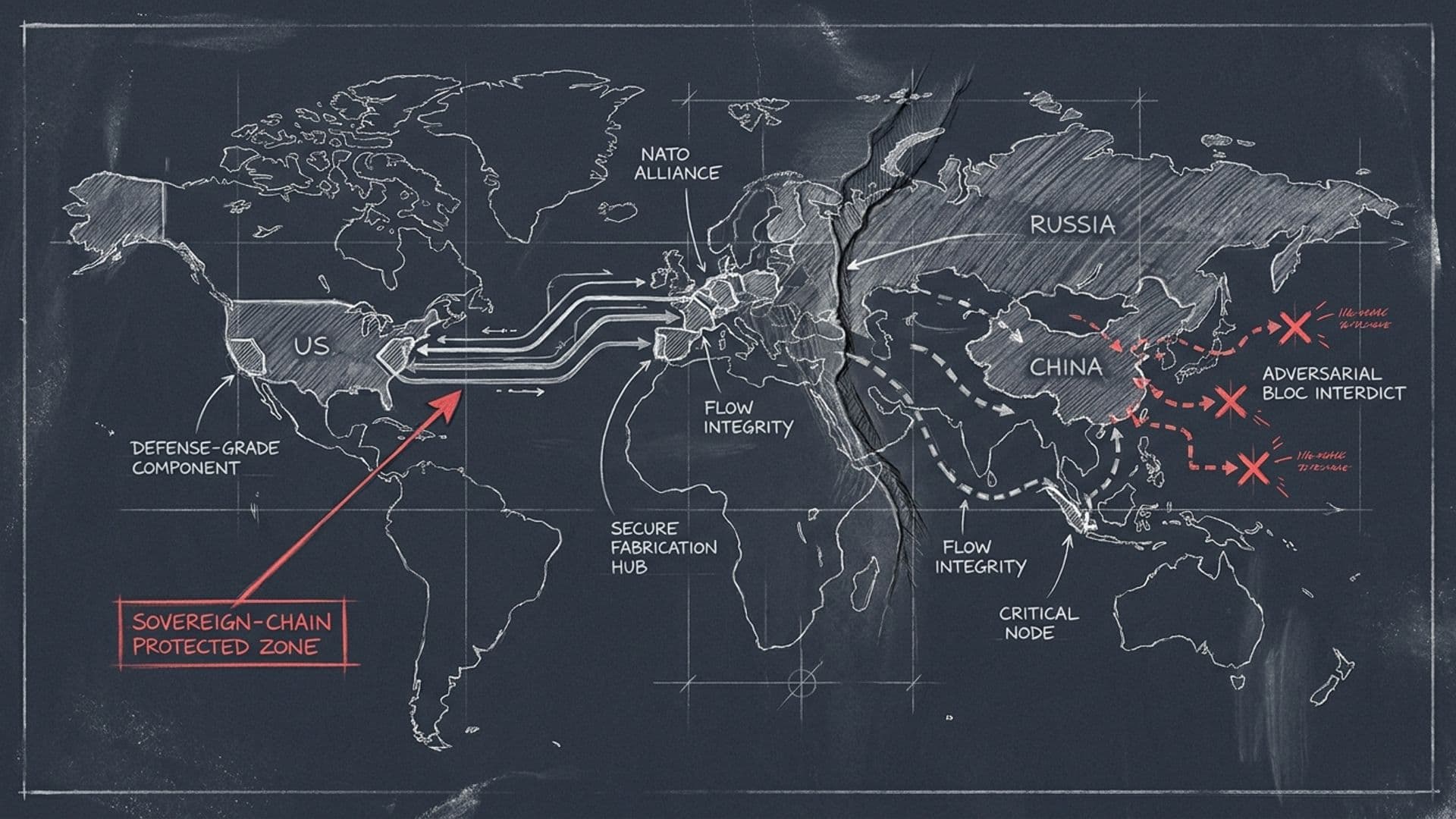
The structural sovereign alternative — NATO-allied non-CN supply chain across Poland (Aviation Valley), Czech Republic, Germany, France, and the US — exists at meaningful scale and is procurement-ready for federal-civil, defense, and commercial critical-infrastructure buyers.
Source · NATO-allied aerospace and defense industrial mapping, 2024–2026
In this piece
The sovereign supply chain question moved from optional to default somewhere between February 2022 and March 2024. It didn't happen in a single regulatory step. It happened in a convergence: Russia's invasion of Ukraine, the European Union's EDIS publication, the NDAA Section 848 expansion across US federal agencies, NIS2 coming into force, NERC CIP tightening, and intelligence-community advisories on Chinese drone supply chain risk. By the end of 2024 the procurement frame across NATO had converged on a single answer: sovereign supply chain is required, not preferred.
This post unpacks what actually changed, where the new rules apply, what the cost of staying on non-sovereign supply chain looks like, and what the practical sovereign alternative actually is in 2026.
What changed, and when
The defense procurement frame has cared about supply chain origin for a long time. ITAR controls were drafted in 1976. CFIUS reviews of Chinese acquisitions of US defense suppliers became routine after 2018. NDAA Section 848 was codified in FY2020. The European Defence Fund had supply-chain provisions from its 2017 inception. None of this is new.
What changed was the speed and the breadth.
Pre-2022, sovereign supply chain was a defense-procurement concern that bled slowly into adjacent federal-civil and critical-infrastructure spaces. The compliance frame was tightening but at a pace that gave commercial buyers room to ignore it without consequence. The major Chinese drone vendors — DJI most prominently, but several others — sold into critical-infrastructure operators globally without significant pushback. Federal-civil agencies bought Chinese drones for non-DoD use. Even some defense organisations procured Chinese commercial-grade UAS for non-classified missions.
Then Russia invaded Ukraine in February 2022. The procurement-policy debate that had been moving at peacetime speed compressed by roughly 18 months in 18 months.
Three things happened in parallel.
Section 848 expansion. The DoD rule that restricted covered foreign components in DoD UAS procurement spread across federal agencies. DHS, DoE, DOT, NASA, and the FAA implemented mirrored frameworks. State-level grid and critical-infrastructure programmes followed. The procurement-pathway closure for non-sovereign UAS vendors accelerated.
EDIS publication. The European Commission published the European Defence Industrial Strategy in March 2024. EDIS was the EU's first formal industrial-strategy framework dedicated to defense supply-chain sovereignty. The framework established parallel restrictions for EU member-state defense procurement, with national implementations following.
NIS2 implementation. The EU's Network and Information Security Directive 2 came into force in October 2024, extending supply-chain accountability to critical-infrastructure operators across telecommunications, energy, transport, banking, health, and digital infrastructure. Commercial buyers in regulated verticals inherited a sovereign-supply-chain requirement from their own regulators.
The defense framework, the industrial framework, and the commercial-inheritance framework converged inside 24 months. The resulting procurement reality is materially different from the pre-2022 frame, and it is not going to revert.
The geopolitical context
The procurement frame did not converge on sovereign supply chain because of a clever bureaucratic plan. It converged because the geopolitical context made the previous frame untenable.
Russia's 2022 invasion of Ukraine demonstrated three things relevant to drone procurement. First, that a state with sufficient industrial capacity will use uncrewed systems as primary strike, ISR, and logistics assets across the operational range — and that the vendors supplying components into those systems become a sovereign-capability question. Second, that supply-chain dependencies on potentially adversarial states create operational fragility under conflict — components can be sanctioned, redirected, or interdicted in ways that disable the dependent system. Third, that intelligence collected through deployed UAS — telemetry, imagery, operator-pattern data — flows back to the manufacturer's home jurisdiction unless the supply-chain architecture prevents it.
The Five Eyes intelligence community has issued multiple public advisories on Chinese-manufactured drone supply chain risk, with several focused specifically on the consumer-and-commercial vendor pool that critical-infrastructure operators had been relying on. The advisories vary in granularity but converge on the same procurement implication: critical-infrastructure operators and federal-civil buyers should structure away from Chinese-controlled supply chain.
The China-Taiwan posture adds a second axis. A scenario in which Taiwan is the object of conflict accelerates every supply-chain concern around Chinese-origin components. Procurement decisions made in 2026 are decisions about the depreciation horizon of the asset — typically 5–10 years in critical infrastructure — and that horizon spans the period of maximum Taiwan-scenario uncertainty.
The procurement frame converged on sovereign supply chain because the strategic context made the previous frame too expensive in expected cost.
Commercial inheritance
The part that catches commercial operators by surprise is the inheritance.
The defense rules — Section 848, EDIS — apply to defense buyers directly. A commercial operator running drones at a refinery is not subject to Section 848 in a strict statutory sense. But the parallel commercial framework operates in mirrored form.
EU NIS2 requires critical-infrastructure operators to maintain supply-chain accountability across their digital and operational infrastructure. National implementations of NIS2 vary, but the practical procurement effect converges: commercial operators of critical infrastructure increasingly cannot procure non-sovereign UAS without taking on regulatory exposure their auditors and insurers will surface.
US CISA critical-infrastructure frameworks impose equivalent rules under federal critical-infrastructure designation. NERC CIP in North American power. Sector-specific frameworks in transportation, finance, and health. The rule transmits from the regulator to the operator to the procured asset.
The downstream-customer transmission adds a second axis. Utility operators selling power into the grid increasingly inherit supply-chain requirements from their grid-operator counterparties. Industrial operators supplying defense primes inherit from the prime's Section 848 / EDIS compliance frame. The transmission propagates from the sovereign procurement frame at the top through commercial supply chains downstream.
The practical result: commercial operators in regulated verticals are operating inside the sovereign-supply-chain frame whether they realised it or not. Procurement decisions taken without that frame in mind create regulatory liability that materialises in audit cycles, contract renewals, and insurance underwriting reviews.
The cost of staying on non-sovereign supply chain
Three classes of cost, all compounding over the asset depreciation horizon.
Procurement lockout. Federal-civil and defense procurement pathways close progressively. The addressable market shrinks. A vendor whose product cannot be procured by DoD, DHS, DoE, DOT, NASA, the FAA, and state-level critical-infrastructure programmes has lost the largest single category of high-value procurement. For end-buyers, the implication is that committing to a non-sovereign vendor stack means foreclosing on the federal-civil and defense pathways for the duration of the asset depreciation.
Regulatory exposure. The commercial inheritance from NIS2, NERC CIP, sector-specific frameworks creates compliance liability that materialises in audit cycles. Operators in regulated verticals face audit findings, regulator queries, and (in serious cases) operational sanctions for supply-chain non-compliance. The cost is not just the audit-finding remediation; it's the trust loss with the regulator that affects every subsequent inspection.
Strategic dependency. Operating mission-critical infrastructure on supply chain controlled by an adversarial state creates intelligence, sabotage, and continuity-of-operations exposure that surfaces in incident response, insurance underwriting, and board-level risk reviews. The exposure is not theoretical. Reported incidents involving non-sovereign UAS supply chain — firmware updates suspended by geopolitical events, components becoming sanctioned in mid-deployment, telemetry leakage to manufacturer home jurisdictions — have demonstrated the cost is real and operational rather than abstract.
Across the typical 5-to-10-year depreciation horizon of critical-infrastructure UAS deployment, the three cost classes compound non-linearly. A procurement decision that looked cheap in 2022 has, by 2026, accumulated procurement lockout, regulatory exposure, and strategic risk that exceeds the original capital savings by orders of magnitude.
Where the sovereign alternative actually exists
The structural sovereign alternative exists at meaningful scale across NATO-allied jurisdictions, concentrated in a small number of clusters. The depth is uneven, and the procurement pool is smaller than the global drone-vendor catalog — but it is meaningful and procurement-ready.
United States. Prime-led capability concentrated in a handful of vendors plus the Blue UAS pre-vetted catalog, run by the Defense Contract Management Agency (DCMA) since December 2025. Blue UAS covers small-UAS classes; enterprise-class and specialised UAS procure outside Blue UAS via direct-contract supply-chain review.
Poland. Aviation Valley around Rzeszów in southeastern Poland is the densest aerospace and defense supply cluster in NATO Europe outside the major prime hubs. The cluster integrates engineering bench, supplier network, certified aerospace materials supply, defense-procurement heritage, and EDIS-aligned industrial-strategy support. The Dronehub Jasionka factory line sits inside the cluster.
Germany. Bavaria and Hamburg host significant defense-industrial depth, with established primes (Airbus DS, Diehl) and a growing SME ecosystem. The German market is large enough to anchor sovereign-supply procurement on its own.
France. DGA-aligned primes (Thales, Airbus DS, Safran) plus a developing dual-use SME tier. French sovereign-procurement frameworks align with EDIS without significant national divergence.
Czech Republic. Strong defense-research bench (the Military Technical Institute Brno and Military Research Institute Brno are partner organisations in several Dronehub R&D programmes). Capability is at the SME and specialised-system level rather than at prime scale.
United Kingdom. Post-Brexit but Five Eyes-aligned, with specialised UAS capability and a defense-procurement framework that operates alongside (rather than within) EDIS.
Nordic cluster (Sweden, Finland, Norway). Specialised, particularly around sensor systems, autonomy, and northern-environment operations.
Italy, Spain, Netherlands, Belgium, Greece. Each has specific capability pockets, integrating into the broader EDF / NATO DIANA frame.
The Polish-Czech-German axis is the practical centre of gravity for EU defense supply chain in 2026, with the US prime-and-Blue-UAS axis as the parallel anchor on the other side of the Atlantic. For a buyer looking to procure sovereign UAS at scale, the path runs through these clusters.
What this means in practical terms
For US federal-civil and defense buyers — the sovereign-supply-chain frame is now the default. Vendor selection collapses to NATO-allied non-CN suppliers with traceable BOM provenance. Dronehub Inc. is the Delaware C-Corp US entity; manufacturing is at Jasionka in Aviation Valley under NATO-allied non-CN supply chain. Section 848-equivalent compliance documentation survives federal procurement review on first cycle.
For EU defense and industrial buyers — EDIS-aligned sovereign supply chain is the equivalent procurement frame. The same Jasionka manufacturing serves both compliance frames simultaneously, with the Polish Sp. z o.o. entity handling the EU-side commercial relationship.
For commercial critical-infrastructure operators — utilities, rail, ports, refineries, energy — the rule is increasingly inherited from regulators and downstream customers. Procurement of a sovereign-supply-chain vendor is the future-proof default. The cost of doing it now is bounded; the cost of not doing it accumulates across the asset depreciation horizon.
For more on the specific procurement frame — what Section 848 covers, how it's verified, what the EDIS parallel looks like — see the Section 848 procurement guide. The manufacturing context lives at /manufacturing. The defense industry door is at /industries/defense; critical infrastructure at /industries/critical-infrastructure. For a structured procurement conversation, open the contact form.
FAQ
- What actually changed after 2022?
- Russia's invasion of Ukraine compressed the policy timeline that had been moving slowly since 2017. Section 848 had been on the books since FY2020 but applied narrowly to DoD. EDIS had been telegraphed as an EU priority for years but not yet codified. NIS2 had been negotiated since 2020. The 2022 invasion accelerated all three simultaneously. By 2024 the rules were either codified or in implementation across the entire NATO-EU procurement frame. The change wasn't a single new rule — it was the convergence of multiple existing rules onto a coherent procurement frame, applied at scale, with audit teeth.
- Is this just about defense procurement?
- No, and that's the part that catches commercial operators by surprise. The defense rules — Section 848, EDIS — apply to defense buyers directly. But the parallel commercial framework (NIS2 in the EU, CISA critical-infrastructure rules in the US, ICAO and IATA security frameworks in transportation, NERC CIP in North American power) extends supply-chain accountability to commercial critical-infrastructure operators. The rule transmits downstream: a utility operating under NERC CIP inherits supply-chain requirements from its regulator; a rail operator inherits from its national rail safety authority; a port authority inherits from its national security framework. Commercial buyers in regulated verticals are operating inside the sovereign-supply-chain frame whether they realised it or not.
- What's the cost of staying on non-sovereign supply chain?
- Three classes of cost. First, procurement lockout — federal-civil and defense procurement pathways close progressively, the addressable market shrinks. Second, regulatory exposure — the commercial inheritance from NIS2, NERC CIP, sector-specific frameworks creates compliance liability that materialises in audit cycles. Third, strategic dependency — operating mission-critical infrastructure on supply chain controlled by an adversarial state creates intelligence, sabotage, and continuity-of-operations exposure that surfaces in incident response, insurance underwriting, and board-level risk reviews. The cost compounds across all three over the depreciation horizon of the procured asset, which for drones in critical-infrastructure is typically 5–10 years.
- Where does sovereign drone supply chain actually exist?
- At meaningful scale, across NATO-allied jurisdictions — but concentrated in a small number of clusters. The US has prime-led capability in a handful of vendors plus the Blue UAS pre-vetted catalog, run by the Defense Contract Management Agency (DCMA) since December 2025. NATO Europe has depth in Poland (Aviation Valley around Rzeszów, the densest aerospace cluster in NATO Europe outside major prime hubs), Germany (around Bavaria and Hamburg), France (under DGA-aligned industrial primes), Italy (under Leonardo's ecosystem), and the Czech Republic (with strong defense-research bench depth). The UK and the Nordic cluster have specialised capability. Outside that set, the sovereign alternative thins quickly. Polish-Czech-German axis is the practical centre of gravity for EU defence supply chain in 2026.
- Does this apply to non-US, non-EU allied jurisdictions?
- Yes — Five Eyes nations (UK, Canada, Australia, New Zealand) have implemented or are implementing equivalent sovereign procurement frameworks. NATO member states outside the EU (Norway, Turkey, the Western Balkans) apply varying degrees of equivalent restriction. Asia-Pacific allies with sovereign-defense priorities — Japan, South Korea, Taiwan, the Philippines — operate parallel frames. The defining characteristic is procurement framework that excludes Chinese, Russian, Iranian, and North Korean origin components from defense, federal-civil, and critical-infrastructure procurement. The specific statute varies; the procurement effect converges.
- What's the practical first step for a commercial operator who's never thought about this?
- Audit the BOM. Ask the current UAS vendor for a documented bill-of-materials with country-of-origin marking on every line item, and a Section 848-equivalent compliance attestation. If the vendor can produce both quickly and credibly, the supply chain is probably sovereign-ready. If the vendor pushes back, dodges, or claims they don't have the documentation — that is the answer. Vendors with sovereign supply chain maintain this documentation as a standing pack because they need it for federal-civil and defense procurement; the documentation either exists or it doesn't.