Key facts
DIU describes its Commercial Solutions Opening and Other Transaction authority as a way to competitively solicit proposals for defense projects, 'often awarding within 60-90 days'.
Source · Defense Innovation Unit, Open Solicitations diu.mil ↗
DIU strongly recommends that solution briefs not exceed five written pages in 12-point font or 15 briefing slides, and states that prior government experience is not required.
Source · Defense Innovation Unit, Solution Brief Guidance diu.mil ↗
From fiscal years 2016 through 2023 DIU made 450 prototype awards, and DIU reported that 51 percent of completed prototypes transitioned to production.
Source · U.S. Government Accountability Office, GAO-25-106856 highlights, February 2025 gao.gov ↗
3 more key facts
DIU transferred the Blue UAS Cleared List to the Defense Contract Management Agency on 3 December 2025 and remains a partner that shapes standards and checklists.
Source · Defense Innovation Unit, 3 December 2025 diu.mil ↗
The Drone Dominance Program plans to offer $1 billion to industry over two years in four phases; in the first, 12 vendors were to produce 30,000 drones at $5,000 each, and later phases move toward five vendors, 150,000 drones and $2,300 per unit.
Source · U.S. Army / Pentagon News, 3 December 2025 army.mil ↗
Gauntlet 2 of the Drone Dominance Program flew 1,858 sorties across 23 platforms from 19 companies; the department plans to buy about 60,000 drones from that pool and aims to acquire more than 200,000 drones by 2027.
Source · DefenseScoop, 18 September 2026 defensescoop.com ↗
In this piece
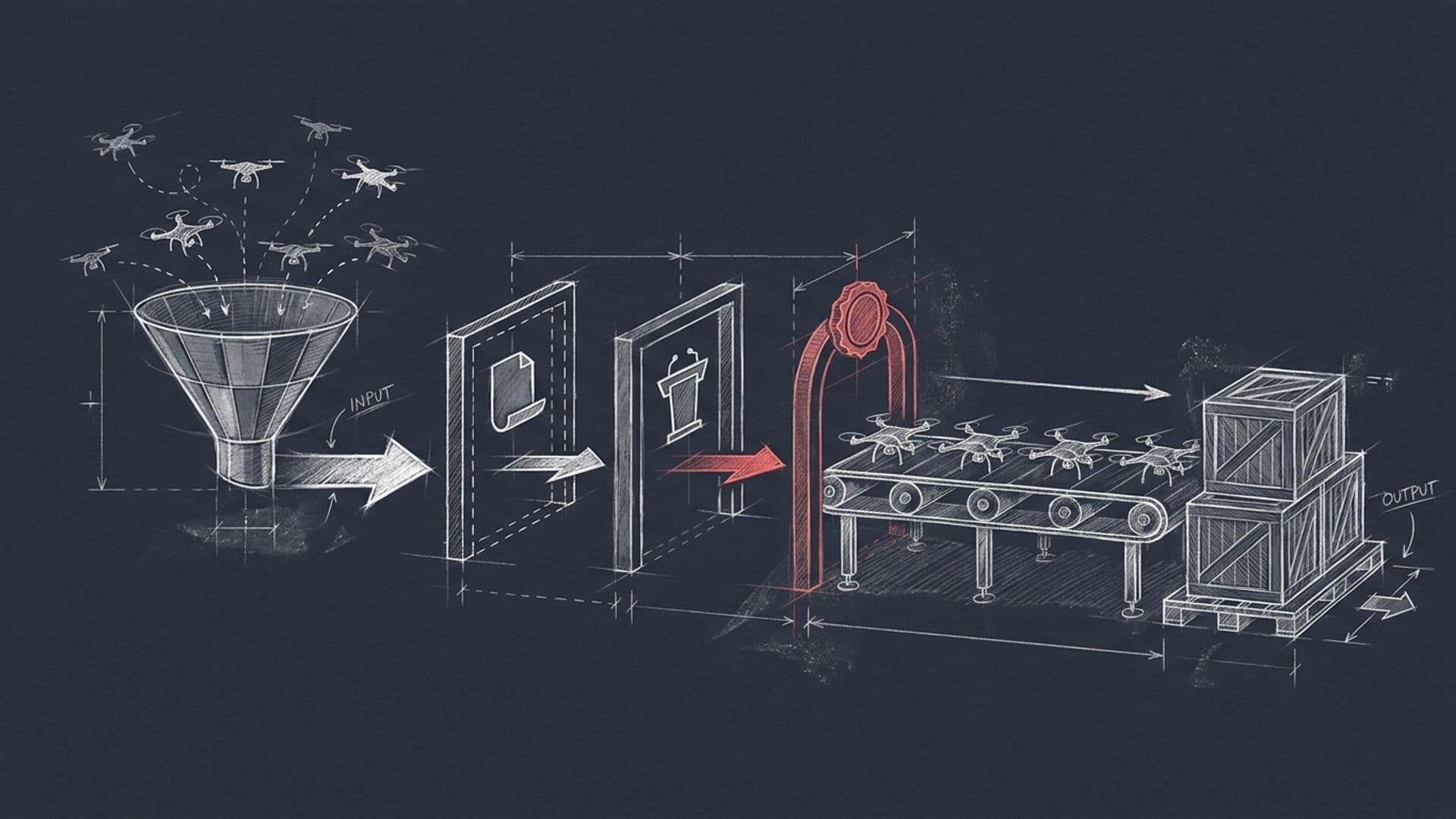
Drone companies win Defense Innovation Unit (DIU) work mainly through a Commercial Solutions Opening (CSO): you answer a posted area of interest with a short solution brief, pitch if invited, and negotiate a prototype Other Transaction agreement, which DIU says it often awards within 60–90 days. A prototype that succeeds can move to follow-on production without a new competition. In 2026 two adjacent tracks matter just as much to drone makers: the Blue UAS list, which DIU handed to the Defense Contract Management Agency (DCMA) on 3 December 2025, and the roughly $1 billion Drone Dominance Program, which DIU is shepherding through competitive "Gauntlet" fly-offs.
This explainer is published by Dronehub, a US-owned drone-infrastructure company that follows these pathways. It is built from diu.mil and other official sources, with trade press for the latest results. Nothing here describes or implies a DIU award or contract for Dronehub.
DIU in 2026 at a glance
Item | Fact | Source |
|---|---|---|
What it is | The Pentagon unit that brings commercial technology to the military fast; made a Department of War Field Activity in January 2026 | |
Director | Owen West, former Assistant Secretary for Special Operations and Low-Intensity Conflict | DIU, 14 Jan 2026 |
Main route in | Commercial Solutions Opening leading to a prototype Other Transaction agreement | |
Stated speed | "Often awarding within 60-90 days" | |
Track record | 450 prototype awards in FY2016–FY2023; 51% of completed prototypes transitioned to production, as reported by DIU | |
Drone work in 2026 | Shepherding Drone Dominance; partner to DCMA on Blue UAS |
The CSO, step by step
Step | What happens | What DIU says |
|---|---|---|
1. Area of interest | DIU posts a problem on its open solicitations page | It solicits "commercial solutions that address current needs of our DoW partners" |
2. Solution brief | You describe your solution | No more than 5 pages in 12-point font or 15 slides, strongly recommended |
3. Response | DIU decides whether to hear more | Within 30 days if interested |
4. Pitch | You present; DIU scores seven criteria | Relevance to the area of interest, technical merit, company viability, uniqueness, rough-order-of-magnitude price, schedule, data rights |
5. Proposal | Full proposal and negotiation | "The beginning of negotiating all the terms and conditions of a proposed prototype contract" |
6. Award | Prototype Other Transaction agreement | "Often awarding within 60-90 days" |
7. Follow-on | Production without a new competition | Allowed under 10 U.S.C. 4022 once the prototype is successfully completed |
DIU's solution-brief guidance is blunt about what wins at step 2: show technology you have in production now, show real deployments, and prove market viability with revenue or fundraising figures. Prior government experience is explicitly not required. Reworking existing sales material is fine; a concept without a product is not.
The legal plumbing, briefly
A March 2026 Holland & Knight guide sets out three kinds of CSO: the competitive procedure for prototype agreements under 10 U.S.C. 4022; the DFARS 212.70 route for ordinary contracts under the CSO authority in 10 U.S.C. 3458; and a hybrid of the two. Three details matter to a drone company:
- Production can now come straight from a CSO. The FY2026 NDAA revised §3458 so the government can award a production Other Transaction agreement directly, and removed the requirement that CSO solutions be "innovative".
- Cost share. A prototype agreement carries a one-third cost share unless a nontraditional defense contractor participates to a significant extent, all significant participants are small businesses, or the agency grants an exception.
- Follow-on goes to "the participants". Under §4022(f) the sole-source follow-on may be awarded to the participants in the prototype, if it was competed and successfully completed — so plan the team before the award, not after.
Blue UAS: DIU built it, DCMA runs it
DIU launched the Blue UAS list in 2020. On 3 December 2025 — ahead of the 1 January 2026 deadline set in the Defense Secretary's July 2025 "Unleashing U.S. Military Drone Dominance" memo — it transferred the list to DCMA. Management moved to DCMA's new Unmanned Systems–Experimental Command (US-X) in Palmdale, California, and DCMA now publishes the Cleared List on its Blue List site. DIU remains a partner that shapes standards and updates checklists. DIU had processed 81 companies onto the list, which held more than 39 certified systems and 165 components as of 19 November 2025.
One route onto the list now runs through third parties. As DCMA described it in July 2026, a vendor submits a checklist packet to the Blue List portal, contracts a Recognized Assessor to evaluate the system or components for NDAA compliance, and can be added on the strength of the assessor's report.
Blue status now carries weight outside the Pentagon too. Executive Order 14307 of June 2025 told the DoD to expand the list, as far as practicable, to every drone and critical component compliant with NDAA Section 848, update it monthly and let listed platforms operate on military installations without an exception to policy. And since January 2026 the FCC has exempted Blue-listed drones and components, now until 1 January 2028, from its Covered List, which otherwise blocks new equipment authorisations for foreign-produced drones. Listing is item-specific, so list the drone, the dock and the components you want buyers to find.
Drone Dominance: the $1 billion small-drone buy
The Hegseth memo set the goal of "small UAS domain dominance" by the end of 2027. In December 2025 the War Department asked industry, through a request for information, whether it could build some 300,000 drones quickly and cheaply. The plan it described:
Element | Plan as announced in December 2025 |
|---|---|
Money | $1 billion from the 2025 budget reconciliation law, over two years |
Structure | Four phases, called "Gauntlets" |
Gauntlet I | February–July 2026: 12 vendors, 30,000 drones at $5,000 each, $150 million |
Later Gauntlets | 12 vendors narrowing to five; 30,000 drones rising to 150,000; unit price falling to $2,300 |
Total | About 340,000 small drones for combat units |
What has happened since, per DefenseScoop:
- Gauntlet I. The Pentagon named 25 vendors in February 2026, including several Ukraine-based companies. After trials at Fort Benning, London-based Skycutter finished first with 99.3 points, about 12 ahead of Neros, and the department planned about $150 million in delivery orders for 30,000 one-way attack drones.
- Gauntlet 2. At Fort Carson, Colorado, operators flew 1,858 sorties across 23 platforms from 19 companies. Perennial Autonomy led the deep-strike leaderboard and Neros the close-quarters leaderboard. The department plans to buy about 60,000 drones from that pool.
- Next. A Gauntlet 2.5 for "bomber" drones was due to start in October 2026, Gauntlet 3 about six months after Gauntlet 2, and a final Gauntlet 4 six months after that. The stated goal is more than 200,000 drones by 2027.
The Gauntlets also show how fast the hardware is improving. In Gauntlet I only 24% of drones reached 10 km; in Gauntlet 2 all 11 platforms evaluated at long distance reached 15 km, according to DIU's own post quoted by DefenseScoop. Scores blend operator evaluations with mission results: Skycutter, for example, placed third on the military operator evaluation but first in long-distance strike.
The Gauntlets reward what a production contract needs: performance in operators' hands and the ability to deliver at falling unit prices. Skycutter was ranked highly for its "strong" production capabilities, and officials said the Gauntlet 2 drones were "cheaper, more capable, and sourced from a supply chain more closely tied to the American industrial base". Hundreds of companies have applied, according to the Pentagon's chief technology officer; firms that were not in Gauntlet I can still compete in later rounds, and results are published on the programme's leaderboard.
Key dates for drone companies, 2025–2026
Date | Event |
|---|---|
6 Jun 2025 | Executive Order 14307 orders Blue UAS expansion and a preference for US-made drones |
10 Jul 2025 | "Unleashing U.S. Military Drone Dominance" memo sets the end-2027 goal |
Early Dec 2025 | Request for information sets out the Drone Dominance plan |
3 Dec 2025 | Blue UAS list moves from DIU to DCMA |
14 Jan 2026 | Owen West named DIU director; DIU becomes a Field Activity |
3 Feb 2026 | 25 vendors named for Gauntlet I |
Mar 2026 | Gauntlet I results; about $150 million in delivery orders planned |
Jul 2026 | DCMA describes its faster, assessor-based Blue List process |
18 Sep 2026 | Gauntlet 2 results; about 60,000 drones to be bought |
Oct 2026 | Gauntlet 2.5 for "bomber" drones due to start |
Replicator and DAWG: the other half of the drone push
Replicator, launched under former Deputy Secretary of Defense Kathleen Hicks to field thousands of low-cost, attritable drones within two years, lives on. In December 2025 Admiral Samuel Paparo said the deputy secretary of defense had placed it in "an autonomous warfighting group", which Breaking Defense identifies as the Defense Autonomous Warfare Group (DAWG). Pentagon chief technology officer Emil Michael drew the line: Drone Dominance is "for smaller drones"; DAWG works on "larger drones, one-way attack drones". DAWG received $225.9 million in fiscal 2026, and the Pentagon asked for $54.6 billion for fiscal 2027, mostly from a future reconciliation bill. Do not confuse the two budgets: they fund different drones, run by different owners.
Non-US and foreign-owned drone companies
DIU's own answer is open: "Any individual or commercial entity is eligible to respond to a DIU solicitation," and it works "with companies both in the U.S. and internationally, across allied countries." The limits are practical rather than blanket:
- Classified work. DIU's CLASS ACT solicitation for maritime counter-drone work, open until 13 October 2026, requires every key manager to hold US citizenship.
- Clearances. An Army counter-drone CSO from February 2026 lets foreign-owned businesses bid alone or with US partners, but warns that an award may depend on obtaining the necessary clearances, according to Holland & Knight.
- Controlled information. Handling controlled unclassified information requires CMMC Level 2, which typically takes six to 12 months and can take more than 18.
- Supply chain. NDAA Section 848 still governs what the DoD can buy and fly; our Section 848 buyer's guide covers the component rules.
Allied firms do win: a London company topped the first Gauntlet, and Ukraine-based companies were among its vendors. SBIR/STTR awards, by contrast, go only to US small businesses, which is why non-US founders set up a US entity — the route we describe in SBIR/STTR for non-US drone companies.
A preparation checklist for drone makers
- Map your bill of materials to Section 848's categories: flight controllers, radios, data links, cameras, gimbals, ground control software, and where data is stored.
- Decide which items go to a Recognized Assessor for the Blue UAS list — drone, dock, components.
- Watch the open solicitations and write every brief to DIU's five-page, 15-slide guidance, covering all seven criteria, including a rough price.
- Plan teaming and cost share before the prototype award, because the follow-on goes to the participants.
- Start CMMC Level 2 early if the work will touch controlled information.
- Prove production and unit cost. Drone Dominance weighs production capability against falling price targets, and a follow-on production contract will test both.
Where Dronehub fits
Dronehub Inc. is US-owned, and our compliance page states it is eligible to compete as a small-business prime for SBIR/STTR and adjacent programmes such as DIU CSOs. Eligibility is not an award; how we work with US programme offices is set out on our US defense page. For the Air Force side of the same pipeline, see AFWERX Open Topics; for the allied route, NATO DIANA.
FAQ
- How do drone startups get contracts with the Defense Innovation Unit?
- Mostly through a Commercial Solutions Opening. DIU posts an area of interest; you send a short solution brief, ideally no more than five pages or 15 slides; DIU replies within 30 days if it wants a pitch; a successful pitch leads to a full proposal and a negotiated prototype Other Transaction agreement, which DIU says it often awards within 60 to 90 days. If the prototype succeeds, a follow-on production contract can be awarded without a new competition. Prior government experience is not required.
- What is a DIU Commercial Solutions Opening (CSO)?
- A CSO is a competitive solicitation for commercial technology that is faster and lighter than a traditional Federal Acquisition Regulation contract. DIU uses it mainly to award prototype Other Transaction agreements under 10 U.S.C. 4022. The CSO authority itself sits in 10 U.S.C. 3458, which the FY2026 NDAA revised so that a production agreement can be awarded directly from a CSO and CSOs are no longer limited to 'innovative' solutions, according to a March 2026 Holland & Knight analysis.
- Can a foreign or non-US drone company work with DIU?
- Often, yes. DIU says any individual or commercial entity is eligible to respond to its solicitations and that it works with companies across allied countries. There are limits: some classified solicitations require every key manager to be a US citizen, foreign-owned firms may need clearances before an agreement is signed, and handling controlled unclassified information requires CMMC Level 2. Allied firms do compete: London-based Skycutter topped the first Drone Dominance Gauntlet.
- Does DIU still run the Blue UAS list?
- No. DIU created the Blue UAS list in 2020 and transferred it to the Defense Contract Management Agency on 3 December 2025. DCMA's Unmanned Systems–Experimental Command in Palmdale, California now manages it and publishes it at bluelist.appsplatformportals.us, and DIU stays on as a partner on standards and checklists. One route onto the list: submit a checklist packet through the Blue List portal and hire a third-party Recognized Assessor to evaluate NDAA compliance.
- What is the Drone Dominance Program?
- It is the Pentagon's roughly $1 billion effort, funded by the 2025 reconciliation law, to buy large numbers of low-cost small drones, mainly one-way attack drones, through four competitive 'Gauntlet' phases over two years. DIU is shepherding it. Gauntlet I at Fort Benning led to about $150 million in delivery orders for 30,000 drones; Gauntlet 2 at Fort Carson evaluated 23 platforms from 19 companies, and the department aims to acquire more than 200,000 drones by 2027.
- What happened to the Replicator drone initiative?
- Replicator was not cancelled. Admiral Samuel Paparo said in December 2025 that the deputy secretary of defense had folded it into an autonomous warfighting group, which Breaking Defense identifies as the Defense Autonomous Warfare Group (DAWG). The Pentagon's chief technology officer described a split: Drone Dominance buys smaller drones, while DAWG works on larger and one-way attack drones. DAWG received $225.9 million in fiscal 2026, and the Pentagon asked for $54.6 billion for it in fiscal 2027.