Key facts
NDAA Section 848 (FY2020), as amended by Section 817 (FY2023), bars the Secretary of Defense from operating or buying drones made in China, Russia, Iran or North Korea, or drones that use flight controllers, radios, data transmission devices, cameras or gimbals made there, a ground control system or operating software developed there, or network connectivity or data storage administered from there.
Source · U.S. Code, 10 U.S.C. 4871 note (Pub. L. 116-92 §848, as amended by Pub. L. 117-263 §817) uscode.house.gov ↗
Since 1 October 2024 the Department of Defense may not enter into, extend or renew a contract with a company that operates equipment from a covered drone company, with DJI named in the statute, in the performance of a DoD contract.
Source · U.S. Code, 10 U.S.C. 4871 note, subsection (b) uscode.house.gov ↗
Under the American Security Drone Act, from 22 December 2025 federal executive agencies may not buy services that operate drones from listed covered foreign entities or use federal funds to procure or operate them; the authorities expire on 22 December 2028.
Source · Federal Acquisition Regulation, subpart 40.2 acquisition.gov ↗
3 more key facts
The Defense Innovation Unit transferred the Blue UAS Cleared List to the Defense Contract Management Agency on 3 December 2025; as of 19 November 2025 the list held more than 39 certified systems and 165 components, and DIU had processed 81 companies onto it.
Source · Defense Innovation Unit, 'DIU's Blue UAS List To Transition to DCMA', 3 December 2025 diu.mil ↗
On 22 December 2025 the FCC added drones and drone critical components produced in any foreign country to its Covered List, which blocks new FCC equipment authorisations; the FCC states that drone docks fall within that definition.
Source · FCC, Covered List FAQs: UAS and UAS Critical Components fcc.gov ↗
The FCC Covered List exempts drones and components on DCMA's Blue UAS Cleared List and Buy American 'domestic end products' until 1 January 2028, plus devices granted a Conditional Approval by the Department of War or the Department of Homeland Security.
Source · FCC, Covered List (UAS entry updated 21 July 2026) fcc.gov ↗
In this piece
NDAA §848, as amended by §817, is a law: it stops the US Department of Defense from buying or operating drones — and drones with key parts, software or data services — from China, Russia, Iran or North Korea. The Blue UAS Cleared List is not a law but a catalogue of drones and components already vetted against that standard, run by the Defense Contract Management Agency (DCMA) since 3 December 2025. The FCC Covered List is a telecoms rule: since 22 December 2025 it has blocked new FCC equipment authorisations for drones and drone critical components produced in any foreign country — docks included — unless an exemption applies.
The detail matters because vendor brochures blur the three, and one dock purchase can touch all of them. This explainer is published by Dronehub, which builds and licenses drone-in-a-box infrastructure; where we mention ourselves, we say so and stick to what dronehub.ai states. Every rule below links to the primary text.
The requirement matrix
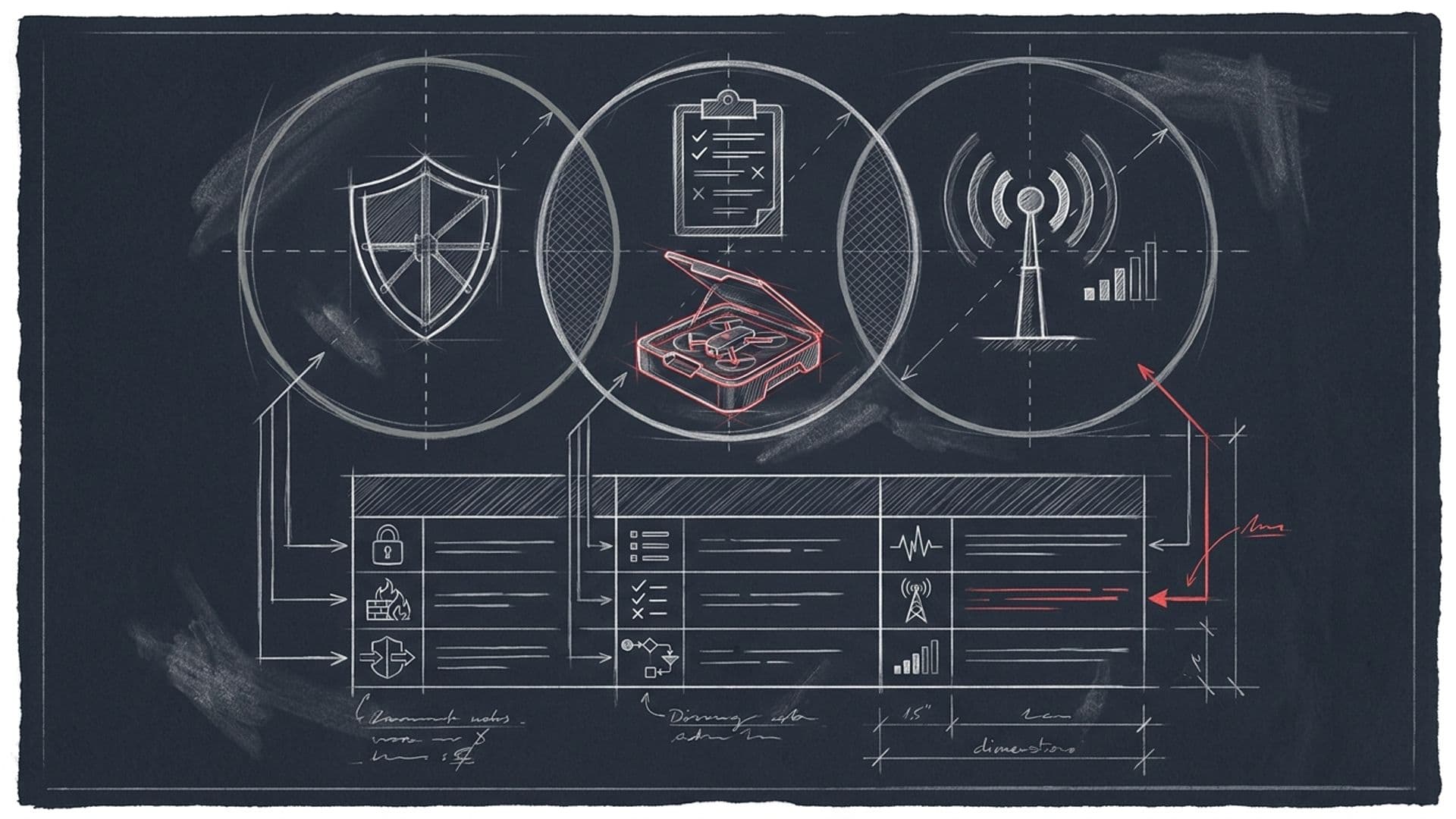
NDAA §848 / §817 | American Security Drone Act | Blue UAS Cleared List | FCC Covered List | |
|---|---|---|---|---|
What it is | A statute | A statute | A vetted list | A list of equipment barred from new FCC authorisations |
Legal basis | FY2020 NDAA §848, amended by FY2023 NDAA §817 (10 U.S.C. 4871 note) | FY2024 NDAA §§1821–1833; FAR subpart 40.2 | DoD programme since 2020; moved to DCMA under the July 2025 drone dominance memo | Secure Networks Act; FY2025 NDAA §1709; National Security Determination of 21 Dec 2025 |
Who runs it | Department of Defense | Every executive agency; covered-entity list kept by the Federal Acquisition Security Council | DCMA since 3 Dec 2025; DIU stays a partner | FCC, acting on national-security determinations |
Who it binds | DoD, and since 1 Oct 2024 DoD contractors that operate covered-company drones on DoD work | All federal executive agencies; federal funds from 22 Dec 2025 | Nobody directly; it is a fast path for DoD buyers and now an FCC exemption | Anyone who needs a new FCC equipment authorisation to import or sell a device in the US |
What it restricts | Drones made in, or by entities domiciled in, the four countries, or using their flight controllers, radios, data links, cameras, gimbals, ground control systems, operating software, connectivity or data storage | Buying, operating or federally funding drones made or assembled by listed covered foreign entities | Nothing; listing is evidence of compliance | New authorisations for foreign-produced drones and critical components, docks included |
Country test | China, Russia, Iran, North Korea | Named entities on a list | NDAA compliance plus security assessment | Place of production: any country outside the US |
Main exits | Counter-UAS testing, intelligence and electronic warfare; waiver certified to Congress | Agency exemptions, exceptions (wildfire, search and rescue), waivers; sunset 22 Dec 2028 | — | Blue-listed items and Buy American domestic end products (to 1 Jan 2028); Conditional Approvals |
What a buyer checks | Component-origin declaration | Covered-entity list in SAM.gov | Entry on DCMA's public Blue List | FCC ID and grant date |
NDAA §848 and §817: the statute behind "NDAA compliant"
Section 848 of the FY2020 National Defense Authorization Act, enacted on 20 December 2019, says the Secretary of Defense "may not operate or enter into or renew a contract for the procurement of" a covered unmanned aircraft system. Section 817 of the FY2023 NDAA, enacted on 23 December 2022, extended it from China to Russia, Iran and North Korea and added a contractor clause. Today the ban reaches a drone that:
- is manufactured in China, Russia, Iran or North Korea, or by an entity domiciled there;
- uses flight controllers, radios, data transmission devices, cameras or gimbals made there;
- uses a ground control system or operating software developed there; or
- uses network connectivity or data storage located in or administered by an entity domiciled there.
Two details matter for dock buyers. First, the statute defines a covered system as the drone "and any related services and equipment", so the ground segment and the cloud are in scope, not just the airframe. Second, the contractor clause: since 1 October 2024 the DoD may not sign, extend or renew a contract with a company that operates equipment from a "covered unmanned aircraft system company" in the performance of a DoD contract. DJI is named; so is any drone maker on Commerce's Consolidated Screening List or domiciled in, or under the unmitigated ownership, control or influence of, a covered country. The exits, listed in the matrix above, are narrow.
The statute creates no product certificate. "NDAA compliant" on a datasheet is the vendor's own declaration; §817 told the DoD to write a due-diligence policy for its own determinations. That gap is what the Blue UAS list fills. Our Section 848 buyer's guide walks through the component audit.
The American Security Drone Act: the same idea, government-wide
Section 848 covers only the DoD and its contractors. The American Security Drone Act of 2023 — sections 1821–1833 of the FY2024 NDAA, implemented in FAR subpart 40.2 — carries the idea to every federal executive agency. Agencies may not procure a drone "manufactured or assembled by a covered foreign entity", including the communication links and control components that fly it. The entities sit on a list kept by the Federal Acquisition Security Council and published in SAM.gov; the law says it will include companies on Commerce's Consolidated Screening List and companies domiciled in, or controlled by, China, as determined by DHS. Since 22 December 2025 agencies also may not buy services that operate such drones, and no federal funds "awarded through a contract, grant, or cooperative agreement" may be used to buy or operate them. Exemptions, exceptions and waivers are narrow, and the authorities expire on 22 December 2028 unless Congress renews them.
The federal-funds clause reaches beyond Washington: a grant-funded city or utility should check the list, not only the vendor's brochure.
Blue UAS: a list, not a law — and now DCMA's
The Defense Innovation Unit launched Blue UAS in 2020 as the Pentagon's catalogue of drones and components vetted for NDAA compliance and security. It has two parts: the Cleared List of complete systems and the Framework of compliant components and software. On 3 December 2025, ahead of a 1 January 2026 deadline in Defense Secretary Pete Hegseth's July 2025 drone-dominance memo, DIU handed the list to DCMA. Management moved to DCMA's new Unmanned Systems–Experimental Command (US-X) in Palmdale, California, and DCMA now publishes the Cleared List on its Blue List site. DIU stays on as a partner shaping standards and checklists. As of 19 November 2025 the list counted more than 39 certified systems and 165 components, and DIU had processed 81 companies onto it.
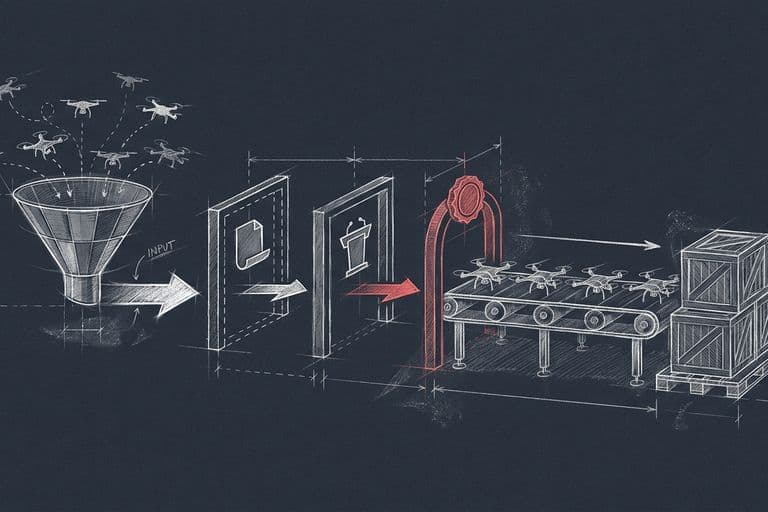
The route onto the list has changed too. Under DCMA's current policy, as the agency described it in July 2026, one way in is to submit a checklist packet to the Blue List portal and hire a Recognized Assessor, a third-party organisation, to evaluate the system or components for NDAA compliance; its report goes back through the portal.
Three things buyers get wrong:
- Blue UAS is not a legal requirement. It is the DoD's shortcut to trusted procurement; an unlisted drone can still be NDAA compliant.
- Listing is item-specific. A cleared drone does not make its dock cleared. Skydio announced on 23 July 2026 that its Dock for X10 had joined the Cleared List together with the X10 and R10; Ondas says its Optimus drone was granted Blue List status on 28 January 2026, and that release names the drone, not the dock.
- Blue status now has commercial weight. Since January 2026 it is one of the exemptions from the FCC Covered List.
The FCC Covered List: the rule that reaches the commercial market
The FCC keeps the Covered List under the Secure and Trusted Communications Networks Act. Equipment on it cannot receive an FCC equipment authorisation, and most electronic devices need one before they can be imported, marketed or sold in the US. On 21 December 2025 a White House-convened interagency body issued a National Security Determination; the next day the FCC added "UAS and UAS critical components produced in a foreign country", together with the DJI- and Autel-linked equipment listed in section 1709 of the FY2025 NDAA.
Four points decide what this means in practice, all from the FCC's own FAQ:
- Docks are in. Asked whether drone docks are included, the FCC answers "Yes". Critical components also include data links and radios, flight controllers, ground control stations, navigation systems, sensors and cameras, batteries and motors.
- Place of production decides. The FCC identifies covered drones and components by where they are produced, not by who makes them, and applicants for an authorisation must certify that a device was not produced abroad.
- It looks forward, for now. New models cannot be authorised. Models the FCC authorised before the listing can still be imported, sold and used, and owners can keep flying them. In July 2026 the FCC proposed going further: ending imports and sales, for buyers other than the federal government, of previously authorised foreign-produced "military-grade" equipment that is not exempt, a category that includes thermal and LiDAR drones, swarming drones and docking stations. The proposal had not been adopted by late September 2026, and drones already bought would stay usable.
- Federal-only equipment sits outside it. Drones made exclusively for federal use generally do not need FCC authorisation, so the FCC says the list does not affect sales to the Department of War, DHS or other federal agencies. Those buyers are governed by §848 and the Drone Act instead.
The exits: drones and components on DCMA's Blue UAS list, and "domestic end products" under the Buy American standard, are exempt until 1 January 2028 on the Covered List as updated on 21 July 2026. The January 2026 notice set 1 January 2027, and one answer on the FCC's FAQ page still shows that date, so check the list itself. The Department of War or DHS can also grant a Conditional Approval tied to an onshoring plan; since July 2026 these carry no end date. The first ones came on 17 March 2026, and the published list now names more than a dozen drone makers, among them SiFly Aviation, ScoutDI, Air6 System GmbH and Verity AG.
Key dates at a glance
Date | Event |
|---|---|
20 Dec 2019 | NDAA §848 enacted |
23 Dec 2022 | NDAA §817 extends §848 to Russia, Iran and North Korea and adds a contractor clause |
22 Dec 2023 | American Security Drone Act enacted |
1 Oct 2024 | §817 contractor clause takes effect |
6 Jun 2025 | Executive Order 14307 prioritises US-made, §848-compliant drones and tells the DoD to expand Blue UAS |
3 Dec 2025 | Blue UAS list moves from DIU to DCMA |
22 Dec 2025 | FCC lists foreign-produced drones and components; Drone Act operation and federal-funds bans start |
7 Jan 2026 | FCC exempts Blue-listed and Buy American items |
17 Mar 2026 | First Conditional Approvals |
21 Jul 2026 | FCC extends Blue UAS and Buy American exemptions to 1 Jan 2028; proposes limits on some already-authorised drones |
1 Jan 2028 | Blue UAS and Buy American exemptions end unless extended |
22 Dec 2028 | Drone Act authorities expire unless renewed |
What this means for buying a dock in 2026
- Start with who is paying. DoD money brings §848 and §817 in full. Other federal money brings the Drone Act, including grant funds since 22 December 2025. A commercial buyer in the US is mainly affected through the FCC Covered List, which governs what can be newly sold, not what you already own.
- Audit the whole system, not the airframe. Ask for a component-origin declaration mapped to §817's categories for the drone, the dock's radios and controller, the ground-control software, and the cloud that stores your imagery.
- Look up the exact item on DCMA's public Blue List. Drone, dock and components are listed separately.
- Ask for the FCC ID and grant date of every radio device — dock and drone. An authorisation granted before 22 December 2025 keeps that model on sale for now; a new foreign-produced model needs Blue status, Buy American content or a Conditional Approval. Ask how supply and support would continue if the FCC's July 2026 proposal is adopted.
- Write compliance into the contract: a representation that no component falls under §848, notice if the supply chain changes, and a right to audit.
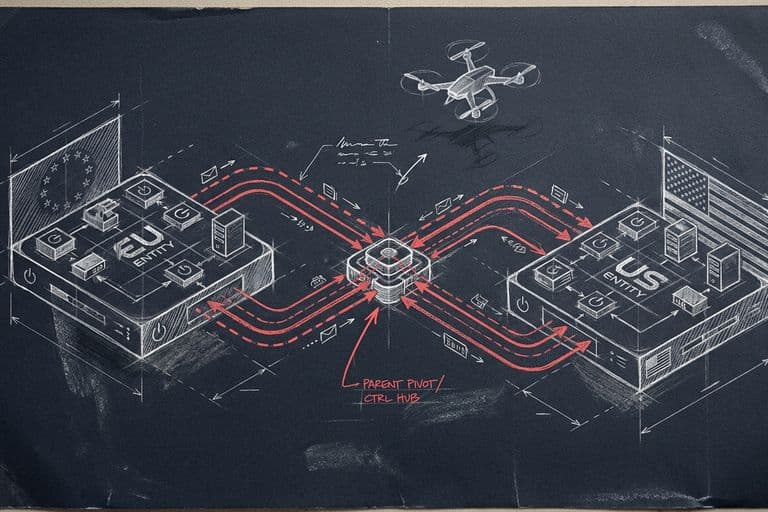
- In the EU, none of these rules bind you, though supply-chain questions still apply; our European drone supply chain map covers the EU side.
Where Dronehub stands
We build and license a drone-in-a-box with a two-minute robotic battery swap, and we publish our compliance position on the compliance page. In our own words there: compliance with the NDAA covered-UAS and covered-entity provisions is engineered upstream in the supply chain — designed in from the bill of materials, not patched after an award — and no components are sourced from China, Russia, Iran or any sanctioned state. Blue UAS appears on that page under "positioned for, not yet claimed": eligibility is in scope by design and subject to the programme's own review, and we do not present it as a completed authorisation. Programme offices and integrators can request the credentials package.
FAQ
- What is the difference between NDAA compliant and Blue UAS?
- NDAA compliant describes a drone that meets Section 848 of the FY2020 NDAA as amended by Section 817: no airframe, flight controller, radio, data link, camera, gimbal, ground control software or data service from China, Russia, Iran or North Korea. It is usually the vendor's own declaration, because the law creates no certificate. Blue UAS means the specific drone or component has been assessed and placed on the Pentagon's Blue UAS Cleared List or Framework, now run by the Defense Contract Management Agency. Every Blue UAS item is meant to be NDAA compliant; many NDAA-compliant products are not on the list.
- Who runs the Blue UAS list now?
- The Defense Contract Management Agency. The Defense Innovation Unit created the list in 2020 and handed it to DCMA on 3 December 2025, following the July 2025 memo 'Unleashing U.S. Military Drone Dominance'. Management sits with DCMA's Unmanned Systems–Experimental Command (US-X) in Palmdale, California, and DCMA publishes the list at bluelist.appsplatformportals.us. DIU remains a partner on standards and checklists. One route onto the list is a checklist packet through the Blue List portal plus an evaluation by a third-party Recognized Assessor.
- Are drone docks covered by the FCC Covered List?
- Yes. The FCC's FAQ on drones states that docks are included within the definition of UAS and UAS critical components. Since 22 December 2025, a dock produced in any foreign country cannot receive a new FCC equipment authorisation unless it is on DCMA's Blue UAS Cleared List, qualifies as a Buy American domestic end product, or holds a Conditional Approval from the Department of War or DHS. Docks the FCC authorised before the listing can still be imported, sold and used, although a July 2026 FCC proposal to restrict further imports and sales of some previously authorised equipment was still pending in late September 2026. Ask any vendor for the dock's FCC ID and grant date, or the exemption it relies on.
- Can I still buy and use a DJI Dock in the United States in 2026?
- It depends who you are. For a commercial buyer, the FCC Covered List blocks only new authorisations: DJI models the FCC authorised before 22 December 2025 can still be imported, sold and used, and owners can keep flying them. A July 2026 FCC proposal would end further imports and sales of DJI docks and thermal drones to buyers other than the federal government; it had not been adopted by late September 2026. The Department of Defense cannot buy or operate them under Section 848, and since 1 October 2024 DoD contractors may not operate DJI equipment in the performance of a DoD contract. Other federal agencies and federally funded buyers must check the American Security Drone Act covered-entity list in SAM.gov.
- Does NDAA Section 848 apply to state and local agencies or private companies?
- Not directly. Section 848 binds the Department of Defense and, through Section 817, companies performing DoD contracts. The American Security Drone Act extends restrictions to all federal executive agencies and, from 22 December 2025, to the use of federal funds to procure or operate drones from listed covered foreign entities, which reaches grant-funded buyers. Private companies are mainly affected through the FCC Covered List, which controls which new drone and dock models can be sold in the US.
- Do these US drone rules apply to European buyers?
- No. Section 848, the American Security Drone Act, Blue UAS and the FCC Covered List are US rules; a European operator buying a dock for use in Europe is governed by EU and national rules instead. They matter to a European company in two cases: when it sells drones or docks into the US, where every radio device needs a valid FCC authorisation or an exemption, and when it serves US government customers, whose procurement rules it inherits.