Key facts
Dronehub became an official IBM Solution Partner in 2021 — the only drone-in-a-box company in Europe with the designation at the time.
Source · IBM Partner Programme registration, 2021
The IBM partnership focused on scalable AI server infrastructure and intelligent monitoring workflows for real-time drone-imagery analysis — the engineering foundations that became the Sentinel platform.
Source · Dronehub × IBM joint partnership announcement, 2021
Sentinel — Dronehub's in-house AI anomaly-detection stack — now runs at national scale on Germany's 33,000-km Deutsche Bahn rail network, with per-fastener defect detection above 95% accuracy.
Source · Deutsche Bahn deployment metrics
1 more key fact
The IBM partnership predates the Deutsche Bahn AI rail-inspection deployment, the European Defence Agency CBRN programme, and the Forbes 30 Under 30 recognition — establishing AI as a core capability before the commercial validations arrived.
Source · Dronehub R&D portfolio timeline
In this piece
In 2021, Dronehub became the only drone-in-a-box company in Europe with official IBM Solution Partner status. The IBM partnership wasn't a sales channel — it was the engineering blueprint for what became the Sentinel AI stack that now runs Deutsche Bahn's national-scale rail inspection at 95%+ per-fastener accuracy.
This post unpacks what the IBM partnership actually was, how it shaped the Sentinel architecture decisions, and why owning the AI stack end-to-end (rather than licensing third-party models) matters for the industrial buyers, federal innovation programmes, and licensing partners who deploy autonomous infrastructure today.
What the IBM partnership actually was
When Dronehub joined the IBM Partner Programme in 2021, the headline was simple: a Polish drone-in-a-box company became IBM's only European drone partner. The substantive content underneath the headline was the architectural collaboration on how to scale AI for industrial drone operations.
At the time, the drone industry was running into a clear ceiling. Cargo drones, inspection drones, and surveillance drones could all collect imagery faster than any analyst team could process it. The bottleneck wasn't the flying — it was the analysis. A 100-kilometre rail-corridor inspection generates thousands of frames; a refinery perimeter sweep generates more. Without scalable AI inference that produces operator-readable anomaly reports in minutes (not days), the drone deployment doesn't pay back fast enough to justify the capital.
IBM's contribution was the scalable AI infrastructure pattern. Specifically: how to architect inference at the scale industrial inspection actually requires, with real-time analysis instead of batch processing. The partnership shaped four architectural decisions that became the Sentinel platform:
- Edge + cloud compute split. First-pass classification on the drone itself (using Nvidia Jetson hardware on board), with only frames that warrant human review sent to the cloud. The bandwidth between drone and cloud becomes a controlled resource, not a bottleneck.
- Operator-readable outputs. The dispatcher sees anomalies — annotated frames with location pins, severity classification, recommended action — not raw video. Analyst workload drops by orders of magnitude versus CCTV-style monitoring.
- Audit-grade telemetry. Every flight, every detection, every reviewer decision logged. The receiving operator gets an evidence trail that holds up to regulatory or court-grade scrutiny.
- Real-time at scale. Sub-15-minute end-to-end latency from drone landing to operator report. That latency is what unlocks operational use cases — calendar-based inspection becomes condition-based inspection becomes alert-driven response.
The IP for the models, the training pipeline, the anomaly taxonomy, and the operator UI stayed inside Dronehub. The partnership shaped how the engineering was built; ownership stayed where commercial leverage required it.
What Sentinel is now
Sentinel is the operational implementation of those architectural decisions. It is the AI side of the Dronehub drone-in-a-box platform — the in-house anomaly-detection stack that runs against deployed customer environments.
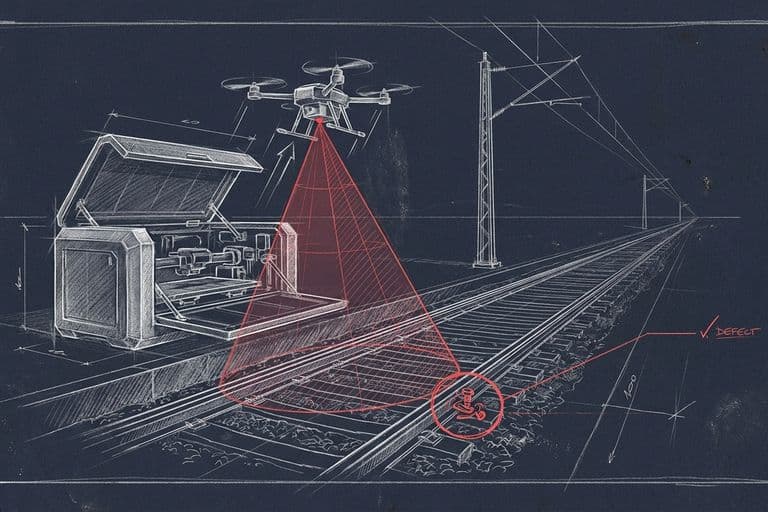
The flagship validation is Deutsche Bahn — Germany's 33,000-kilometre national rail network. Sentinel, paired with the drone-in-a-box hardware platform and Eagle One inspection drones, delivers:
- 95%+ per-fastener defect detection accuracy on bolts, screws, spring clips, and joints across the rail corridor
- Sub-15-minute report latency from drone landing to dispatcher operator UI
- 24/7/365 availability by design — robotic 2-minute battery swap inside the dock, edge-classified frame streaming, no analyst in the immediate loop
- EU + US data sovereignty — imagery, detections, and audit logs stay inside EU and US infrastructure
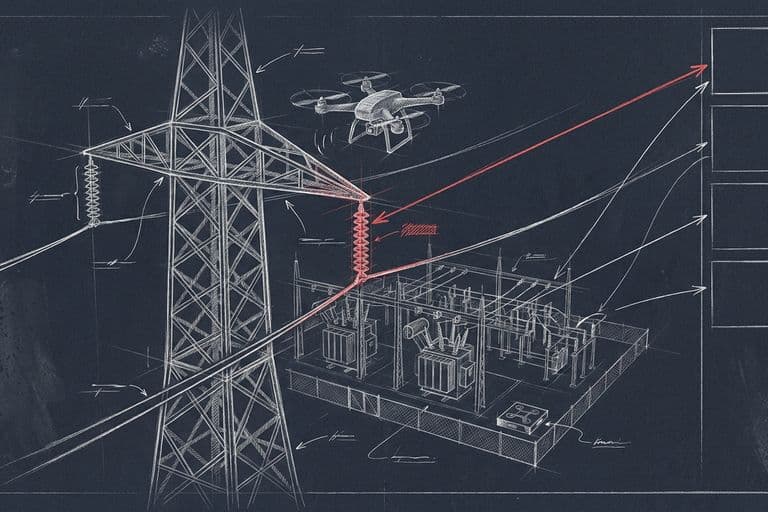
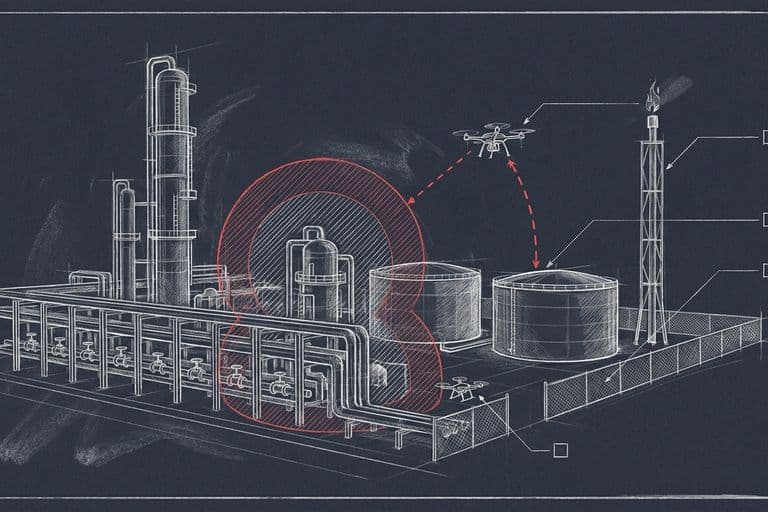
The same Sentinel architecture is portable across asset classes. Per-asset anomaly detection that works on rail fasteners works on transmission-line insulators, refinery flare-stack hotspots, pipeline-corridor leakage signatures, water-treatment infrastructure, dam joints, port-perimeter intrusion events. The taxonomy of anomalies changes per asset class; the architecture doesn't.
Why in-house AI matters for licensing
The case for owning the AI rather than licensing third-party models becomes important when a deployment matures from pilot to commercial scale, and especially when the buyer wants to license the stack rather than buy a managed service.
- Licensable IP. Dronehub can license the Sentinel platform — models, training infrastructure, inference architecture, operator UI — to an industrial prime, a defense integrator, or a national-rail operator who wants to deploy the inspection capability under their own brand and contracts. That kind of licensing is impossible if the AI is rented from a third party.
- Models improve against operator data. When the AI is in-house, Dronehub can train models against the licensing operator's specific asset class — rail joints in their network, transformer types in their grid, pipeline weld patterns in their corridor. The improvement accrues to the operator. With a third-party model, the improvement accrues to the third party.
- Sovereign data path. When the AI inference runs on Dronehub-controlled infrastructure (or under a licensing partner's roof), the operator's imagery and detections never leave EU + US jurisdictions. For regulated medical, defense-grade, or critical-infrastructure workloads — and increasingly, just for operators that want to retain commercial leverage over their own data — this is non-negotiable.
What this means for procurement
For industrial operators evaluating autonomous inspection — Sentinel has been validated at the most demanding deployment scale available (Deutsche Bahn) and is licensable for in-house deployment at the operator's facility.
For US federal innovation programmes — NASA SBIR/STTR, AFWERX, DIU on AI-driven infrastructure monitoring — Dronehub Inc. is a Delaware C-Corp and SBIR/STTR-eligible, with EB1A-resident founder, NATO-allied supply chain, and NDAA Section 848-compatible hardware. The Sentinel + drone-in-a-box stack transitions directly into US federal procurement.
For EU primes — the European Defence Fund (EDF), Horizon Europe Cluster 4 (Digital, Industry, Space), and NATO DIANA all have call topics that map directly onto the Sentinel capability set. The IBM-partnership and Deutsche Bahn-deployment credentials anchor the technical-merit case.
The full Deutsche Bahn case study is on the project page. For licensing the Sentinel stack or co-developing a variant, open the contact form.
FAQ
- What is Sentinel?
- Sentinel is Dronehub's in-house AI anomaly-detection platform — models, training pipeline, inference infrastructure, and operator UI all built and owned by the Dronehub team rather than licensed from a third party. It runs the AI side of the Deutsche Bahn rail inspection deployment (per-fastener defect detection above 95% accuracy, sub-15-minute reports) and is the AI layer that ships with the drone-in-a-box platform across other vertical deployments.
- What role did IBM play in building Sentinel?
- IBM's contribution was the scalable AI infrastructure pattern — how to run inference at the scale industrial inspection actually requires, with real-time analysis instead of batch processing. The partnership shaped the architectural decisions behind Sentinel: edge + cloud compute split, on-board first-pass classification on the drone's Nvidia hardware, only flagged frames sent to cloud review, audit-grade telemetry preservation. The IP and the models stayed Dronehub-owned; the partnership gave us the IBM-grade infrastructure thinking.
- Why does it matter that the AI is in-house rather than licensed?
- Three reasons. First, the IP is licensable to operators who want to deploy the inspection capability under their own brand — you can't license what you don't own. Second, the models improve against the operator's data over time; with a vendor-owned model that improvement accrues to the vendor, not the operator. Third, the data path stays sovereign — when the AI is in-house, the operator's imagery and detections never leave EU + US infrastructure, which is non-negotiable for regulated, defense-grade, and critical-infrastructure workloads.
- Where does the Sentinel stack deploy today?
- Deutsche Bahn (national-scale rail inspection in Germany — the flagship validation), with the same architecture applicable to energy grid and transmission corridors, oil-and-gas pipeline inspection, port and airport perimeter, dam and water utilities, telco tower inspection, and any critical-infrastructure deployment where the inspection-cost / missed-defect-cost ratio justifies autonomy.
- Is the Sentinel stack available outside the EU?
- Yes. The stack is licensable to US primes, industrial operators, and EU defense industrial partners. Dronehub Inc. is a Delaware C-Corp and SBIR/STTR-eligible US small business — federal-innovation pathways (NASA SBIR, AFWERX, DIU) are open. NATO-allied supply chain. EU + US data sovereignty by design.