Key facts
Dronehub has secured seven funded R&D programmes with the European Space Agency, the European Defence Agency, the European Commission Horizon programme, and the Polish National Centre for Research and Development (NCBR) — the portfolio is engineered around R&D depth, not fleet operations.
Source · Dronehub, US defense R&D partnership — https://dronehub.ai/rd-partnership/us-defense; Dronehub, Compliance & Credentials dronehub.ai ↗
Since 22 December 2025 the FCC has refused new equipment authorisations to drones and drone critical components produced outside the US, and it states that drone docks are included; items on DCMA's Blue UAS Cleared List and Buy American domestic end products are exempt until 1 January 2028.
Source · FCC, Covered List FAQs: UAS and UAS Critical Components — https://www.fcc.gov/covered-list-faqs-uas-and-uas-critical-components; FCC, Covered List (UAS entry updated 21 July 2026) fcc.gov ↗
EU product law defines the manufacturer as whoever manufactures a product, or has it designed or manufactured, and markets it under their own name or trademark. The Radio Equipment Directive, which covers a dock's radios, treats an importer or distributor that places equipment on the market under its own name or trade mark as the manufacturer, and the EU drone regulation 2019/945 applies the same rule to drones sold for the open category.
Source · EUR-Lex, Directive 2014/53/EU, Articles 2(1)(12) and 14 — https://eur-lex.europa.eu/legal-content/EN/TXT/?uri=CELEX:32014L0053; Commission Delegated Regulation (EU) 2019/945, Articles 3(13) and 10 eur-lex.europa.eu ↗
5 more key facts
Under FCC rules the party to whom a grant of certification is issued is responsible for the equipment's compliance, and a change of model number or trade name alone does not require a new authorisation.
Source · eCFR, 47 CFR 2.909 — https://www.ecfr.gov/current/title-47/section-2.909; 47 CFR 2.933 ecfr.gov ↗
Shenzhen-based dock maker HEISHA states that it provides ODM and OEM drone charging and battery-swapping solutions and that its docks can be customised to fit a buyer's brand.
Source · HEISHA, Custom abilities — https://heishatech.com/for-developers/custom-abilities/; HEISHA, Customized drone dock — https://heishatech.com/customized-drone-dock/; HEISHA, Contact heishatech.com ↗
Aeronext says its patent network built around 4D GRAVITY also covers peripheral technologies such as drone ports, and its NEXT DELIVERY unit licenses to third parties some of the know-how, tools and operations of its SkyHub logistics network.
Source · Aeronext, License — https://aeronext.com/business/license/; Aeronext, SkyHub Provider License aeronext.com ↗
A Dronehub licence includes mechanical CAD, electronic schematics, PCB layouts, firmware sources, bills of materials and manufacturing process documentation, inspectable reference systems and integration support; Dronehub quotes 8–12 weeks from first conversation to signed agreement.
Source · Dronehub, License our IP dronehub.ai ↗
The Polish Jasionka factory ($7.5M production line, fully operational since 2025) builds for licensees, R&D partners, and manufacturing customers — not for Dronehub-operated fleets.
Source · Dronehub, European Drone Manufacturing dronehub.ai ↗
In this piece
Yes — you can license drone-in-a-box technology and manufacture the docks yourself instead of buying them. There are three ways to put a fleet of drone docks into service: buy finished docks from a vendor, white-label a dock that its maker builds under your brand, or license the design — CAD, electronics, firmware, bill of materials — and build it yourself or through a contract manufacturer. Buying is the fastest start. Licensing takes the longest and makes you the manufacturer, with the certification duties that come with that, but it is the only route that puts the supply chain, the product and the unit cost in your hands.
Published by Dronehub, which builds and licenses a drone-in-a-box with a two-minute robotic battery swap — licensing is our main business, so weigh our view accordingly. Facts about other companies and regulation come from the linked sources, checked on 28 September 2026; where a vendor publishes no price, we say "on quote".
The three routes at a glance
Buy a finished dock | White-label a dock | License the design | |
|---|---|---|---|
What you get | A finished dock and drone, usually tied to the vendor's software and cloud | The maker's dock, built by the maker and sold under your brand, sometimes customised | Design files, bill of materials, manufacturing documentation and engineering support; you build the dock or have it built |
Cost structure | Unit price, plus software subscription, installation and maintenance | Per-unit price from the maker, usually plus one-off customisation work | Licence fee and/or per-unit royalty, plus your own tooling, parts, production and certification |
Published prices | DJI Dock 3 about $15,800 dock-only; Skydio Dock for X10 $36,000 MSRP; most industrial docks on quote | Rarely published | On quote, ours included |
Time to first dock | Shortest: delivery and installation | Longer: customisation, and compliance paperwork in your name | Longest: licence negotiation, then production set-up, testing and certification |
Who owns the IP | The vendor; the software is licensed to you | The maker keeps the design; you own the brand and the customer relationship | The licensor keeps title; you get defined rights to make and sell |
Who carries product certification | The vendor | In the EU, you: your name on the product makes you its manufacturer in law. In the US, the holder of the FCC grant | You, as the manufacturer |
Supply chain | The vendor's | The maker's | Yours to choose |
Best fit | A few sites and a fast start | Integrators and service providers building a product line without an engineering team | Operators and primes at fleet scale, and anyone whose buyers apply origin rules |
In every route, the permission to fly stays with whoever operates the dock: an operational authorisation from the national aviation authority in the EU, FAA waivers in the US, where the Part 108 rule for routine beyond-visual-line-of-sight flight is still only proposed.
Route 1: Buy a finished dock
Buying is the default because it is the fastest way to get a dock flying. You pick a system, the vendor delivers and commissions it, and the product engineering and certification are already done. Published prices set the range: in September 2026, US resellers listed DJI Dock 3 on its own at $15,799 to $15,890, and Skydio's 2025 cooperative-contract price list gives an MSRP of $36,000 for the Dock for X10 alone and $50,547 for an X10 dock bundle. Most industrial and European docks, including ours, are priced on quote. Our cost guide lists every published figure we could find, and the systems comparison sets 18 docks side by side.
What you give up is control. The dock usually arrives with the vendor's drone, software and cloud, so the subscription runs for the life of the hardware, and you inherit the vendor's supply chain and compliance position. In the US that decides who may buy it. NDAA Section 848 bars the Department of Defense from drones made in, or with flight controllers, radios, cameras or gimbals from, China, Russia, Iran or North Korea. Since 22 December 2025 the FCC has refused new equipment authorisations to drones and docks produced outside the US unless an exemption applies — Blue UAS listing or Buy American status (both until 1 January 2028), or a Conditional Approval; models authorised earlier can still be sold and used, although a July 2026 FCC proposal, not yet adopted, would end further imports and sales of such foreign-produced docks to buyers other than the federal government. Our explainer has the detail.
Route 2: White-label a dock
In a white-label deal, a manufacturer builds its own dock — sometimes with custom panels, firmware or integrations — and you sell or run it under your brand. It suits integrators, telecom operators and service providers who want a product line without building an engineering team. Shenzhen-based HEISHA, for one, states that it "provides ODM and OEM of different drone charging and battery swapping solutions" (HEISHA) and that its docks "can be customized to fit your brand" (HEISHA).
Two things catch buyers out.
Your name makes you responsible. EU product rules define the manufacturer as whoever manufactures a product, or has it designed or manufactured, and markets it under their own name or trademark. For a dock the main one is the Radio Equipment Directive, which covers its radios and treats an importer or distributor that places radio equipment on the market under its own name or trade mark as the manufacturer; the EU drone regulation, Delegated Regulation (EU) 2019/945, applies the same rule to drones sold for the open category. Put your brand on a product and you take on the manufacturer's obligations: conformity assessment, technical documentation, the EU declaration of conformity and the CE marking — so the contract must give you access to the maker's technical file. In the US, the holder of the FCC grant of certification stays responsible for compliance, and a change of trade name alone needs no new authorisation (47 CFR 2.909, 2.933). A new FCC ID does, and for a dock produced outside the US that door is closed unless an exemption applies.
A badge does not change the origin. NDAA Section 848 looks at where the drone and its flight controllers, radios, cameras and software come from; the FCC looks at where the device was produced. A dock made in a covered country is still that dock under your logo.
Route 3: License the design and build it
A licence gives you the right to manufacture and sell a design someone else has engineered, within limits the contract sets. What arrives should be enough to build from. In our licences that means mechanical CAD, electronic schematics, PCB layouts, firmware sources and embedded software, bills of materials and manufacturing process documentation, test fixtures and training, reference systems you can inspect, and integration support from the engineers who designed it — the full list is on our licensing page.
The commercial terms are what you negotiate: scope (which systems), field of use, territory, exclusivity, support tier, and how the fee is paid — up front, per unit, or both. Pricing is on quote across this market; we have not found a dock licensor that publishes a rate card. Ours is quoted per deal. Deal sizes range from low-six-figure per-capability licences to multi-million-euro multi-capability programme licences for major operators.
The trade-off is responsibility. As manufacturer of record you carry product certification — the CE marking, including radio-equipment conformity, in the EU, and an FCC equipment authorisation for every radio device you sell in the US — and, if you also build the aircraft for the EU's open category, the class-marking obligations of Regulation 2019/945. You also carry the production risk: tooling, supplier qualification, quality control and warranty.
What you gain is control. You choose the suppliers, so you can meet whatever origin rules your buyers apply: NDAA Section 848 for US defense, or, for purchases financed by the EU's SAFE loans, a ceiling of 35% on the cost of components from outside the EU, EEA-EFTA states and Ukraine. You set the unit cost, and the brand and the customer relationship are yours.
Time. At Dronehub, first conversation to signed agreement takes 8–12 weeks. Production set-up, pilot builds, testing and certification follow, and go faster if the first units come off the licensor's line while yours ramps up.
Who licenses dock and drone-charging technology
Criteria: the company states on its own site that it licenses dock, charging or drone-infrastructure technology, or invites licensing enquiries. Disclosure: this guide is published by Dronehub. Some companies often named in this context hold dock patents but sell or operate their own docks, so they are not listed.
Company | What it offers | Source |
|---|---|---|
Dronehub | Drone-in-a-box, docking and battery-swap systems, mobile and stationary charging stations, drone management software; build it yourself or on our line | |
Aeronext | A technology licensing business around its 4D GRAVITY patent portfolio, which it says also covers "peripheral technologies such as drone ports"; its NEXT DELIVERY unit licenses the know-how, tools and operations of its SkyHub logistics network | |
Arrive AI | Says its patents, which include drone charging and landing stations, enable it "to license key technologies to industry players" | |
Powermat | IP licensing and reference designs for wireless charging, including a drone charging line | |
WiBotic | Wireless charging hardware for OEMs to integrate, and an invitation to companies looking for "a licensing opportunity" |
How to choose: five questions
- How many docks? For a few sites, buying wins. Licensing earns back its up-front work only across a fleet.
- Whose name goes on the product? If yours, choose between white-label and licence — and in the EU your name brings the manufacturer's obligations either way.
- Which origin rules bind your buyers? Section 848 for US defense, the FCC's place-of-production test for new drone and dock models sold in the US, SAFE's 35% ceiling for EU defence purchases financed by its loans. Only a licence lets you set the bill of materials yourself.
- Can you manufacture and certify, or contract someone who can? If not, buy or white-label.
- How soon must the first dock fly? This quarter means buy — and in every route, budget time for the permission to fly.
Why Dronehub licenses
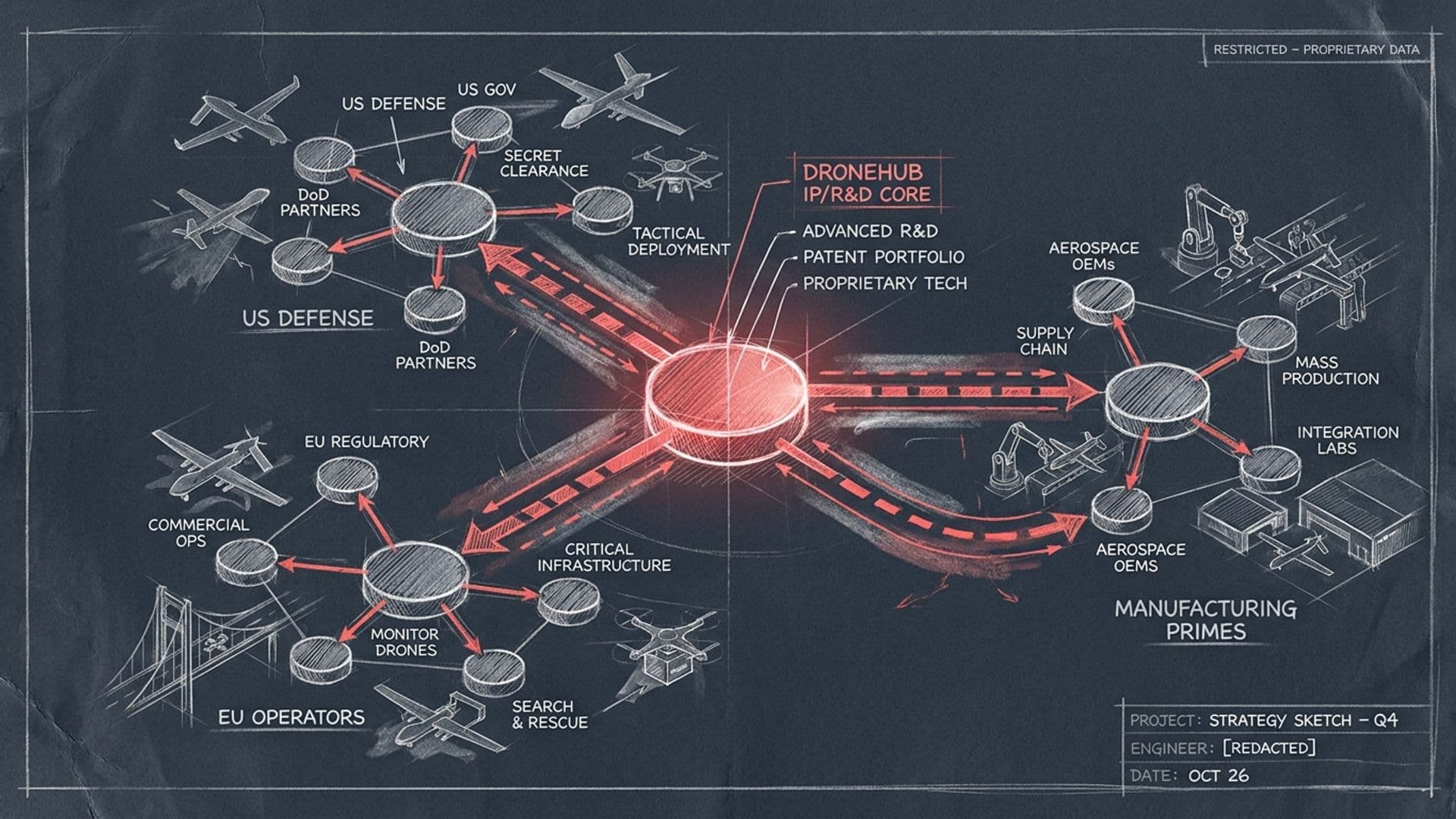
Dronehub sells its drone-in-a-box outright and licenses the technology behind it to other drone companies. Our drone-in-a-box page lists three ways to use the system — buy it, license it and ship it under your own brand, or co-develop a variant — and alongside the sale the company works through three commercial doors:
- IP licensing — for operators and integrators, who deploy a ready capability under their own brand and own the market and the customer relationship.
- R&D partnerships — for governments and defense agencies. The funding agency co-funds a development programme (ESA, EDA, European Commission, Polish NCBR; increasingly SBIR/STTR in the US), Dronehub leads or participates in a multi-partner consortium, and the resulting IP becomes deployable across the broader licensee pool.
- Manufacturing — for defense primes and companies with their own IP that need sensitive hardware made in Europe with no components from China, Russia, Iran or any sanctioned state.
Why not operate the docks ourselves? Because operating drones and inventing them are different businesses: a fleet needs local staff, approvals in every jurisdiction and capital that produces no new IP. The R&D investment that built Dronehub's portfolio — counter-UAS net-capture interception, AI rail inspection at Deutsche Bahn national scale, hybrid UAV-UGV with Galileo authentication, robotic battery swap, mobile docking — would have to compete inside the same company against the fleet-opex. The flywheel that converts EU public-programme funding into deployable IP would slow. So we keep the half that scales — the IP, the R&D and the manufactured platform — and let partners run the half bounded by geography.
For a licensee, the practical consequence is that the IP arrives deployment-ready. The licensee isn't buying a research prototype — they're buying a stack that's been validated at production scale (Deutsche Bahn for AI rail inspection, AUDROS for counter-UAS, HUUVER for hybrid mobility, Nomad for mobile docking).
The R&D door behind the licence
This door is structured differently. Governments and defense agencies fund Dronehub-led or Dronehub-participating R&D programmes — ESA, EDA, European Commission Horizon, Polish NCBR, increasingly SBIR/STTR and AFWERX on the US side, and NATO DIANA. The agency funds the work; Dronehub leads or participates in the consortium; the resulting IP becomes deployable across the broader licensee pool.
The economics work on a different axis from the licensing door. The R&D programme funds the development cost directly (Horizon, ESA, EDA, NCBR grants typically cover 70-100% of the work depending on the instrument). The agency gets a national-capability outcome — a deployed technology that addresses a sovereign-capability gap. Dronehub gets the IP, the consortium-leadership credential, and the deployment-validation programme that becomes the reference for future commercial licensees.
This is the door that produced the AUDROS counter-UAS programme (ESA + EDA jointly funding an SME for the first time, European Defence Agency scoring Dronehub 98/100 on the CBRN counter-UAS evaluation). It's the door that produced HUUVER (Horizon 2020 #870236, first UAV with full Galileo OS-NMA authentication). It's the door that produced Nomad (Polish NCBR mobile-charging-station grant). And it's the door that produces the next generation of capabilities — the SBIR pipeline that runs through Dronehub Inc. and the EDF / NATO DIANA pipeline that runs through Dronehub Sp. z o.o.
R&D partnership is the engine that fuels the licensing door. Without the R&D depth, the licensing door has nothing to license.
Licensing detail: /ip-licensing. R&D partnership: US and Europe. Manufacturing: /manufacturing. To talk through which route fits your fleet, open the contact form.
FAQ
- Can I license drone-in-a-box technology and manufacture it myself?
- Yes. Some companies license drone-dock designs — mechanical CAD, electronic schematics, firmware, bills of materials and manufacturing documentation — so the licensee can build docks in its own plant or through a contract manufacturer and sell them under its own brand. Dronehub licenses its drone-in-a-box, docking and battery-swap designs this way, and Aeronext, WiBotic and Powermat describe licensing routes for drone-port or charging technology. The licensee becomes the manufacturer, so it carries product certification such as CE marking in the EU and FCC authorisation in the US, while whoever operates the dock still needs its own permission to fly.
- What is the difference between white-labelling and licensing a drone dock?
- In a white-label deal the maker builds its own dock and you sell it under your brand: the maker keeps the design and the supply chain, and you get a product quickly without an engineering team. Under a licence you receive the design and the right to build it, so you choose the suppliers and the factory, set the unit cost and carry the manufacturer's obligations. White-label is faster; licensing gives you control of origin, which matters when your buyers apply NDAA Section 848, the FCC's rules on foreign-produced drones and docks, or the EU SAFE ceiling of 35% on components from outside the EU, EEA-EFTA states and Ukraine.
- Who is responsible for certification if I put my brand on a drone dock?
- In the EU, you are. EU product law treats whoever markets a product under their own name or trademark as its manufacturer, with the conformity assessment, technical documentation, declaration of conformity and CE marking that go with it, so a white-label contract should give you access to the maker's technical file. In the US, the holder of the FCC grant stays responsible for compliance, and a change of trade name alone needs no new authorisation. A new FCC ID does, and since 22 December 2025 new authorisations are unavailable for drones and docks produced outside the US unless an exemption applies.
- How long does it take to license a drone dock design and start building?
- The licence is the short part: Dronehub quotes 8–12 weeks from first conversation to signed agreement, covering a technical brief under NDA, engineering diligence and the licence terms. After that the timeline depends on the licensee — production set-up, pilot builds, testing and product certification — and it shortens if the first units are built on the licensor's line while the licensee's own production ramps up. Buying a finished dock is faster, although in every route the permission to fly can take longer than the hardware.
- Who licenses or partners with Dronehub?
- Three kinds of partner. First, operators and integrators who want a deployment-ready stack: energy and infrastructure operators bringing inspection in-house, system integrators packaging drone-in-a-box under their own brand, and OEMs replacing components from adversarial supply chains. Second, governments and defense agencies that fund R&D under sovereign-capability programmes: ESA, EDA, European Commission, NCBR, and increasingly SBIR/STTR through the US pipeline. Third, manufacturing customers — defense primes and companies with their own IP that need sensitive hardware produced in Europe on a non-adversarial supply chain. Each door is procurement-grade, with deal sizes that range from low-six-figure licence fees to multi-million-euro R&D programmes to multi-year manufacturing engagements.
- Is drone-dock licensing only for defense buyers?
- No. Defense is a large customer category — US federal innovation programmes (SBIR/STTR, AFWERX, DIU), European and NATO defense programmes (EDF, NATO DIANA, national ministries) and defense primes that need a non-adversarial supply chain. But commercial critical-infrastructure operators are a large category too: rail operators (Deutsche Bahn-class deployments), energy utilities, port authorities, refinery operators. Licensing fits any buyer with the scale, regulatory exposure and operational depth to run its own deployment.