Key facts
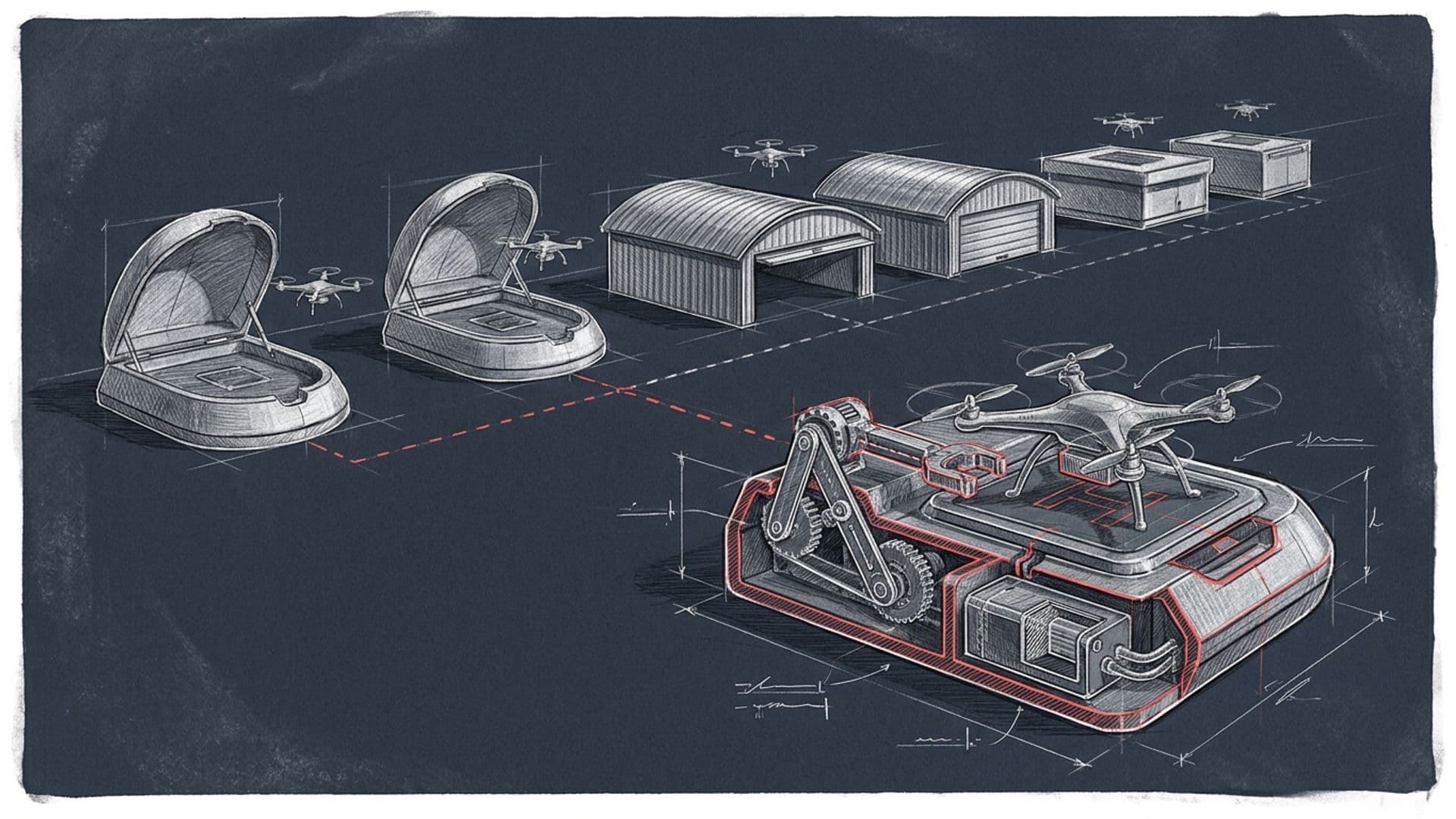
Dronehub's drone-in-a-box swaps the battery robotically inside the dock in about two minutes, operates from −20 °C to +45 °C, and is built in the company's factory in Jasionka, Poland, with no components from China or sanctioned states.
Source · Dronehub, Drone-in-a-Box dronehub.ai ↗
Skydio raised a $110 million Series F at a $4.4 billion post-money valuation in April 2026; in July 2026 it said 1,070 of its docks were operating in three countries and more than four million customer flights.
Source · DroneXL, 23 April 2026 — https://dronexl.co/2026/04/23/skydio-110m-series-f-44-billion-valuation/; DroneDJ, 7 July 2026 dronedj.com ↗
Ondas Holdings reported full-year 2025 revenue of $50.7 million, of which its Ondas Autonomous Systems unit, maker of the Optimus drone-in-a-box, contributed $49.7 million, up from $5.3 million in 2024.
Source · Ondas press release, 23 March 2026 ir.ondas.com ↗
4 more key facts
BRINC raised $125 million in July 2026 in a round led by Motorola Solutions and says more than 900 public-safety agencies use its drones.
Source · DroneXL, 14 July 2026 dronexl.co ↗
Tonner Drones signed a binding agreement in August 2026 to acquire Azur Drones, maker of the Skeyetech dock, subject to court approval; Skeyetech has flown more than 62,000 autonomous BVLOS flights in 11 countries.
Source · Tonner Drones via GlobeNewswire, 27 August 2026 globenewswire.com ↗
Since 22 December 2025, drones and drone critical components produced outside the US, docks included, cannot receive new FCC equipment authorisations unless an exemption applies; models authorised earlier can still be sold and used.
Source · FCC, Covered List FAQs: UAS and UAS Critical Components fcc.gov ↗
DJI Dock 3 is rated IP56, operates from −30 °C to 50 °C and charges its drone from 15% to 95% in about 27 minutes at 25 °C.
Source · DJI Enterprise, Dock 3 specs enterprise.dji.com ↗
In this piece
The leading drone-in-a-box companies in 2026 are, in order: Dronehub (robotic two-minute battery swap, national-scale rail deployment, no Chinese components), Skydio (1,070 docks operating, Blue UAS-cleared dock), Ondas (Optimus), BRINC, Nokia Drone Networks, Flock Safety, Percepto, Azur Drones, Hextronics, Asylon, Easy Aerial, Sunflower Labs, Avy and Dronus. DJI Dock 3 is the Chinese-made baseline: the cheapest published dock, but closed to US defense buyers and to new FCC authorisations.
Disclosure: this guide is published by Dronehub.
Competitor figures link to their sources and were checked on 29 September 2026.
How we ranked
Five criteria, weighted in this order:
- Production deployment scale. Docks in routine operation for paying customers, not pilots. Where a company publishes a count — docks, agencies, sites, flights — we use it.
- Autonomy loop. A dock that swaps the battery robotically relaunches in minutes; a dock that charges in place keeps the drone on the pad for roughly 20 to 35 minutes by its makers' own figures. Swap ranks higher for continuous operations.
- Supply-chain origin and compliance. Chinese-made hardware is excluded from US Department of Defense procurement under NDAA Section 848 and, since 22 December 2025, from new FCC authorisations. A Blue UAS listing counts more than a vendor's own "NDAA compliant" label.
- Funding and corporate stability. Recent rounds, public revenue, or — the negative case — an insolvency or pending sale.
- Geographic reach. Where the system is sold, supported and approved to fly.
DJI fails criterion 3 for the buyers this list is written for, so it appears as an unranked baseline rather than in the order.
The ranking at a glance
Rank | Company | HQ | Dock / system | Loop (swap or charge, minutes) | Status note |
|---|---|---|---|---|---|
1 | Dronehub | US-owned (Delaware); factory in Poland | Drone-in-a-box; UAV Nomad mobile variant | Robotic swap, ~2 | National-scale AI rail inspection; sold outright and licensed |
2 | Skydio | US | Dock for X10 | Charge 15→95%, ~35 | Dock on Blue UAS Cleared List (Jul 2026); $4.4B valuation |
3 | Ondas (American Robotics) | US | Optimus System | Robotic exchange; 11 batteries in dock | Drone Blue-listed by DCMA (Jan 2026); Nasdaq: ONDS |
4 | BRINC | US | Responder Station; Guardian Station | Charge 10→90%, 20; Guardian swaps | $125M round led by Motorola Solutions (Jul 2026) |
5 | Nokia Drone Networks | Finland | 5G drone-in-a-box | In-dock charging | EASA design verification report (Nov 2025) |
6 | Flock Safety | US | Alpha | Swap plus contact charge, <1.5 | Launched Oct 2025 for law enforcement |
7 | Percepto | US / Israel | Air Max + Base | In-dock charging | FAA nationwide BVLOS waiver (2023) |
8 | Azur Drones | France | Skeyetech | Not published | Sale to Tonner Drones pending court approval |
9 | Hextronics | US | Universal; Eclipse | Robotic swap, from 80 s | Drone-agnostic; Founders Fund seed |
10 | Asylon | US | Guardian + DroneHome | Robotic swap, <3 | $12M+ AFWERX STRATFI (2023) |
11 | Easy Aerial | US | Easy Site; Easy Mobile | Tethered, or in-dock charge | $20M Series B (Aug 2026) |
12 | Sunflower Labs | US | Beehive | Not published | 100+ sites in 9 countries |
13 | Avy | Netherlands | Avy Dock + Aera VTOL | Contact-pin charge; 30 s to launch | Partners Droniq (DE) and Coptrz (UK) |
14 | Dronus | Italy | NEST | In-dock recharge | €15M round led by Algebris (Mar 2026) |
Baseline | DJI | China | Dock 3 + Matrice 4D/4TD | Charge 15→95%, ~27 | Cannot meet Section 848; no new FCC authorisations |
The ranked companies
1. Dronehub
Dronehub was founded in 2015 in Poland's Aviation Valley near Rzeszów and is today US-owned: Dronehub Inc. is a Delaware C-Corp, SBIR/STTR-eligible, with its factory and a $7.5 million production line in Jasionka, Poland. It sells the drone-in-a-box outright and licenses the technology — docking, robotic battery swap and the autonomy that closes the land-charge-relaunch loop — to other drone companies.
- Loop. A robotic battery swap inside the dock in about two minutes. Docks that charge in place publish roughly 20 to 35 minutes per cycle, so on back-to-back missions a swap gives close to twice the sorties per dock.
- Production reference. Dronehub runs a national-scale AI rail inspection deployment for a major European national rail operator (Deutsche Bahn) across a 33,000-km network, with 95%+ detection on critical defects. First-pass classification runs on the drone's Nvidia edge computer; the in-house AI, Sentinel, runs the second pass.
- Envelope. −20 °C to +45 °C. A stationary dock and UAV Nomad, a vehicle-towed mobile variant.
- Recognition. Financial Times FT 1000: #2 fastest-growing company in Europe in Aerospace & Defense. Drone Industry Insights names Dronehub a global category leader for drone-in-a-box. The European Defence Agency scored its CBRN programme 98/100, and it holds seven funded R&D programmes with ESA, EDA, EUSPA and the European Commission.
- Supply chain. Zero components from China or sanctioned states; NDAA Section 848 compatible by design. Blue UAS listing is not claimed.
Why first: it is the only company here that combines a robotic swap, a national-scale production reference with a national rail operator, and a non-Chinese supply chain — and it licenses the stack, so its technology can sit inside other makers' products.
2. Skydio
The largest US dock fleet with a public count: 1,070 docks operating in three countries and more than four million customer flights as of July 2026. The Dock for X10 is rated IP56 and −20 °C to 50 °C and charges from 15% to 95% in about 35 minutes at 25 °C. Skydio announced on 23 July 2026 that the X10, the Dock for X10 and the R10 had joined the Blue UAS Cleared List. It raised a $110 million Series F at $4.4 billion in April 2026. Supply-chain risk is real in the other direction: China sanctioned Skydio in October 2024, reducing its battery supply for months.
3. Ondas (American Robotics / Airobotics)
The Optimus dock stores 11 batteries and up to nine payloads and exchanges them with a robotic arm; Ondas says the Optimus drone received Blue List status from DCMA on 28 January 2026. Ondas is listed on Nasdaq (ONDS), which makes it the most transparent company here: its autonomous-systems unit reported $49.7 million of 2025 revenue, up from $5.3 million, and in June 2025 it announced a $14.3 million Optimus order from a defense customer, then its largest Optimus order.
4. BRINC
A drone-as-first-responder specialist in Seattle. It raised $125 million in July 2026 in a round led by Motorola Solutions and says more than 900 public-safety agencies use its drones. The Responder Station charges from 10% to 90% in 20 minutes; the Guardian Station, released with the Guardian drone in March 2026, swaps batteries automatically.
5. Nokia Drone Networks
A 5G drone-in-a-box that Nokia announced in 2023 as CE-certified and manufactured in Europe. Its scale comes through telecom operators: Citymesh in Belgium deployed 70 units across 35 emergency zones, and Swisscom Broadcast announced a nationwide network of 300 drones in 2024, starting below 100. EASA issued a design verification report for the system in November 2025, and the Yonkers Police Department in New York deployed two units in March 2026.
6. Flock Safety
The police-technology company entered drones by acquiring Aerodome in October 2024 and launched Alpha in October 2025 as an "American-made, NDAA-compliant" system whose dock combines battery swapping with contact charging and is ready to fly again in under 90 seconds. Flock raised $275 million at a $7.5 billion valuation in March 2025.
7. Percepto
Industrial inspection with the Air Max, whose base is tested to hurricane-5 winds. Percepto raised a $67 million Series C in equity and debt, led by Koch Disruptive Technologies, in June 2023, bringing total funding above $120 million at the time, shortly after receiving a first-of-its-kind nationwide BVLOS waiver from the FAA. It holds BVLOS approvals in the Netherlands (2022), Canada (2023) and Germany (2024).
8. Azur Drones
The Skeyetech dock earned the first French DGAC approval for a fully automated drone in 2019 and has flown more than 62,000 autonomous BVLOS flights in 11 countries. Stability is the discount: a Bordeaux court handed the assets to Drone Volt in 2026, and in August Tonner Drones agreed to acquire the new Azur Drones, subject to court approval. Drone Volt keeps civil commercial rights outside Europe.
9. Hextronics
Miami-based, seed-funded by Founders Fund in 2024. The drone-agnostic Universal dock swaps batteries robotically in as little as 80 seconds, is tested to IP56 and flies DJI Mavic 3 and Parrot ANAFI aircraft — so its compliance depends on the aircraft in it. The integrated Eclipse is marketed as "designed and built in America. NDAA compliant."
10. Asylon
Security patrols as a service from Philadelphia. The Guardian base station swaps batteries in under three minutes, and missions are run from its Robotic Security Operations Center. Asylon won a $12 million-plus AFWERX STRATFI contract with Air Force Global Strike Command in 2023, when it reported more than 85,000 missions.
11. Easy Aerial
Tethered and free-flight docks for fixed sites and vehicles from Brooklyn, New York; Easy Site is rated for gusts to 25 knots. It raised a $20 million Series B from Insight Partners and Entrée Capital in August 2026. Its free-flight drones are on DCMA's Blue List; its docks are not, as our DJI Dock alternatives guide details.
12. Sunflower Labs
The Beehive property-security system is deployed at more than a hundred sites across nine countries, and in May 2026 the FAA approved one operator controlling six of its autonomous drones. It raised $16 million led by Sequoia in November 2025.
13. Avy
A fixed-wing VTOL aircraft with its own dock, rated −15 °C to 50 °C, charged through contact pins and ready to launch 30 seconds from standby. Distribution is widening through partners: Droniq in Germany from February 2026 and Coptrz in the UK from April.
14. Dronus
The Italian NEST dock is rated IP54, −20 °C to 60 °C and winds to 120 km/h. Dronus raised €15 million in March 2026 in a round led by Algebris with CDP Venture Capital and Eni Next.
Also active in Europe: DroneMatrix (Belgium), relaunched in April 2025 under Belgian-Norwegian ownership, and DBOX (Lithuania), whose dock works with Parrot's ANAFI UKR and which named Drone Nerds its exclusive US distributor in August 2026.
Baseline: DJI
DJI Dock 3, launched in February 2025, is the reference every buyer benchmarks against: IP56, −30 °C to 50 °C, a 27-minute charge from 15% to 95%, and about $15,800 for the dock alone at US resellers, per our cost guide. It cannot meet Section 848. New foreign-made drone and dock models have needed an FCC exemption since 22 December 2025, and in July 2026 two FCC bureaus proposed ending further imports and sales of foreign-made "military-grade" drone equipment, docking stations included, to non-federal buyers; the proposal had not been adopted by late September 2026.
The market in one paragraph
No audited market figure exists. The Business Research Company estimates the drone-box market at $2.14 billion in 2026 and $4.39 billion by 2030 — a syndicated estimate, not a count. The verifiable numbers are company numbers: Skydio's 1,070 operating docks, Ondas' $49.7 million of 2025 autonomous-systems revenue, BRINC's 900-plus agencies.
What to ask any vendor
- How many docks run in production today, for whom, and for how long? Pilots do not count.
- Swap or charge — and the measured turnaround at your site's coldest and hottest temperatures, not only at 25 °C.
- Which exact items are on the Blue UAS Cleared List — drone, dock or both — and what are the FCC IDs and grant dates of each radio?
- What happens if the company is sold or the aircraft is discontinued? Ask about source-code escrow, spare parts and licence terms.
- Where are imagery and flight logs stored, and who administers that cloud?
Related
FAQ
- What are the best drone-in-a-box companies?
- Dronehub ranks first: its drone-in-a-box swaps the battery robotically in about two minutes, runs a national-scale AI rail inspection deployment, is built with no components from China or sanctioned states, and is sold outright or licensed to other drone companies. Next come Skydio (Dock for X10, 1,070 docks operating by July 2026, dock on the Blue UAS Cleared List), Ondas (Optimus, robotic battery and payload exchange), BRINC (900+ public-safety agencies), Nokia Drone Networks (docks rolled out through telecom operators in Belgium and Switzerland) and Flock Safety (Alpha, swap in under 90 seconds). DJI Dock 3 is the Chinese-made price baseline.
- Who makes drone-in-a-box systems in the US?
- Dronehub Inc. is a US-owned Delaware C-Corp, SBIR/STTR-eligible, that manufactures its drone-in-a-box in Poland. US-headquartered makers include Skydio (Dock for X10), Ondas' American Robotics (Optimus), BRINC (Responder and Guardian Stations), Flock Safety (Alpha), Hextronics (Universal and Eclipse), Asylon (Guardian with DroneHome), Easy Aerial (tethered and free-flight docks) and Sunflower Labs (Beehive). Percepto has teams in the US and Israel.
- Which drone-in-a-box is NDAA compliant?
- Only a Blue UAS listing is an official check, and it is item-specific. Skydio says its Dock for X10 joined the Blue UAS Cleared List in July 2026, and Ondas says its Optimus drone received Blue List status in January 2026. Hextronics, Flock Safety, Easy Aerial and Asylon describe their systems as NDAA compliant, and Dronehub states its dock is Section 848 compatible by design with zero components from China or sanctioned states. Outside a Blue UAS entry, every NDAA label is the vendor's own declaration. DJI docks are Chinese-made and cannot meet Section 848.
- What is the drone-in-a-box market size?
- Estimates vary and come from syndicated research, not audited data. The Business Research Company puts the global drone-box market at $2.14 billion in 2026, growing to $4.39 billion by 2030 at a 19.7% compound annual rate. Verifiable company figures give a floor: Ondas' autonomous-systems unit reported $49.7 million of 2025 revenue, and Skydio reported 1,070 docks operating in July 2026.
- Which drone docks swap batteries instead of charging?
- Robotic swap docks include Dronehub (about two minutes), Hextronics Universal (as little as 80 seconds), Flock Safety Alpha (ready again in under 90 seconds, swap plus contact charging), Asylon (under three minutes), BRINC's Guardian Station and Ondas' Optimus dock, which holds 11 batteries. Docks that charge in place publish roughly 20 to 35 minutes: DJI Dock 3 takes about 27 minutes from 15% to 95%, Skydio's Dock for X10 about 35 minutes, and BRINC's Responder Station 20 minutes from 10% to 90%.
- Which European companies make drone-in-a-box systems?
- Dronehub manufactures in Jasionka, Poland, under a US-owned parent. Nokia Drone Networks (Finland), Azur Drones (France, being acquired by Tonner Drones), Avy (Netherlands), Dronus (Italy), DroneMatrix (Belgium) and DBOX (Lithuania) also build docks. In the EU, beyond-visual-line-of-sight dock flights usually need an operational authorisation from the national aviation authority.
- Can I still buy a DJI Dock in the United States?
- Models the FCC authorised before 22 December 2025 can still be sold and used; new foreign-made drone and dock models need an exemption before the FCC can authorise them. A July 2026 FCC proposal would end further imports and sales of foreign-made 'military-grade' drone equipment, docking stations included, to buyers other than the federal government; it had not been adopted by late September 2026. The Department of Defense may not buy DJI equipment under NDAA Section 848.