Key facts
Deutsche Bahn operates Germany's 33,000-kilometre national rail network — the largest integrated passenger-freight rail system in Europe and one of the densest in the world by track-kilometres relative to land area.
Source · Deutsche Bahn network operations record
The Sentinel anomaly-detection stack achieves above 95% per-fastener defect detection accuracy on the Deutsche Bahn deployment, measured against ground-truth labels validated by DB's internal inspection teams.
Source · Dronehub × Deutsche Bahn deployment validation metrics
Reports land in the operator's hands in under 15 minutes from drone landing — versus 24 to 72 hours for manual inspection followed by analyst review of raw video.
Source · Dronehub × Deutsche Bahn deployment latency benchmarking
3 more key facts
Modelled savings of up to USD 500 million annually for Deutsche Bahn at full network deployment, driven by defect-driven incident avoidance, lower asset-failure rates, and the redirection of physical track-walking labour into higher-value maintenance work.
Source · Deutsche Bahn × Dronehub deployment modelling
Edge first-pass classification runs on the drone's onboard Nvidia Jetson compute — only frames carrying potential anomalies travel to the cloud review path. Bandwidth-thin operation works over LTE, satellite, or degraded RF.
Source · Sentinel architecture documentation
Imagery, telemetry, audit logs, and detection records remain on infrastructure inside EU and US jurisdictions by architecture — a procurement requirement under EU NIS2 and increasingly under US CISA critical-infrastructure frameworks.
Source · EU NIS2 Directive; US CISA critical-infrastructure framework
In this piece
Germany's national rail network is 33,000 kilometres long. Inspecting it on the regulator's required cadence is mathematically impossible with track-walking teams. Deutsche Bahn and Dronehub built the AI-driven inspection stack that closed the gap — and at full network deployment the modelled savings reach USD 500 million annually. This is what the deployment actually taught us about scaling AI rail inspection from prototype to national infrastructure.
The Deutsche Bahn programme is the flagship validation in the Dronehub portfolio. It's referenced across every other deployment narrative — wind farms, pipelines, ports, refineries — because the architectural pattern that scaled at DB is the same pattern that scales on adjacent asset classes. This post is the deeper look at what the deployment actually proved.
The starting problem
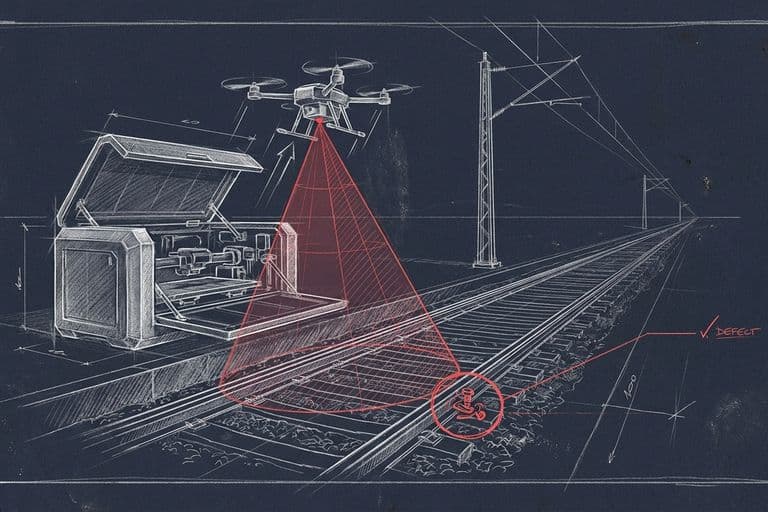
Rail-network inspection in 2020 ran on a hybrid: track-walking inspection crews for the close-range fastener-and-joint check, train-mounted optical for the long-tail surface survey, and periodic specialised inspections for non-routine assets (bridges, tunnels, electrical infrastructure). All three approaches had brutal latency. A track-walker covers maybe one to three kilometres an hour over the asset class they're qualified for. A train-mounted optical inspection produces gigabytes of video that take an analyst team 24 to 72 hours to review. Specialised inspections are episodic.
At 33,000 kilometres of network and a regulator-required inspection cadence that's tightening every cycle, the math collapses. Either the inspection workforce triples — which the labour market does not support — or the cadence slips. The cadence cannot slip. The third option is to change the architecture of inspection.
That's the problem the deployment was sized to solve. The lessons below are what the deployment specifically taught us, in the order the team discovered them.
Lesson one: the accuracy ceiling moves with training data, not algorithm
The first instinct on a vision-AI deployment is to spend engineering time on the model architecture. The Deutsche Bahn data invalidated the instinct early. Across the first deployment phases, swapping between transformer architectures, between depth-vs-width tradeoffs, between training-loss strategies — none of it shifted the accuracy ceiling more than two or three percentage points. What moved the ceiling, by 10 to 15 percentage points at a time, was training data discipline.
Three properties of training data mattered most:
- Labeller authority. Labels generated by Deutsche Bahn's own inspection teams produced models that outperformed labels generated by general-purpose crowdsourced annotators by a wide margin. The senior inspectors had judgement encoded in their labels that the crowdsourced workforce did not.
- Per-asset taxonomy. A single "rail defect" classifier underperformed a federation of per-asset-class detectors — one for rail joints, one for fastener patterns, one for plate damage, one for ballast condition, one for drainage features. Each detector was trained against a narrower distribution and a more disciplined taxonomy, and the combined system outperformed the unified model on every cross-validation fold.
- Synthetic supplementation for rare classes. Some defect classes are operationally critical but statistically rare in the field archive. Synthetic data — physics-based defect simulation augmented onto base imagery — closed the gap on the rare-but-critical tail without forcing inspection teams to wait years for organic field samples.
The aggregate result was above 95% per-fastener defect detection accuracy at deployment scale, measured against ground-truth labels validated by DB's inspection teams. That's the headline number. The pattern behind it — labelling discipline first, taxonomy specialisation second, architecture last — is the lesson we've imported into every adjacent deployment since.
Lesson two: latency is operational, not a vanity metric
The marketing instinct on a vision-AI platform is to publish accuracy. The Deutsche Bahn programme office cared about accuracy, but it cared more about latency.
The reason is operational. Rail maintenance dispatch runs on shift cycles. A defect detected at hour 17 of a shift, with the inspection report landing the next morning, lands too late to redirect the field crew before they return to depot. A defect detected at hour 17 with the inspection report landing at hour 17:15 is a defect that can be remediated by the same crew before the shift ends. The compounding value of speed-to-detection is non-linear with severity — fast detection of a high-severity defect prevents events that slow detection would not have prevented.
The deployment hit sub-15-minute report latency by design. The architecture decisions that made it possible:
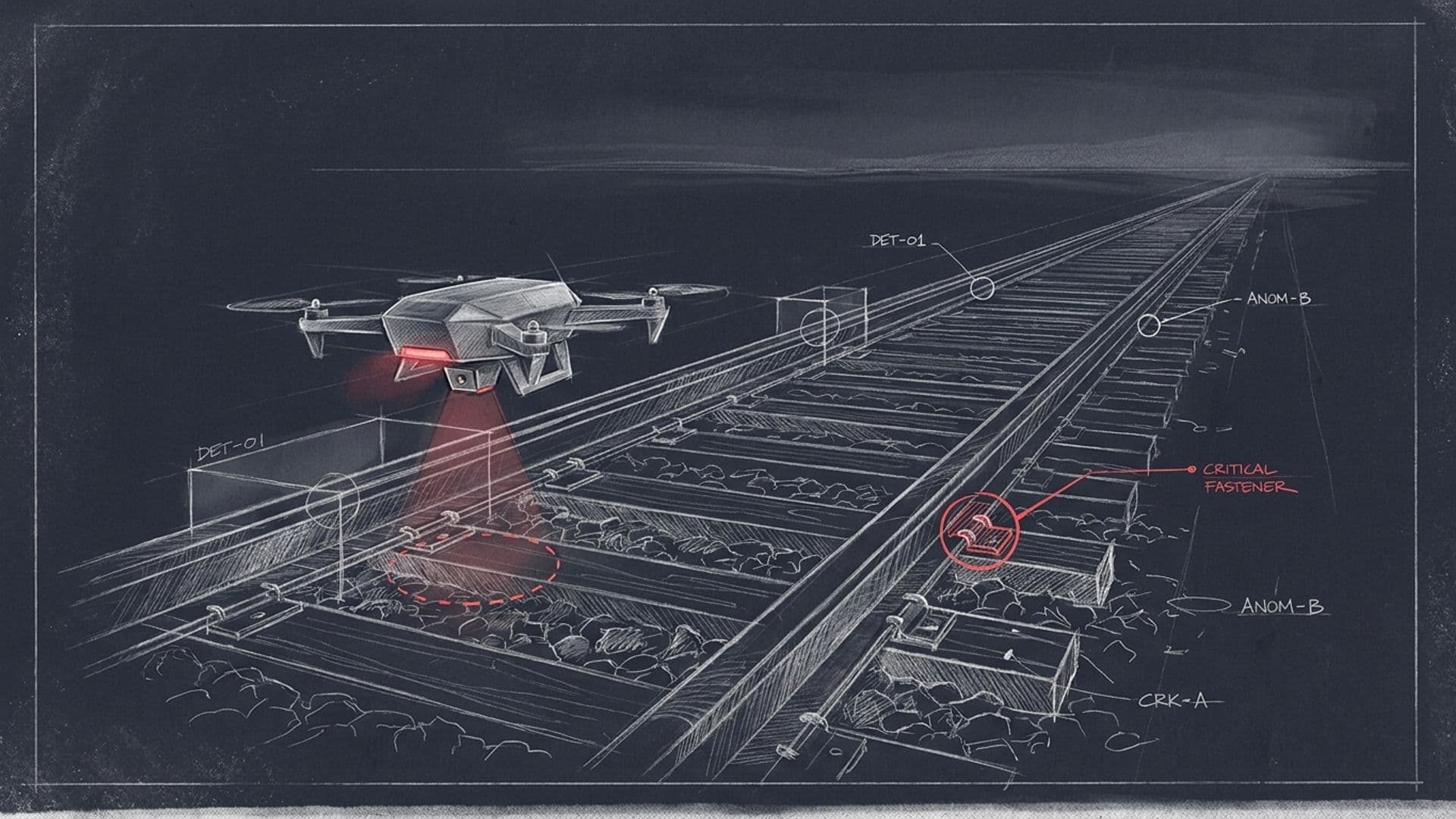
- Edge first-pass classification. The drone's onboard Nvidia Jetson runs a lighter-weight version of the anomaly classifier in real time during flight. Most frames — the routine, no-anomaly-detected frames — never travel further. Only frames flagged by the edge classifier travel to cloud review. The bandwidth required to operate the system over LTE, satellite, or degraded RF collapses by roughly two orders of magnitude.
- Cloud-side specialisation. The cloud review path runs the deeper, slower, more accurate per-asset detectors against the candidate frames. Because the candidate set is small, the deeper model can run with the latency budget the workflow needs.
- Pre-routed operator outputs. Reports land in the operator's existing maintenance-planning stack — annotated, severity-scored, GPS-pinned, ready for dispatch. The analyst handoff (review raw video, generate report manually) was removed entirely from the critical path.
Sub-15-minute latency is the operational property that turned the platform from a vision-AI demo into an inspection-scheduling tool the operator actually uses.
Lesson three: edge-first architecture survives bandwidth reality
Most AI vision deployments in adjacent fields make the architectural assumption that bandwidth is abundant — that the drone (or the camera, or the sensor) can stream raw video to a hyperscaler endpoint, with the model running entirely in cloud. The assumption breaks at rail-network scale and on every adjacent linear-infrastructure deployment we've examined since.
Rail networks pass through cellular dead zones, tunnels, mountain valleys, and rural corridors with intermittent LTE coverage. Pipelines run through worse environments. Transmission corridors traverse mountain ranges. Offshore wind sites operate beyond reliable cellular range. Defense-grade deployments operate under deliberate RF denial. None of these environments support continuous streaming of inspection-grade raw video.
Edge-first inverts the assumption. The drone's onboard compute runs the first-pass classifier locally. Bandwidth-thin operation becomes a default rather than a fallback. The cloud connection only needs to handle the candidate frames — kilobytes per minute, not gigabytes — which works over the operationally-available bandwidth even in degraded environments.
The architectural property that lets the same stack work on Deutsche Bahn and on the offshore wind cluster and on the defense forward operating base is the edge-first split. The Deutsche Bahn deployment proved the pattern at scale; everything since has imported it.
Lesson four: data sovereignty stops being a checkbox at this scale
At the prototype scale, "data sovereignty" reads as a procurement checkbox. At Deutsche Bahn scale, it becomes architectural.
Imagery, telemetry, build records, detection logs, audit traces — all of it stays on infrastructure inside EU and US jurisdictions by design. EU NIS2 requires critical-infrastructure operators to keep operational data on sovereign infrastructure. The US CISA framework imposes equivalent rules under federal critical-infrastructure designation. Both directives have audit teeth. An operator running inspection through a third-party cloud whose data path passes through adversarial jurisdictions fails the audit, fails the regulator review, and lands in front of a board explaining why.
The Sentinel architecture was built with sovereignty as a structural property rather than a configuration setting. The cloud-side review runs on EU and US infrastructure only. The drone-side inference runs locally and emits no telemetry to non-sovereign endpoints. The operator's data path is auditable end to end.
For rail-network operators specifically, sovereignty matters in a second way: the imagery and detection record are themselves operational intelligence about the network's vulnerability surface. A foreign-controlled cloud path holding national rail-network defect imagery is a sovereign-security problem, not just a compliance problem. The architecture had to be designed for that constraint, not retrofitted under it.
Lesson five: operator handoff is the actual product
The last lesson is the one we underestimated initially and corrected on. The vision-AI platform is necessary but not sufficient. What makes the deployment work is the handoff to the operator's existing maintenance-planning stack.
A maintenance planner does not want raw video. The planner wants a prioritised list of defects with severity scores, GPS coordinates, asset identifiers, historical comparison against the last inspection of the same asset, and a recommended action class. The planner's existing workflow already has those fields — in spreadsheets, in CMMS systems, in regulatory-compliance trackers. The inspection stack's job is to populate the existing workflow, not to replace it.
The Deutsche Bahn deployment shipped with deep integration into DB's maintenance dispatch and asset-management systems. Detections route into the right work-order queues, with the right severity classes, with the right historical-context attachments. The planner's experience of the platform is "the inspection reports show up where I expect them, faster and more accurately than before" — not "we have a new vision-AI tool to learn."
This is the property that turned the platform from a successful proof-of-concept into a deployment the operator depends on. We import it into every adjacent vertical. The energy-grid version of Sentinel routes into the operator's CMMS the same way; the pipeline version routes into the operator's integrity-management workflow; the port version routes into the asset-management system. The operator-handoff layer is the actual product, with vision AI as the input substrate.
What this means for operators in 2026
For European rail operators (SNCF, ÖBB, SBB, Trenitalia, the Polish PKP, the UK rail-network operators) — the architectural pattern proven at Deutsche Bahn is licensable today, manufactured at the Jasionka factory in Aviation Valley under NATO-allied non-CN supply chain. EU NIS2 sovereignty by architecture. Sentinel per-asset taxonomy adapts to the specific fastener patterns and ballast types of the local network. The full rail-industry context is on /industries/rail.
For US rail operators and DoT-funded infrastructure programmes — Dronehub Inc. is a Delaware C-Corp SBIR/STTR-eligible US small business with NDAA Section 848-compatible hardware. The same Sentinel stack runs on a sovereign-US data path. AFWERX and DIU rail-resilience programmes, DoT Federal Railroad Administration funded inspection pilots, and Class I freight-operator commercial procurement all use the same procurement pattern.
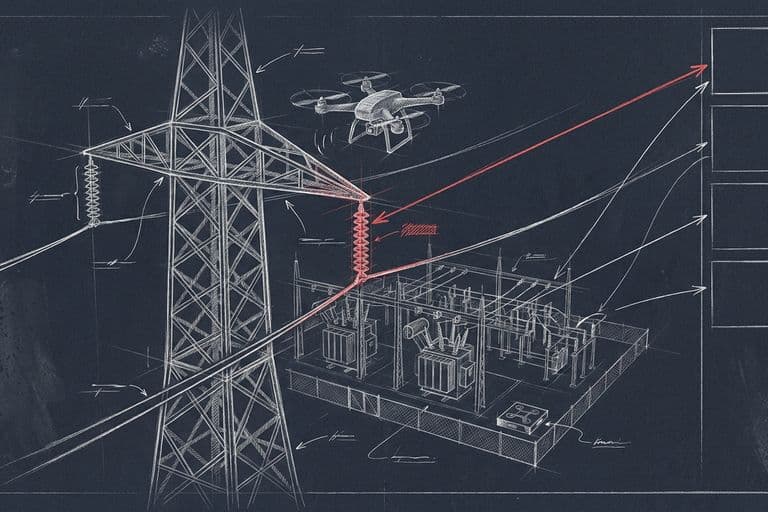
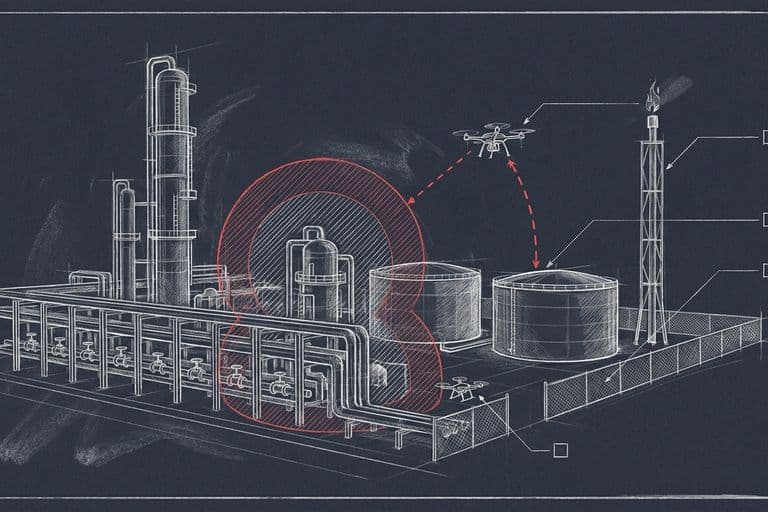
For adjacent linear-infrastructure operators — energy transmission, pipelines, ports, dams — the same architecture re-points by changing the per-asset taxonomy without re-engineering the upstream platform. The energy-industry context lives at /industries/energy. The drone-in-a-box product page is at /drone-in-a-box. The full Deutsche Bahn case study is at /projects/deutsche-bahn.
For a deployment conversation, open the contact form.
FAQ
- What is Sentinel and what does it actually do?
- Sentinel is the in-house Dronehub anomaly-detection and inspection-analytics platform. The drone captures imagery during autonomous flight; the onboard Nvidia Jetson runs a first-pass classifier in real time; only frames carrying potential anomalies travel to the cloud, where a deeper model classifies, severity-scores, and pins each detection to GPS coordinates. The maintenance planner sees the anomalies — annotated, scored, prioritised — not raw video. The architecture is identical at Deutsche Bahn and on every other Halo-driven deployment; only the per-asset anomaly taxonomy changes.
- How was 95%+ accuracy achieved at national scale?
- The ceiling moved with training data, not with model architecture changes. The base classifier — a transformer-architecture vision model — was trained on hundreds of thousands of labelled rail-asset images sourced from Deutsche Bahn's own inspection archive and supplemented with synthetic data for rare defect classes. The accuracy gain came from labelling discipline (Deutsche Bahn's inspection teams validated the training set rather than crowdsourced labellers), from per-asset taxonomy specialisation (rail joints, fasteners, ballast condition, drainage features each get a dedicated detector), and from continuous on-deployment retraining as new edge cases surface.
- Why does sub-15-minute latency matter operationally?
- Because rail maintenance dispatch operates on shift cycles. A defect detected after the shift has dispatched is a defect that waits until the next shift — sometimes 8, 16, or 24 hours. Sub-15-minute reports mean the same crew that's already in the field can be redirected to investigate or remediate before they return to depot. The annual savings model breaks down primarily into incident-avoidance value (where the speed-to-detection compounds non-linearly with severity prevention) and labour-redirect value (where physical track-walking shifts to higher-value maintenance work).
- Does the same AI stack apply to other linear infrastructure?
- Yes — and that's the architectural design intent. The Sentinel platform separates the per-asset anomaly taxonomy from the inspection workflow. Rail-fastener defect classification swaps out for pipeline-weld defect classification, transmission-tower corrosion classification, wind-blade delamination classification, or port-quay-wall surface anomaly classification — without re-engineering the upstream drone autonomy, the edge inference pipeline, the cloud handoff, or the operator's report-ingest layer. The Deutsche Bahn deployment is the proof of architectural scaling; the platform now repoints at energy, pipelines, and ports under the same operational pattern.
- What's the procurement pathway for non-EU operators?
- Dronehub Inc. — the Delaware C-Corp US entity — qualifies as an SBIR/STTR-eligible US small business with NDAA Section 848-compatible hardware. US operators can procure under federal-innovation pipelines (SBIR/STTR, AFWERX, DIU, DoT IIJA-funded infrastructure programmes) or under direct commercial licence. EU operators procure through Dronehub Sp. z o.o. in Poland, under the EU defence industrial strategy frame or under direct industrial licence. Both paths source from the same Jasionka factory in Aviation Valley under a NATO-allied non-CN supply chain.
- Does this replace the rail-operator's inspection workforce?
- It changes the workforce shape, not the headcount. Physical track-walking — the highest-risk, lowest-value-per-hour work in the inspection portfolio — gets redirected. Senior inspection technicians shift toward review of flagged anomalies (where their judgement is the differentiator) and toward the on-track remediation work that drone inspection schedules for them. The net effect at the Deutsche Bahn scale is workforce-as-leverage rather than workforce-replacement — the same inspectors cover a network they could not previously cover at the cadence the regulator now requires.