Key facts
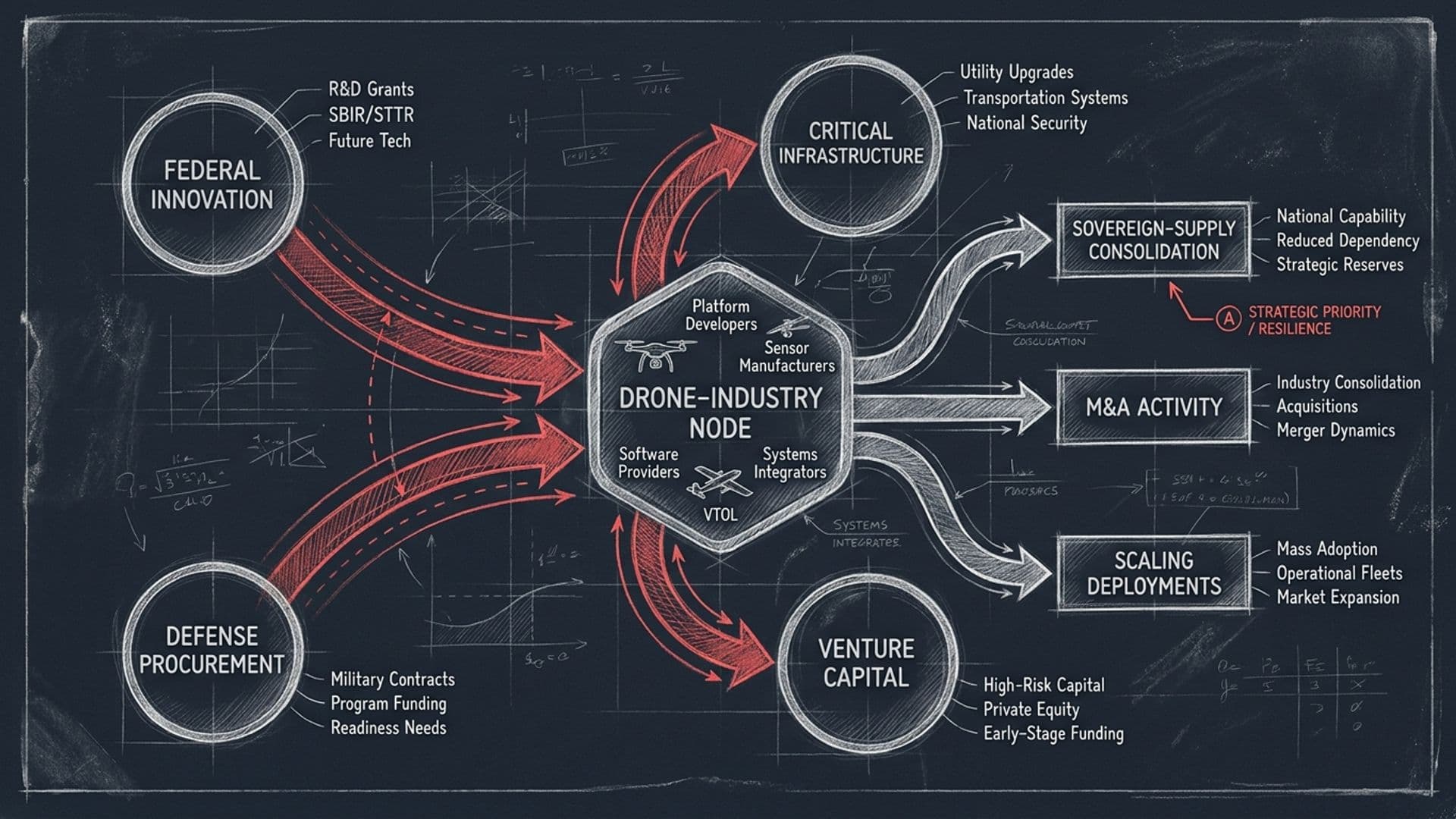
The 2026 drone industry sits at the intersection of four major capital flows: federal innovation funding (SBIR/STTR, AFWERX, DIU, NIF), defense procurement (US Section 848-compatible plus EDIS-aligned EU pathways), critical-infrastructure operator capital (rail, energy, ports, refineries), and venture capital deploying into sovereign-supply deep-tech.
Source · Drone industry capital-flow analysis 2024–2026
Sovereign-supply consolidation is the dominant 2026 trend — operators across defense, federal-civil, and commercial critical-infrastructure are migrating from Chinese-supply-chain UAS vendors to NATO-allied non-CN sovereign-supply suppliers. The consolidation accelerates structurally rather than reversibly.
Source · Sovereign-supply-chain consolidation pattern analysis 2022–2026
EU defense industrial capital (EDF, NATO DIANA, NIF, national-MoD programmes, EIC Accelerator) deploys at multi-billion-euro scale annually into deep-tech innovation. The pipeline has grown progressively since 2022 and is structured to continue growing through 2028-2034.
Source · EU defense and dual-use innovation funding analysis
3 more key facts
US federal innovation capital (SBIR/STTR, AFWERX, DIU, NATO Innovation Fund US contributions) deploys substantial annual dollar volume into drone-and-autonomy SMEs through both Phase II R&D awards and Phase III sole-source contracting.
Source · US DoD innovation funding flow analysis
M&A activity in 2026 increasingly centres on sovereign-supply-chain consolidation — defense primes acquiring SME capability with sovereign-supply-chain provenance, NATO-allied SMEs combining for scale, and the Chinese-supply-chain vendor segment progressively shrinking from regulated procurement pathways.
Source · Drone industry M&A pattern analysis 2024–2026
The structural winners of the 2026 drone market are companies operating across multiple capital-flow categories simultaneously — federal-innovation eligible, defense-procurement compliant, commercial-critical-infrastructure deployable, venture-capital fundable. Single-axis companies face structural disadvantage.
Source · Drone industry positioning analysis 2026
In this piece
The 2026 drone market sits at the intersection of four major capital flows: federal innovation, defense procurement, critical-infrastructure operator capital, and venture capital deploying into dual-use deep-tech. Sovereign-supply consolidation is the dominant structural trend. The companies positioned across multiple capital-flow categories simultaneously are the structural winners; single-axis companies face progressive disadvantage. This post is the strategic map of where 2026 drone-industry capital actually flows.
The post is a founder-essay synthesis of the market structure as it exists in 2026. It draws on the structural drivers we've covered in the sovereign-supply-chain piece, the EDF and AFWERX programming pieces, the manufacturing essays, and the operational deployment narratives. The aim is to give SMEs, primes, and strategic operators a coherent reading of the market they're operating in.
The four capital-flow categories
Capital flows into the 2026 drone industry through four primary channels, each with distinct sources, structures, and selection criteria.
Federal innovation
The largest single category by SME-count engagement and one of the largest by total funding volume. Includes:
- US SBIR/STTR — across all participating agencies (DoD, NASA, DoE, DHS, NSF, NIH where applicable). The combined annual volume runs in the billions of dollars across all agencies.
- AFWERX Open Topics and SpaceWERX — US Air Force and Space Force innovation pipelines, primarily routing through SBIR/STTR but with distinctive Open Topics architecture that favours dual-use SME innovation.
- DIU Commercial Solutions Opening — Defense Innovation Unit's commercial-technology engagement pipeline.
- NATO Innovation Fund — €1 billion+ NATO-aligned investment fund for dual-use deep-tech scale-up.
- EU Horizon Europe Clusters 4 and 5 — €95.5 billion programme with substantial drone-and-autonomy programming.
- European Defence Fund — €8 billion 2021-2027 with continuing programming, defense-specific R&D and capability development.
- EIC Accelerator — up to €12.5M combined grant + equity per selected company for deep-tech SMEs.
- NATO DIANA — accelerator pipeline with progressively expanding network of accelerator sites and test centres across NATO member states.
- National R&D programmes — Polish NCBR, German BMVg, French AID, equivalents across other NATO and EU members.
The category's structural property: distributed across many programmes and agencies, with each programme having distinct selection criteria, application processes, and downstream pathways. SMEs operating across multiple federal-innovation pipelines simultaneously have stacking funding sources; SMEs dependent on a single programme face the single-point-of-failure risk if that programme's funding profile shifts.
Defense procurement
Larger total funding volume than federal innovation but concentrated among fewer awardees. Includes:
- US DoD direct procurement — multi-billion-dollar annual UAS procurement across all DoD components, with the addressable surface shifting toward dual-use commercial-technology integration as cost-of-traditional-defense-procurement rises.
- NATO national-MoD programmes — UK MoD, French DGA-managed procurement, German BMVg programmes, Italian MoD, Spanish MoD, Polish MoD (with significant modernisation envelope), Czech MoD, equivalents across all NATO members.
- Allied-government defense contracting — Five Eyes allies (Canada DND, Australian DoD, NZ DoD), Asian allies (Japan, South Korea, Taiwan, Philippines), Middle East partners with defense procurement relationships.
The category's structural property: high per-contract value, multi-year programme structures, demanding compliance frameworks (Section 848 in the US, EDIS in the EU, equivalent in allied jurisdictions), and concentrated procurement pools where prime-led consortia dominate. SMEs typically participate as sub-contractors or specialist work-package leads inside prime-led architectures.
Critical-infrastructure operator capital
A category that has matured significantly across the 2020-2026 window. Includes:
- Transmission System Operators and Distribution System Operators — Tennet, ELIA, RTE, Red Eléctrica, Terna, 50Hertz, plus US ISOs/RTOs, US investor-owned utilities, public-power utilities, electric cooperatives. Multi-billion-dollar annual capital deployment into grid modernisation, with AI inspection and drone-in-a-box capability becoming standard procurement categories.
- Rail operators — Deutsche Bahn (national-scale Sentinel deployment), SNCF, ÖBB, SBB, Trenitalia, Polish PKP, UK Network Rail, US Class I freight operators (BNSF, UP, NS, CSX), regional passenger rail. Capital deployment into AI inspection at scale.
- Port authorities — major commercial ports globally, with capital deployment into perimeter security, asset-condition monitoring, and counter-UAS.
- Refinery operators — major energy companies, with capital deployment into perimeter security, counter-UAS, and asset-condition monitoring.
- Prison-system operators — federal and state-level corrections (US BOP, state DoCs, private operators), national corrections systems in EU member states. Capital deployment into anti-smuggling C-UAS.
The category's structural property: operator-controlled procurement, longer evaluation cycles than federal-innovation but more predictable per-contract value, increasing inheritance of sovereign-supply-chain requirements from regulators and downstream customers. SMEs with deployed operational references at meaningful scale are the structural winners in this category.
Venture capital
The smallest category by total volume but the most strategically influential for SME scale-up. Includes:
- Defense-focused venture funds — Anduril-style investors, dedicated defense-tech VCs, sovereign-defense funds.
- Dual-use deep-tech funds — multiple billion-dollar+ funds raised or being raised across 2024-2026 with explicit dual-use thesis.
- NATO Innovation Fund — formally a NATO programme but operates with venture-capital-style investment thesis and process.
- EIC Fund — operates as the equity-investment vehicle for the EIC Accelerator.
- Sovereign wealth funds — increasingly deploying into dual-use deep-tech as sovereign-supply considerations elevate.
- Strategic investors — defense primes, large industrial operators making strategic investments into dual-use SMEs.
The category's structural property: dilutive funding (equity in exchange for capital), but with the highest growth-capital scale available to deep-tech SMEs. VC funding pairs structurally with the federal-innovation and operator-capital flows — VC funds the scale-up; federal-innovation and operator-capital fund the customer pipeline.
The sovereign-supply consolidation pattern
The dominant 2026 trend across all four capital-flow categories is sovereign-supply consolidation.
Operators across defense, federal-civil, and commercial critical-infrastructure are progressively migrating from Chinese-supply-chain UAS vendors to NATO-allied non-Chinese sovereign-supply suppliers. The migration is driven by:
Procurement-framework requirements. NDAA Section 848 expansion across US federal agencies. EDIS formalisation in March 2024. NIS2 implementation in October 2024. NERC CIP tightening. Sector-specific frameworks across transportation, finance, health, energy. Each framework either explicitly excludes Chinese-supply-chain vendors or creates compliance overhead that effectively excludes them from the procurement pool.
Strategic-dependency concerns. The cost of supply-chain failure under conflict scenarios has been demonstrated since 2022. Operators that depend on Chinese-supply-chain UAS face strategic exposure that's increasingly priced into procurement and insurance decisions.
Insurance-economics shifts. Insurers increasingly price sovereign-supply premiums — operators on NATO-allied non-CN supply chain attract lower premiums than equivalent operators on Chinese supply chain. The premium differential compounds across asset depreciation horizons.
Geopolitical environment. Supply-chain sovereignty has been elevated as a sustained priority rather than a momentary concern. The China-Taiwan posture, Russia's invasion of Ukraine, and broader geopolitical tension keep sovereign-supply as a top-tier procurement consideration.
The structural property of the consolidation: it accelerates rather than reverses. Once an operator has migrated to sovereign-supply suppliers, the audit trail, the integration work, the operational training, and the regulator-alignment work don't unwind for an episodic Chinese-supply-chain re-engagement. The investment in the migration is sunk; the operational continuity makes reversal expensive and uncertain.
For drone-technology vendors, the consolidation means the addressable procurement market is structurally divided. Sovereign-supply suppliers compete for an expanding share of the procurement pool. Chinese-supply-chain vendors compete for a shrinking share of the procurement pool that hasn't yet inherited the sovereign-supply requirement (which is itself shrinking as inheritance propagates).
The M&A pattern
M&A activity in 2026 increasingly centres on sovereign-supply-chain consolidation.
Defense primes acquiring SME capability. Primes need depth in counter-UAS, autonomous mobility, AI inspection, sovereign positioning, and they're filling these gaps via SME acquisition rather than internal build. The acquired SME must satisfy the prime's sovereign-supply-chain frame; SMEs with strong sovereign-supply provenance attract premium acquisition valuations.
NATO-allied SMEs combining for scale. Smaller dual-use SMEs combining to reach the operational scale that procurement-grade deployment requires. Combined entities have stronger market positioning, broader customer reach, and the capital structure to fund deeper R&D pipelines.
Chinese-supply-chain vendor segment compressing. Not necessarily via direct M&A but via market-share erosion and downstream-revenue compression as the regulated procurement pool moves away. The compression accelerates as inheritance propagates across the commercial market.
Strategic-investor positioning. Defense primes, large industrial operators, and sovereign-defense entities making strategic investments into dual-use SMEs. The strategic-investor positioning sometimes precedes outright acquisition; sometimes it stays as a strategic partnership with capital-allocation dimension.
The combined effect is consolidation toward fewer, larger, sovereign-supply-aligned drone-technology companies in the procurement-eligible category. The companies that emerge from the 2024-2028 consolidation window with strong positioning across multiple capital-flow categories are the structural winners.
The structural winners
Companies operating across multiple capital-flow categories simultaneously are the structural winners of the 2026 drone market.
The ideal positioning:
- Federal-innovation eligible — US SBIR/STTR-eligible entity (Delaware C-Corp + founder residency + supply-chain compliance) plus EU programme-eligible structure (EDIS-aligned manufacturing + consortium-leadership credential)
- Defense-procurement compliant — Section 848 documentation, EDIS-aligned supply chain, third-party validation (EDA-class, comparable national-defense-research-body validation)
- Commercial critical-infrastructure deployable — operational reference cases at meaningful scale (Deutsche Bahn-class for rail; AUDROS-class for counter-UAS; equivalent for energy, ports, refineries)
- Venture-capital fundable — dual-use deep-tech with credible scale-up pathway, novel technical depth, demonstrated market traction
The structural property: companies positioned across all four categories simultaneously have multiple capital sources, multiple revenue streams, and multiple procurement pathways. The portfolio property is durable — a single capital-source disruption doesn't break the business; a single procurement-pathway closure doesn't materially affect the broader operations.
Single-axis companies face structural disadvantage. Defense-only companies miss the commercial-critical-infrastructure revenue and the dual-use VC capital. Civilian-only companies miss the federal-innovation and defense-procurement pipelines that have the largest funding envelopes. Federal-funding-dependent companies face the funding-discontinuity risk. VC-funded-but-no-procurement-fit companies face the burn-rate-versus-revenue gap.
The Dronehub positioning fits the multi-category structural pattern by design. SBIR/STTR-eligible US entity. EDIS-aligned Jasionka manufacturing in Aviation Valley. Section 848-compatible supply chain. EDA 98/100 validation on counter-UAS. Deutsche Bahn national-scale deployment validation on AI inspection. Multi-EU-programme consortium-leadership track record (ESA, EDA, European Commission Horizon, NCBR). The architecture isn't a coincidence; it's the structural answer to the 2026 market reality.
Outlook through 2028-2030
Continuation of the structural drivers, with progressive deepening.
Sovereign-supply consolidation continues across the federal-civil and commercial-critical-infrastructure procurement pool. Inherited requirements propagate from regulators to operators to downstream customers. The Chinese-supply-chain vendor segment compresses progressively from the regulated procurement pool.
EU defense industrial funding under EDIS continues to scale. The 2028-2034 MFF is in negotiation but the structural direction is set — EDF programming expands, NATO DIANA network continues to grow, EU sovereign-defense funding deepens.
US federal innovation funding continues at substantial volume. SBIR/STTR programmes continue their multi-billion-dollar annual award volume across DoD, NASA, DoE, DHS. AFWERX Open Topics continues as a major engagement point. DIU programming expands.
Critical-infrastructure operator demand transitions further from pilot to scaled deployment. Rail operators following Deutsche Bahn into national-scale deployment. Energy TSOs and DSOs scaling AI inspection. Port authorities scaling perimeter security and condition monitoring.
Venture capital continues to mature the dual-use deep-tech thesis. More funds with explicit dual-use mandates raise and deploy capital. Strategic investors increase their dual-use SME positions.
The 2026 positioning of strong dual-use deep-tech with sovereign supply chain becomes the standard procurement profile by 2028-2030 — not a competitive advantage but a baseline expectation. Companies positioned today for this trajectory are positioned for the long-cycle market structure. Companies not positioned will face progressive lockout from the procurement-eligible pool.
For drone-technology SMEs, primes, and strategic operators reading the market in 2026 — the trajectory is clear, the structural drivers are in place, and the positioning decisions made now have multi-year consequences. The companies that emerge from the 2024-2028 consolidation window with strong multi-category positioning are the companies that define the 2028-2030 market.
For more on the underlying drivers — the sovereign-supply-chain reality is at /blog/sovereign-supply-chain-not-optional; the EU manufacturing strategic case is at /blog/eu-drone-manufacturing-matters-2026; the Section 848 procurement guide is at /blog/ndaa-section-848-compatible-drones-procurement-guide; the SBIR/STTR entity-path piece is at /blog/sbir-sttr-non-us-drone-companies-entity-path; the EDF, DIANA, AFWERX, EIC programming pieces are all in the programmes cluster. The Dronehub positioning across multiple capital-flow categories is documented at /about and the per-door context at /ip-licensing, /rd-partnership, /manufacturing. For a strategic-positioning conversation, open the contact form.
FAQ
- What's actually different about the 2026 drone market versus 2020?
- Five structural changes compressed into a five-year window. (1) Sovereign-supply consolidation moved from policy preference to procurement default — NDAA Section 848 expansion across US federal agencies, EDIS formalisation in March 2024, EU NIS2 implementation, commercial inheritance from regulators. The Chinese-supply-chain vendor segment shrunk progressively from the regulated procurement pool. (2) Dual-use capital deployment accelerated — federal-innovation programmes (SBIR/STTR, AFWERX, DIU on the US side; EDF, DIANA, EIC, Horizon Europe Clusters 4-5 on the EU side) deploy substantially more capital into dual-use deep-tech than they did pre-2022. (3) Defense-procurement modernisation tightened compliance frameworks while expanding addressable market — the procurement frame is more demanding but the budget is larger. (4) Critical-infrastructure operator demand matured — rail, energy, ports moved from pilot deployments to procurement-grade national-scale roll-outs. (5) Venture capital reorientation — deep-tech defense-civilian dual-use became investable categories where pre-2022 they were neglected by mainstream VC.
- Where does the money actually flow in 2026?
- Four primary capital-flow categories. (1) Federal innovation — US SBIR/STTR, AFWERX, DIU; EU Horizon Europe Clusters 4 and 5, EDF, EIC Accelerator; NATO DIANA and Innovation Fund; national R&D programmes (Polish NCBR, German BMVg, French DGA, equivalents). Total annual volume runs in the multi-billion-dollar range across all pipelines. (2) Defense procurement — DoD direct procurement, NATO national-MoD programmes, allied-government defense contracting. Even larger total volume than federal-innovation but concentrated among fewer awardees. (3) Critical-infrastructure operator capital — TSOs, DSOs, rail operators, port authorities, refinery operators, prison-system operators all deploying capital into AI inspection, C-UAS, and persistent-coverage drone-in-a-box. Multi-billion-dollar annual volume across the operator pool. (4) Venture capital — increasingly deploying into sovereign-supply deep-tech with dual-use capability. Multiple billion-dollar funds raised or being raised across 2024-2026 with explicit dual-use thesis.
- What does sovereign-supply consolidation actually mean?
- Operators across defense, federal-civil, and commercial critical-infrastructure are progressively migrating from Chinese-supply-chain UAS vendors to NATO-allied non-Chinese sovereign-supply suppliers. The migration is driven by procurement-framework requirements (NDAA Section 848, EDIS, NIS2-equivalent commercial frameworks), strategic-dependency concerns (the cost of supply-chain failure under conflict scenarios), insurance-economics shifts (insurers increasingly price sovereign-supply premiums), and the broader geopolitical environment (which has elevated supply-chain sovereignty as a sustained priority rather than a momentary concern). The structural property: the consolidation accelerates rather than reverses. Once an operator has migrated to sovereign-supply suppliers, the audit trail and integration work doesn't unwind for an episodic Chinese-supply-chain re-engagement.
- What's the M&A pattern?
- Sovereign-supply-chain consolidation is the dominant M&A driver. Three patterns: (1) Defense primes acquiring SME capability with sovereign-supply-chain provenance — primes need depth in counter-UAS, autonomous mobility, AI inspection, sovereign positioning, and they're filling these gaps via SME acquisition rather than internal build. (2) NATO-allied SMEs combining for scale — smaller dual-use SMEs combining to reach the operational scale that procurement-grade deployment requires. (3) Chinese-supply-chain vendor segment progressively shrinking from regulated procurement — not necessarily via direct M&A but via market-share erosion and downstream-revenue compression as the regulated procurement pool moves away. The combined effect is consolidation toward fewer, larger, sovereign-supply-aligned drone-technology companies in the procurement-eligible category.
- Who are the structural winners?
- Companies operating across multiple capital-flow categories simultaneously. The ideal positioning is: federal-innovation eligible (US SBIR/STTR-eligible entity + EU programme-eligible structure), defense-procurement compliant (Section 848 + EDIS supply chain documentation), commercial-critical-infrastructure deployable (operational reference cases at meaningful scale), venture-capital fundable (dual-use deep-tech with credible scale-up). Single-axis companies — defense-only, civilian-only, federal-funding-dependent, VC-funded-but-no-procurement-fit — face structural disadvantage. The companies that operate across all four categories simultaneously have multiple capital sources, multiple revenue streams, and multiple procurement pathways. They're the structurally most-funded and least-fragile category.
- What's the outlook through 2028-2030?
- Continuation of the structural drivers, with progressive deepening. Sovereign-supply consolidation continues across the federal-civil and commercial-critical-infrastructure procurement pool. EU defense industrial funding under EDIS continues to scale. US federal innovation funding continues at substantial volume. Critical-infrastructure operator demand transitions further from pilot to scaled deployment. Venture capital continues to mature its dual-use deep-tech thesis. The 2026 positioning of strong dual-use deep-tech with sovereign supply chain becomes the standard procurement profile by 2028-2030 — not a competitive advantage but a baseline expectation. Companies positioned today for this trajectory are positioned for the long-cycle market structure; companies not positioned will face progressive lockout from the procurement-eligible pool.