Autonomous Drone Security
A drone-based ski-slope safety system, deployed at Dolni Morava (Czech Republic). Dronehub's earliest formal European Space Agency programme — and the proof-of-fit that opened the door to AUDROS, the first-ever joint ESA + EDA SME counter-UAS programme.
- Programme
- SIS-SREM
- Funder
- European Space Agency
- Track
- Business Applications
- Customer site
- Dolni Morava, CZ
- Domain
- Public safety · winter sports
- Role
- Foundational ESA reference
- Status
- Deployed · multi-season ops data
- Unlocked
- AUDROS (ESA + EDA, 2020)
Why this matters
Every defense reference in our portfolio traces back to a ski resort in the Czech Republic.
Track records matter to procurement officers because they show pattern. SIS-SREM is the start of Dronehub's pattern: deploy an autonomous drone-in-a-box for a public-safety customer with rigorous evaluators, deliver under a public funding agreement, harden the architecture, and then re-point the same architecture at the next class of problem.
The ESA Business Applications programme that funded SIS-SREM is the European Space Agency's downstream track — applying space-derived technologies (Earth observation, navigation, telecoms) to commercial and public-service problems. Dronehub was an early funded participant. The relationship that started there matured into AUDROS in 2020 — the first time ESA and the European Defence Agency jointly funded a small business.
If you're reading our defense credentials today — AUDROS 98/100 on CBRN, UAV Nomad for convoy ops, the Deutsche Bahn AI deployment — they all stand on top of the foundation that SIS-SREM built. The architecture is the same. Only the threat model changed.
The problem
Vast terrain. High stakes. Small ground team.
Modern ski resorts span hundreds of hectares across terrain that is, by design, hostile to ground patrol — steep gradients, dense tree lines, unstable snowpack, drainage cuts, off-piste pockets that aren't reachable in the time an avalanche-survival window allows. The patrol team is excellent and the resort safety record is strong, but the basic resource math is unforgiving: one ski-patrol skier cannot cover a 15-kilometre trail network in real time.
When the situation changes — a skier deviates into a closed zone, a cornice releases, a child gets separated from their family near a drainage run — the responder team is operating on minutes. The resource gap between the area and the team is the gap that costs lives.
The SIS-SREM thesis was straightforward: deploy an autonomous drone-in-a-box for continuous aerial coverage of the high-risk zones, run the AI-assisted change detection on the imagery, and surface the alerts to ski patrol in real time. The drone is in the air during operating hours whether the team is or not. When a developing situation is detected, the drone can also provide first situational awareness to the responder team before they depart.
The thesis cleared ESA technical review. The system deployed at Dolni Morava. The pattern hardened. Years later, the same pattern (autonomous launch, scheduled patrol, AI change detection, dispatcher integration) is what runs on the rail network at Deutsche Bahn, intercepts hostile UAVs at AUDROS, and patrols the convoy corridor from a UAV Nomad mobile dock.
What the system does
Four capabilities — proven at the resort, applicable everywhere else.
Avalanche risk monitoring
Snowpack assessment, cornice formation tracking, wind-loading observation. The drone surveys the high-risk zones repeatedly on a scheduled patrol — a coverage cadence that no ground-based ski-patrol team can match against the area an alpine resort spans.
Off-piste deviation detection
Skiers leaving marked trails into avalanche-prone or closed terrain is a perennial source of resort incidents. AI-assisted change detection flags off-piste activity to the patrol command, who can intercept or warn before the situation becomes an emergency.
Rapid first-response situational awareness
When an incident is reported, the drone is in the air within minutes — feeding aerial imagery of the scene back to dispatcher and ski patrol. Locates injured skiers in tree cover, supports search across drainage runs, informs the rescue plan before crews depart base.
Trail and infrastructure inventory
Lift line condition, trail-marker integrity, snowmaking-system inspection, end-of-day sweep for left-behind equipment or skiers. The drone delivers an audit-grade visual record at a cadence the human team can't sustain across the resort footprint.
The hardware
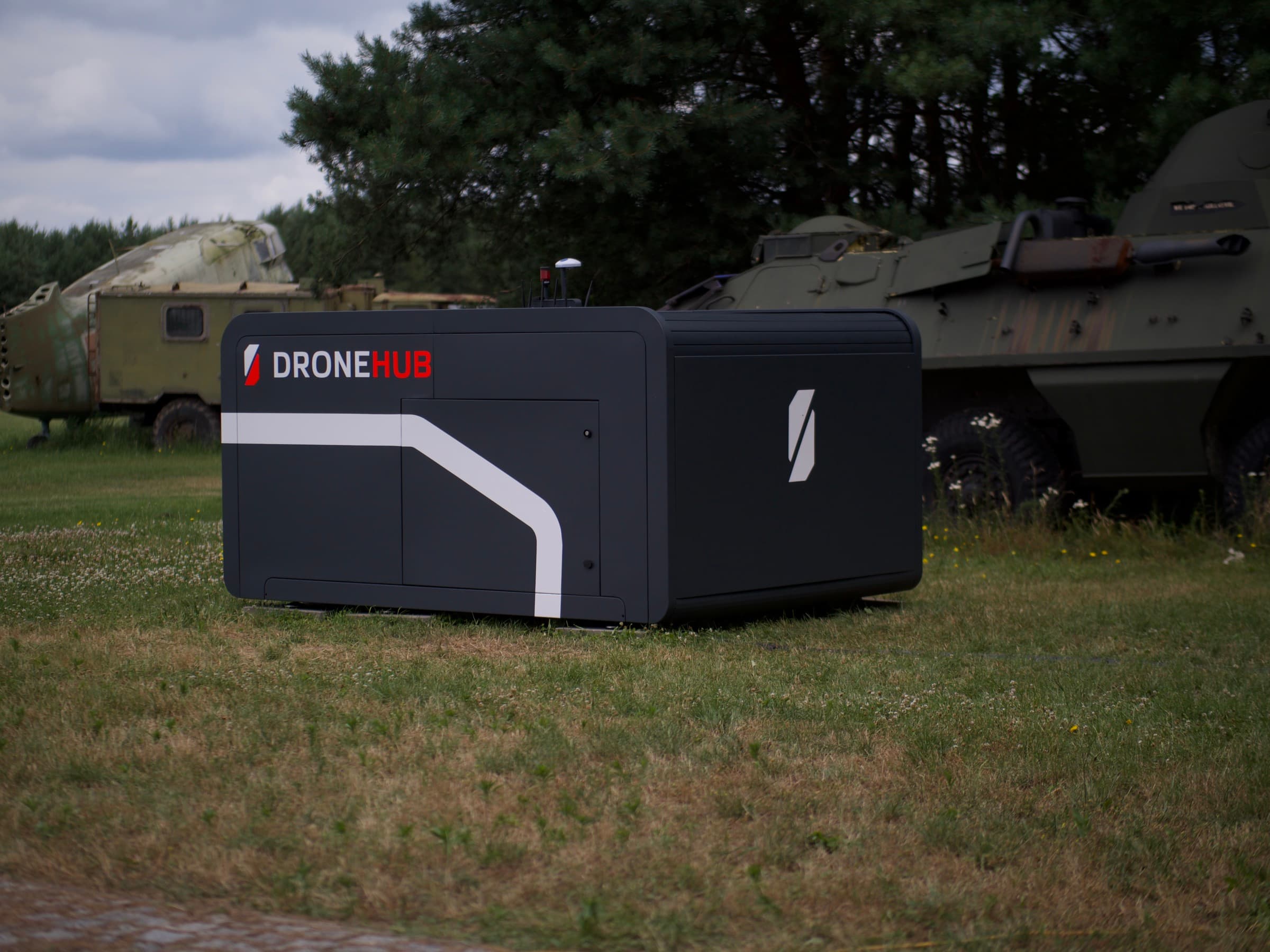
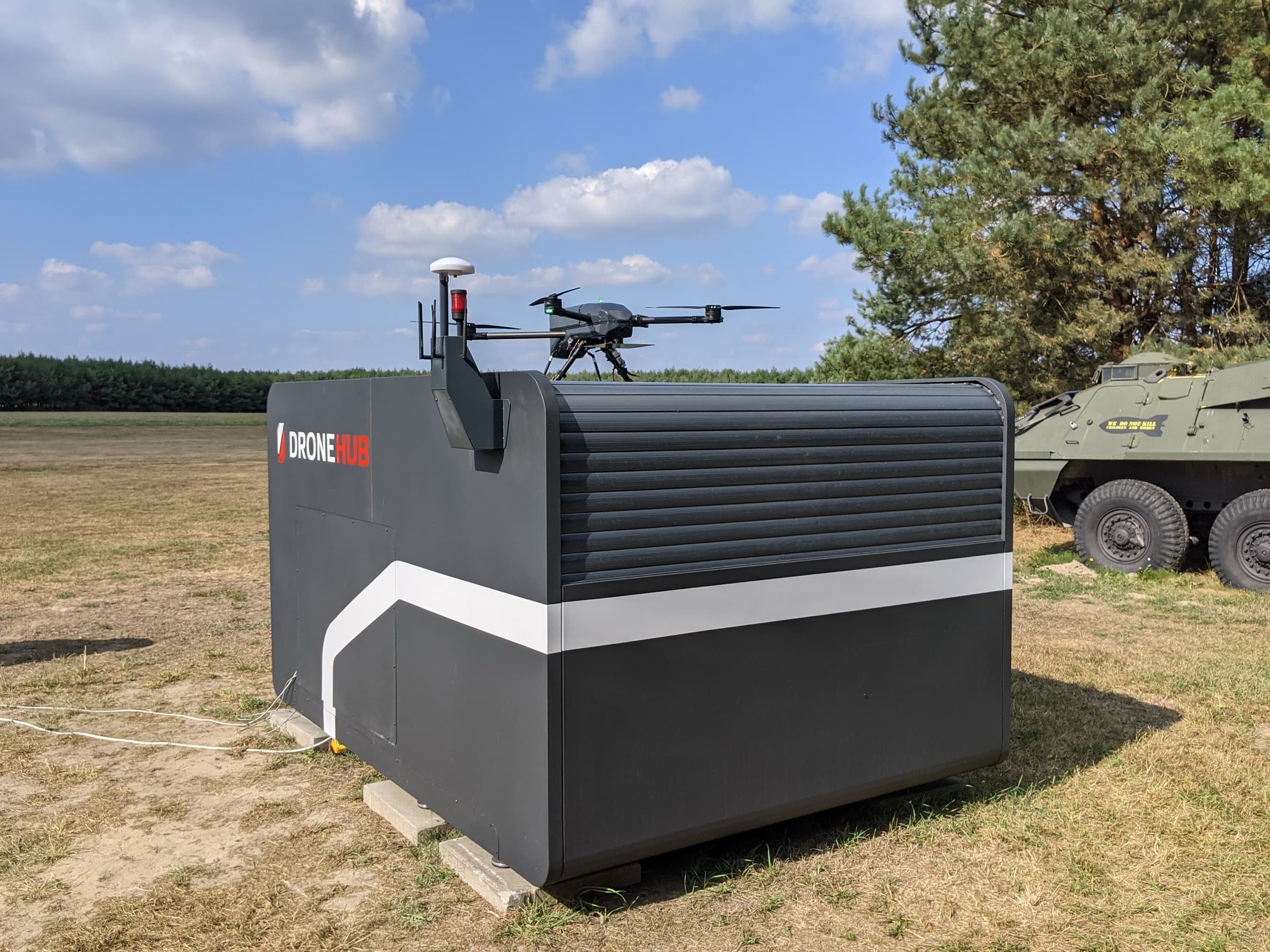
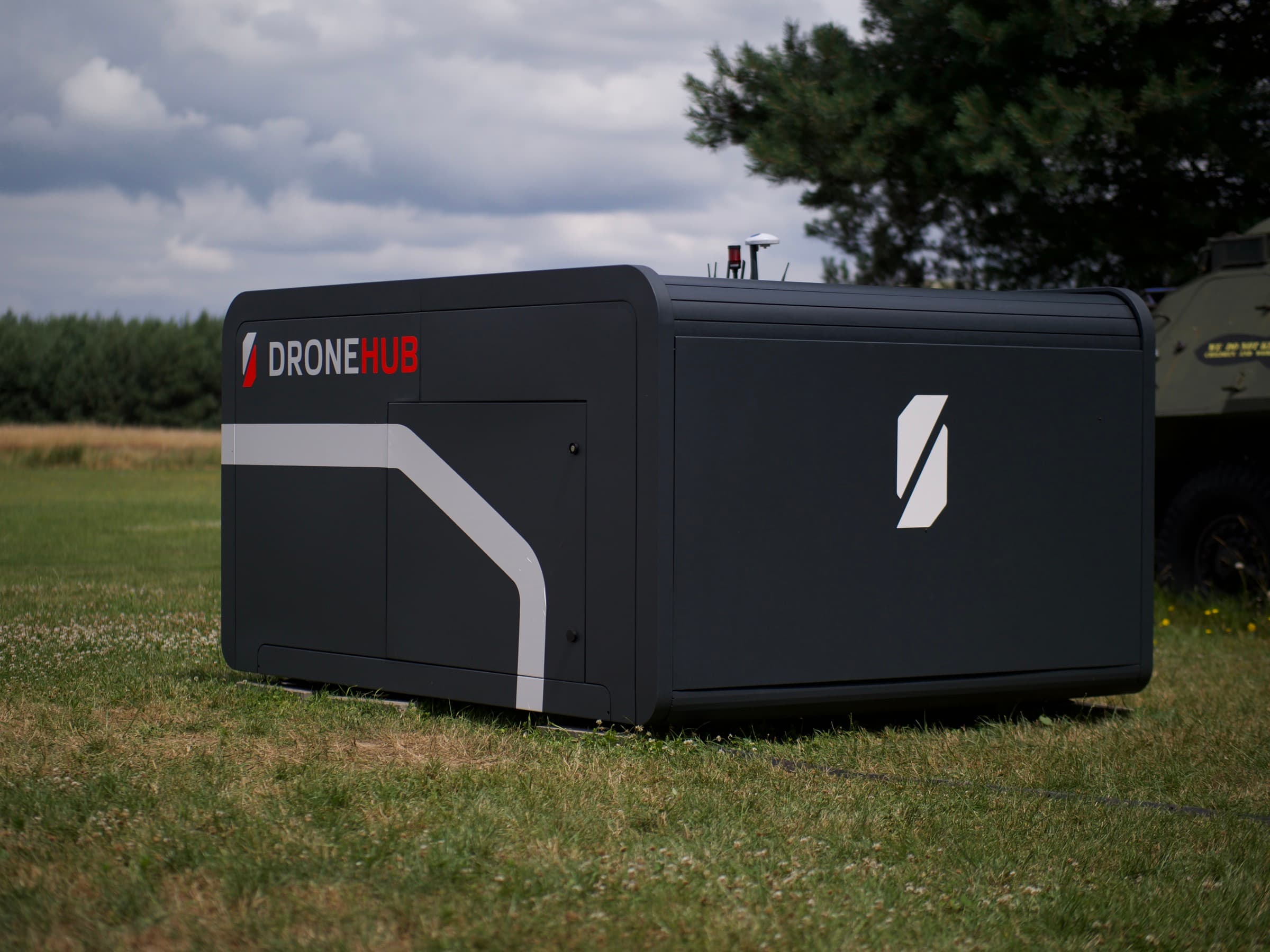
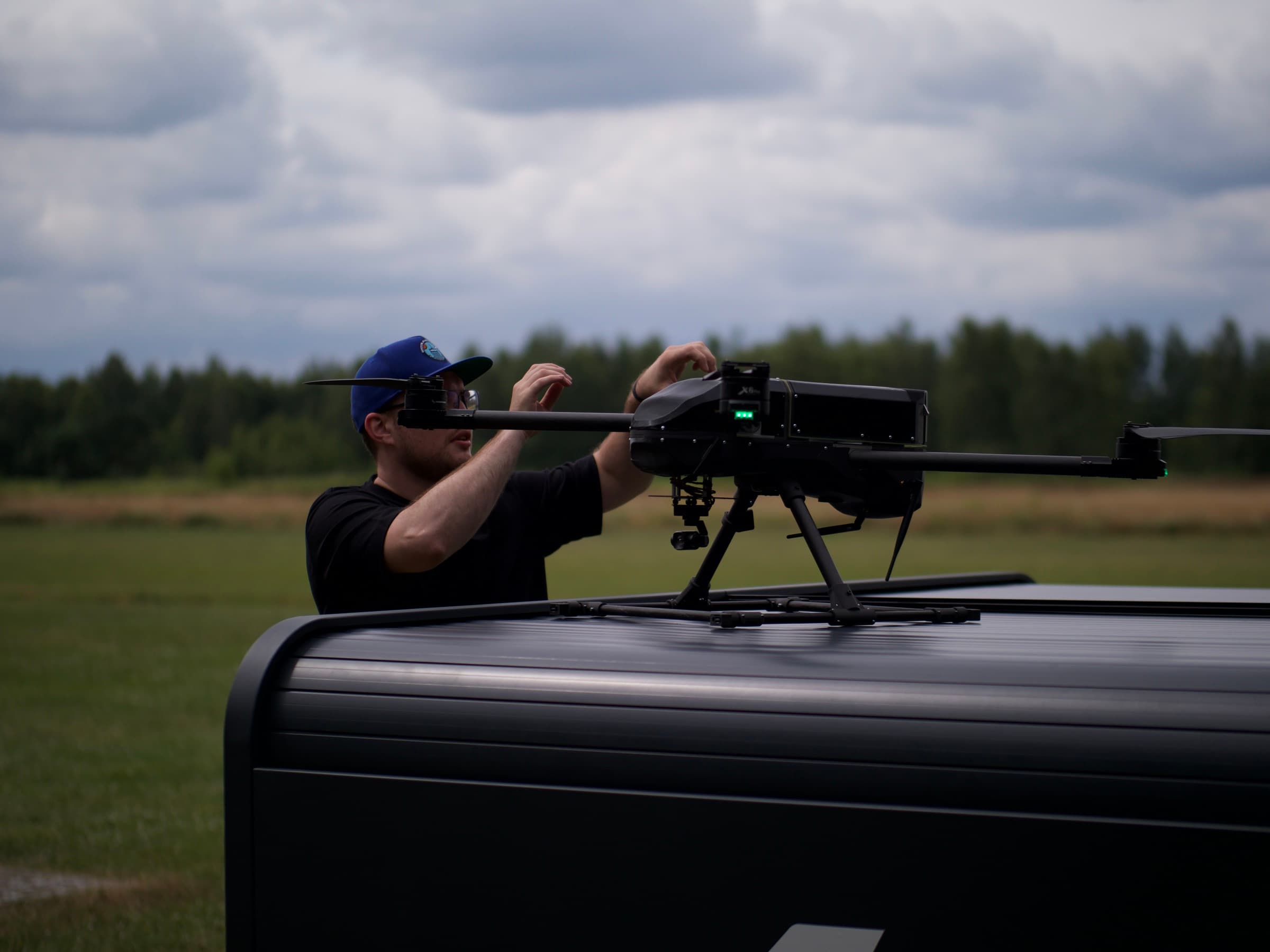
Autonomous drone-in-a-box. Stationary dock, scheduled patrol.
From SIS-SREM to AUDROS
The exact same architecture, pointed at three different problems.
SIS-SREM operated autonomous drones for ski-slope safety: a commercial-grade public-safety system funded through ESA Business Applications. That worked. AUDROS — three years later — operated autonomous drones for counter-UAS interception and CBRN response: a defense-grade public-safety system jointly funded by ESA and the European Defence Agency. That also worked, and scored 98/100 on the EDA CBRN evaluation.
The technical pattern between the two is identical: drone-in-a-box hardware, scheduled-plus-on-demand patrols, AI-assisted detection, dispatcher integration. The work between SIS-SREM and AUDROS was about hardening the architecture across two threat models (one ski-resort, one CBRN counter-UAS) and building the relationship with the European Space Agency that ultimately convinced two EU agencies to jointly fund an SME for the first time in history.
That same pattern then matured into the Deutsche Bahn AI rail inspection (commercial critical-infrastructure), the Mobile Charging Station (mobile-host autonomous infrastructure), and the U-Space4UAM contribution to EU urban-air-mobility regulation. The architecture compounded across deployments. SIS-SREM is where the compounding started.
Why this reference still matters
Four reasons the earliest deployment is part of the present-day credential set.
First Dronehub-ESA relationship
ESA Business Applications was Dronehub's first formal European Space Agency programme. The vetting that ESA applies before funding a Business Applications proposal is rigorous — technical feasibility, market validation, deployment readiness, dual-use potential. SIS-SREM cleared all of it.
Architectural seed for the AUDROS programme
The autonomous drone-in-a-box pattern, the scheduled-patrol logic, the AI-assisted change detection — all originated in SIS-SREM and matured through subsequent programmes. AUDROS (the first-ever joint ESA + EDA SME counter-UAS programme, 2020) was the direct downstream output. SIS-SREM made AUDROS possible.
Public-safety credential
Ski-resort safety is a regulated public-safety domain — incidents are reported to civil-aviation authorities, search-and-rescue protocols apply, evidence handling matters. Operating in that envelope is the precursor experience for counter-UAS, CBRN, and any other regulated-public-safety deployment.
International deployment reference
Deployed at Dolni Morava in the Czech Republic — Dronehub's earliest cross-border commercial deployment. The same operating pattern (Polish engineering, deployed across NATO Europe) defines our work today on Deutsche Bahn (Germany), AUDROS (Czech Republic), HUUVER (5 EU countries), and U-Space4UAM (5 EU countries).
What this means for you
The architecture stack is licensable. The deployment pattern is repeatable.
For a resort operator, mountain rescue authority, or alpine tourism agency — the SIS-SREM platform deploys today, under license or direct purchase, with European manufacturing from our Jasionka factory. The reference deployment at Dolni Morava is a real customer site you can visit.
For a procurement officer reviewing our defense credentials — SIS-SREM is the foundation of the pattern. The European Space Agency relationship that started here is the same one that funded AUDROS, the same one that gives us standing inside EU UAM rulemaking, and the same one that flows through every funded programme in our portfolio. Track-record continuity matters, and we have nearly a decade of it on the same agencies.
From the blog
Browse all UPDATED · SEP 2026
Counter-UAS Without Jamming: Critical-Infrastructure Vendors and the Legal Map (EU and US, 2026)
Counter-drone protection for critical infrastructure without jamming: detection, non-jamming mitigation, who may use it in the EU and US, and 16 vendors.
Read- UPDATED · JUN 2026
Counter-UAS Methods Compared in 2026: Detection, Jamming, Kinetic, and Net Capture
A side-by-side comparison of counter-drone methods — detection, RF jamming, GNSS spoofing, kinetic, net capture, directed energy, and protocol takeover — by RF-dependence, collateral risk, permits, and effectiveness against autonomous drones.
Read  UPDATED · MAY 2026
Why ESA + EDA Jointly Funded an SME: The AUDROS Story
AUDROS was the first project in history where the European Space Agency and the European Defence Agency jointly funded a small business. Here's how it happened.
Read