Key facts
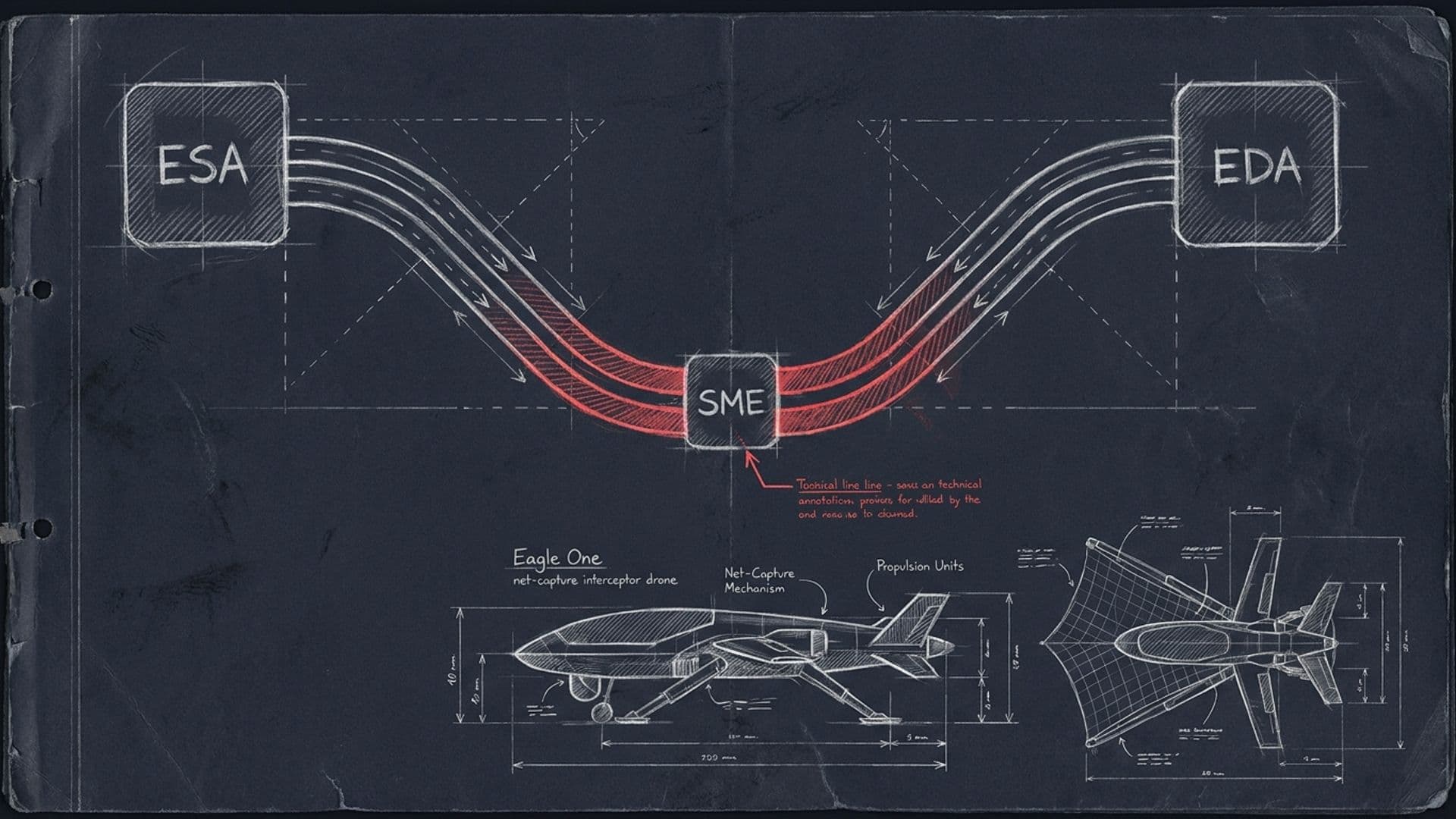
AUDROS was the first project in history where the European Space Agency (ESA) and the European Defence Agency (EDA) jointly funded a small business. Both agencies have funded SMEs separately; AUDROS was the first joint funding programme between the two agencies directed at an SME-led consortium.
Source · ESA × EDA AUDROS programme record
The European Defence Agency subsequently scored Dronehub 98 out of 100 on the CBRN counter-UAS programme — the first time EDA had worked directly with a startup at this evaluation level.
Source · European Defence Agency CBRN c-UAS programme evaluation
The AUDROS consortium has seven partners across two EU countries: Dronehub (Poland, lead), Fly4Future, GINA Software, BizGarden, MTI Brno, and MRI Brno (Czech Republic), plus ESA and EDA as co-funders.
Source · AUDROS consortium composition record
3 more key facts
The Czech consortium members include the Military Technical Institute Brno and the Military Research Institute Brno — both Czech government defense-research bodies under NATO-allied procurement frameworks.
Source · AUDROS consortium technical-partner record
The AUDROS Eagle One net-capture interceptor is the kinetic component of the broader AUDROS counter-UAS stack, deployed as the procurement-grade reference for net-capture C-UAS in NATO Europe.
Source · AUDROS programme technical documentation
Joint ESA + EDA funding for SMEs is now an institutional precedent — following AUDROS, the framework has been used for additional dual-use technology programmes that combine space-domain capability with defense-application development.
Source · Post-AUDROS programme-architecture analysis
In this piece
AUDROS was the first project in history where the European Space Agency and the European Defence Agency jointly funded a small business. The institutional precedent — getting two agencies that operate under different governance, different funding cycles, and different evaluation frameworks to co-fund a single SME-led programme — was as meaningful as the technology that came out of it. This is the backstory.
The post unpacks how the AUDROS proposal aligned with both agencies' priorities, what the consortium architecture looked like, what came out of the programme, and what the precedent means for SMEs evaluating EU defense funding pathways in 2026.
The institutional context
ESA — the European Space Agency — funds space-domain technology under its science, exploration, and applications programmes. The agency operates under intergovernmental governance with member-state contributions and is structurally oriented toward space capability development. ESA funds SMEs across multiple programme instruments (ARTES, NAVISP, EO programmes, Discovery, In-Orbit Demonstration), but its core mission is space-domain, not defense.
EDA — the European Defence Agency — operates under the Common Security and Defence Policy framework, supporting EU member-state defense cooperation, capability development, and industrial coordination. EDA funds defense-capability research and demonstration programmes through its operational budget and through coordination with the European Defence Fund. EDA has worked with SMEs before AUDROS, but the engagement pattern typically routed through prime-led consortia.
The two agencies operate independently. Before AUDROS, joint funding of a programme directed at an SME consortium had not been done. The technical reasons were straightforward — space-domain programmes are ESA's lane, defense programmes are EDA's lane, and an SME-led consortium working at the intersection didn't have an obvious institutional home.
The work of establishing the joint funding mechanism for AUDROS was meaningful. The two agencies had to align on the programme scope, the funding distribution, the evaluation framework, and the consortium-management architecture. The political and administrative effort was substantial. The institutional precedent that came out of it is what makes AUDROS structurally important beyond the specific technology it funded.
Why AUDROS succeeded as a proposal
Three properties of the proposal aligned with both agencies' priorities simultaneously, and the alignment is what made the joint funding institutionally appropriate rather than artificially forced.
Dual-use core. Net-capture counter-UAS technology has clear civilian-protection applications and clear defense applications. The civilian-protection cases — prisons (anti-smuggling), critical infrastructure (refineries, substations, ports), civil-protection scenarios (CBRN incident response, major events, head-of-state visits), correctional facilities — all sit in regulated airspace where standard counter-UAS modalities don't operate legally. The defense cases — counter-UAS in deployed environments, CBRN response, sovereign-airspace overwatch, base perimeter — sit in the broader defense capability gap. The technology serves both pools with the same underlying architecture. The dual-use property is what made co-funding institutionally appropriate. ESA could fund the space-integrated and civilian-protection dimensions; EDA could fund the defense-domain dimensions; the same SME-led consortium executed both.
Space-domain integration. The proposal leveraged Galileo positioning for authenticated UAV navigation, satellite communications for interceptor command-and-control in degraded-environment operations, and earth-observation data for threat-environment characterisation. The space-domain elements gave ESA institutional fit. This wasn't gratuitous integration — the underlying technology genuinely required these space-domain capabilities to operate at the procurement-grade level the programme was funded to achieve. Galileo authentication in particular became the foundation for HUUVER's later world-first integration of full OS-NMA on a UAV platform.
NATO-allied consortium. Polish lead (Dronehub) with Czech partners (Fly4Future, GINA Software, BizGarden, MTI Brno, MRI Brno). Both countries are NATO members, both are EU members, both operate under EDIS-aligned (then nascent, now formal) industrial-strategy frameworks. The geopolitical alignment was clean. The Czech military research institutes (MTI Brno and MRI Brno) brought deep-defense-domain expertise and the institutional credibility of working with allied government defense-research bodies. The political fit for EDA was straightforward.
Combined, the three properties produced a proposal that landed naturally in the joint-funding institutional envelope rather than awkwardly. That's the property that makes precedent-setting proposals work — the precedent is institutionally awkward only if the proposal forces the architecture; if the architecture is the natural fit, the precedent becomes the cleanest path forward.
The consortium architecture
AUDROS launched as a seven-partner consortium across two EU countries.
Dronehub (Poland) — consortium lead. Airframe development, autonomy stack, mode-transition logic, integration across the full counter-UAS engagement chain. The SME prime role.
Fly4Future (Czech Republic) — Eagle One net-capture interceptor development. The Czech engineering partner that built the kinetic component of AUDROS.
GINA Software (Czech Republic) — command-and-control integration. The software platform that integrates AUDROS engagement data into the broader civil-protection and defense command stacks.
BizGarden (Czech Republic) — additional engineering and integration support.
Military Technical Institute Brno (Czech Republic) — Czech government defense-research body. Deep-defense-domain validation, threat-environment characterisation, and the institutional credibility of allied government partnership.
Military Research Institute Brno (Czech Republic) — Czech government defense-research body, complementary to MTI Brno across specific research domains.
ESA + EDA — co-funders, with governance oversight and technical-evaluation roles across the programme.
The consortium architecture is itself a procurement-grade signal. Five of the seven partners are based in NATO members; the cross-border allied pattern is exactly what subsequent EDF, NATO DIANA, and EU-defense procurement programmes require. The consortium-leadership experience that Dronehub built across AUDROS has translated directly into the broader EU-procurement track record since.
What AUDROS funded and delivered
The programme funded development of the AUDROS counter-UAS stack across the full engagement chain. The major workpackages:
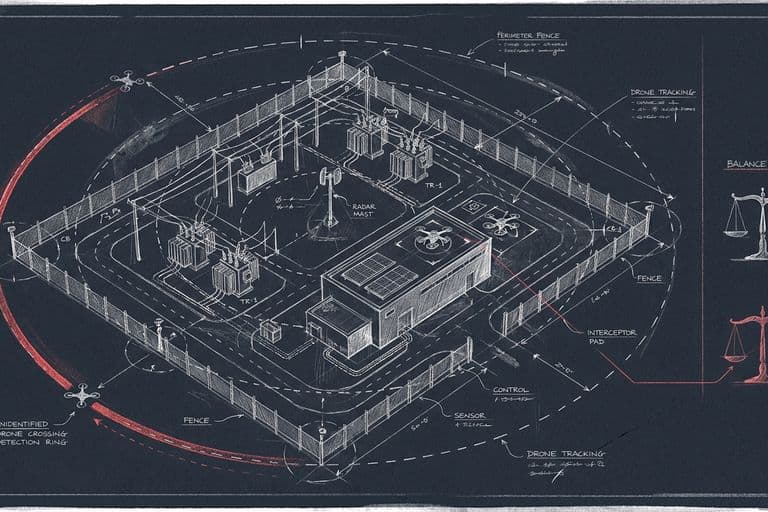
- Detection layer — multi-sensor fusion across radar, RF sensing, acoustic detection, and machine-vision pipelines. Track-quality, discrimination, and hostile-UAS classification under the engagement envelope.
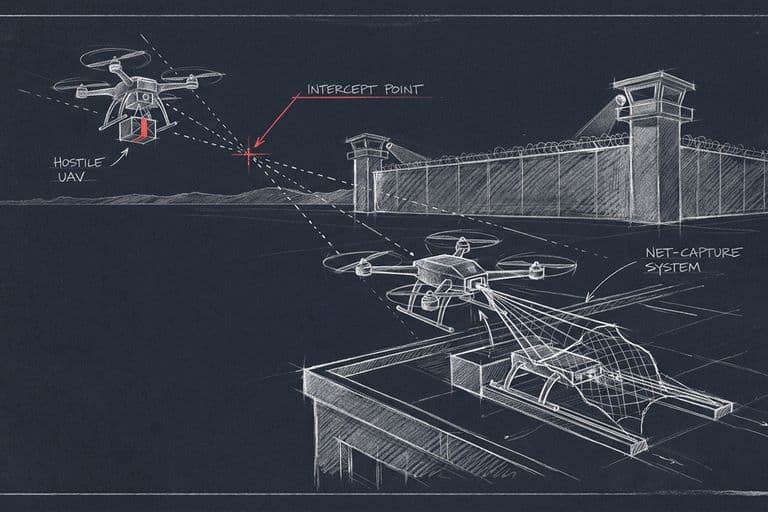
- Eagle One interceptor — the net-capture kinetic component. Multirotor airframe, net launcher, fire-control logic, parachute drogue, and intact-recovery engineering.
- CBRN-response variant — sensor-equipped UAVs for plume survey post-interception. The full chemical, biological, radiological, nuclear response chain that handles the worst-case airspace scenario.
- Forensic-recovery workflow — chain-of-custody handling for captured hostile UAVs and their payloads. The integration with hazmat-team handover and the evidence-chain processing.
- Dispatcher integration — integration of the AUDROS stack with the broader civil-protection and defense command-and-control infrastructure. The data-format compatibility, real-time streaming, and operator-workflow integration.
The programme spanned multi-year execution with the consortium partners each leading specific work packages. The deliverable artifact is a procurement-grade counter-UAS stack that has been subsequently validated by the European Defence Agency at 98 out of 100 on the CBRN counter-UAS evaluation — independent third-party scoring that places AUDROS as the strongest single counter-UAS credential in the Dronehub portfolio.
What AUDROS established as institutional precedent
The technology AUDROS produced is procurement-grade today. But the institutional precedent AUDROS established may be the more durable contribution.
Joint funding mechanism between ESA and EDA exists. The administrative architecture is built, the governance has been exercised, the evaluation framework has been used. Future joint programmes can leverage the institutional precedent rather than re-establishing it from scratch.
SME-led consortium leadership at this funding scale is institutionally normalised. Pre-AUDROS, an SME leading a joint ESA + EDA programme was unprecedented. Post-AUDROS, it's a documented pattern. Subsequent SMEs with credible dual-use proposals can target this funding architecture with AUDROS as the reference case.
Dual-use technology programmes have a structured path. The EDF, NATO DIANA, and Horizon Europe Cluster 4 frameworks all support dual-use technology development — and they each have something analogous to the AUDROS architecture available. SMEs evaluating which EU-funding pathway to pursue have more options today than they did when AUDROS originated, and the AUDROS-style joint-funding pattern remains one of the viable targets.
For Dronehub, AUDROS became the credential that compounds in every subsequent EU-funding application. The consortium-leadership track record at the ESA + EDA joint-funding scale is procurement-grade signal that translates into EDF prime roles, NATO DIANA accelerator participation, Horizon Europe consortium membership, and the broader EU-defense procurement frame.
What this means for SMEs and primes evaluating EU funding
For European drone-technology SMEs — AUDROS is the reference case for what a credible joint ESA + EDA proposal looks like. The dual-use property, the space-domain integration, the NATO-allied consortium architecture — these are the structural elements that align with both agencies' institutional priorities. SMEs with proposals fitting this template have a documented pathway with AUDROS as the precedent.
For EU defense industrial primes — AUDROS demonstrates the SME-led-consortium pattern at procurement-grade depth. Primes that build consortia for EDF, NATO DIANA, or national-MoD programmes can use the AUDROS-style architecture to position SME participation as the technology-innovation core of the consortium, with prime leadership handling the industrial-scale and procurement-relationship dimensions.
For non-EU drone-technology companies evaluating EU procurement — AUDROS is the reference case for what NATO-allied consortium architecture produces at the highest funding-scale. The Dronehub dual-domicile structure (Polish Sp. z o.o. plus Delaware C-Corp Dronehub Inc.) provides the framework for non-EU companies to participate via EU-domiciled partners while maintaining their non-EU procurement relationships.
The full AUDROS programme deep-dive lives at /projects/audros. The original AUDROS programme story is at /blog/drones-intercepting-drones-intruders-we-are-ready-for-action. The CBRN response variant — where the 98/100 EDA score lives — is at /blog/cbrn-drone-response-eda-98-100-validation. The net-capture engagement physics is at /blog/net-capture-interceptor-physics. The EU R&D-partnership door is at /rd-partnership/europe. For a programme-formation conversation, open the contact form.
FAQ
- What was unprecedented about ESA + EDA joint funding?
- The two agencies had not jointly funded a small business before AUDROS. ESA funds space-domain technology under its R&D programmes; EDA funds defense-capability development under its programmes. The two domains overlap (space technology has defense applications; defense technology uses space-domain capabilities like satellite navigation and earth observation), but joint funding by both agencies into a single SME-led programme had not been operationalised until AUDROS. The political and administrative work of establishing the joint funding mechanism was meaningful — the two agencies operate under different governance, different funding cycles, different evaluation frameworks. Making them co-fund a single programme required institutional precedent-setting.
- Why did the AUDROS proposal succeed?
- Three properties of the proposal aligned with both agencies' priorities simultaneously. (1) Dual-use core — net-capture counter-UAS technology has clear civilian-protection applications (prisons, critical infrastructure, civil-protection scenarios) and clear defense applications (counter-UAS in defense environments, CBRN response). The dual-use property is what made co-funding institutionally appropriate. (2) Space-domain integration — the proposal leveraged Galileo positioning, satellite communications for interceptor command-and-control, and earth-observation data for threat-environment characterisation. The space-domain elements gave ESA institutional fit. (3) NATO-allied consortium — Polish lead with Czech partners, both NATO members, both EU members, both under EDIS-aligned industrial frameworks. The geopolitical alignment was clean.
- What did the AUDROS programme actually fund?
- Development of the AUDROS counter-UAS stack across the full engagement chain — detection layer, interception capability (the Eagle One net-capture interceptor), forensic-recovery workflow, CBRN-response variant, and dispatcher integration with civil-protection command-and-control. The programme spans multiple work packages over multi-year execution, with consortium partners each leading specific technical workpackages. The Czech military-research institutes (MTI Brno and MRI Brno) handled deep-defense-domain validation; the Czech industrial partners (Fly4Future, GINA Software, BizGarden) contributed specialised technology; Dronehub led the airframe, autonomy stack, and integration.
- What did the 98 out of 100 EDA score actually validate?
- The CBRN counter-UAS evaluation that followed AUDROS measured capability across five technical dimensions: detection, interception, forensic recovery, plume survey, and dispatcher integration. The 98/100 composite score reflects independent third-party validation across all five dimensions simultaneously. This is the strongest single counter-UAS credential in the Dronehub portfolio — and it landed because the AUDROS programme built the underlying capability stack to procurement-grade depth before the evaluation. The full deep-dive on the 98/100 evaluation is in the dedicated post.
- Why does this matter for SMEs looking at EU defense funding?
- Two reasons. First, AUDROS established the precedent that ESA + EDA can co-fund SME-led programmes. The institutional mechanism exists. Future SMEs with credible dual-use proposals can target this funding pattern, with AUDROS as the reference case. Second, the consortium-leadership credential at this funding scale is procurement-grade signal in itself. An SME that has led an ESA + EDA jointly-funded programme has demonstrated the consortium-leadership, technical-depth, and institutional-coordination capabilities that downstream procurement (EDF, NATO DIANA, national MoD contracts) screens for. For Dronehub, the AUDROS programme became the credential that compounds in every subsequent EU-funding application.
- Is the AUDROS framework still relevant to current programmes?
- Yes — the joint-funding pattern is institutional precedent, not a one-off. Subsequent dual-use technology programmes have used similar architectures. The broader EU procurement frame has moved further toward dual-use capability development since AUDROS launched, with EDF, NATO DIANA, and Horizon Europe Cluster 4 all running topics that align with the AUDROS template. For SMEs evaluating which EU-funding pathway to pursue, AUDROS-style programmes remain a viable target, with the institutional pathway better-trodden now than when AUDROS originated.