Key facts
CBRN drone threats — hostile UAVs delivering chemical, biological, radiological, or nuclear payloads — represent the worst-case airspace scenarios for populated areas, critical infrastructure, and military installations. The threat catalog has matured from theoretical concern to operational planning assumption.
Source · NATO CBRN doctrine; comparative international threat-assessment analysis
Kinetic counter-drone response against an in-flight CBRN payload is worse than doing nothing — fragmenting the delivery vehicle in mid-air disperses the chemical, biological, or radiological agent faster, increasing the contamination zone and the casualty estimate.
Source · CBRN response doctrine analysis; HAZMAT incident modelling
RF jamming does not reach an autonomous UAV running pre-loaded GPS waypoints with degraded-GNSS fallback logic. Modern threat UAVs increasingly assume jamming and are engineered to complete delivery missions even with RF command-and-control denied.
Source · Adversary UAS capability analysis 2022–2025
3 more key facts
The European Defence Agency's CBRN counter-UAS programme evaluated capability across the full response chain — detection, interception, forensic recovery, plume survey, and dispatcher integration. Dronehub scored 98 out of 100, the highest known score in the category and the first time the agency had worked directly with a small business.
Source · European Defence Agency CBRN c-UAS programme evaluation
The AUDROS CBRN response variant deploys sensor-equipped UAVs into the contamination zone post-interception — surveys the plume, locates the source, maps the event, and supports first-responder coordination without exposing personnel to the chemical, biological, or radiological hazard.
Source · AUDROS programme technical documentation
CBRN counter-UAS capability is procurable today through Dronehub Inc. (Delaware C-Corp, SBIR/STTR-eligible US small business) for US federal-civil and defense buyers, and through Dronehub Sp. z o.o. (EDIS-aligned Polish manufacturing) for EU defense and critical-infrastructure buyers.
Source · Dronehub commercial procurement pathway documentation
In this piece
A drone enters controlled airspace carrying a chemical, biological, radiological, or nuclear payload. The conventional counter-UAS modalities don't work, or actively make the outcome worse. Net-capture interception combined with sensor-equipped plume-survey UAVs handles the threat — and is the capability that earned Dronehub the European Defence Agency's 98 out of 100 score on the CBRN counter-UAS programme. That score is the strongest single counter-UAS credential in the Dronehub portfolio. This post unpacks what it actually validated.
The CBRN response problem is the worst-case airspace scenario in modern counter-UAS doctrine. The threat catalog has matured from theoretical concern to operational planning assumption across NATO, the EU, and allied jurisdictions. The defensive doctrine has converged on what does and doesn't work. The capability that the EDA's 98/100 score validated is the response architecture this post explains.
The CBRN threat profile
CBRN drone delivery refers to a hostile UAV — typically a commercial or modified-commercial multirotor or fixed-wing platform — carrying a chemical, biological, radiological, or nuclear payload over a target. The threat is not exotic. Commercial UAVs have payload capacity sufficient for meaningful CBRN delivery. The cost-of-attack is low for the adversary. The cost-of-event for the defender is potentially catastrophic.
Four categories of agent are operationally relevant in the threat catalog:
- Chemical agents — industrial chemicals (chlorine, ammonia, hydrogen cyanide), nerve agents (Sarin, VX), blister agents (mustard). Liquid or gas delivery. Plume forms by atmospheric dispersion, casualty pattern depends on agent volatility and dispersion conditions.
- Biological agents — pathogens (anthrax spores, plague bacillus, smallpox virus). Powder or aerosol delivery. Plume forms by aerosolisation; secondary transmission risk depending on pathogen class.
- Radiological agents — Radiological Dispersal Devices (RDDs, commonly known as "dirty bombs") delivering radioactive isotopes by mechanical dispersal. Localised contamination, long persistence.
- Nuclear — improvised or stolen nuclear material. The least likely of the four categories operationally but the highest consequence.
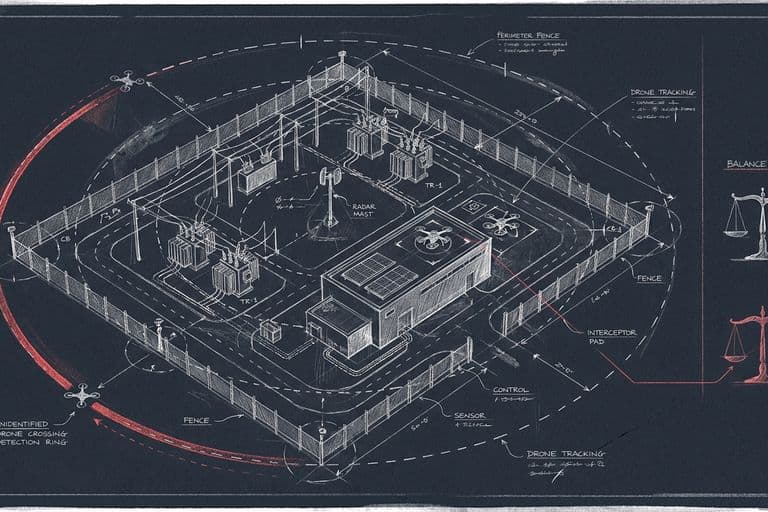
The threat scenario assumes an autonomous UAV running pre-loaded GPS waypoints with degraded-GNSS fallback, command-and-control link used only for mission abort/update, and a delivery payload sized for meaningful effect. The target may be a city centre, a critical-infrastructure facility, a military installation, a transportation hub, or a planned public event.
Why the classical response modalities fail
The counter-UAS doctrine across allied forces has converged on a few baseline response modalities. Against CBRN-payload threats, two of the three fail structurally.
Kinetic shoot-down fragments the payload mid-delivery. A kinetic strike — autocannon round, surface-to-air munition, fragmentation missile — destroys the delivery vehicle. In conventional counter-UAS that's the desired outcome. In CBRN counter-UAS it's not. Fragmenting the agent container distributes the agent across a wider area than directed delivery would have. A liquid chemical agent in a fragmented container atomises across a wider area. A powder biological agent in a fragmented container disperses by airflow more broadly than the original delivery pattern. A radiological dispersal device fragmenting kinetically produces a wider contamination zone than the original device design. Kinetic response in confirmed-CBRN-payload scenarios is explicitly excluded by NATO counter-UAS doctrine.
RF jamming doesn't reach the threat. Threat UAVs tasked with CBRN delivery are engineered for autonomous mission completion. The mission profile assumes adversary electronic warfare and counter-UAS posture in the target area. The threat UAV runs pre-loaded GPS waypoints with multiple fallback navigation modes — inertial dead-reckoning, visual SLAM, magnetometer-based navigation. The command-and-control RF link is typically used only for mission abort or update. Jamming the RF link or denying GPS doesn't stop the delivery; it might marginally degrade accuracy but does not intercept the mission.
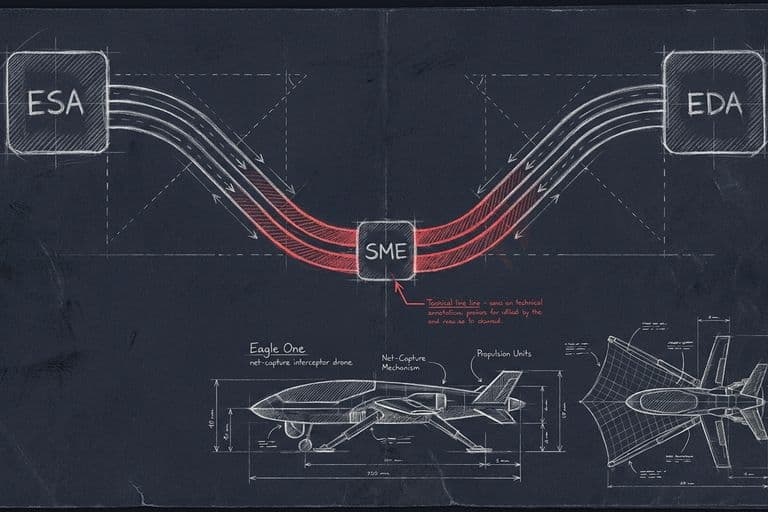
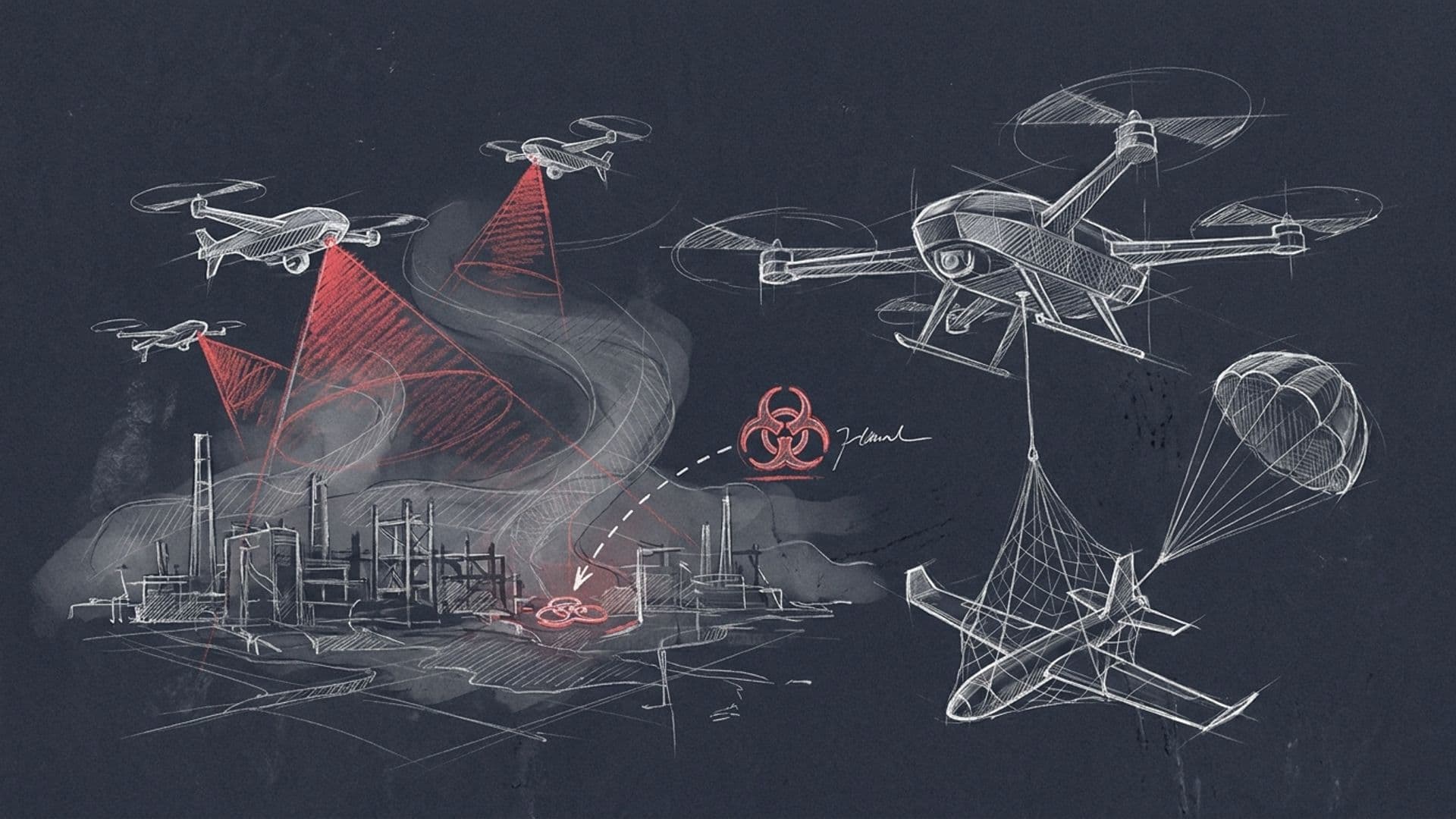
That leaves net-capture as the only viable interception modality. The capture mechanism brings the hostile UAV down intact, preserves the payload for hazmat-team handover, and operates inside the legal envelope of regulated civilian airspace. The intact-recovery property is the load-bearing element — without it, the engagement itself becomes part of the CBRN incident.
The plume survey component
Interception is necessary but not sufficient. Even with net-capture preserving the payload intact, the interception happens at altitude over a target area, and the contamination event may already be in progress — the hostile UAV may have started releasing agent before interception completed, the wind may carry the release plume across populated areas, the source of release may be on the ground if any payload reached release point.
The plume-survey component handles the post-interception response. Sensor-equipped UAVs deploy into the contamination zone, executing a structured search pattern that maps the agent concentration in three dimensions, locates the source of release if any, characterises the plume's movement vector under prevailing wind, and streams the analysis to the incident commander's dispatcher console.
The sensor payload varies by threat class:
- Chemical detection — handheld-class ion-mobility spectrometers, photoionisation detectors, electrochemical sensors. Sized to UAV payload capacity.
- Biological sampling — aerosol collectors that capture air samples for ground-based PCR or immunoassay analysis. The plume-survey UAV doesn't identify the agent in real time but collects the sample that enables identification.
- Radiological detection — geiger-counter-class sensors, scintillation detectors, gamma spectrometers depending on the isotope characterisation requirement.
- Multi-modal — for unknown-agent scenarios, a combined-sensor payload covers the highest-probability agent classes simultaneously.
The plume-survey UAVs themselves are expendable. Operating in a contamination zone, they accumulate agent on airframes and rotors and become hazmat assets after the mission. Recovery and decontamination follows hazmat protocol; in some scenarios the UAVs are disposed of rather than recovered. The deployment-pattern economics are sized accordingly — the cost of expendable UAV is small compared to the operational value of contamination-zone characterisation without exposing personnel.
What 98/100 validated
The European Defence Agency's CBRN counter-UAS programme assessed capability across five technical dimensions simultaneously. Each was scored independently by the agency's technical-assessment panel, and the composite score across all five reflects the integrated capability rather than any single component's performance.
Detection. The upstream sensor stack's ability to identify a hostile UAV approaching with payload-delivery characteristics. Discrimination between operational UAS traffic and threat platforms. Track quality over the engagement envelope. Integration across radar, RF sensing, acoustic detection, and machine-vision sensors. Score reflects detection accuracy, false-positive rate, and discrimination capability at the threat envelope.
Interception. The net-capture engagement against the in-flight target, preserving the payload intact. Engagement geometry, fire-control accuracy, miss-rate, intact-recovery rate. The Eagle One interceptor platform and its engagement chain were evaluated under representative threat profiles.
Forensic recovery. Chain-of-custody handling of the captured hostile UAV and its payload for hazmat-team handover. The recovery point selection, the descent profile predictability, the integrity of the captured artefact, and the handover protocol to specialised CBRN response teams.
Plume survey. Post-interception deployment of sensor-equipped UAVs into the contamination zone. Sensor accuracy under operational conditions, search pattern coverage, source-localisation accuracy, plume-mapping fidelity, and integration of the output into the dispatcher console.
Dispatcher integration. The c-UAS stack's integration with the broader civil-protection and first-responder command-and-control infrastructure. Data format compatibility, real-time streaming, alert classification, command-and-control workflow. The integration property is what determines whether the technical capability becomes operationally usable.
The composite 98/100 across the five dimensions means the capability survived independent third-party scrutiny on each dimension simultaneously. Strong scores on individual dimensions are common in counter-UAS evaluations; strong scores across all five at once are not.
Dispatcher integration in detail
The dispatcher integration is worth dwelling on because it's the dimension that most counter-UAS vendors get wrong. Strong technical capability that doesn't integrate with the operator's existing command-and-control becomes a parallel system the incident commander has to mentally fuse with the rest of the response — and incident commanders under time pressure don't fuse mental models well.
The AUDROS dispatcher integration ships data into the response organisation's existing incident-management infrastructure. In the US, that typically follows ICS/NIMS (Incident Command System / National Incident Management System) command structures. In the EU it follows civil-protection standards that vary by member state. In the UK it follows specific national protocols. In the Nordic cluster, sector-specific frameworks apply. AUDROS publishes data in the formats and protocols that match the responder organisation's existing tooling, rather than asking the responder to consume the data through a new vendor-specific console.
The integration is what makes the 98/100 capability operationally usable rather than impressive on a brochure. A score of 98/100 for technical capability with poor integration would have landed somewhere in the 70s.
Procurement context
For US defense and federal-civil — direct contract through Dronehub Inc. (Delaware C-Corp, SBIR/STTR-eligible US small business). DoD CBRN programmes, DHS S&T CBRN response, DOE radiation-response capability, FEMA emergency-management programmes, state-level CBRN response funding. The Section 848-compatible documentation, the NATO-allied non-CN supply chain, and the EDA 98/100 third-party validation pre-resolve the diligence pack.
For EU defense and civil-protection — Dronehub Sp. z o.o. and the EDF, NATO DIANA, national-MoD, and national-civil-protection procurement pathways. The EDIS-aligned manufacturing, the consortium-leadership credential from the AUDROS programme, and the agency-direct validation through the EDA evaluation translate directly to the procurement frame.
For commercial critical-infrastructure operators with CBRN consequence-of-event exposure — refineries handling toxic-industrial chemicals, chemical plants, water-treatment facilities, nuclear sites, transportation hubs — direct industrial licensing through either entity. The consequence-of-event argument is the procurement driver: even rare CBRN scenarios justify dedicated capability because the alternative outcome is catastrophic for the operator.
For major-event security operations (Olympic Games, international summits, head-of-state visits, large public gatherings) — typically procured through the event security contractor or the host government's protective-services arm, with Dronehub providing the AUDROS capability stack under direct contract or sub-contract to the prime security operator.
The full AUDROS programme context lives at /projects/audros. The counter-UAS modality landscape is at /blog/counter-uas-2026-jamming-kinetic-capture. The net-capture engagement physics is at /blog/net-capture-interceptor-physics. The defense industry context is at /industries/defense; critical infrastructure at /industries/critical-infrastructure. For a procurement-readiness conversation on CBRN counter-UAS, open the contact form.
FAQ
- Why isn't kinetic shoot-down the answer for CBRN drones?
- Because fragmenting a CBRN payload mid-delivery disperses the agent faster than letting the delivery complete. A liquid chemical agent in a fragmented container atomises across a wider area; a powder biological agent disperses by airflow more broadly; a radiological dispersal device fragmenting kinetically produces a wider contamination zone than a directed-delivery would have. Kinetic response in the CBRN context turns a potential point-source incident into a confirmed wide-area incident. The casualty estimates run in the wrong direction. CBRN doctrine across NATO explicitly excludes kinetic response for confirmed-CBRN-payload threats; the alternative interception modality has to preserve the payload intact.
- Why doesn't jamming work against CBRN-delivery drones?
- Because the threat UAVs that get tasked with CBRN delivery are engineered for autonomous mission completion. The mission profile assumes adversary electronic warfare and counter-UAS posture in the target area. The threat UAV runs pre-loaded GPS waypoints with multiple fallback navigation modes — inertial dead-reckoning, visual SLAM, magnetometer-based navigation. The command-and-control RF link is typically used only for mission abort or update, not for active flight control during the delivery phase. Jamming the RF link or denying GPS doesn't stop the delivery. It might delay it or degrade accuracy at the margin, but it doesn't intercept the mission. The threat catalog from 2022 forward routinely assumes jamming and operates accordingly.
- What does the 98/100 EDA score actually measure?
- It measures the full response chain across five technical dimensions, evaluated by the European Defence Agency's technical-assessment panel. Detection — the upstream sensor stack's ability to identify a hostile UAV approaching with payload-delivery profile. Interception — the net-capture engagement against the in-flight target, preserving the payload intact. Forensic recovery — the chain-of-custody handling of the captured hostile UAV and its payload for hazmat-team handover. Plume survey — the post-interception deployment of sensor-equipped UAVs into the contamination zone to map, locate the source, and support response coordination. Dispatcher integration — the integration of the c-UAS stack with the broader civil-protection and first-responder command-and-control infrastructure. The 98/100 score represents independent third-party validation across all five dimensions simultaneously.
- What does the plume-survey component actually do?
- Once the hostile UAV has been intercepted, the contamination event is already in progress — agent has been at least partially released, the plume is forming, the source location needs to be characterised, and first-responders need real-time situational awareness without entering the contamination zone. The plume-survey UAVs (multi-rotor airframes equipped with chemical-detection, biological-sampling, or radiological-sensor payloads depending on the threat class) deploy into the contamination zone, sample the agent concentration along a structured search pattern, map the plume's extent and movement vector, locate the source of release (which may be on the ground if any payload reached release point), and stream the analysis to the incident commander's dispatcher console. The responders work from the dispatcher console; they don't enter the contamination zone until the analysis is complete and PPE protocols are matched to the identified agent.
- How does this integrate with civil first-responder operations?
- Through structured dispatcher-stack integration. The AUDROS c-UAS stack publishes its data — detection events, interception outcomes, plume-survey results, source-location estimates — into the incident-management system the responder organisation uses (which varies by jurisdiction, but typically follows ICS/NIMS in the US, civil-protection standards in the EU, sector-specific frameworks in the UK and Nordic cluster). Responders consume the data from their normal incident-command tools rather than learning a new system. The c-UAS-driven analysis becomes one input among many — radar, ground sensors, mutual-aid resources, weather data — that the incident commander synthesises into the response plan. The integration is the property that makes the technical capability operationally usable; without it the c-UAS data ends up in a parallel system that the incident commander has to mentally fuse.
- Where does CBRN counter-UAS actually deploy?
- Critical-infrastructure perimeter (refineries, chemical plants, water-treatment facilities, nuclear sites, transportation hubs) where the CBRN consequence-of-event drives the procurement decision. Sovereign defense installations (military bases, weapons facilities, command centres) where adversary CBRN UAV delivery is a doctrinal threat scenario. Major event security (head-of-state visits, large public gatherings, international summits) where the consequence-of-event during a one-time window justifies dedicated CBRN response capability. Civil-protection regional deployments where the regional civil-protection agency maintains CBRN response as a sovereign-capability function. Border infrastructure where CBRN smuggling is a documented or modelled threat vector. The procurement frame is structured around consequence-of-event rather than threat-likelihood — even rare CBRN scenarios justify dedicated capability because the alternative outcome is catastrophic.