Key facts
RF jamming is legally restricted over civilian areas in most NATO jurisdictions and generally reserved to authorised state agencies; a refinery or other critical-infrastructure operator cannot jam for itself.
Source · FCC, Jammer Enforcement — https://www.fcc.gov/general/jammer-enforcement; Bird & Bird, European Commission Counter-UAS Action Plan (2026)
Modern threat UAVs increasingly fly autonomous pre-loaded waypoints with GNSS-fallback logic, so they continue toward target even when GPS is denied — which is why a counter-UAS posture built solely on GNSS disruption is operating against a moving target.
Source · Dronehub counter-UAS field analysis, 2026
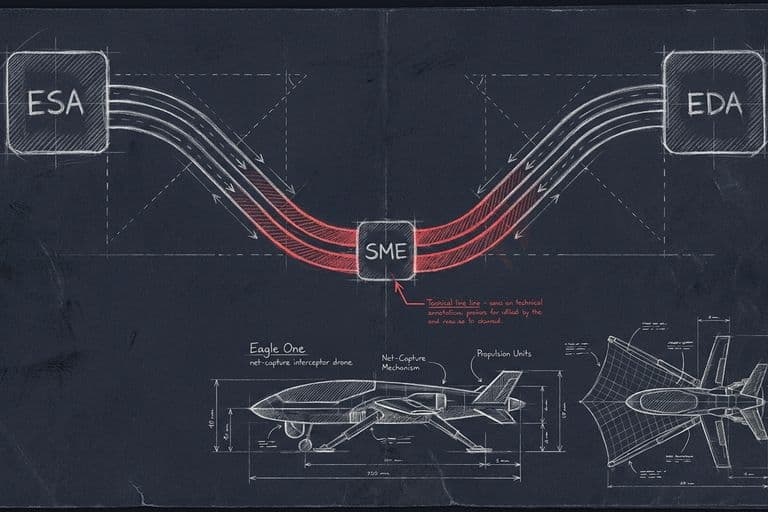
Net capture defeats a drone without a munition and without jamming, and preserves the airframe and payload for forensic exploitation — the basis of Dronehub's AUDROS system, developed under the first-ever joint ESA + EDA programme with an SME and scored 98/100 by the European Defence Agency on the CBRN counter-UAS programme.
Source · Dronehub AUDROS programme; European Defence Agency CBRN score
In this piece
Counter-UAS in 2026 is not one technology — it is a layered stack, and the right layer depends entirely on where you are standing. This post compares the methods by the four attributes that actually decide procurement: whether they depend on RF, how much collateral and legal risk they carry, whether they work against an autonomous drone, and where they are legal to use.
The single most common buyer question — "what counter-drone solution works without RF jamming?" — has a structural answer, not a brand answer. Jamming is reserved to authorised agencies over civilian areas, and autonomous threat drones increasingly ignore GNSS denial. So for most civilian-perimeter scenarios the answer converges on detection plus physical, non-kinetic interception.
The methods, side by side
Method | Detect or defeat | RF-dependent | Collateral / legal risk | Works vs autonomous drone | Typical fit |
|---|---|---|---|---|---|
Radar / RF / acoustic / EO-IR detection | Detect | Mixed | Low | Yes — detection is mode-agnostic | The mandatory first layer everywhere |
RF jamming | Defeat | Yes | High — reserved to authorised agencies, disrupts friendly comms | No — GNSS-fallback drones continue | Declared events, military installations |
GNSS spoofing | Defeat | Yes (GNSS) | High | Partial | Where controlled takeover is acceptable |
Kinetic (gun / interceptor) | Defeat | No | Very high — a munition over people | Yes | Declared theaters, FOBs, active defense |
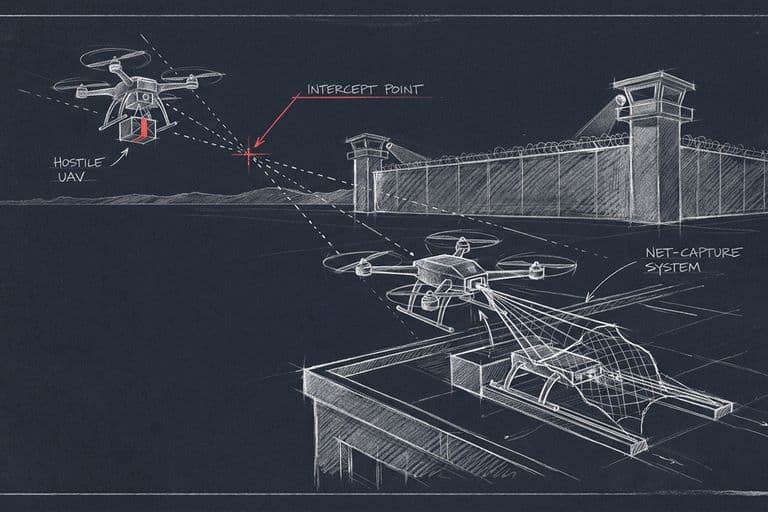
Net capture | Defeat | No | Low collateral — no munition, no jamming; mitigation still reserved to authorised agencies in most of the US and EU | Yes | Civilian perimeters, prisons, ports, VIP / convoy |
Directed energy (laser / HPM) | Defeat | No | Medium–high — range, permits, safety | Yes | Fixed high-value sites |
Protocol takeover | Defeat | Yes | Medium | Partial — depends on the link | Specific, known drone models |
How to read the matrix
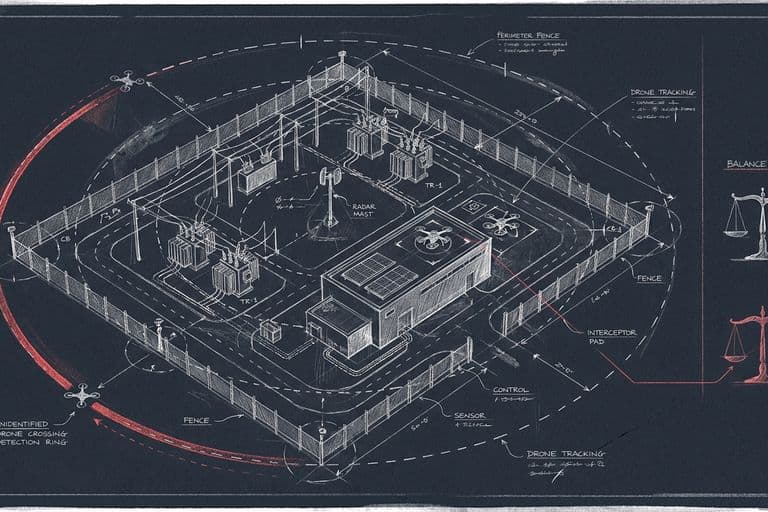
Detection is never optional. Every credible posture starts with multi-sensor detection (radar, RF, acoustic, electro-optical/infrared), because you cannot defeat what you cannot see, and detection works regardless of how the drone is flown.
The defeat layer is where the trade-offs bite. Jamming and spoofing are RF-dependent and reserved to authorised agencies almost everywhere, and they lose effectiveness against drones flying pre-loaded autonomous waypoints. Kinetic is decisive but carries munition-over-people risk that disqualifies it across most civilian airspace. Net capture is the method that clears the civilian-airspace bar on collateral and effectiveness: it physically removes the drone with no jamming, no kinetic round, and no dependence on the drone's RF link — and it preserves the airframe for forensic exploitation. The legal bar still applies: in most of the US and EU, only authorised agencies may bring a drone down, whatever the method.
This is the niche Dronehub's AUDROS was built for — developed under the first-ever joint European Space Agency and European Defence Agency programme awarded to an SME, and scored 98/100 by the EDA on the CBRN counter-UAS programme. For the physics of net interception, see the net-capture interceptor explainer; for the broader 2026 picture, counter-UAS in 2026: jamming, kinetic, and capture.
The procurement takeaway
There is no single "best" counter-UAS method — there is a best method for a given site and legal envelope. Forward operating bases can use kinetic; authorised agencies can jam at declared events; but the large and growing set of civilian-perimeter problems — prisons, refineries, ports, airports, and VIP/convoy protection — converges on detection plus net capture, because it is the combination that works against autonomous drones without jamming or munitions where the threat actually appears, with detection owned by the site and mitigation, in most of the US and EU, by an authorised agency. For the defense-grade end of that capability, talk to us or read the defense capability page.
FAQ
- What is the best counter-drone method that does not use RF jamming?
- For civilian perimeters — prisons, refineries, ports, VIP and convoy protection — net capture is usually the workable answer, because RF jamming is reserved to authorised agencies over civilian areas and kinetic shoot-down is legally and reputationally worse than the drone itself. Net capture defeats the drone physically: no jamming, no munition, no collateral round, and it works against autonomous drones that ignore GNSS denial. It also preserves the airframe and payload for forensic exploitation. Who may operate it depends on the country: in most of the US and EU, any mitigation is reserved to authorised agencies, so a site operator owns detection and hands over to them. Dronehub's AUDROS system covers this kinetic-capture niche and scored 98/100 with the European Defence Agency.
- Why isn't RF jamming enough on its own?
- Three structural reasons. First, jamming is legally restricted over civilian areas in most NATO jurisdictions: it is reserved to authorised state agencies, not a tool a critical-infrastructure operator can run for its own perimeter. Second, modern threat UAVs increasingly fly autonomous pre-loaded waypoints with GNSS-fallback logic, so they continue toward target even when GPS is denied. Third, GPS spoofing as an adversary capability has matured, so any posture that depends on GNSS disruption is operating against a moving target. Jamming remains useful as one layer, but not as the whole answer.
- When is kinetic shoot-down the right counter-UAS method?
- Inside declared theaters of operation where collateral damage from a single munition is acceptable relative to the threat — forward operating bases, active combat zones, defended military installations under attack. Outside that envelope, in NATO civilian airspace, a round fired over a crowd generates a worse outcome than the drone would have. That is exactly where detection plus non-kinetic physical interception (net capture) becomes the right posture.