Key facts
RF jamming is generally reserved to authorised state agencies (in the US federal law prohibits operating jammers, with no exemption for use within a business; in the UK interfering with wireless telegraphy is an offence; in most EU states jamming is a state task), and it is increasingly ineffective against autonomous drones running pre-loaded GPS waypoints with degraded-GNSS fallback.
Source · FCC, Jammer Enforcement — https://www.fcc.gov/general/jammer-enforcement; Wireless Telegraphy Act 2006, s. 68; Bird & Bird, European Commission Counter-UAS Action Plan (2026)
Kinetic counter-UAS systems are legally unusable outside a declared theater of operations in nearly every NATO jurisdiction — a single round fired over a populated area becomes the legal and reputational event, displacing the hostile drone as the primary incident.
Source · Comparative jurisdictional analysis, NATO C-UAS doctrine
Net-capture interceptors bring hostile UAVs down intact, preserving payload, electronics, and geolocation history for attribution and post-incident forensic review, evidence that a kinetic shoot-down destroys.
Source · AUDROS programme outcomes; net-capture C-UAS technical literature
3 more key facts
The European Defence Agency scored Dronehub 98 out of 100 on the CBRN counter-UAS programme — the first time the agency had worked directly with a small business, and the highest known third-party score in the net-capture category.
Source · European Defence Agency CBRN C-UAS programme evaluation
GPS spoofing has been routinely documented over Eastern Europe and the Eastern Mediterranean since 2022 — degrading any counter-UAS posture that depends on RF-pattern recognition or GNSS-denial as its primary response.
Source · Operational reporting on GNSS interference, 2022–2025
Drone-borne contraband into US and EU correctional facilities has grown from rare anomaly to a primary smuggling vector across the 2020–2025 window, making prisons the volume use case for per-facility C-UAS deployment.
Source · US Bureau of Prisons advisories; EU correctional industry reports 2020–2025
In this piece
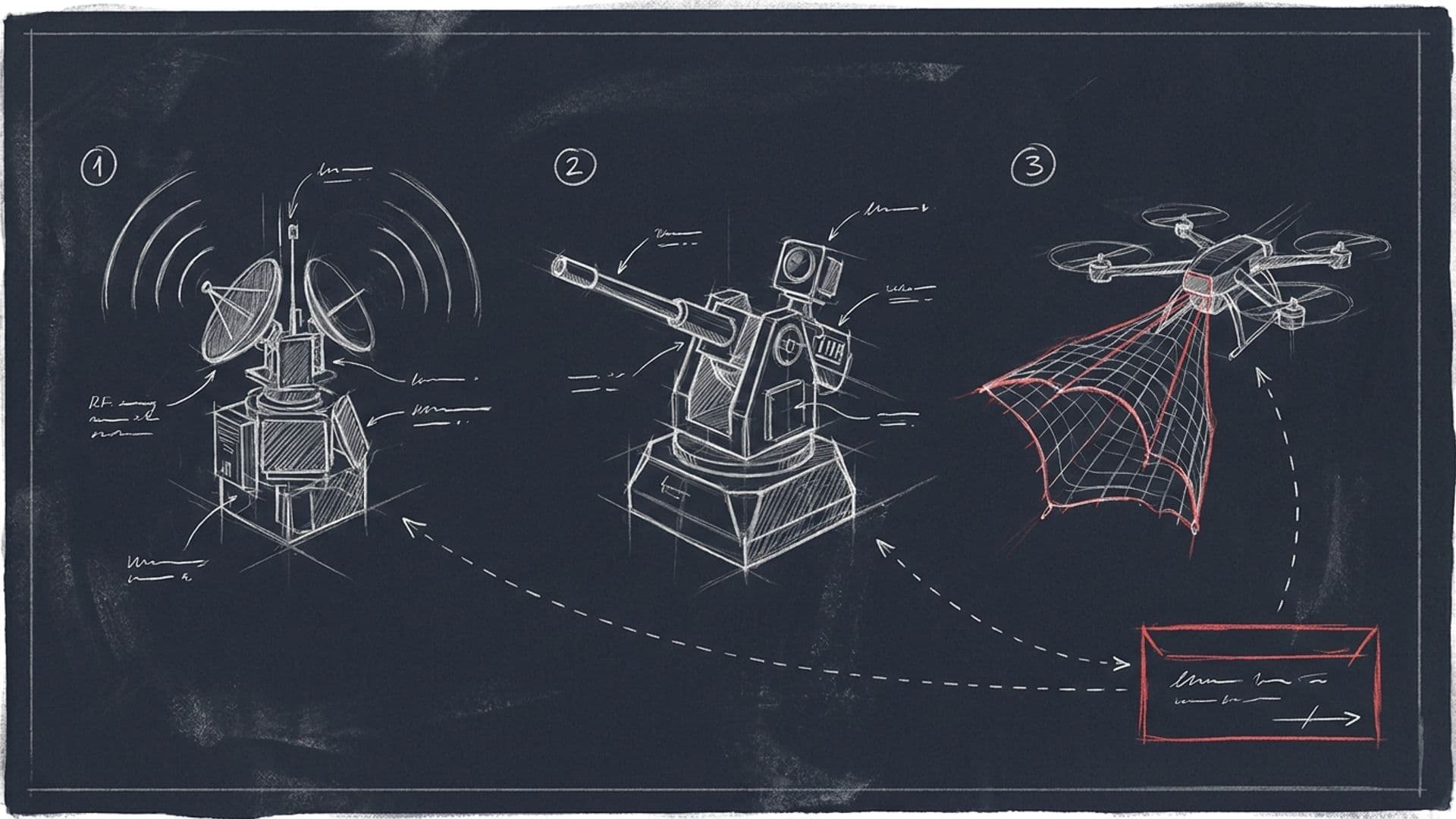
Detection is mostly solved. Response is mostly not. Inside the seconds between "we see a hostile drone" and "the drone is no longer a threat," the operator has three classical options — RF jamming, kinetic shoot-down, and net-capture interception. Two of the three are constrained out of the airspace where the threat actually appears. The third avoids jamming and munitions alike, though who may operate it still depends on the country and on the operator — and the procurement market hasn't fully caught up yet.
This is the 2026 buyer's guide to picking a counter-UAS modality. It walks through where each option works, where each one breaks, and which procurement pipelines the surviving modality actually fits.
The response gap is the entire problem
Counter-UAS doctrine in 2020 still treated detection as the hard problem. By 2026 it isn't — radar, RF sensing, acoustic arrays, and machine-vision pipelines detect hostile UAVs reliably across most operational profiles. The intelligence is in the catalog; the catalog is integrated into command stacks; the alert reaches the operator. Detection-to-decision has compressed to seconds. The hard problem is what happens next.
The response gap is the window between alert and neutralisation. In that window the operator's choices are constrained by three things simultaneously: the regulatory envelope of the modality, the operational envelope of the threat UAV, and the collateral-damage envelope of the airspace below. A modality that wins on one axis and loses on the other two is not deployable in operational reality.
Two of the three classical modalities have lost on two axes simultaneously. That's the structural shift the procurement market is still catching up to.
Modality one: RF jamming
RF jamming was the dominant first-generation C-UAS modality. The mechanism is direct: broadcast in the GPS, command-and-control, or video-link bands at sufficient power to drown out the hostile drone's signal, and the drone either lands, returns to launch, or loses control entirely. For consumer-grade UAVs running unauthenticated commercial GPS and standard 2.4/5.8 GHz command links, jamming was effective the first time it was tried.
Three structural changes have eroded the modality.
The first is legal. Jamming is reserved to the state almost everywhere. The FCC says federal law prohibits the operation, marketing or sale of jamming equipment, with no exemption for use within a business; federal law enforcement may use jammers only in limited cases, and since July 2026 state and local agencies certified under the SAFER SKIES Act may use authorised mitigation systems, subject to FCC authorisation. In the UK, interfering with wireless telegraphy is an offence under the Wireless Telegraphy Act 2006, and in most EU states jamming is a state task under national telecoms and police law. Poland, since July 2026, lets a notified critical-infrastructure operator allow specialised armed security formations to jam in the drone-threat cases the law lists. Operators of critical infrastructure cannot run continuous RF jamming as their own C-UAS posture.
The second is technical. Threat UAVs have matured. Autonomous drones running pre-loaded GPS waypoints with degraded-GNSS fallback logic continue toward target after the GPS signal is denied. Inertial navigation, visual-odometry SLAM, and mesh-network command paths all provide redundancy that defeats single-axis RF disruption. The threat catalog from 2022 forward routinely assumes jamming and is engineered to continue mission anyway. Jamming an autonomous delivery vehicle that has already been told where to go and what to drop does not prevent the delivery.
The third is asymmetric. Adversary states with electronic-warfare capability have demonstrated that they can spoof GNSS at operational scale across Eastern Europe and the Eastern Mediterranean since 2022 — and spoofing is the inverse of jamming. A defender whose counter-UAS posture depends on RF-pattern recognition can be overwhelmed by an adversary running spoof signals that mimic legitimate UAV traffic. The defender's RF discrimination layer becomes a liability.
RF jamming retains a place in the modality stack. It remains valuable in the hands of authorised agencies, for event security and declared military installations, and as one layer of a multi-modal posture. It does not work as the primary response for persistent critical-infrastructure coverage, prison anti-smuggling, or sovereign-airspace overwatch in regulated civilian environments.
Modality two: kinetic shoot-down
Kinetic shoot-down is the modality the doctrine wants. A munition strikes the hostile drone, the drone is destroyed, the threat is neutralised. Simple, direct, satisfying. The constraint is that the modality is legally unusable across the airspace where the threat now appears.
In a declared theater of operations — a forward operating base, an active combat zone, a defended installation under attack — kinetic C-UAS is doctrinally available and operationally appropriate. The collateral-damage envelope is sized for the operational context, the rules of engagement permit the response, and the alternative (a hostile drone reaching target) is worse than the kinetic effect on the ground below.
Outside that envelope, the modality fails. A round fired over a populated area in NATO civilian airspace becomes the legal and reputational event, displacing the hostile drone as the primary incident. The drone might have caused embarrassment or damage; the kinetic response causes lawsuits, headlines, regulatory inquiries, and the careers of the people who authorized it. The collateral-damage envelope of a NATO city does not accommodate spent munitions falling under gravity, autocannon rounds tumbling outside their intended dispersion, or surface-to-air missile fragments distributed across several blocks.
The legal envelope shrinks further once you cross from open airspace into the regulatory space of prison perimeters, refinery perimeters, port environments, or stadium districts. Operators in those environments do not have the legal authority to discharge munitions even if they could acquire and operate them. Insurance carriers do not write policies that contemplate kinetic C-UAS in civilian environments. The modality is not procurable for the use cases the procurement panels are actually evaluating.
Kinetic C-UAS retains relevance for defended military installations under explicit hostile-airspace doctrine, for active combat operations, and for sovereign-defense procurement aimed at war-fighting environments. It does not work for the much larger commercial and federal-civil procurement surface in 2026.
Modality three: net-capture interception
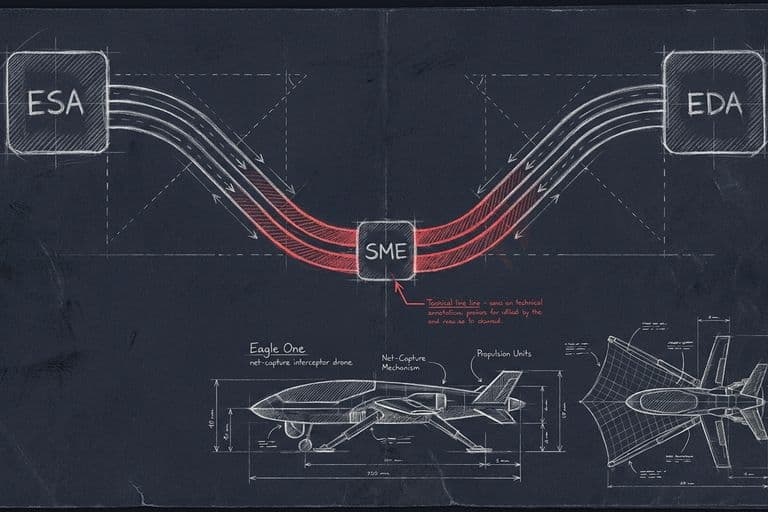
Net-capture avoids the weaknesses of the other two: it does not depend on the drone's radio link, and it brings the target down rather than breaking it apart. A multirotor interceptor — Dronehub's Eagle One platform within the AUDROS programme is the reference design — fires a wide-spread capture net at the hostile UAV. The net wraps the rotors, the hostile drone loses lift, and the engaged system descends under a parachute drogue. The target is brought down intact at a reduced terminal velocity, in a location the operator can predict from the interception geometry rather than the threat's last momentum vector.
Three engineering properties make the modality procurement-grade.
Intact-target capture. The hostile UAV does not fragment. Its payload, its flight controller, its memory cards, its GPS log, and its operator-side telemetry trace are all preserved. Forensic teams recover an artifact. Attribution becomes possible. For the contraband-into-prison use case, the contraband itself becomes the evidence. For sovereign defense, the captured drone is the intelligence asset that enables further analysis of adversary capability.
Safety on the ground. A drone descending under a parachute drogue is a different ballistic profile from drone debris falling after a kinetic strike. Personnel on the ground and infrastructure below are not put at additional risk. The collateral-damage envelope of net-capture is closer to a controlled UAV emergency landing than to a munition discharge.
Legal envelope. No RF jamming is employed and no munition is discharged. That does not put net capture outside counter-drone law: the 2020 US interagency advisory lists nets among the techniques that may implicate federal laws protecting aircraft, and in most of the US and EU, bringing a drone down is reserved to authorised agencies — federal agencies and, since July 2026, certified state, local and correctional agencies in the US; the police in most EU states; specialised armed security formations at protected sites in Poland. What the law requires depends on the country and on who operates the system, so a prison, refinery, port, substation or dam plans net capture together with the agency authorised to run it.
The CBRN response variant of AUDROS extends the modality into the worst-case airspace threats — chemical, biological, radiological, or nuclear payloads dispersed by drone. Kinetic response in those scenarios is worse than doing nothing; fragmenting the drone disperses the payload faster. Jamming does not reach an autonomous delivery vehicle. The interception that fits is net-capture mid-delivery, with the captured payload preserved for hazmat handling, paired with sensor-equipped UAVs deployed into the contamination zone to survey the plume and locate the source. The European Defence Agency scored Dronehub 98/100 on exactly this capability — the strongest single C-UAS credential in the Dronehub portfolio and the first time the agency had worked directly with a small business.
Picking a modality by use case
The procurement frame collapses to a matrix between threat profile and airspace regulation. Two example use cases make the pattern visible.
Prison anti-smuggling. The threat is consumer-grade or modified-consumer UAVs delivering contraband — drugs, phones, weapons, sometimes more. The volume is meaningful: US Bureau of Prisons advisories and EU correctional reports document that drone-borne contraband has shifted from rare anomaly to primary smuggling vector across the 2020–2025 window. The airspace is regulated civilian, RF jamming is reserved to authorised agencies in most jurisdictions, and kinetic response is legally unavailable. Net-capture fits those constraints when the agency the law authorises runs it (in the US since July 2026, that can be a certified state or local correctional agency) — and the intact-recovery property turns the captured drone into the evidence chain that the facility's prosecution effort needs. Per-facility deployment is the volume use case where net-capture's procurement advantages compound.
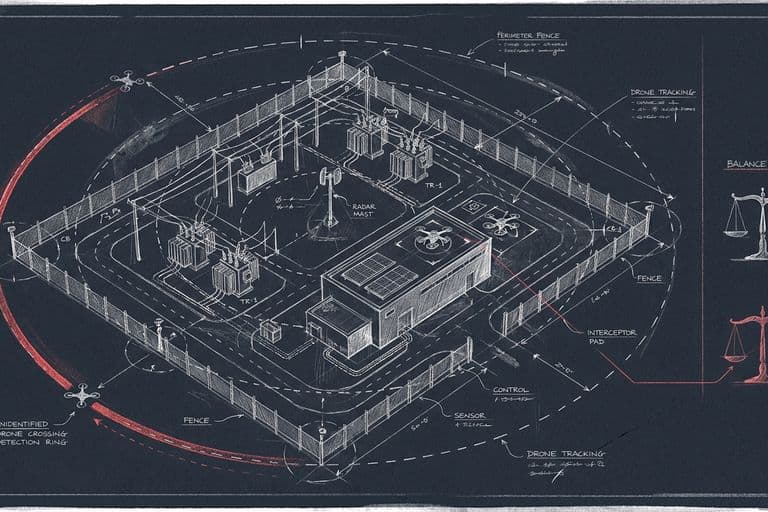
Critical-infrastructure perimeter. A refinery, a substation, a port, a dam, an airfield. The threat profile is broader — espionage, sabotage, contraband, and increasingly attempted CBRN delivery. The coverage requirement is 24/7, not event-windowed. The regulatory frame is civilian airspace, where in most of the US and EU the operator may detect but not mitigate. The modality stack collapses to a multi-layer detection layer the operator owns, feeding a net-capture interception layer run by the authorised agency, with RF jamming left to agencies authorised to use it. Persistent counter-UAS overwatch at this profile is becoming infrastructure-scale procurement — every facility, not just the named-target ones.
A short summary of where each modality fits across the use cases:
- RF jamming — event protection and declared military installations, by authorised agencies; one layer of multi-modal posture (not the primary)
- Kinetic shoot-down — declared theaters of operations, active combat zones, defended installations under hostile-airspace doctrine
- Net-capture interception — prison anti-smuggling, critical-infrastructure perimeter, CBRN response, VIP and convoy escort, civil incident response, sovereign airspace overwatch in NATO civilian environments
The first two modalities continue to matter inside their envelopes. The third modality is the one with the procurement-surface area scaling fastest in 2026, because it's the one that fits the airspace where the threats actually appear.
What this means for procurement
For US programme offices — SBIR/STTR, AFWERX, DIU, DHS S&T — the procurement question is no longer "which C-UAS vendor has the highest claimed detection accuracy." The question is "which C-UAS vendor's response modality is legally deployable in the airspace I am defending." For most US federal-civil and critical-infrastructure mission profiles run by an agency with counter-UAS authority, that answer collapses to net-capture, with multi-modal layering for the edge cases. Dronehub's AUDROS programme delivers the net-capture stack with European Defence Agency third-party validation at the 98/100 confidence level, NDAA Section 848-compatible hardware, and a Delaware C-Corp SBIR-eligible US entity to procure through.
For EU defense primes assembling consortia under the European Defence Fund, NATO DIANA, or national-MoD C-UAS programmes — the SME partner needed for the response-side workpackage has the same profile: NATO-allied supply chain, third-party-validated capability, consortium-leadership experience across multiple programmes. AUDROS is the consortium-leadership credential. The CBRN 98/100 score is the technical credential. Bring Dronehub in as the C-UAS workpackage lead and the SME diligence half-resolves on day one.
For industrial operators of critical infrastructure — refinery managers, port authorities, energy utilities, correctional system directors, airport security chiefs — the procurement decision is becoming an infrastructure decision. Per-facility C-UAS coverage is moving from optional to standard: the operator owns detection, and net capture is the mitigation layer the authorised agency can run on site. Direct license of the AUDROS C-UAS stack, manufactured at the Jasionka factory in Aviation Valley under NATO-allied supply chain, is the path.
The full AUDROS case study lives at /projects/audros. The defense-industry context is at /industries/defense; critical-infrastructure context at /industries/critical-infrastructure. For an R&D partnership conversation, open the contact form.
FAQ
- What are the top counter-UAS solutions for VIP and executive protection in moving convoys?
- For VIP and executive protection along a moving corridor, RF jamming and kinetic shoot-down are usually unavailable over civilian areas, so the workable posture is detection plus physical interception, such as net capture, run by the agency authorised to mitigate drones in that country. Dronehub's AUDROS-class counter-UAS (European Defence Agency 98/100 on CBRN) pairs with UAV Nomad, our mobile drone-in-a-box, for sustained overwatch along a moving event corridor.
- Why isn't RF jamming sufficient on its own?
- Three structural reasons. First, jamming is legally restricted over civilian areas in most NATO jurisdictions: it is reserved to authorised state agencies, not a tool a refinery or port operator can run for itself. Second, modern threat UAVs increasingly fly autonomous pre-loaded waypoints with GNSS-fallback logic, meaning they continue toward target even when GPS is denied. Third, GPS spoofing as an adversary capability has matured since 2022, and any C-UAS posture that depends on GNSS-disruption as the response is now operating against a moving target.
- When is kinetic shoot-down the right answer?
- Inside declared theaters of operations where collateral damage from a single munition is acceptable relative to the threat — forward operating bases, active combat zones, defended military installations under attack. Outside that envelope, kinetic shoot-down becomes legally and reputationally worse than the hostile drone itself. A round fired over a crowd generates a different news cycle than the drone would have. The legal envelope for kinetic C-UAS shrinks dramatically inside NATO civilian airspace, which is exactly where most threat scenarios now appear.
- Why does net-capture preserve forensic value?
- Because the hostile UAV is brought down intact rather than fragmented. The payload, the flight controller, the memory cards, the GPS log, the operator-side telemetry trace — all preserved. Forensic teams recover an artifact, attribution becomes possible, and the evidence chain holds up in court or in classified incident review. Kinetic shoot-down destroys this evidence by definition. RF jamming may force a controlled or uncontrolled landing but rarely produces an intact target the responder can examine immediately.
- What does prison anti-smuggling C-UAS actually need?
- Per-facility coverage that does not depend on jamming, brings the hostile drone down intact so the contraband becomes the evidence, and integrates with the facility's existing security command stack. Net-capture from an interceptor drone — launched from a roof-mounted dock on detection — fits all three constraints. Who may operate it depends on the country: in the US, since July 2026, trained and certified state and local correctional agencies may conduct counter-UAS operations under the SAFER SKIES Act; in the UK, police and prison authorities. RF jamming is reserved to authorised agencies in most US states and EU member states, and kinetic shoot-down fails the legal test categorically.
- How does C-UAS for critical infrastructure differ from event security?
- Critical infrastructure is persistent — a refinery, a substation, a port, a dam needs 24/7 overwatch, not a one-day event window. Authorised agencies can protect a declared event for a day; a critical-infrastructure site needs coverage every day, and in most of the US and EU its operator may detect drones but not bring them down. That pushes critical infrastructure toward a detection layer the operator owns and a mitigation layer, such as net capture, that the authorised agency (in Poland, a specialised armed security formation at a protected site) can run on site. The same dock-mounted launch logic that covers a refinery perimeter also covers a port, a substation, or a defense installation — one infrastructure pattern, many use cases.
- Does CBRN response change the calculus?
- Yes, decisively. Chemical, biological, radiological, or nuclear payloads dispersed by drone are the worst-case airspace threats — kinetic shoot-down would amplify the chemical plume, jamming wouldn't reach an autonomous delivery vehicle. The interception that fits is to capture the hostile UAV mid-delivery, intact, and then deploy sensor-equipped UAVs into the contamination zone to survey, locate the source, and map the event without exposing first responders. The European Defence Agency scored Dronehub's CBRN C-UAS capability 98/100 on exactly this evaluation.