Key facts
Drone-borne contraband into correctional facilities has shifted from rare anomaly to primary smuggling vector across US and EU prisons since 2020 — driven by commercial-grade UAV proliferation, GPS-waypoint autonomy, and the open overhead envelope of most prison facilities.
Source · US Bureau of Prisons advisories; EU correctional industry reports 2020–2025
Per-incident contraband-via-drone delivery typically carries narcotics, mobile phones, weapons, currency, or USB storage — with street values of $5,000 to $25,000+ per successful delivery depending on contraband class.
Source · Correctional contraband market analysis
Net-capture brings the drone and its contraband down intact for evidence-chain processing, as does a cyber takeover that lands the drone at a designated place; kinetic shoot-down scatters the contraband and destroys the evidence; RF jamming may force a landing but rarely produces a recoverable artifact at a known location.
Source · Counter-UAS modality analysis; correctional evidence-chain doctrine
3 more key facts
Per-facility c-UAS deployment with net-capture interceptor recovers payback against deterred contraband within months at most US state-level and federal facilities — the procurement-grade ROI is structurally fast in this use case relative to other critical-infrastructure deployments.
Source · Correctional c-UAS deployment economic modelling
RF jamming is legally restricted for persistent prison perimeter use in nearly every US state and EU jurisdiction, and kinetic counter-UAS systems are not procurement-eligible for civilian-airspace correctional operations. Net capture is counter-drone mitigation too, so who may run it depends on the country: in the US, federal agencies with counter-UAS authority and, since 1 July 2026, trained and certified state, local, tribal and territorial correctional agencies under the SAFER SKIES Act; in the UK, police and prison authorities.
Source · Federal Register 2026-13609, Counter-UAS Authority for SLTT Law Enforcement and Correctional Agencies — https://www.federalregister.gov/documents/2026/07/06/2026-13609/counter-uas-authority-for-state-local-tribal-and-territorial-law-enforcement-and-correctional; counter-UAS legal-envelope analysis
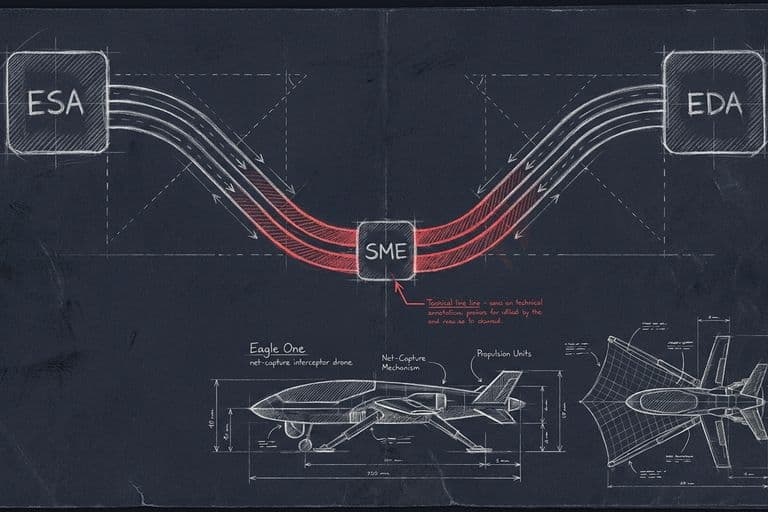
AUDROS, the Dronehub-led counter-UAS programme scored 98 out of 100 by the European Defence Agency on the CBRN counter-UAS evaluation, has the Eagle One net-capture interceptor as its kinetic component — directly procurable for correctional anti-smuggling under the same architecture.
Source · AUDROS programme outcomes; EDA c-UAS programme evaluation
In this piece
Drone-borne contraband into correctional facilities is now a primary smuggling vector across US and EU prisons. The threat profile matured from rare anomaly to operational concern across the 2020-2025 window, driven by commercial-grade UAV proliferation, GPS-waypoint autonomy that lets the operator never enter the facility's airspace, and the open overhead envelope of nearly every correctional facility built before drones existed as a category. Counter-UAS for corrections is the volume use case where net-capture interception structurally wins — and where the procurement-grade ROI is fastest in the broader counter-UAS market.
This post unpacks the threat profile, why net-capture fits the regulatory and operational constraints, who may operate it, and what the per-facility procurement decision actually looks like in 2026.
The smuggling threat profile
The contraband classes delivered by drone are well-documented across US Bureau of Prisons advisories, state-level corrections reports, and EU correctional industry analysis: narcotics, mobile phones, weapons, currency, USB storage media, and small electronics. Street values per successful delivery typically range from $5,000 to $25,000 or more depending on contraband class and the facility's internal market dynamics.
Three delivery patterns dominate the threat catalog.
GPS-waypoint autonomous delivery. The operator pre-loads target coordinates — a specific cell window, an exercise yard zone, a kitchen ventilation gap — and the drone flies the route autonomously. The operator stays well outside the facility's perimeter, often outside its line-of-sight. The drone arrives at the drop point, releases the package, and returns to a recovery location. The operator's exposure to detection is minimal. This is the dominant pattern across the 2022-onward incident catalog.
Cell-window targeted delivery. A variant of the autonomous pattern with operator-in-the-loop terminal guidance. The drone navigates to the general area via GPS waypoints, then the operator confirms terminal positioning via satellite-imagery-derived visual cues or via communication with an inmate-accomplice inside who confirms the drop point. The drone delivers to a specific window where the inmate retrieves through bars or a damaged window fitting.
Yard drop. The package is released over the exercise yard during scheduled outdoor time. An inmate-accomplice retrieves while the yard is active. This is less precise than cell-window delivery but harder to interdict because the yard's open environment doesn't provide retrieval-point ambiguity to the perimeter security team.
All three patterns exploit the same structural property: prison facilities have open overhead envelopes (most were built before drones existed as a category), and inmates can co-ordinate from inside via contraband phones to confirm delivery timing. The threat is not theoretical; it's operationally consequential at meaningful volume across the US and EU correctional system.
Why kinetic and RF don't work for corrections
The conventional counter-UAS doctrine offers three primary response modalities. Two fail structurally in the correctional environment.
Kinetic shoot-down is legally unusable. A round fired over a correctional facility lands in the same legal envelope as a round fired over any populated area — outside a declared theater of operations, with no military rules of engagement, with civilian liability fully attached. No US state or EU jurisdiction permits kinetic counter-UAS operations at correctional facilities. The modality is not procurement-eligible.
RF jamming is reserved to authorised agencies. The FCC says federal law prohibits the operation, marketing or sale of jamming equipment, with no exemption for use within a business; since July 2026, state and local agencies certified under the SAFER SKIES Act may use authorised mitigation systems, subject to FCC authorisation, and in most EU states jamming is a state task. Continuous jamming over a routine correctional perimeter is not a realistic posture in nearly every US state and EU jurisdiction. Beyond the legal envelope, RF jamming has the operational gap that modern threat UAVs assume jamming — they run autonomous waypoint missions with degraded-GNSS fallback, so the jamming may degrade accuracy at the margin but rarely intercepts the mission.
Net-capture interception avoids both problems: no munition, no jamming. It is still counter-drone mitigation, so the law decides who runs it: the 2020 US interagency advisory lists nets among the techniques that may implicate federal laws protecting aircraft, and in the US the operator is a federal agency with counter-UAS authority or, since July 2026, a certified state or local correctional agency. And the engagement intercepts the mission — the hostile drone is brought down intact at a predictable recovery point, not allowed to complete delivery with degraded precision.
For the agency that holds the authority, the procurement frame for prison c-UAS therefore comes down to interception that ends the delivery, and net capture does that with the drone brought down intact.
The evidence-chain argument
The strongest single reason to pick net-capture for corrections is the evidence-chain property. The captured hostile UAV is the evidence.
A recovered drone preserves:
- The contraband itself — the package as released, intact, before any inmate-accomplice could retrieve it
- The flight controller log — coordinates, waypoints, mission timeline, operator-side commands
- The memory card — if present, potentially containing operator telemetry, satellite imagery used for terminal guidance, or operational records
- GPS waypoint history — the route flown, the takeoff point, the planned return location
- The physical artifact — the drone airframe and components, for forensic analysis (fingerprints, supply-chain identifiers, modification patterns)
Each of these enables some part of the upstream investigation — locating the operator, identifying the smuggling network, tracing the supply chain. Per-facility deployments that recover hostile UAVs intact contribute disproportionately to the broader corrections-system counter-smuggling effort because the recovered drones support prosecutions that reach beyond the single facility.
Kinetic response destroys all of this. RF jamming might force a controlled or uncontrolled landing — but typically at a location the operator could not predict in advance, often closer to the operator's launch point than to the facility, and rarely with the intact-recovery property. Net capture, like a cyber takeover that lands the drone at a designated place, converts the engagement into an investigative asset.
The fast-payback economics
The ROI argument for prison c-UAS compounds across two savings categories.
Deterred contraband. Once a facility deploys c-UAS capability and the smuggling supply chain knows it (knowledge spreads quickly via inmate networks), attempted drone deliveries drop materially at that facility. The successful pre-c-UAS deliveries were worth $5,000–$25,000+ each in street value. The facility-cost of contraband incidents — lockdowns, investigations, internal-security operations, staff overtime — is multiples of the deterred contraband value. Deterring a meaningful share of attempted deliveries pays back the deployment quickly.
Intercepted-evidence value. Recovered drones support upstream prosecutions that disrupt the smuggling supply chain beyond the single facility. Cross-facility benefit accrues to the broader corrections system; depending on jurisdiction and contracting structure, this benefit may be valued explicitly in the procurement business case or treated as an externalised public-safety benefit.
The combined payback typically lands inside the first 6-18 months for a per-facility deployment, well within the depreciation horizon of the procured asset. This is fast relative to other critical-infrastructure c-UAS deployments (refineries, ports, substations), where the consequence-of-event is high but the threat-frequency is lower. Prisons combine high-frequency threat with quantifiable contraband-deterrence value, which is what produces the fast payback.
What deployment looks like
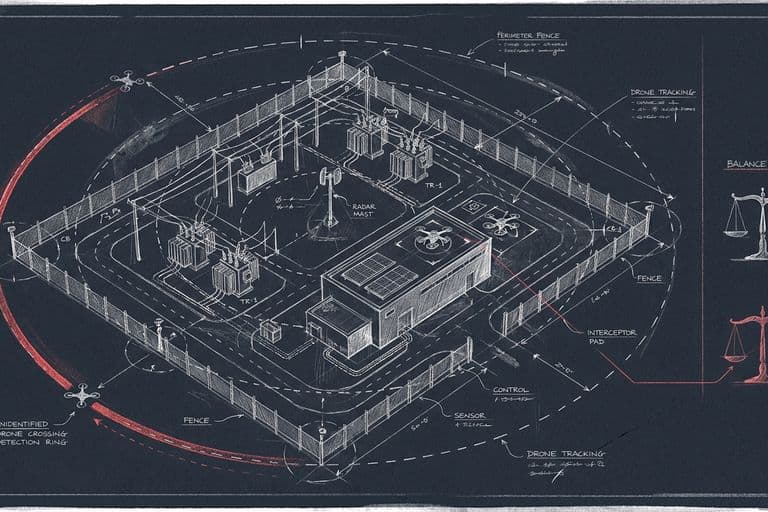
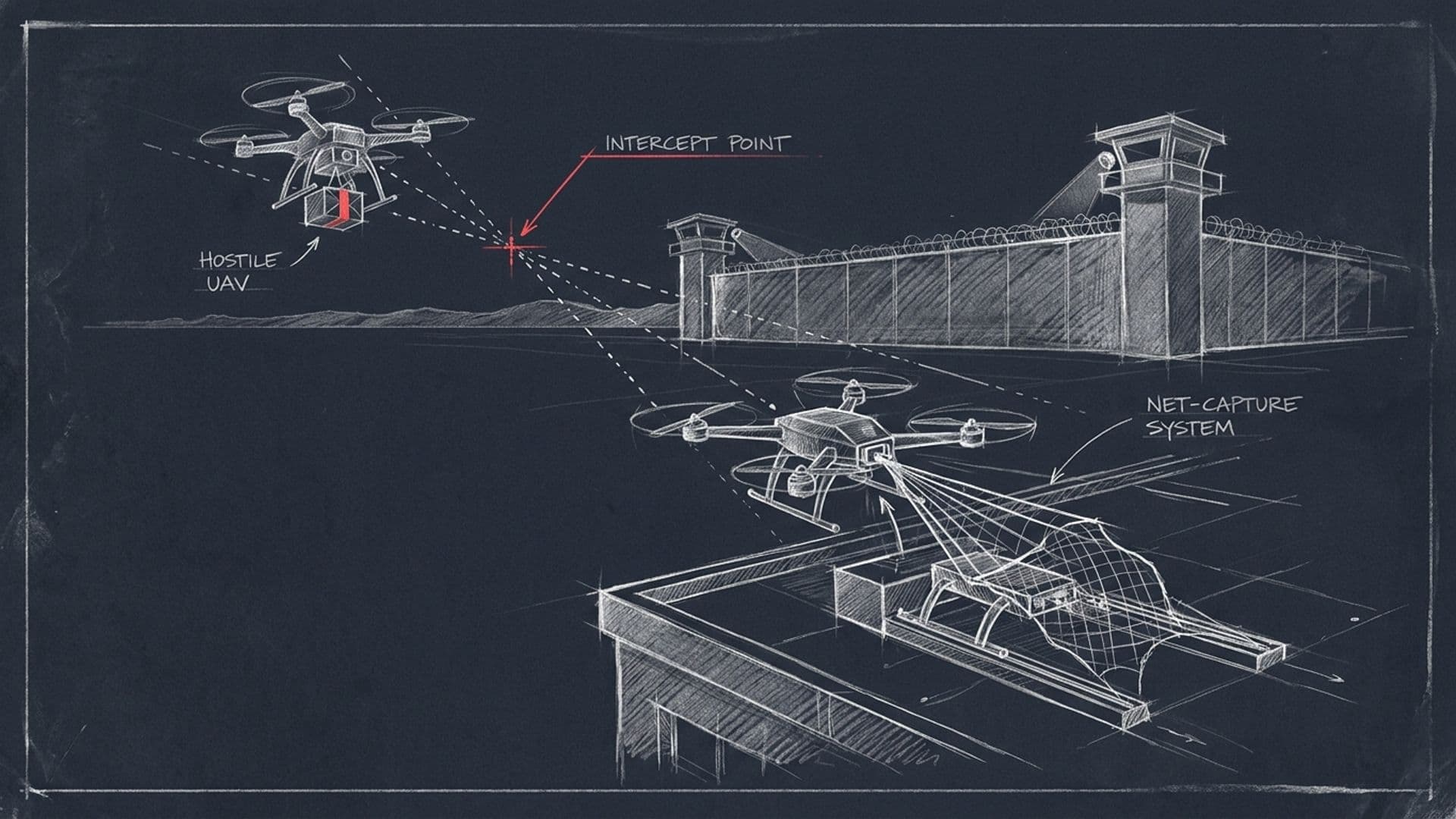
A roof-mounted or watchtower-mounted dock houses the net-capture interceptor UAV. The dock connects to the facility's existing security command stack — detection layer (RF sensing, perimeter radar, acoustic detection, machine-vision pipelines integrated through fixed-camera coverage) integrated into the facility's existing VMS or PSIM platform.
On detection of a hostile UAV approaching the perimeter, the engagement chain runs:
- Detection — multi-sensor fusion identifies the approaching UAV, classifies it as hostile based on flight profile, and surfaces a track to the security operations centre.
- Authorisation — operator-in-the-loop confirms the engagement. The decision happens at the security command level; the threshold for authorisation is well-defined in the facility's c-UAS operating procedures.
- Engagement — the interceptor launches from the dock, closes to engagement range, and fires the capture net. The hostile UAV is wrapped and descends under parachute drogue to a predictable recovery zone.
- Recovery — the corrections response team retrieves the engaged drone with evidence-chain handling protocols. Photography, sealed-bag transport, chain-of-custody documentation, and forensic-team handover follow the facility's standard evidence procedures.
- Documentation — the engagement is logged into the facility's incident-management system. Cross-referencing across facilities builds the corrections-system-wide intelligence picture.
Between engagements, the interceptor dock supports persistent ISR overflight patterns — perimeter patrol, scheduled inspections, yard surveillance during high-risk windows. The same UAV that handles c-UAS handles routine perimeter security. One platform, multiple missions.
Procurement pathways
For US federal facilities (Bureau of Prisons, US Marshals Service detention, ICE Enforcement and Removal Operations detention) — direct contract through Dronehub Inc., with NDAA Section 848-compatible hardware and the SBIR/STTR-eligible US small-business status. The federal-civil procurement frame aligns directly with the c-UAS sovereign-supply-chain requirements.
For US state corrections — through the state department of corrections under state-level critical-infrastructure or contraband-prevention budgets. Several states have established or are establishing dedicated counter-UAS line items in corrections budgets following the 2022-onward escalation of drone-smuggling incidents.
For US local corrections (county jails, regional facilities) — through the county procurement frame, sometimes via state-level pass-through funding for c-UAS modernisation. Local procurement is fragmented but increasingly active.
For EU corrections — through the national-level corrections departments under EDIS-aligned terms with Dronehub Sp. z o.o. handling the EU commercial relationship. Several EU member states have established national c-UAS programmes that fund prison perimeter coverage.
For private corrections operators (CoreCivic, GEO Group, various national-level operators) — direct commercial contracting under either entity depending on jurisdiction and procurement frame. In the US, private operators do not hold counter-UAS mitigation authority, so there the work centres on detection and the handover to the authorised agency.
The full AUDROS programme context — including the Eagle One net-capture interceptor that fits this use case — lives at /projects/audros. The counter-UAS modality landscape is at /blog/counter-uas-2026-jamming-kinetic-capture. The net-capture engagement physics is at /blog/net-capture-interceptor-physics. The CBRN response variant, with the EDA 98/100 validation, is at /blog/cbrn-drone-response-eda-98-100-validation. The defense industry context is at /industries/defense; critical infrastructure at /industries/critical-infrastructure; public safety at /industries/public-safety. For a corrections c-UAS procurement conversation, open the contact form.
FAQ
- How does drone-borne contraband smuggling actually work?
- Three primary delivery patterns. (1) GPS-waypoint autonomous delivery — the operator pre-loads coordinates of the target cell window or yard, the drone flies the route autonomously, drops the package, returns. The operator never enters the facility's airspace. (2) Cell-window targeted delivery — operator uses commercial GPS plus visual cues from satellite imagery to deliver directly to a specific window where an inmate retrieves through bars or a damaged fitting. (3) Yard drop — package released over the exercise yard during scheduled outdoor time, retrieved by an inmate. All three exploit the fact that prison facilities have open overhead envelopes and inmates can co-ordinate from inside via contraband phones to confirm delivery timing.
- Why does net-capture matter for prison c-UAS specifically?
- Because the captured drone IS the evidence. With a recovered hostile UAV intact, the prosecution has the contraband, the flight controller log (showing operator coordinates), the memory card (potentially with operator-side telemetry), the GPS waypoint history, and the physical artifact for forensic analysis. With kinetic shoot-down, the contraband is destroyed or scattered and the evidence chain collapses. With RF jamming, the drone might land, but at an unpredictable location that's harder to recover and may already be where an inmate-accomplice was waiting. Net-capture brings the drone down intact, on a predictable descent profile, at a recovery point the operator controls.
- What's the procurement-grade ROI on prison c-UAS?
- Structurally fast relative to other critical-infrastructure deployments. Two compounding savings categories. First, deterred contraband — once the c-UAS capability is known to the smuggling-supply chain, attempted deliveries drop materially. Successful deliveries that did get through pre-c-UAS were worth $5,000–$25,000+ each in street value; the facility-cost of contraband incidents (lockdowns, investigations, internal-security operations) is multiples of the deterred contraband value. Second, intercepted-evidence value — recovered drones support prosecutions that disrupt the smuggling supply chain upstream from the facility, with cross-facility benefit. Combined payback typically lands inside the first 6-18 months for a per-facility deployment, well within the depreciation horizon of the procured asset.
- What's the legal frame for prison c-UAS?
- It depends on the country and on who operates the system. In the US, the FCC says federal law prohibits operating jammers, with no exemption for use within a business; counter-UAS mitigation, net capture included, is reserved to federal agencies with that authority and, since 1 July 2026 under the SAFER SKIES Act, to trained and certified state, local, tribal and territorial correctional and law-enforcement agencies. In the UK, police and prison authorities can authorise effectors; in most EU states, mitigation is a task for the police or other state services. Kinetic counter-UAS systems are not procurement-eligible for civilian-airspace correctional operations in any major jurisdiction. A net-capture interceptor avoids jamming and munitions, which makes it a practical tool for the correctional agency that holds the authority.
- What does per-facility deployment actually look like?
- A roof-mounted or watchtower-mounted dock houses the interceptor UAV. The dock connects to the facility's existing security command stack — detection sensors (RF, radar, acoustic, vision) integrated into the operator's existing VMS / PSIM. On detection of a hostile UAV approaching the perimeter, the interceptor launches under operator authorisation, closes to the engagement envelope, fires the capture net, and the engaged UAV descends under parachute drogue to a predictable recovery area. The dock supports persistent overflight patterns between engagements (perimeter ISR, scheduled patrols) using the same UAV. Reload cycle is fast; the facility's responding-officer workflow is updated to include the interceptor cycle as one input among the existing security operations.
- How does this integrate with state-level corrections procurement?
- Direct contracting with state-level corrections departments under their critical-infrastructure or contraband-prevention budget lines. Some state procurements channel through the state public-safety apparatus (which may also include broader homeland-security counter-UAS budget). For federal-level contracts (US Bureau of Prisons, ICE detention, US Marshals Service detention), Dronehub Inc. (Delaware C-Corp, SBIR/STTR-eligible US small business) is the procurement entity, with NDAA Section 848-compatible hardware. EU correctional procurement runs through Dronehub Sp. z o.o. under EDIS-aligned terms with national-level corrections departments and union-level procurement frameworks.