Key facts
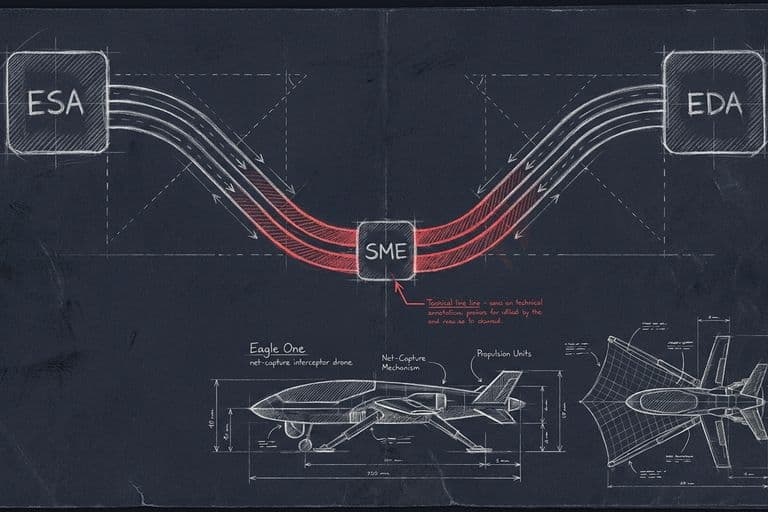
The Eagle One interceptor — developed by Czech consortium partner Fly4Future inside the AUDROS programme — is a multirotor airframe carrying a net-launch mechanism that fires a wide-spread capture net at a hostile UAV in flight.
Source · AUDROS programme technical documentation; Fly4Future engineering specifications
The capture net wraps the hostile UAV's rotors, brings the engaged system down under a parachute drogue at a controlled descent rate, and preserves the target's payload, flight controller, memory cards, and geolocation history intact for forensic review.
Source · Net-capture C-UAS engagement physics; AUDROS testing outcomes
Net-capture preserves the target intact, as does a cyber takeover that lands the drone at a designated place. Kinetic shoot-down fragments the target by definition, and RF jamming forces an uncontrolled or controlled landing but typically can't produce an intact captured asset with intelligence value.
Source · Comparative analysis of counter-UAS modality outcomes
3 more key facts
Testing of the Eagle One platform within the AUDROS programme was conducted with the Czech Military Technical Institute Brno and the Military Research Institute Brno — both NATO-allied defense research bodies — validating engagement geometry, net-deployment timing, and parachute descent profile.
Source · AUDROS consortium testing programme records
The European Defence Agency scored Dronehub 98 out of 100 on the CBRN counter-UAS programme that incorporates the Eagle One net-capture component — the highest known third-party validation score in the net-capture C-UAS category.
Source · European Defence Agency CBRN counter-UAS programme evaluation
The interceptor discharges no munition and uses no RF jamming, but it is still counter-drone mitigation: the 2020 US interagency advisory lists nets among the techniques that may implicate federal laws protecting aircraft, and in most of the US and EU, bringing a drone down is reserved to authorised agencies. Who may operate it depends on the country and on the operator.
Source · DOJ–DHS–FAA–FCC Interagency Legal Advisory on UAS Detection and Mitigation Technologies (2020); Bird & Bird, European Commission Counter-UAS Action Plan (2026)
In this piece
A hostile drone enters a controlled airspace. Five seconds later, it's wrapped in a capture net, descending under a parachute drogue toward an interceptor's recovery point — intact, with payload preserved, with forensic evidence chain intact. That five-second sequence is what the Eagle One interceptor was engineered to deliver, and it's the engagement that earned Dronehub the European Defence Agency's 98/100 score on the CBRN counter-UAS programme.
This post is the technical companion to the broader counter-UAS modality overview. Where that piece walked through when to use which counter-UAS modality, this one walks through how net-capture actually works at the engagement level — the engagement geometry, the net deployment physics, the parachute drogue ballistics, and the operational implications that follow from each.
The interceptor airframe
Eagle One is a multirotor airframe purpose-built as a counter-UAS interceptor. The design priorities are different from a standard ISR multirotor and worth understanding.
Lift-to-mass margin. The interceptor has to carry the net launcher, the net cartridges, the parachute drogue system, and the fire-control electronics in addition to its own structure. The lift envelope has to handle the engagement-payload mass without compromising the speed and manoeuvrability required to close to engagement range. Eagle One sits in a larger size class than typical commercial ISR multirotors.
Manoeuvrability at engagement speed. Closing to engagement range typically requires speed comparable to or exceeding the target's. Multirotor designs that prioritise endurance over speed trade off badly for this mission profile. Eagle One's rotor configuration and motor specification optimise for the close-range manoeuvring envelope.
Sensor cluster for terminal guidance. The interceptor's own sensors confirm the target's identity, motion vector, and engagement geometry before the net is deployed. This is in addition to the broader detection layer's tracking — the interceptor's terminal-guidance refinement reduces miss rate and reduces wasted net cartridges.
Net launcher as integrated component, not aftermarket. Eagle One's launcher mechanism is engineered into the airframe's lower mass-balance, with the deployment axis aligned to the airframe's principal direction of travel. The launcher's recoil is absorbed by the airframe structure rather than disturbing the multirotor's stability during the engagement cycle.
The combined design point: an interceptor airframe optimised for the engagement, not a stock ISR drone with a strapped-on launcher.
The net deployment mechanism
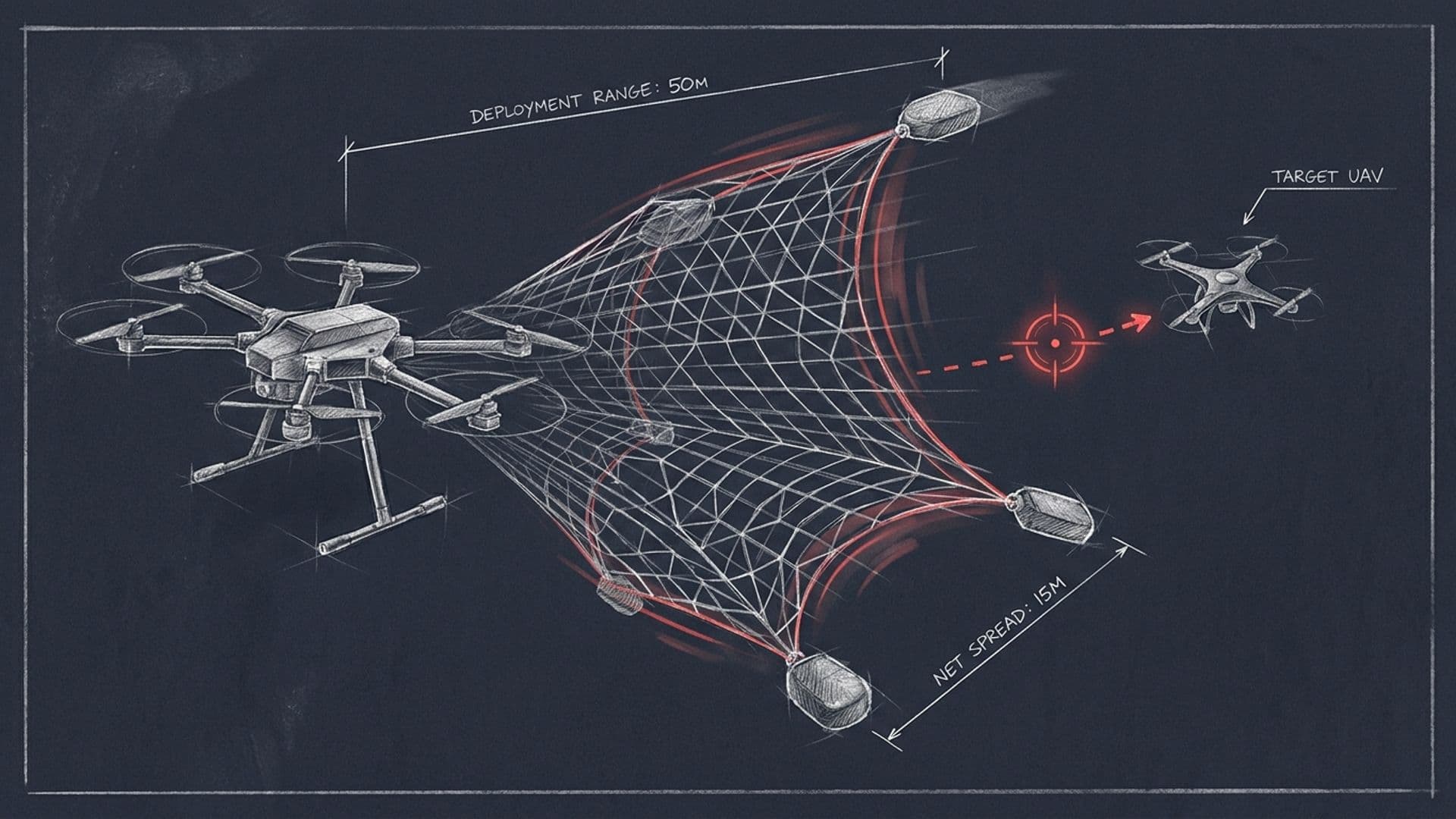
The capture net is stored compressed in a launcher tube on the airframe's underside. The deployment sequence:
- Engagement authorisation — operator-in-the-loop confirmation that the target is hostile, the engagement geometry is appropriate, and the recovery area is safe for descent.
- Pre-launch fire-control solution — the interceptor computes lead angle, launch velocity setting, and timing based on the target's tracked motion vector relative to the interceptor's own position.
- Propulsion charge — pneumatic or pyrotechnic charge ejects the compressed net forward of the interceptor at controlled velocity. The launch axis aligns with the engagement geometry computed in the previous step.
- Net expansion — four weighted corner masses on the net's perimeter pull the net into its wide-spread configuration during the first half-second of flight. The net reaches maximum spread (the engagement-effective footprint) at roughly mid-flight to the target.
- Target intercept — the wide-spread net contacts the hostile UAV. The corner masses wrap around the target's rotors and structure. Forward motion of the net imparts angular velocity to the target, which compounds the wrap geometry.
- Drogue deployment — as the engaged combined-mass loses lift (the target's rotors are no longer functional under the net wrap), the parachute drogue stowed in the net assembly deploys automatically and stabilises the descent.
- Controlled descent — the engaged combined-mass falls at the drogue-controlled terminal velocity (typically 5-8 m/s, comparable to a sport parachute descent) toward the recovery area.
The whole sequence — engagement authorisation to ground recovery — is in the order of five to fifteen seconds depending on engagement range and recovery distance.
Parachute drogue ballistics
The drogue is the property that makes the entire engagement procurement-grade rather than just an interesting engineering exercise. Three structural reasons.
Ground safety. A hostile UAV with a meaningful payload falling under gravity from operational altitude is a kinetic hazard to anything underneath. A typical commercial-class quadcopter with a 1-5 kg payload, falling from 50-200 metres, lands at impact energies that range from "broken sensors" to "lethal projectile" depending on mass and altitude. A drogue-controlled descent at 5-8 m/s terminal velocity reduces the impact energy by an order of magnitude, putting the engaged combined-mass into the comparable-to-controlled-emergency-landing envelope.
This matters because counter-UAS operations are typically conducted over populated areas — prisons, refineries, ports, substations, urban environments. Whoever is authorised to engage in those airspaces, in most countries a state agency, has to be able to defend the ground-safety property.
Evidence preservation. Forensic recovery of an intact hostile UAV preserves payload, flight controller, memory cards, GPS log, and operator-side telemetry trace. A kinetic strike or a free-fall descent damages or destroys most of those artefacts. The evidence chain that enables attribution — who flew the drone, from where, with what intent, against what target — depends on the recovered artefact being intact.
For prison anti-smuggling, the contraband itself becomes the evidence. For sovereign defense, the captured drone is the intelligence asset that enables further analysis. For critical-infrastructure incident response, the recovered drone informs the post-incident review and the criminal or counter-intelligence investigation.
Predictable recovery. A drogue descent has a well-defined trajectory that the operator can predict from the engagement geometry and the prevailing wind. The recovery team can be positioned at the expected ground-impact area before the engagement completes. Free-fall trajectories are much harder to predict accurately, and the recovery team faces a search problem rather than a known recovery point.
The drogue is therefore not an optional safety addition; it's the load-bearing element that converts the engagement from a tactical event into a procurement-grade capability.
Engagement envelope
The effective engagement envelope is determined by three constraints simultaneously.
Net structural travel. As the net travels from the launcher to the target, it loses spread (the corner masses pull inward under aerodynamic drag) and slows. Engagement distance beyond a certain envelope produces unreliable wrap geometry — the net arrives at the target with reduced spread, which increases miss probability. The effective range for reliable wrap is in the close-to-medium tactical envelope.
Target tracking accuracy. Engagement requires a fire-control solution good enough to put the wide-spread net on the target's predicted position at the time of intercept. Target motion uncertainty compounds with range — a fast-moving target at extreme range has accumulated position uncertainty by intercept time that exceeds the net's spread. Slower targets, more predictable targets (autonomous waypoint UAVs), and closer engagement ranges all produce more reliable fire-control solutions.
Recovery descent profile. The engaged combined-mass descends from the engagement altitude under the drogue. The descent path is influenced by prevailing wind, the engagement altitude, and the original motion vector at engagement time. Capturing a target at extreme range can mean the descent path extends outside the interceptor's secure recovery area, which complicates forensic recovery.
The interceptor's mobility (multirotor VTOL with operational endurance) is the property that handles the envelope constraints. Rather than firing from extreme stand-off, the interceptor closes to the engagement envelope on demand — launches from its dock when the threat is detected, transits to engagement range, and fires inside the reliable envelope.
Single-engagement and re-engagement logic
Each net launch consumes one net cartridge. If the engagement misses or fails to wrap correctly, the interceptor returns to its dock, the dock's automated reload mechanism loads a fresh net cartridge, and the interceptor is ready for re-engagement within the dock's standard cycle time.
The operational implications:
- Persistent C-UAS deployment requires stockpiled net cartridges proportional to expected engagement volume. Prison anti-smuggling environments typically engage rarely (high-deterrent effect once the capability is known); critical-infrastructure perimeter under contested conditions can engage more frequently. The dock's reload-cartridge inventory has to be sized accordingly.
- High-threat scenarios with rapid-engagement requirements can support a multi-interceptor posture from a single dock or networked dock cluster — while the first interceptor returns for reload, a second interceptor can be in flight handling subsequent engagements.
- The reload cycle is orders of magnitude faster than munition reloading for kinetic systems. The operational cadence of net-capture C-UAS is favourable compared to the alternatives.
Where this fits operationally
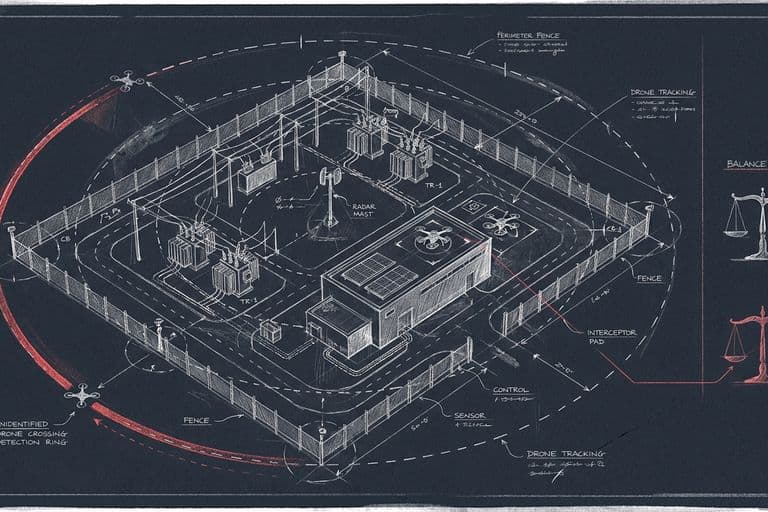
The Eagle One net-capture interceptor is the response component of the broader AUDROS counter-UAS stack. Detection is handled by the upstream sensor layer (radar, RF, acoustic, vision); tracking is integrated across sensors; engagement authorisation is operator-in-the-loop; the interceptor handles the kinetic component; recovery and forensic chain-of-custody is the downstream operations.
The CBRN response variant — where the engagement target is a drone delivering chemical, biological, radiological, or nuclear payload — extends the basic engagement profile with sensor-equipped UAVs deployed into the contamination zone post-engagement, mapping the plume, locating the source, and supporting first-responder coordination without exposing personnel to the hazard.
This is the engagement profile that the European Defence Agency evaluated at 98 out of 100 on the CBRN counter-UAS programme. The score is independent third-party validation of the complete engagement chain — detection through engagement through forensic recovery through plume survey — and remains the strongest single counter-UAS credential in the Dronehub portfolio.
The full AUDROS programme context lives at /projects/audros. The broader counter-UAS modality landscape (jamming vs kinetic vs net-capture) is at /blog/counter-uas-2026-jamming-kinetic-capture. The original AUDROS programme deep-dive is at /blog/drones-intercepting-drones-intruders-we-are-ready-for-action. The defense industry context is at /industries/defense; critical infrastructure at /industries/critical-infrastructure. For an R&D partnership conversation, open the contact form.
FAQ
- How does the net actually deploy?
- The net is stored compressed in a launcher tube on the interceptor's underside. On engagement command, a pneumatic or pyrotechnic propulsion charge ejects the net forward of the interceptor while four weighted corner masses pull the net into a wide-spread fan configuration in flight. The net reaches its maximum spread within roughly the first half-second of flight, gradually losing spread as it travels toward the target. The deployment geometry — angle of the launch, velocity of the net, target lead angle — is computed by the interceptor's onboard fire-control logic based on the target's tracked motion vector and the interceptor's own position.
- What's the effective engagement range?
- Effective range is determined by three constraints simultaneously. First, the net's structural travel — the net loses spread and slows as it travels, so engagement distance beyond a certain envelope produces unreliable wrap geometry. Second, the target's evasive capability — fast-moving or evasive targets require shorter engagement distance because the fire-control solution degrades faster as range increases. Third, the recovery descent profile — capturing the target at extreme range can mean the engaged combined-mass descends outside the interceptor's recovery area, which complicates forensic recovery. Practical engagement envelope sits in the close-to-medium tactical range, with the interceptor's mobility (multirotor with VTOL endurance) used to close to the engagement envelope rather than firing from extreme stand-off.
- Why a parachute drogue instead of just letting the target fall?
- Three reasons. First, ground safety — a hostile UAV with a meaningful payload falling under gravity from operational altitude is a kinetic hazard to anything underneath. A drogue-controlled descent at terminal velocity 5-8 m/s lands the engaged combined-mass at impact energy comparable to a controlled emergency landing rather than a kinetic strike. Second, evidence preservation — the slower descent means the payload, flight controller, memory cards, and any sensor data on the hostile UAV are recovered intact rather than damaged on impact. Third, predictable recovery — a drogue descent has a well-defined trajectory that the operator can predict from engagement geometry, which means the recovery team knows where to expect the engaged target. Free-fall trajectories are much harder to predict.
- How does the interceptor target the hostile UAV?
- Multi-sensor tracking handed off from the detection layer. The full AUDROS C-UAS stack integrates radar, RF sensing, acoustic detection, and machine-vision pipelines into a unified track on each detected hostile UAV. Track data is handed to the interceptor's fire-control system, which uses the track to compute lead angle, launch geometry, and engagement timing. The interceptor itself carries optical sensors for terminal-guidance refinement — confirming the target's identity and motion before committing the net launch. The engagement command is operator-in-the-loop in the standard deployment — the operator authorises engagement based on the integrated track and the interceptor's terminal-guidance assessment.
- What happens if the net misses?
- The interceptor recovers and the engagement re-cycles. The net is single-use per launch — once deployed, it cannot be re-stowed in flight. The interceptor returns to its dock (mobile or fixed), reloads with a fresh net cartridge under the dock's automated reload mechanism, and is ready for re-engagement within the dock's standard cycle time. The mission-readiness implications are that each engagement attempt consumes one net cartridge; high-threat environments require a stockpile of net cartridges proportional to the expected engagement volume, and dock-replenishment logistics needs to be planned accordingly.
- Does this work against fast-moving or evasive targets?
- It works across a meaningful subset of the threat catalog, but not against every target. Engagement effectiveness is highest against unevasive autonomous-waypoint targets, smaller targets where the wide-spread net captures most of the airframe regardless of target attitude, and targets operating in regulated airspace where the engagement envelope is geometrically constrained. Against fast-moving evasive targets — fixed-wing high-speed designs, manoeuvring quadcopters under active operator control, military-grade loitering munitions — engagement requires either faster interceptors (multiple-engagement-attempt logic) or multi-modal posture (net-capture as one layer plus other modalities for fast-moving classes). The CBRN response variant of AUDROS handles a specific subset: hostile UAVs that have already committed to a payload delivery and are therefore on a relatively predictable terminal trajectory, which is the engagement envelope where net-capture excels.