Key facts
The European Defence Agency scored Dronehub 98 out of 100 on the CBRN counter-UAS programme — the first startup ever to work directly with the agency.
Source · European Defence Agency, CBRN counter-UAS programme evaluation
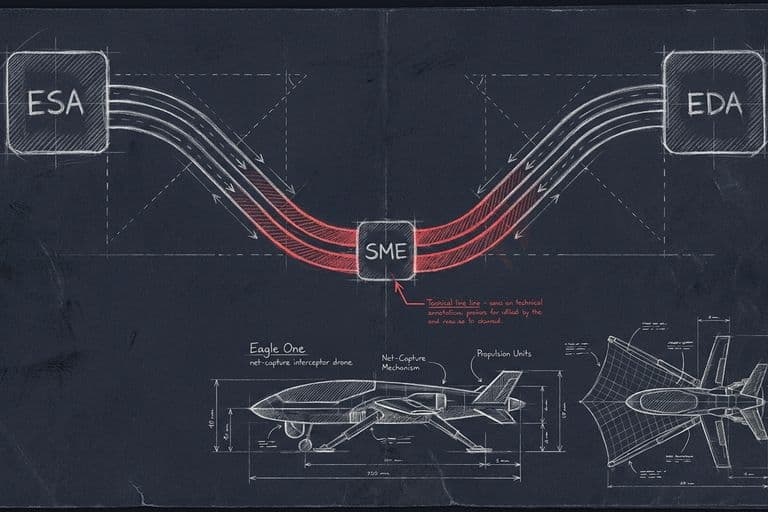
AUDROS is the first project in history where the European Space Agency and the European Defence Agency jointly funded an SME.
Source · ESA × EDA AUDROS programme (2020–present)
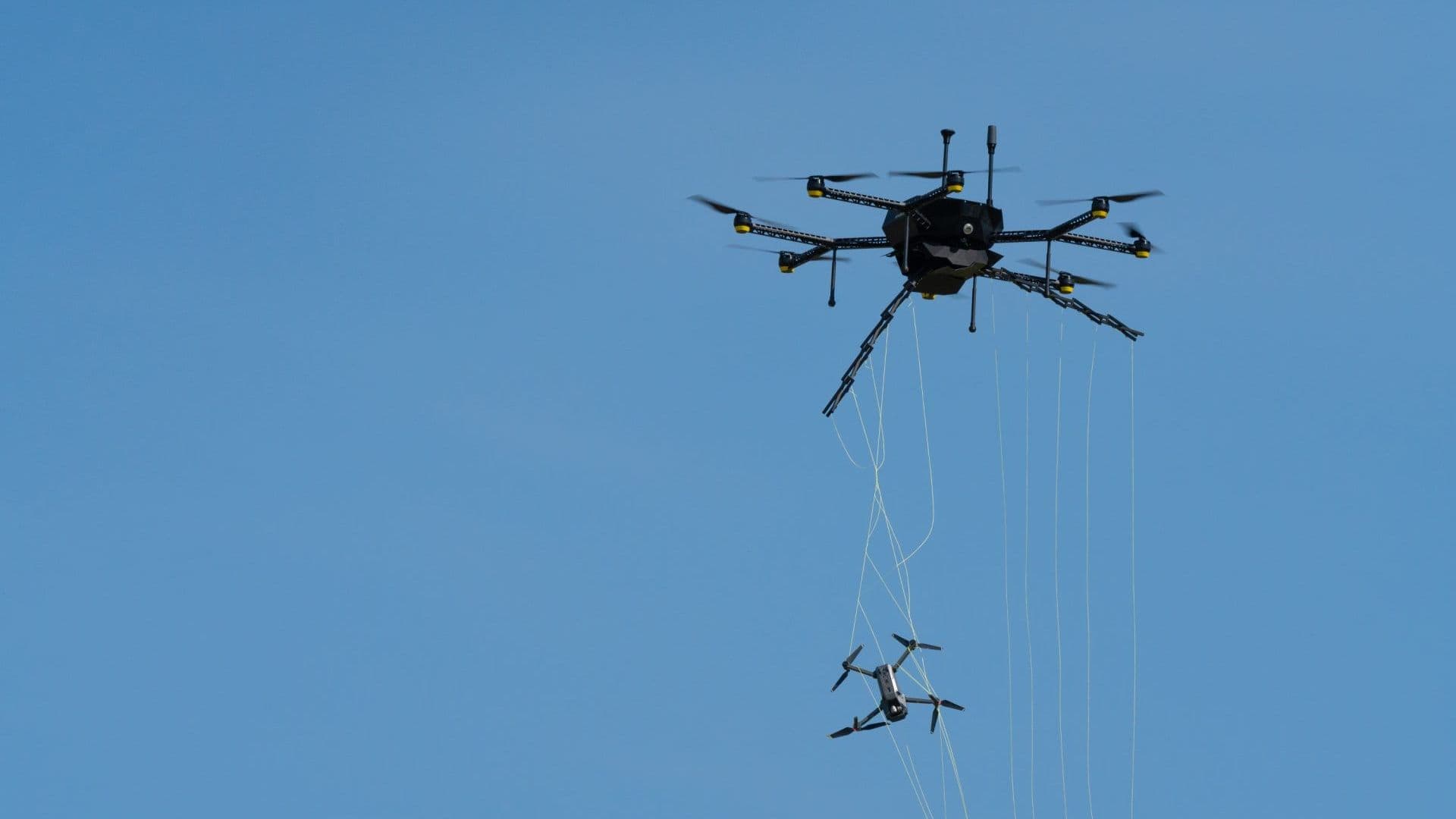
The Eagle One interceptor fires a capture net that ensnares a hostile drone's rotors and brings it down under a parachute drogue, preserving the target's payload, electronics, and geolocation history for forensic review.
Source · AUDROS consortium testing with the Czech Military Technical Institute Brno
2 more key facts
AUDROS was tested with the Military Technical Institute Brno and the Military Research Institute Brno — both Czech government defense-research bodies and NATO-allied.
Source · AUDROS consortium composition, public programme record
The AUDROS consortium has seven partners: Dronehub (Poland, lead), Fly4Future (Czech Republic), GINA Software (Czech Republic), BizGarden (Czech Republic), MTI Brno and MRI Brno (Czech Republic), plus ESA and EDA as co-funders.
Source · AUDROS programme records
In this piece
Hostile drones over a stadium. Over a prison. Over a refinery. Over a substation. Over a head-of-state visit. Once a drone clears the perimeter, the responder has seconds to decide what to do — and almost no legal tools to do it with. AUDROS is the answer to that decision window.
AUDROS is an autonomous counter-UAS and public-safety platform that brings hostile drones down intact, using an interceptor drone (Eagle One) that fires a capture net. It was the first project in history where the European Space Agency and the European Defence Agency jointly funded a small-business company. The European Defence Agency subsequently scored Dronehub 98 out of 100 on the CBRN counter-UAS programme — the first time the agency had worked directly with a startup.
This post unpacks how AUDROS works, why net-capture beats the alternatives in the airspace where the threat actually appears, and what the credentials mean for procurement evaluators in the US, EU, and NATO supply chains.
The counter-UAS response gap
Detection isn't the hard problem. Radar, RF sensing, and acoustic arrays can detect hostile UAVs reliably. The hard problem is the response gap — the seconds between "we see a drone" and "the drone is no longer a threat."
In that window the operator has three classical options, and all three are constrained:
- RF jamming is illegal over civilian crowds in most jurisdictions, and useless against an autonomous drone running on pre-loaded GPS waypoints with degraded-environment fallback. Adversary drones increasingly assume jamming and don't depend on continuous RF reception.
- Kinetic shoot-down (firearms, autocannons, surface-to-air munitions) is legally unusable outside a declared theater of operations. A round fired over a populated area becomes the news event, not the drone.
- Capture-from-the-ground (net launchers, projectile-deployed nets) require the operator to be physically close to the target, which is precisely where the operator doesn't want to be when the drone is delivering a payload.
What's missing is a fourth option: kinetic interception from another drone, in flight, at altitude, with attribution preservation. That's the product AUDROS was funded to build.
The Eagle One net-capture interceptor
Eagle One is the kinetic component of AUDROS. It's a custom multirotor airframe carrying a net-launch mechanism that fires a wide-spread capture net at a hostile UAV. The net wraps the target's rotors and brings it down under a parachute drogue.
Three engineering properties matter:
- Intact-target capture. The hostile UAV doesn't fragment. Its payload, its electronics, its memory cards, its geolocation history — all preserved. Forensic teams recover an artifact. Attribution becomes possible.
- Safety on the ground. A drone falling under a drogue at terminal velocity is a different ballistic profile from drone debris falling after a kinetic strike. Personnel on the ground and infrastructure below are not put at additional risk.
- Legal envelope. No munition is discharged and no RF jamming is employed. Who may deploy Eagle One is still set by counter-drone law: in most of the US and EU, bringing a drone down is reserved to authorised agencies (in the US, federal agencies and, since July 2026, certified state and local agencies), and in Poland, specialised armed security formations at protected sites.
Eagle One was developed by the Czech partner Fly4Future inside the AUDROS consortium and tested with the Czech Military Technical Institute Brno and Military Research Institute Brno.
The CBRN response variant
The harder half of AUDROS isn't the interception itself — it's the chemical, biological, radiological, and nuclear (CBRN) incident-response variant.
A CBRN scenario assumes the hostile drone has already started delivering its payload — a chemical agent over a city, a biological agent near a water-treatment intake, a radiological source over a transit hub. In those conditions, kinetic shoot-down is worse than doing nothing — fragmenting the drone disperses the payload faster. Jamming doesn't reach an autonomous waypoint-flying delivery vehicle. And first responders cannot enter the contamination zone to assess the source.
AUDROS handles CBRN along two axes simultaneously:
- The interception axis catches the hostile UAV mid-delivery, with the net-capture mechanism preserving whatever payload was being released.
- The response axis deploys sensor-equipped UAVs into the plume to survey the contamination, locate the source, and map the event — all without exposing personnel to the chemical, biological, or radiological hazard.
This full chain — detection through interception through forensic capture through plume-survey through dispatcher integration — is what the European Defence Agency scored 98 out of 100. The score isn't marketing positioning; it's the artifact of a complete technical, security, and supply-chain review. It is the strongest single counter-UAS credential in the Dronehub portfolio.
Six deployment classes
AUDROS deploys into six operational profiles, all sharing the same constraint: regulated airspace where RF jamming and kinetic shoot-down are not available options.
- Corrections — anti-smuggling. Drone-borne contraband (drugs, phones, weapons) into prisons is a primary smuggling vector globally. AUDROS provides per-facility counter-UAS without jamming, operated where the law allows (in the US since July 2026, by certified state and local correctional agencies), and the intact-capture mechanism preserves the evidence chain.
- Road safety and major-incident response — multi-vehicle collisions, hazmat events, freeway pile-ups. The same drone network that runs aerial situational awareness for the responder team can intercept a hostile UAV if one appears over the scene.
- Civil unrest and crowd management — stadium events, summits, protests, head-of-state visits. AUDROS supports the public-safety side (situational awareness, crowd density) and the counter-UAS side simultaneously.
- VIP and convoy escort — diplomatic, executive, military movement. Paired with the Dronehub Mobile Charging Station (UAV Nomad), the AUDROS interception capability follows the protected unit instead of being fixed to a single defense installation.
- CBRN incident response — the scoring scenario above.
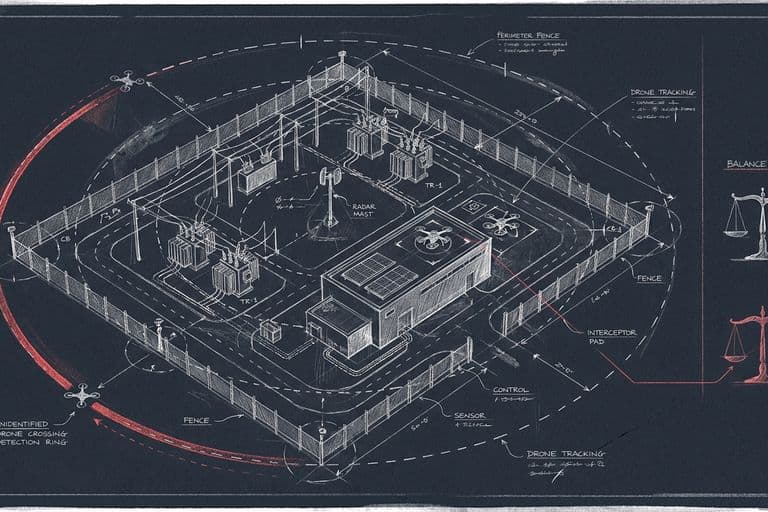
- Critical-infrastructure perimeter — energy substations, refineries, ports, airfields, defense installations. A single hostile UAV at a site like this represents a national-security event. Persistent counter-UAS overwatch becomes essential infrastructure.
What this means for procurement
For US programme offices evaluating dual-use counter-UAS technology under SBIR/STTR, AFWERX, DIU, or DHS S&T — AUDROS is the answer to "has your team built a counter-UAS system that an allied defense agency has independently validated at the 98/100 confidence level?" The answer is yes, and the artifact is documented.
For EU defense primes assembling consortia under the European Defence Fund (EDF) or NATO DIANA — AUDROS gives you an SME partner with the deepest allied-defense-agency credential, consortium-leadership experience across Poland and the Czech Republic, deployed forensic-capture technology, and patent-pending IP behind it.
For critical-infrastructure operators (prisons, refineries, ports, airports, energy substations): AUDROS is an R&D programme and is not offered for purchase or licence today.
The full AUDROS case study, including consortium composition, programme funders, and technical detail, is on the project page. For an R&D partnership conversation, open the contact form.
FAQ
- What is AUDROS?
- AUDROS (Autonomous Drone System) is a counter-UAS and public-safety platform that uses a net-capture interceptor — the Eagle One drone — to physically catch hostile UAVs in flight. Developed by a Polish–Czech consortium led by Dronehub, it was the first project in history where the European Space Agency and the European Defence Agency jointly funded a small business.
- Why net-capture instead of RF jamming or kinetic shoot-down?
- RF jamming is illegal over civilian crowds in most jurisdictions and useless against autonomous drones running pre-loaded waypoints. Kinetic shoot-down is legally unusable outside a declared theater and risks collateral damage. Net-capture brings a hostile UAV down intact, preserves forensic evidence (payload, electronics, geolocation), and operates safely in regulated airspace over populated areas.
- What is the CBRN counter-UAS use case?
- Chemical, biological, radiological, or nuclear payloads dispersed by drone are the worst-case airspace threats — kinetic shoot-down would amplify the chemical plume, jamming wouldn't reach an autonomous delivery vehicle. AUDROS handles the scenario by catching the hostile UAV mid-payload-delivery and deploying sensor-equipped UAVs into the contamination zone to survey, locate the source, and map the event without exposing first responders. The European Defence Agency scored Dronehub 98/100 on this capability.
- Where does AUDROS deploy?
- Correctional facilities (anti-smuggling counter-UAS), road safety and traffic incidents, civil unrest and crowd management, VIP and convoy escort, CBRN incident response, and critical-infrastructure perimeter (ports, energy substations, refineries, dams, defense installations). The constant is regulated airspace where jamming and kinetic shoot-down aren't available, and where the authorised agency needs a way to bring a drone down intact.
- How does AUDROS compare to other counter-drone vendors?
- Most counter-drone vendors offer either RF jammers (reserved to authorised agencies almost everywhere, and ineffective against autonomous drones) or kinetic shoot-down systems (legally unusable outside warzones). Few offer a kinetic-capture system that preserves the target intact, avoids jamming and munitions, and integrates with public-safety command stacks. Almost none have an independently scored validation from an allied defense agency at the 98/100 confidence level.
- Is AUDROS available outside the EU?
- Yes. Dronehub Inc. is a Delaware C-Corp and SBIR/STTR-eligible US small business. The AUDROS counter-UAS IP and the Eagle One interceptor design are licensable to US primes, EU defense industrial partners, and national defense ministries through joint-development or direct-license engagement.