Key facts
A modern wind-turbine blade is 60–80 metres long, and manual climbing inspection takes roughly six hours per turbine — versus 15–20 minutes with an autonomous drone.
Source · Industry benchmarks across major OEM service operations
Global offshore wind capacity is forecast to grow approximately tenfold by 2030, multiplying inspection demand faster than skilled rope-access technicians can be trained.
Source · Global Wind Energy Council outlook 2025
Unplanned wind-turbine downtime costs operators 5–10% of annual revenue per affected unit — making early micro-crack detection the highest-ROI use case for autonomous inspection.
Source · Offshore wind asset-management studies, 2020–2024
2 more key facts
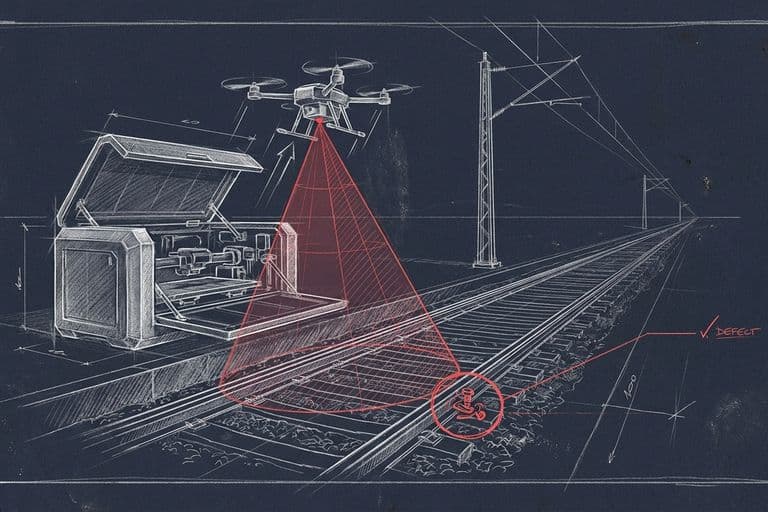
The Sentinel AI anomaly-detection stack — proven on Germany's 33,000-km Deutsche Bahn rail network at 95%+ per-fastener accuracy — applies one-for-one to wind-blade defect typing.
Source · Deutsche Bahn deployment metrics + Sentinel architecture
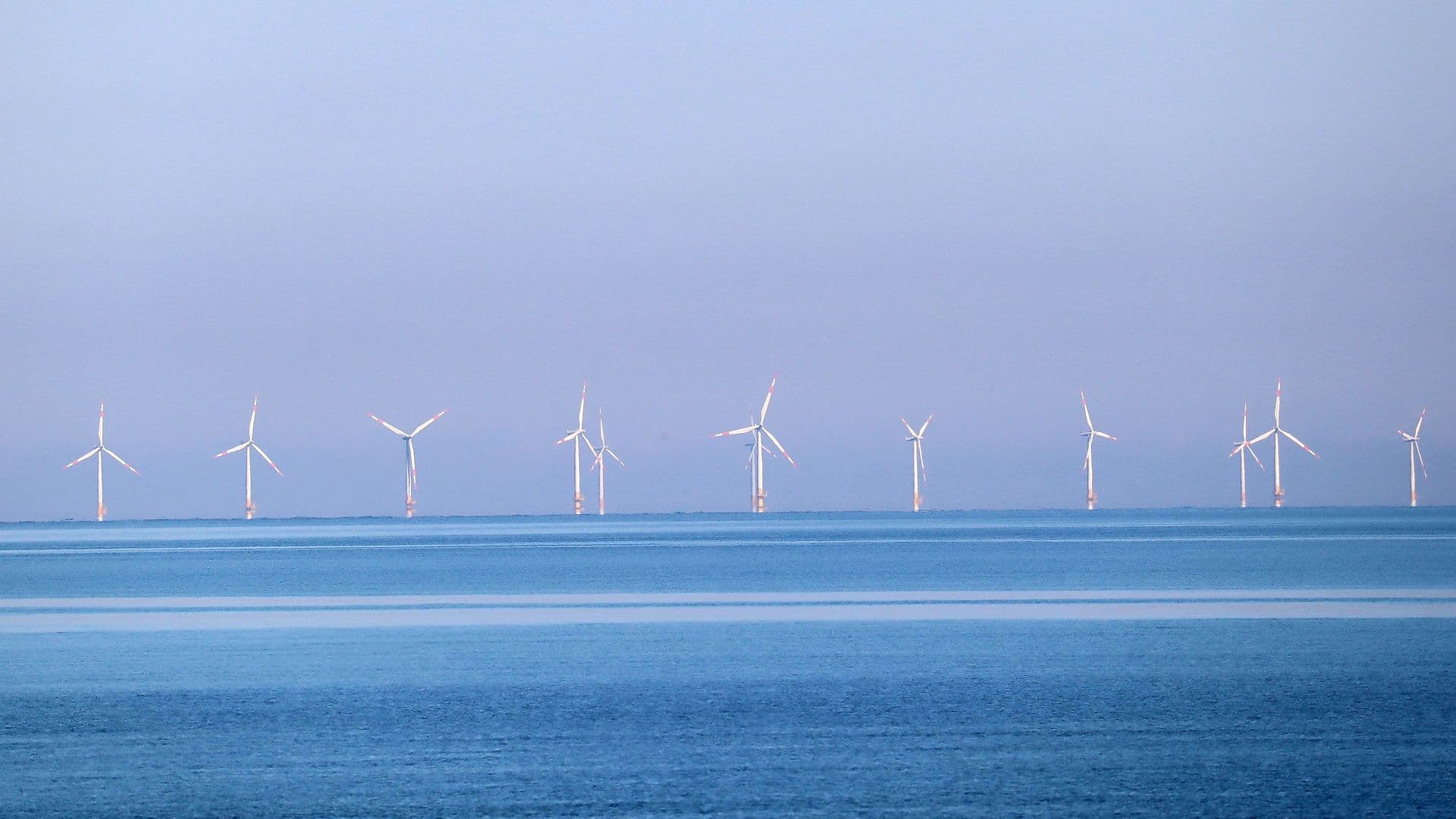
Offshore wind inspection is bottlenecked by boat access (sea-state windows of 4–6 days per month in the North Sea) — drone-in-a-box deployed on the turbine platform itself removes the boat constraint entirely.
Source · Offshore wind operations data, North Sea cluster
In this piece
A wind-turbine blade is eighty metres long. A trained rope-access technician takes six hours to inspect one. An autonomous drone takes fifteen minutes — and doesn't put a human eighty metres in the air to do it. The economics changed sometime around the time global wind capacity started doubling every five years and the trained workforce did not.
This post unpacks why drone-driven wind-farm inspection is no longer an optimisation but a structural requirement, where the offshore bottleneck actually sits, and how the Sentinel AI stack — the same platform that runs Deutsche Bahn's national-scale rail inspection — re-points at wind blades without re-engineering the underlying architecture.
The capacity-vs-workforce gap
The first ceiling that broke was straightforward arithmetic. Global wind capacity is projected to grow roughly tenfold offshore by 2030. The number of skilled blade-inspection technicians — qualified for rope access, working at altitude, certified for the specific OEM platforms — is essentially flat. Training a competent rope-access blade inspector takes years; commissioning a new turbine takes months. The output is a permanently widening capacity-vs-workforce gap that no amount of hiring can close.
The second ceiling is the calendar. Most wind operators inspect blades every two years on a regulatory cadence. That cadence misses everything that happens between inspections — leading-edge erosion that accelerates non-linearly in storm seasons, micro-cracks that propagate over months, lightning damage that goes undetected until a blade comes off the hub. Catastrophic blade failures, when they happen, almost always trace back to a defect that was sub-threshold at the previous inspection and crossed threshold during the interval.
The third ceiling is safety. Every inspection cycle on a manual schedule exposes a technician to fall risk at altitude. The aggregate hours-at-height across a utility-scale wind fleet are non-trivial; the cumulative risk profile is non-trivial. Operators have institutional pressure — from insurers, regulators, and their own safety culture — to reduce hours-at-height. Drone inspection is the only model that reduces it meaningfully.
The offshore bottleneck is the boat
Onshore wind has a hard inspection problem. Offshore wind has a different problem with the same name — and the limiting factor isn't the turbine, it's the boat.
Offshore inspection teams move by service-operations vessel (SOV) or crew-transfer vessel (CTV). Both require operational sea states — typically Beaufort 4 or below, wave heights under about 1.5 metres. Across the North Sea operational cluster, those conditions occur roughly 4–6 working days per month outside summer. That's the entire annual inspection window for a manual approach: maybe 50 working days, spread unevenly across the year, weather-permitting.
Across a hundred-turbine offshore field, fifty working days produces inspections at the rate of about two turbines per day — meaning a single annual rotation is barely achievable, and detailed condition-based inspection is impossible. The result: offshore wind operators essentially run blind on blade condition between catastrophic-failure events.
The drone-in-a-box deployed at the turbine itself collapses the problem. The dock sits on the foundation platform or on the nacelle. The drone launches from the platform, surveys the blade, lands, swaps battery, and the cycle repeats — independent of boat schedule. The operational constraint becomes the turbine's own weather window, which is dramatically wider than the boat's. The inspection moves from twice a year to continuous.
What the Sentinel AI stack does for wind
The wind-blade inspection use case looks different from rail at the sensor level — instead of looking for loose bolts on a fastener pattern, the AI is looking for surface cracks, delamination markers, bonding-line condition, lightning damage, and leading-edge erosion. The taxonomy is different. The architecture is identical.
Sentinel — the in-house Dronehub anomaly-detection platform — was proven at national scale on Germany's 33,000-kilometre Deutsche Bahn rail network with per-fastener accuracy above 95% and sub-15-minute report latency. The architectural pattern that makes that scale possible is portable to wind:
- Edge first-pass classification. The drone's Nvidia Jetson compute classifies every captured frame in real time. Only frames carrying potential anomalies travel to cloud review — bandwidth-thin operation works over LTE, satellite, or even degraded RF.
- Operator-readable outputs. The maintenance planner sees anomalies — annotated blade segments with severity scoring, location pin, comparison against last inspection — not raw video. Analyst load drops by orders of magnitude.
- Audit-grade telemetry. Every flight, every detection, every reviewer decision logged. Insurance and regulator queries get answered with an evidence trail.
- Sovereign data path. Imagery and detections stay inside EU + US infrastructure. For operators that also contribute to critical-grid infrastructure, this becomes a procurement requirement, not a preference.
The AI was trained against a different per-asset taxonomy at Deutsche Bahn. Re-training against a wind-blade defect taxonomy is incremental work — the architecture, the training pipeline, the inference infrastructure all stay. That's the licensing-ready advantage of owning the AI stack rather than renting it.
Where the licensing fit is
For utility-scale wind operators (Iberdrola, Ørsted, RWE, EnBW, Engie, the major US IPPs) — Sentinel + drone-in-a-box can be deployed under license at fleet scale, retaining the operator's data and integrating with the operator's existing CMMS / maintenance-planning stack.
For OEM service organisations (Vestas Service, Siemens Gamesa, GE Vernova) — the platform deploys as a value-add inside the existing service-LTSA contract, replacing rope-access inspection bookings with continuous condition monitoring.
For specialist O&M firms — license the stack and integrate it into the existing service portfolio, with Dronehub providing manufacturing (Jasionka, NATO-allied supply chain) and AI maintenance.
For US federal innovation programmes — NDAA Section 848-compatible hardware and SBIR/STTR-eligible Dronehub Inc. mean the same stack qualifies for DoE wind-grid resilience programmes, NASA SBIR on autonomous inspection, and DHS S&T critical-infrastructure protection where wind grid is the asset class in question.
The drone-in-a-box platform itself sits on the product page. For energy-vertical applications across grid, transmission, pipelines, and renewable generation, the industry context lives on /industries/energy. For a licensing conversation, open the contact form.
FAQ
- Why are drones replacing manual blade inspection?
- Three reasons. First, safety — rope-access technicians at 80 metres face fall risk on every inspection. Second, speed — drones complete a blade survey in 15–20 minutes versus six hours for a climbing team. Third, scale — wind capacity is growing ~10× by 2030 while trained rope-access workforce is essentially flat. The capacity gap is structural, and drone-driven inspection is the only model that scales with software rather than headcount.
- What does drone inspection actually find?
- Surface defects (cracks, erosion, lightning damage), structural anomalies (delamination, fibre damage, ply lifting), bonding-line condition, leading-edge protection wear, and root-area stress markers. With AI anomaly detection, these get classified, severity-scored, and pinned to GPS coordinates — feeding directly into the operator's maintenance-planning stack rather than landing as photo dumps the analyst has to sort.
- How does offshore wind inspection differ from onshore?
- Offshore adds the boat-access constraint. Inspection teams can only reach turbines during specific sea states — typically 4–6 working days per month in the North Sea cluster. That collapses the annual inspection window so much that condition-based maintenance becomes impossible with manual methods. A drone-in-a-box deployed on the turbine platform removes the boat dependency entirely. Inspection runs on the turbine's own weather window, not the boat's.
- Is the Sentinel AI stack the same one used on Deutsche Bahn?
- Yes. The same in-house anomaly-detection platform — Sentinel — that delivers per-fastener defect detection above 95% accuracy on Germany's national rail network. The architectural pattern (edge first-pass classification on Nvidia Jetson, cloud review of flagged frames only, sub-15-minute reports, EU+US data sovereignty) transfers directly. The anomaly taxonomy changes per asset class; the platform doesn't.
- Who licenses this for wind operations?
- Independent power producers running utility-scale wind farms, OEM service organisations (Vestas, Siemens Gamesa, GE service partners), and dedicated wind O&M firms. Dronehub licenses the drone-in-a-box hardware, the Sentinel AI stack, and the deployment playbook. EU + US data sovereignty by design; NATO-allied supply chain; NDAA Section 848 compatible — relevant for operators that double as critical-infrastructure grid contributors.