Key facts
The Dronehub-Tytrax ITWL system is a joint platform — the Tytrax drone designed by the Air Force Institute of Technology (ITWL — Instytut Techniczny Wojsk Lotniczych) paired with a Dronehub-designed docking station and proprietary AI-based autonomy software.
Source · Dronehub × ITWL joint-development programme
MSPO (International Defense Industry Exhibition) in Kielce is one of the three largest defense-industry exhibitions in Europe, alongside Eurosatory (Paris) and DSEI (London), with major NATO defense ministries and primes in attendance.
Source · MSPO Kielce official programme
ITWL is the Polish Air Force's federal R&D institute — comparable in role to the US Air Force Research Laboratory (AFRL) — and works directly with the Polish Ministry of National Defense on equipment, testing, and certification.
Source · ITWL institutional charter
2 more key facts
The ITWL partnership predates the joint ESA + EDA AUDROS counter-UAS programme — the early Polish defense relationship was the credentialing layer that supported subsequent EU-defense-agency engagement.
Source · Dronehub portfolio timeline, 2021-2022
The autonomous Dronehub-Tytrax ITWL system was designed for operations that don't require a human operator in the loop — closer to the operational envelope that NATO doctrines on autonomous combat systems anticipate than to conventional remotely-piloted UAV operations.
Source · Dronehub-Tytrax system architecture
In this piece
In September 2021, the 29th International Defense Industry Exhibition in Kielce hosted the public unveiling of a joint defense system: a Polish Air Force-designed drone, a Dronehub-designed docking station, and Dronehub's AI-driven autonomy software, integrated as a single autonomous platform that doesn't require an operator in the loop. The platform — the Dronehub-Tytrax ITWL system — was the early Polish defense partnership that credentialed Dronehub's subsequent counter-UAS work with the European Defence Agency.
This post explains what the Dronehub-Tytrax system is, why ITWL is a procurement-grade institutional partner, and how the MSPO 2021 unveiling fits into the Dronehub defense portfolio path that runs through AUDROS and beyond.
What MSPO actually is
MSPO — Międzynarodowy Salon Przemysłu Obronnego, the International Defense Industry Exhibition — is one of the three largest defense-industry exhibitions in Europe. Eurosatory in Paris and DSEI in London are the other two; MSPO sits alongside them as the main NATO-Europe procurement-evaluation venue.
Major NATO defense ministries and primes attend. The exhibition floor is where near-term procurement decisions get scoped — operators evaluating platform options, integrators evaluating SME partners, primes evaluating downstream programme structures. For a Polish-engineered defense system, MSPO is the home-market debut event; for a non-Polish prime, it's the screening venue for Polish defense-industrial supply.
The 29th edition in 2021 was where the Dronehub-Tytrax ITWL system surfaced publicly for the first time.
The ITWL partnership
ITWL — Instytut Techniczny Wojsk Lotniczych, the Polish Air Force Institute of Technology — is the Polish Air Force's federal R&D institute. The institutional analog is the US Air Force Research Laboratory (AFRL), the UK Defence Science and Technology Laboratory (DSTL), or the French ONERA. ITWL works on aviation R&D for the Polish Ministry of National Defense and runs joint programmes with national and international primes.
The relationship matters for three reasons:
- Institutional standing. A partnership with ITWL puts Dronehub inside the Polish national-defense vendor pool — not adjacent to it. For follow-on programmes (EDF, NATO DIANA, national MoD direct procurement), the ITWL credential is the kind of allied-defense-institution reference that procurement evaluators recognise.
- Joint-development structure. The Tytrax airframe was designed by ITWL. The docking station and AI autonomy were designed by Dronehub. The integration was the joint programme. That kind of multi-party joint-development with a federal defense institute is precisely the operating model that subsequent EU-defense-agency programmes (notably AUDROS with ESA + EDA) require.
- Technical-doctrine alignment. ITWL operates inside Polish national-defense doctrine and contributes to NATO doctrinal frameworks on aviation technology. The autonomous-operations envelope the Dronehub-Tytrax system was designed for is aligned with where NATO doctrines on autonomous combat systems anticipate persistent surveillance, perimeter response, and rapid-deployment use cases.
What the system does
Three components together:
- Tytrax drone — designed by ITWL, with the Polish Air Force's specifications driving the airframe and aviation-grade requirements
- Docking station — Dronehub-engineered, with the same robotic-swap architecture that runs across the broader Dronehub drone-in-a-box product family
- Autonomous control software — Dronehub's proprietary AI-based autonomy stack, designed for operations without an operator in the loop
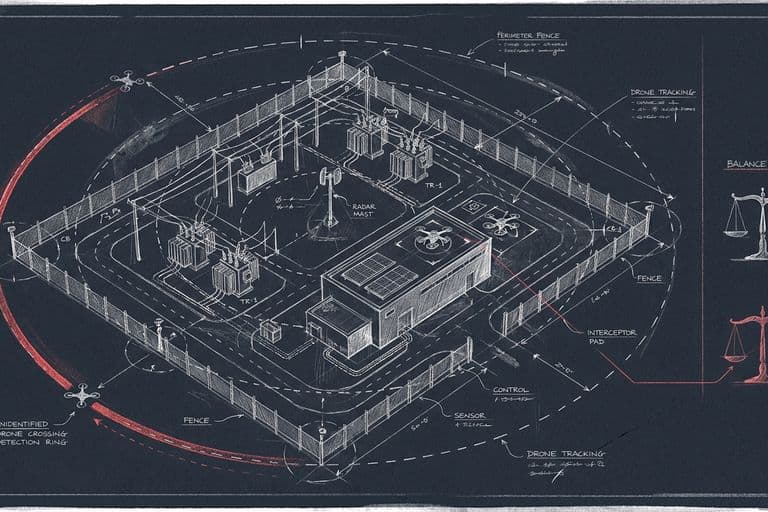
The combined platform operates as an autonomous system — closer to the operational envelope NATO doctrines on autonomous combat systems anticipate than to conventional remotely-piloted UAV operations. The use cases the system was designed for include persistent surveillance, perimeter response, and rapid-deployment scenarios where operator availability is a constraint.
The portfolio path the credential built
The Dronehub-Tytrax ITWL partnership wasn't a one-off — it was the early credential that established Dronehub's standing inside the national-defense vendor pool, which subsequently supported the higher-stakes programmes that followed:
- Tytrax-ITWL at MSPO 2021 — Polish defense credential established
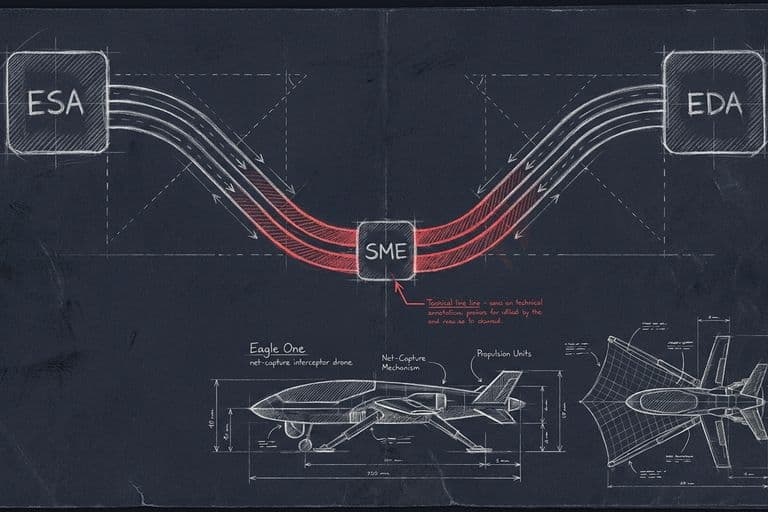
- AUDROS funded by ESA + EDA in 2020-2021 — first project in history where ESA and the European Defence Agency jointly funded a small-business company; the credential from Tytrax was part of the supporting evidence
- AUDROS scored 98/100 by EDA on the CBRN counter-UAS programme — the strongest counter-UAS credential in the Dronehub portfolio, traceable back through ITWL
Each programme built on the credentials of the previous one. The MSPO 2021 unveiling was the public visibility moment for a relationship that quietly underwrites the subsequent defense work.
Where this fits in the current procurement landscape
For US buyers under SBIR/STTR, AFWERX, or DIU evaluating Polish or NATO-Europe-sourced unmanned-systems partners — the ITWL relationship is the credential that distinguishes Dronehub from a commercial-only SME. The institutional pairing with a national defense R&D body signals that the technical envelope has been operating under defense-grade scrutiny since 2021, not just under commercial requirements.
For EU primes under EDF, NATO DIANA, or PESCO consortium-formation — the ITWL credential supports cross-border defense-industrial partnerships with Polish prime defense vendors (PGZ — Polska Grupa Zbrojeniowa, MESKO, Bumar) where the federal R&D institute relationship is the connective tissue.
For Polish MoD direct procurement — the credential is the procurement-readiness signal at the home-market level.
The defense capability set across the Dronehub portfolio is on /industries/defense. The full AUDROS counter-UAS story sits on /projects/audros. For a defense-engagement conversation, open the contact form.
FAQ
- What is MSPO?
- MSPO (Międzynarodowy Salon Przemysłu Obronnego — International Defense Industry Exhibition) is one of the three largest defense-industry exhibitions in Europe, held annually in Kielce, Poland. Alongside Paris's Eurosatory and London's DSEI, MSPO is where NATO defense ministries, primes, and integrators evaluate near-term procurement options. For a Polish-engineered system, MSPO is the home-market debut event.
- What is ITWL?
- ITWL — Instytut Techniczny Wojsk Lotniczych, the Polish Air Force Institute of Technology — is the Polish Air Force's federal R&D institute. It's the institutional counterpart for the US Air Force Research Laboratory (AFRL), the UK Defence Science and Technology Laboratory (DSTL), or the French ONERA. ITWL works on aviation R&D for the Polish Ministry of National Defense and runs joint programmes with national and international primes.
- What did the Dronehub-Tytrax system do?
- Three components together: the Tytrax drone (designed by ITWL), a Dronehub-engineered docking station, and Dronehub's proprietary AI-based autonomy software. The combined system operates autonomously without an operator in the loop — designed for the operational envelope where NATO doctrines on autonomous combat systems and Polish national-defense doctrine anticipate persistent surveillance, perimeter response, or rapid-deployment scenarios.
- How does this connect to the AUDROS programme?
- The ITWL relationship was the early Polish defense credential that established Dronehub's standing in the national-defense vendor pool — which subsequently supported the joint ESA + European Defence Agency AUDROS counter-UAS programme. The portfolio path runs: Tytrax-ITWL at MSPO 2021 → AUDROS funded by ESA + EDA in 2021 → AUDROS scored 98/100 by EDA on the CBRN counter-UAS programme. Each programme built on the credentials of the previous.
- Is the Dronehub-Tytrax system available for export?
- Joint-development components require coordinated approval with ITWL and the Polish Ministry of National Defense for non-Polish defense customers. For NATO-allied buyers in the United States (under SBIR/STTR-eligible engagement with Dronehub Inc.), or for EU defense industrial partners (under EDF or NATO DIANA topics), conversations route through the Dronehub Sp. z o.o. side with appropriate joint-programme coordination. The IP framework supports cross-border licensing with the right authority approvals.