Key facts
U-Space4UAM was a 13-partner EU Horizon 2020 consortium led by Honeywell, running across Poland, Czech Republic, the UK, and Spain — with grant agreement #101017643 under the SESAR Joint Undertaking.
Source · EU Horizon 2020 programme record, grant agreement #101017643
Dronehub flew first across the entire consortium — the opening operational demonstrations originated from Rzeszów, Poland in November 2021.
Source · U-Space4UAM consortium operational record
Approximately 160 demonstration flights were planned across the Polish leg alone, validating three public-service use cases: emergency aerial monitoring of accident sites, orthophotographic and photogrammetric imaging for public institutions, and AED defibrillator transport in cardiac emergencies.
Source · U-Space4UAM Polish demonstration plan
2 more key facts
The empirical data from U-Space4UAM fed directly into EU U-space regulatory development — the rulebook every commercial drone fleet operating over European cities will eventually fly under.
Source · EU U-space framework, SESAR Joint Undertaking R&D pipeline
The consortium co-flew Dronehub alongside Honeywell (Fortune 100 prime), Lilium (leading eVTOL developer), Vertical Aerospace (separate eVTOL programme), and the air-navigation service providers of the Czech Republic, Austria, and Spain.
Source · U-Space4UAM partner roster
In this piece
The EU's flagship urban-air-mobility programme had a 13-partner consortium spanning five countries, was led by Honeywell, and ran approximately 160 demonstration flights across Poland, Czech Republic, the UK, and Spain. Dronehub flew first across the entire consortium — the opening operational flights came from Rzeszów, Poland, in November 2021. The empirical data those flights produced fed directly into the EU's U-space regulatory framework.
This post explains what U-Space4UAM actually was, why "Dronehub flew first" is a procurement-grade trust signal, and how the credential maps to FAA Part 108 rulemaking and NASA Advanced Air Mobility programmes on the US side.
What U-Space4UAM was
U-Space4UAM was an EU Horizon 2020 consortium running under the SESAR Joint Undertaking — the EU's air-traffic management R&D body, comparable in role to the FAA NextGen office. The grant agreement number was #101017643. The consortium prime was Honeywell — a Fortune 100 aerospace and defense company with deep US-DoD and FAA history.
The mission was concrete: demonstrate autonomous drone operations over European cities at scale, produce empirical-flight evidence, and feed that evidence into the EU's U-space regulatory framework. U-space is the rulebook every commercial drone fleet operating in European low-altitude airspace will eventually fly under. The framework is built incrementally from real-flight data contributed by consortium programmes; U-Space4UAM was one of the foundational contributions.
The 13 partners spanned Poland, Czech Republic, the UK, Spain, Germany, and Austria. They included the major eVTOL developers (Lilium, Vertical Aerospace), the air-navigation service providers (ANSPs) for the Czech Republic, Spain, and Austria, the German Aerospace Centre (DLR), and unmanned-airspace data platforms (Altitude Angel, UpVision).
Why "Dronehub flew first" matters
In a programme of this size, with this many partners, the opening demonstrations are a trust signal. The consortium prime — in this case Honeywell — needs a partner to derisk the technical envelope before the broader partner group takes over. Whoever flies first is the partner the prime accepted operational risk with.
That was Dronehub. The opening demonstrations launched from Rzeszów — Dronehub's home — in November 2021, with the Polish leg running through approximately 160 flights through to June 2022. By the time the rest of the consortium scaled up its own demonstrations, the Polish-led opening phase had already produced the empirical baseline.
For procurement evaluators reading the operational record, the implication is concrete: Honeywell — Fortune 100, FAA-track, deep US-DoD relationships — trusted Dronehub to open the operational envelope across an EU-flagship UAM programme. That's the kind of peer-relationship reference that lands meetings at US primes evaluating European SME partners for downstream consortia (EDF, NATO DIANA, NASA AAM).
The three validated use cases
Three public-service use cases were validated end-to-end across the Polish demonstration window:
Emergency aerial monitoring of accident sites. Multi-vehicle collisions, hazmat events, mass-casualty incidents. The drone reaches the scene within minutes of dispatch and feeds live aerial imagery into the responder command stack. Cuts clearance time, supports triage, and informs the resource allocation that follows.
Orthophotographic and photogrammetric imaging for public institutions. Municipal mapping, environmental monitoring, infrastructure-condition surveys, post-event documentation. Drones replace the contracted aerial-photography vendor and deliver on-demand orthophoto coverage at higher cadence and meaningfully lower cost.
AED defibrillator transport in cardiac emergencies. Cardiac-arrest survival drops roughly 10 percentage points per minute without defibrillation; in dense urban geography, ground EMS routinely misses the survival window. The drone delivers the AED faster than the ambulance can — validated end-to-end as a deployable system, not a demonstration, in U-Space4UAM trials.
Each use case is publicly cited in the Dronehub portfolio because each one carries operational evidence behind it. The Sosnowiec AED pilot with Pentacomp (read it) is a separate prior pilot whose architecture maps directly onto the U-Space4UAM validation.
The cross-border airspace coordination
The harder operational property of U-Space4UAM wasn't the flying — it was the cross-border coordination. Demonstrations ran across Poland, the Czech Republic, the UK, and Spain — four jurisdictions with separate air-navigation service providers, separate civil-aviation authorities, and separate national U-space rule trajectories.
Coordinating drone operations across that many ANSPs is exactly the operational complexity the U-space framework needs to handle in production. The consortium proved it works. The data lineage from operational-flight log to ANSP coordination protocol to EU U-space draft rule is traceable end-to-end. Programme contributions of this kind are how the regulatory framework gets built.
For Dronehub specifically, the coordination experience translates into procurement-grade knowledge for any downstream programme that requires multi-jurisdiction operations — EDF cross-border consortia, NATO DIANA dual-use, NASA AAM transition demonstrations.
What this means for procurement
For a US prime evaluating an SME partner on an FAA-track BVLOS programme or a NASA AAM deliverable — U-Space4UAM is the EU-jurisdiction analog. The empirical-flight evidence base, the cross-jurisdiction ANSP coordination, the regulatory-engagement playbook, and the peer-level Honeywell relationship all transfer.
For an EU prime assembling a Horizon Europe Cluster 5 (Climate, Energy, Mobility) or SESAR 3 Joint Undertaking proposal — Dronehub brings consortium-leadership credentials (HUUVER, AUDROS) plus the U-Space4UAM peer-level reference, both grounded in completed public-funding programmes.
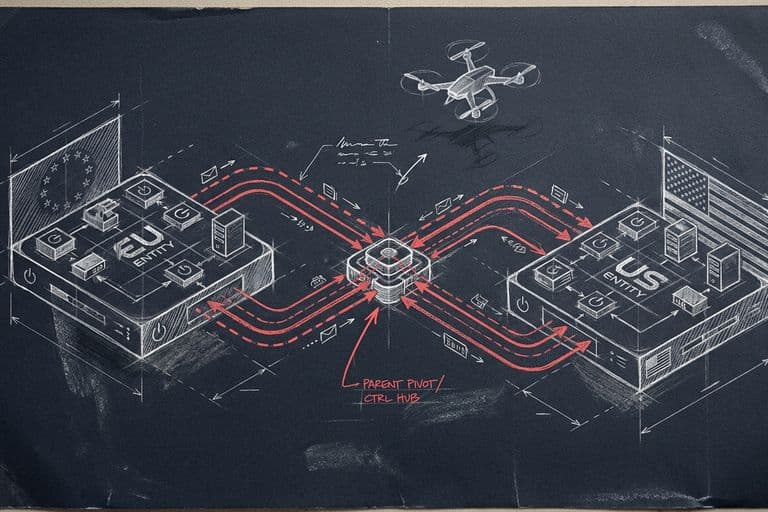
For an industrial drone operator with use cases that intersect with regulated airspace — accident response, public-institution imaging, medical logistics, c-UAS perimeter — the platform that flew under U-Space4UAM is licensable today. Dronehub Inc. (Delaware C-Corp, SBIR/STTR-eligible) handles the US side; Dronehub Sp. z o.o. handles the EU side; manufacturing is at Jasionka under NATO-allied supply chain.
The full U-Space4UAM case study with consortium composition and technical detail is on /projects/u-space4uam. For a procurement conversation, open the contact form.
FAQ
- What is U-Space?
- U-Space is the EU's regulatory framework for low-altitude unmanned airspace — the rule set that commercial drone fleets operating over European cities will eventually fly under. It defines the operational stack: airspace access, traffic management, registration and identification, conflict deconfliction, and integration with crewed aviation. The framework is built incrementally from empirical-flight data contributed by consortium programmes — U-Space4UAM is one of the foundational contributions.
- Why does it matter that Dronehub flew first?
- In a 13-partner, 5-country consortium led by Honeywell, the opening demonstrations are a trust signal. Who flies first is the partner the consortium prime trusts to derisk the technical envelope before the other partners take over. For procurement evaluators reading the operational record, 'Dronehub flew first' means Honeywell — a Fortune 100 aerospace and defense prime — accepted the operational risk of opening flights coming from the Rzeszów demonstration. That's the kind of credential that lands meetings at US primes evaluating European SME partners.
- What were the three validated use cases?
- First, emergency aerial monitoring — drones reaching multi-vehicle accident sites, hazmat events, mass-casualty incidents within minutes of dispatch and feeding live aerial imagery to responder command stacks. Second, orthophotographic and photogrammetric imaging for public institutions — municipal mapping, environmental monitoring, infrastructure-condition surveys. Third, AED defibrillator transport in cardiac emergencies — the use case where minutes of response-time gap translate directly into survival probability.
- How does this connect to FAA-track US programmes?
- Directly. The EU SESAR Joint Undertaking is the EU's air-traffic R&D body — comparable in role to the FAA NextGen office and the NASA Advanced Air Mobility programme. The empirical-flight data, cross-jurisdiction air-traffic coordination experience, and regulatory-engagement playbook all transfer to FAA Part 108 rulemaking engagement, NASA AAM transition deliverables, and FAA UAS Integration Office work. The U-Space4UAM credential is one of the strongest EU-jurisdiction analogs available.
- Is the Honeywell relationship still active?
- The consortium completed its programme cycle. The peer-level co-flight relationship with Honeywell — Fortune 100 aerospace and defense prime with deep US-DoD and FAA history — is the kind of reference that opens follow-on conversations. The U-Space4UAM credential remains the highest-signal Honeywell-relationship reference in the Dronehub portfolio.